
Libary
The Mire of a Thousand Corpses: A Chronicle of the Mere of Dead Men
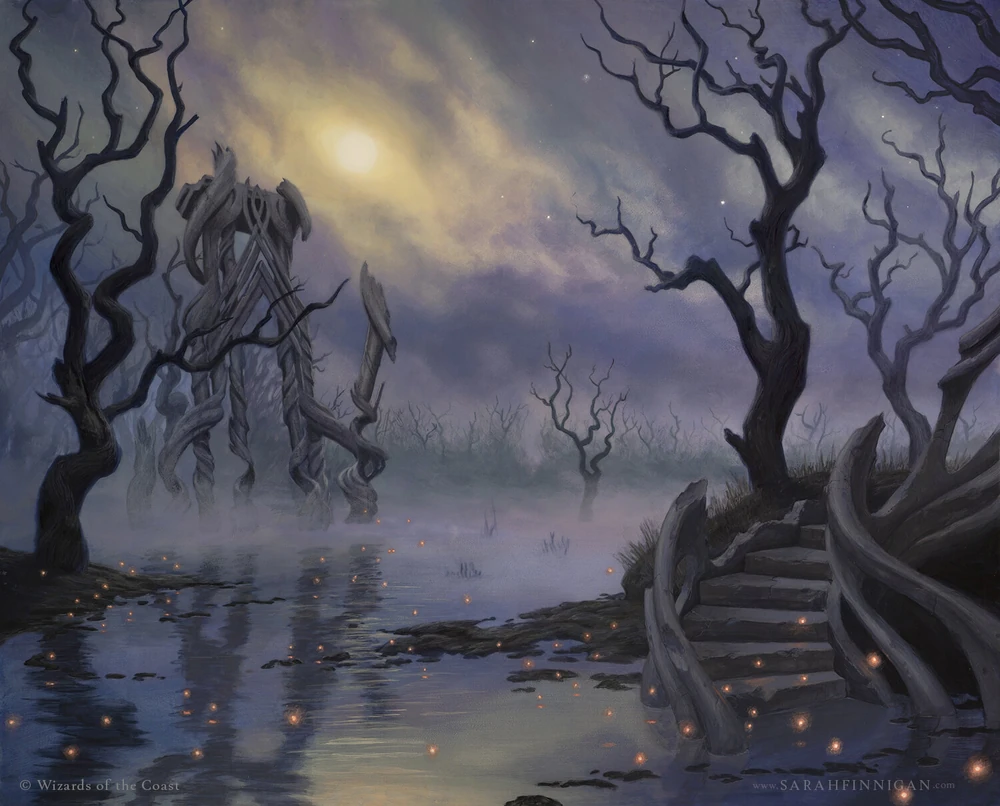
Long ago, the Mere of Dead Men was not a swamp at all, but a stretch of coastal land where the armies of Phalorm and Uthtower made their final stand against an orc horde at Iniarv’s Tower. Desperate, King Uth VII begged the tower’s master, the lich Iniarv, to save them. The lich answered in the cruelest way possible: he called the sea itself over the battlefield, a roaring wall of water that drowned orcs, men, elves and dwarves alike, then receded and left behind a drowned graveyard of mud and saltwater. Over the centuries that battlefield rotted into the Mere of Dead Men: a fog-choked swamp of forgotten ruins, half-sunk towers, disease, and monsters. Today, people whisper of a black dragon that haunts the mire, and of bullywug and lizardfolk tribes locked in simmering hatred. Some say the Mere remembers how it was born in one unnatural spell, and that if another great war is ever fought there, something just as terrible will rise to reshape it all over again.
Shadows in the Mire
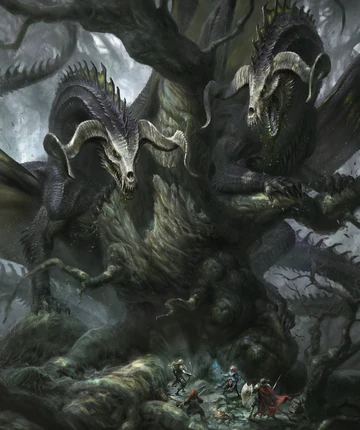
In the Mere of Dead Men, travellers whisper of a black dragon called Voaraghamanthar, the Black Death, whose shadow coils through the mist like living night. Yet newer rumours speak of something stranger still: sightings of the dragon in two distant places at the same time. Could it be true? Old legends tell of twin black dragons, born together, a rarity among their kind, bound by a strange, wordless link that lets thought flow like dark water between them. Dragons are never without desire, and these two are said to hunger for power and dominion, shaping the swamp and all who enter it to serve their hidden designs.
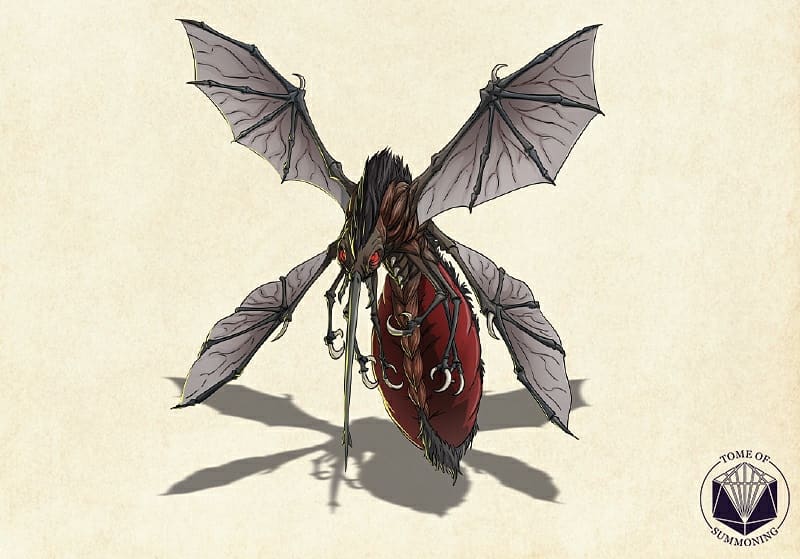
Notice from the Karhold Infirmary
Diseases of the Mere of Dead Men
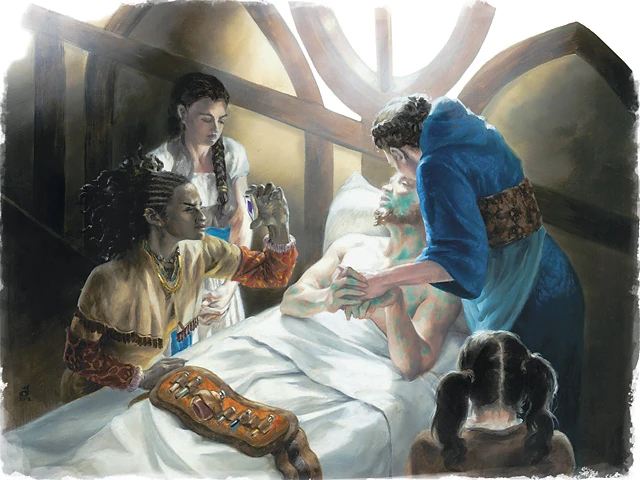
Adventurers, if you insist on trudging into the Mere of Dead Men, understand this: it is not just monsters that will try to kill you. The swamp is full of disease—spread by mosquitoes, biting flies, leeches, and other vermin that happily follow you back to Karhold.
We are seeing more fevers, black phlegm, rotting bite wounds, and strange hallucinations in those returning from “just a little trip” near the Mere. Your stupid quest should not become the city’s problem.
If you go anyway, at least follow this:
- Isolate outside the walls for seven days when you return.
- Wash or burn swamp-soaked clothes.
- Do not bring back “pets” from the mire.
- Cover up and use insect repellent in the swamp.
With mosquitoes already increasing along the roads from the Mere, it may be worth investing in bug-repellent salves and smokes here in Karhold. Go if you must—but do not drag the swamp’s plagues back with you.
ATTENTION!
Karhold Watch Notice
Subject: Missing Persons and Lethal Hazards – Mere of Dead Men
By order of the Karhold Watch, all citizens and travellers are formally warned: the Mere of Dead Men is not to be treated as a hunting ground, shortcut, or proving ground for would-be heroes. Over the last season, multiple patrols and adventuring parties have gone missing along its edges. Survivors report companions driven to madness by whispers, vanishing into the fog, or turning their weapons on their own.
Everything in that swamp is either diseased, hungry, cursed, or all three. The creatures that dwell there do not simply defend their territory; they hunt. Many never leave bones behind.
Effective immediately, the following directives are in force:
- Do not enter the Mere of Dead Men under any circumstances unless under direct, sanctioned order.
- If you must travel near its borders, do so only in daylight, never alone, and never without an armed escort.
- Do not camp within sight of the swamp’s mist line.
- If you hear distant babbling, chanting, or voices that seem to come from nowhere, block your ears and move away at once. Do not investigate.
- Avoid drinking or touching stagnant water; wash any exposed skin as soon as possible.
- On return from the area, monitor for fever, rashes, infected wounds, or confusion, and report to a healer immediately.
The Mere of Dead Men is a graveyard that is still trying to finish its work. Your curiosity, bravado, or “glory quest” is not worth your life, nor the lives of those who will be sent to search for you. Avoid the swamp at all costs.
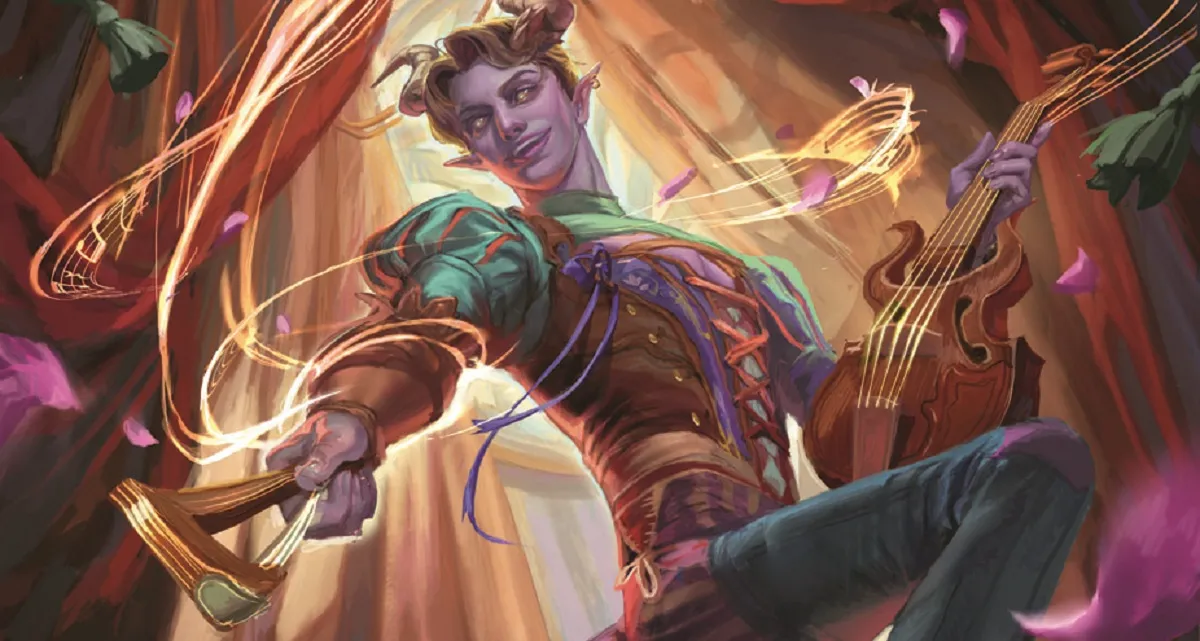
Karhold Courier – Society & Scandal Column
Florist At It Again: Love Triangle With A Cactus?
Karhold’s most chaotic heartbreaker, Dellan “Bloom” Harrow the florist, is in trouble again. This time? A full-blown love triangle in the back room of Petals & Prayers involving:
- A married noble’s spouse
- A travelling bard
- And a seven-foot, possibly sentient carnivorous cactus
Witnesses say the spouse burst in mid-argument, the bard was half-dressed writing a tragic ballad, and the cactus growled, “You promised it was just us,” before angrily scraping its pot toward the door.
Roses were used as weapons, accusations of “emotional root rot” were made, and Dellan’s only defence was, “I’m just very good at helping things blossom.”
Karhold citizens are advised to be wary if their partner brings home “a friendly gift” from Dellan. Especially if it hisses when jealous.
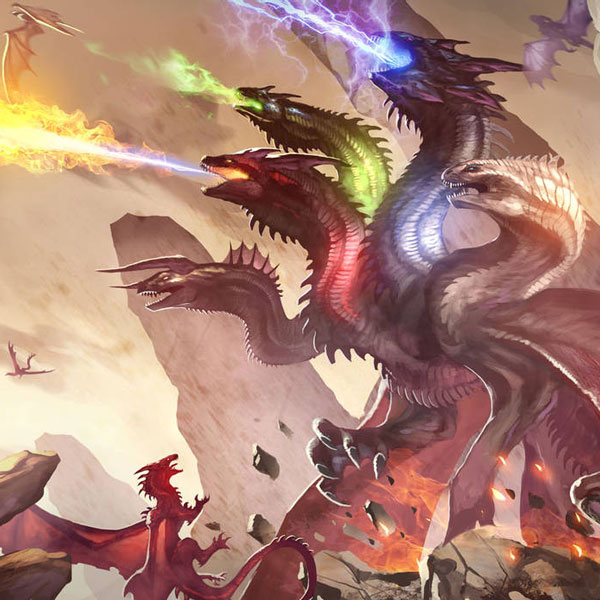
The Hum of the Dark
Mumma, where does that lullaby come from, the one you hum at night?
“That is a sad old story, love, but it isn’t real, all right.”
Once there was a goddess who loved mortals down below,
She bore six sons to guard them all from every creeping foe.
Each evening she would hold them close and hum that wordless tune,
A little sound that told them they were safe beneath her moon.
High above, a wretched god named Bane despised such grace,
One night, while still she softly hummed, he stole them from her place.
He shut them in a twisted maze of cruelty and fear,
The six clung tight and tried to stand, but doom was drawing near.
One slipped into a pool of acid, hissing, cold and green,
One vanished in a lightning flash, burned white and never seen.
One choked on bitter poison gas, one burned in roaring flame,
One froze in jagged shards of ice, five gone without a name.
One boy remained within those halls, his heart one aching scar;
Alone he faced that cruel old god. His name was Malakar.
The shaken boy, now hard inside, dared risk one final game,
He wagered all and somehow won; Tiamat learned his name.
Righteous in his wounded heart, he climbed the halls of light,
But all the shining gods declared his choices foul, not right.
“No good, no evil, only words,” the hardened child declared,
“The games, the pain, the hidden rules show what is truly there.”
He twisted skin and bone to scales, a dragon crowned in hell,
The gentle boy who once loved peace made living feel like a cell.
He plays cruel games on all who live, dares others do the same,
“For what is life,” he softly laughs, “but just a crooked game?”
So much taken from that child, so little of him left,
He ruled with torment, tricks, and fire, of warmth and kindness cleft.
So now you know what tale they tell of the hum I use at night.
Now hush, my love, it’s only myth. Just an old story, all right.
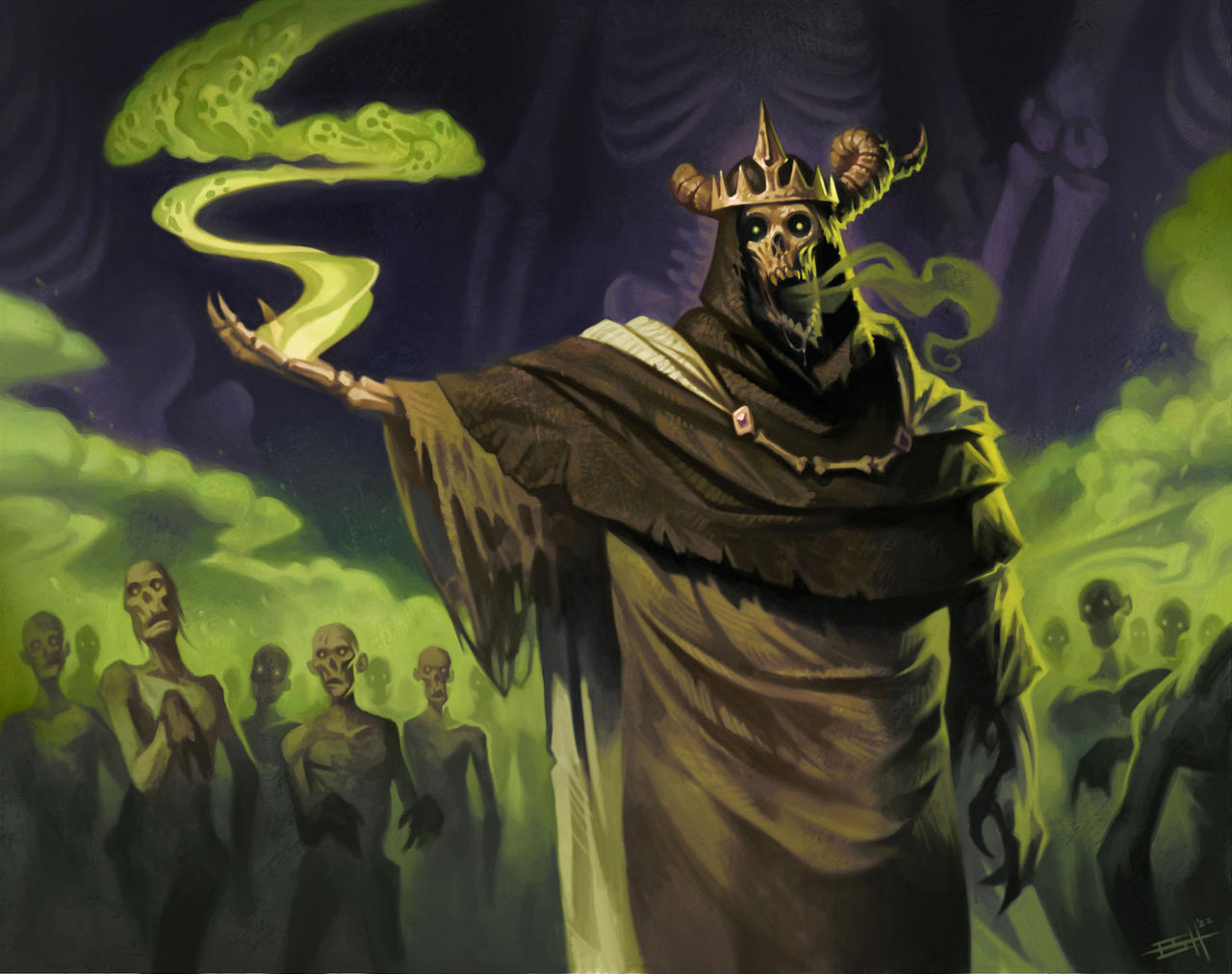
Legend of Iniarv
Iniarv was the Mage Royal of Uthtower during the early years of the kingdom. He built a tall stone tower beside the High Road, around sixty miles from Karhold, and used it as a place to conduct magical research. Many of the strange beasts and experimental creatures he released into the wild originally came from this tower.
In 191 DR, after the sudden death of King Ornoth I and the division of the realm between his twin sons, Iniarv created the Twin Crowns of Myrmoran. When worn by two different rulers, the crowns forged an empathic link between them. Each wearer could sense the emotions of the other and communicate silently mind to mind. For a time, they were meant to keep the sundered kingdom united in spirit, even as it was split in rule. After both kingdoms eventually fell into ruin, the crowns were lost to history.
Eventually Iniarv withdrew from public life. He transformed himself into a lich and retreated into the crypts beneath his tower, and for generations no one knew his true fate. His presence was only revealed during the orc invasion of 615 DR, when the forces of Phalorm used the tower as a defensive position. The fighting disturbed him, and when the king begged him to aid the soldiers, Iniarv responded with fury.
He called upon the ocean, flooding the land and drowning the battlefield. When the waters settled, the swamp now known as the Mere of Dead Men remained. What became of Iniarv, and of the Twin Crowns he forged, has never been discovered.
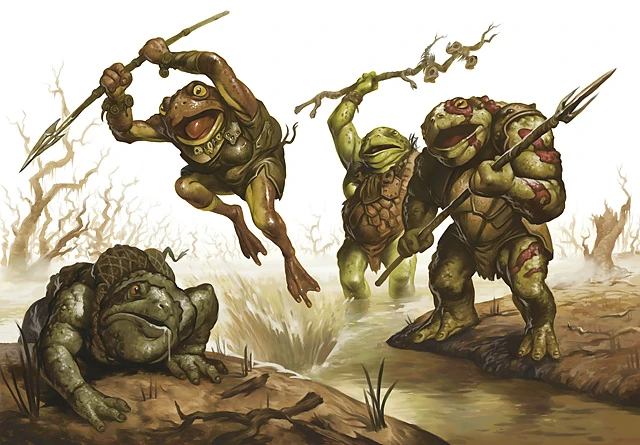
Lords of the Muck: A Bullywug Guide
Bullywugs are swamp-dwelling frog-folk who see themselves as grand nobles, “rightful rulers” of every bog they touch. In truth, they treat the land terribly—littering, overfishing, and overcrowding the marsh until it turns into a choked, filthy mess. At the top of each tribe is the Lord of the Muck, a pompous ruler squatting on a heap of junk and treasure. This king demands constant tribute: shiny trinkets, coins, and magical items brought by their subjects to keep his favor. Treasure isn’t really used for anything practical—it’s just proof of loyalty and a way to climb the social ladder.
Bullywug society is a nasty little aristocracy. They introduce themselves with absurdly grand titles, then immediately grovel and kowtow before their superiors, competing to see who can flatter the loudest and bring the best offerings. Instead of killing each other for rank, bullywugs rise by finding better treasures to present to their lord. Though they aren’t very smart or wise, they are sly: they “talk” to ordinary frogs and use them as spies, believing the frogs report on intruders. Captured travelers aren’t always killed—more often, bullywugs force them into dangerous games and contests for entertainment, croaking with laughter as their prisoners struggle in the muck.
The Purple Eyes of The Swamp
Rumours have spread of folk experiencing vivid, almost lucid dreams about a strikingly attractive woman with unnaturally bright purple eyes, promising to return something they once lost if they meet her in the Mere. Some wake with mud on their feet or reeds in their bedsheets; others never wake at all, last seen wandering toward the swamp in a daze.
Scholars quietly agree this is likely the work of a hag dwelling somewhere in the Mere. Hags are infamous for solving problems no priest or wizard will touch—cursed objects, demons that won’t let go, wasting diseases and stranger afflictions still.
Of course, any true Karholdian knows that such lack of payment is absurd. If no coin changes hands, then some other price is being taken—whether the victim realises it or not.

Comments