

The Edicts of Lumen
The nations of the continent are party to the Edicts of Lumen, a landmark treaty signed after decades of bloody conflict. The agreement establishes the balance of power between noble rulers, the clergy of the Sacred Flame, and the arcane spellcasters of the Amethyst Academy. Under the Edicts of Lumen, arcane spellcasters are barred from holding noble titles. The Edicts of Lumen do not outlaw magic, but do restrict who can teach magic and provide magical services. The Edicts of Lumen maintain peace and stability in the continent by reflecting the shared political will of all those party to it, but the voluminous document has many flaws, oversights, and loopholes. Many try to work around or flout its restrictions without triggering another catastrophic war. Recent disasters have tested the Edicts of Lumen, however, and they may not hold conflict at bay much longer.
Over time, the Amethyst Academy secured allies amongst the nobility by providing them clandestine magical services and occult counsel, crafting enchanted heirlooms, protecting their castles with arcane wards, and teaching their heirs magic. When the Faith of the Sacred Flame discovered these schemes, a renewed series of vicious inquisitions and vengeful witch-hunts began. Divine Matriarch Justice VII anointed the Knights of the Silver Order specifically to hunt down the Amethyst Academy and their leaders. What had been a shadow conflict between paladins and sorcerers for centuries spilled into outright war between noble houses who championed the Faith, and those which supported the Amethyst Academy. Four decades of bloody conflict ended with the Edicts of Lumen. Enacted three hundred years ago, this landmark treaty stopped the murderous suppression of arcane magic by the religious ministry. The agreement established the new balance of power between mages, the Faith, and the nobility throughout the continent which remains to this day.
Enforcing the Edicts
The Edicts of Lumen are a signed contract which establish a set of shared conventions and laws for all participating nations and people, not a magical pact. While magic is often used to inves tigate violations of the agreement, resolve disputes, and enforce penalties and punishments, no arcane spell or divine invocation renders its terms supernaturally binding. The mutual agreement and cooperation of the signatories enforce the Edicts of Lumen, backed up by the threat of another catastrophic continental war.
Other Spellcasters and the Edicts
Although apothecaries, bards, druids, and warlocks are not necessarily mageborn, the Edicts of Lumen do not acknowledge or distinguish them, only discussing the magic of “mages” and “mageborn.” As a result, the Edicts of Lumen do not allow for nuanced interpretations of what constitutes “arcane magic”. Amongst Edict scholars, some believe this is a major flaw in the manner the treaty was originally written. In practice, the noble houses rarely test the letter of the law against the spirit of the law. As a result, no ruler has dared bestow their estates and titles upon an heir with any sort of magical ability since the Edicts were signed. Few are willing to stake their lives and lineages to argue a technicality before a court of their peers.
During the drafting of the Edicts, it was raised whether or not the Edicts should impose restrictions on clerics and paladins of the Sacred Flame. However, it was argued — quite loudly by the Faith — that such restrictions were unnecessary. Divine spellcasting cannot be passed down to one’s progeny: each individual must take up the mantle themselves, a task that requires considerable devotion and faith. Further more, the Faith noted that their oaths and dogma already ask the clergy to forswear their noble claims, pledging their allegiance and service to their faith ahead of their household. However, there have been a handful of instances where a pal adin or cleric took up regency or acted as the custodian of their family title. In such cases, the title was passed on immediately when another suitable scion came to prominence.
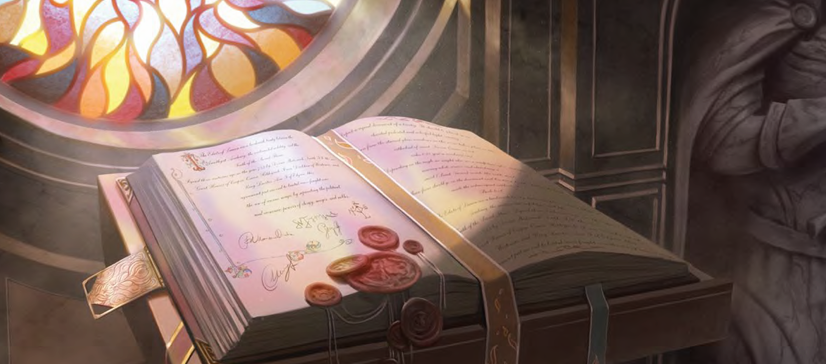
The Edicts of Lumen are a landmark treaty between the Amethyst Academy, the continental nobility, and the Faith of the Sacred Flame. Signed three centuries ago in the year 743 by Divine Matriarch Truth II, the six Great Houses of Caspia, Queen Hildegarde I von Drakken of Westemär, King Laertes Ava I of Elyria, and the Amethyst Academy Directorate, this agreement put an end to brutal wars fought over the use of arcane magic by separating the political and economic powers of clergy, mages, and nobles. The full text is an utterly byzantine and cumbersome document thousands of pages long. The original signed treaty has long been preserved in Saint Tarna’s Cathedral, but many copies have been made since. Nevertheless, the Edicts of Lumen comprise six main articles:
Articles of Inheritance
“...within the Nations party to this Agreement, all Mageborn are hereby stripped of their noble titles, barred from any rank, and must relinquish any land ownership claims.”
- These articles form the key stipulation of the Edicts of Lumen. They are designed to avoid the coalescing of power that lead to the sorcerer kings of old - a legitimate concern in light of how the concentration of both political and magical power amongst ruling houses often results in tyranny and injustice.
- The Amethyst Academy closely monitors noble houses for signs their scions may be mageborn. If a ruling noble has hidden their mageborn ancestry, the grave situation triggers Clause Five of the Articles of Umbrage (described below).
- The terms extend to royalty as well. Indeed, royal successors in particular face much greater scrutiny at the hands of the Academy to ensure no mageborn sits upon the throne of any nation.
Articles of Neutrality
“The Nations of this agreement recognize the Amethyst Academy, so long as the Mages remain neutral and impartial with regards to the political affairs of the Nations. The Mages are hereby granted certain Protections under the Law, are held Exempt from Taxation, retain the Right to Practice Magic, and may freely travel between any Lands under this Agreement.”
- These articles ensure that mages do not face persecution when traveling the continent.
- Mages and mageborn often still serve as court mages and on the royal council of most nations, but their role here is meant to be that of an advisor rarely given the final decision in any matter.
Articles of Guardianship
"The Nations hereby grant the Mages of the Amethyst Academy the Right of Guardianship over all Mageborn Children. These Magelings shall be entrusted as Wards of the Amethyst Academy, who are charged with boarding, protecting, and instructing these Magelings in Magic until they come of age. No exceptions are given to Mageborn children of any Station, not a single noble House, nor any Royal family.”
- After their instruction, adult mageborn are free to depart the Amethyst Academy if they wish. Most, however, opt howe er, opt to remain part of the organization to some degree.
- Those who manifest magical abilities as adults aren’t compelled to join the Amethyst Academy by these articles but are invited and welcomed into its ranks should they choose to do so. Otherwise, the Academy generally leaves such hedge-mages to their own devices, so long as these independent spellcasters abide the Edicts of Lumen.
Articles of Enterprise
“The Nations recognize the right of the Amethyst Academy to conduct its own affairs and govern itself within the stipulations of this Agreement. Within the Nations party to this Agreement, the Amethyst Academy shall have sole authority over any Guild practicing Arcane Magic, any School for Instruction in Arcane Magic, and all Manufacture for Sale of Arcane Artifacts, so long as such Services are available to All at a Fair and Equal Cost.”
- Arcane spellcasters who wish to craft magic items for sale or offer their magical services for hire are required to pay a portion of their profits to the Academy. Furthermore, they are required to use the prices set forward by the Guild, and can’t give discounts or cheaper prices to anyone.
- The Academy takes enforcement of the Articles of Enterprise extremely seriously, and dispatches enforcers to shake down hedge mages behind on their payments.
- There is a notable loophole in the Articles of Enterprise: the secondary market. A merchant who buys and then resells magical items may do so without paying Academy dues, so long as they aren’t crafting any magical items themselves.
Articles of Malediction
“...the Nations forbid the Academy from teaching any Students magical practices such as Summoning Demons and creating Undead Creatures. Mages working any Arcane Magic to influence, control, or harm members of the Nobility or Clergy shall be Put to Death.”
- The provisions against necromancy and demonology pertain specifically to the teaching of such magic, not studying or using it — the Academy argued that banning such magic entirely would impair their ability to understand and contain it.
- Enforcement of these articles has been a vexing challenge. Those who conduct such magic in secret can often evade notice for years or decades.
Articles of Umbrage
“... and if by any means a Noble Estate comes under the Rule of a Mageborn, the Nations and Households party to this Agreement shall immediately Muster Arms against them.”
- Most of the Articles of Umbrage concern the means to deal with minor infractions and petty violations of the Edicts in a peaceful manner.
- Clause Five of the Articles of Umbragecalls upon all noble houses to take up arms against any noble household ruled by a mageborn. Vassals sworn to serve a higher lord — such as a duke ruling under a royal monarch — may disavow their fealty to a mageborn lord. Under the agreement, a vassal cannot be compelled to give any aid, including taxes and levies, to a mageborn.
- Invoking the article calls the accused to trial before representatives of the nobility, the Faith of the Sacred Flame, and the Amethyst Academy. The Faith is given the role of mediator and judge, and the Academy the role of investigator and cross-examiner. The objective of the trial is to determine if the accused is indeed mageborn, and how much their household should be held to account.
- These trials are often an utter debacle. If the accused refuses to appear before the court, the only recourse is armed conflict.
- The Articles of Umbrage close by stating that should the Academy Directorate be found to be in gross violation of the Edicts of Lumen, they will be purged by a combined force of the nobility and priesthood.

Comments