
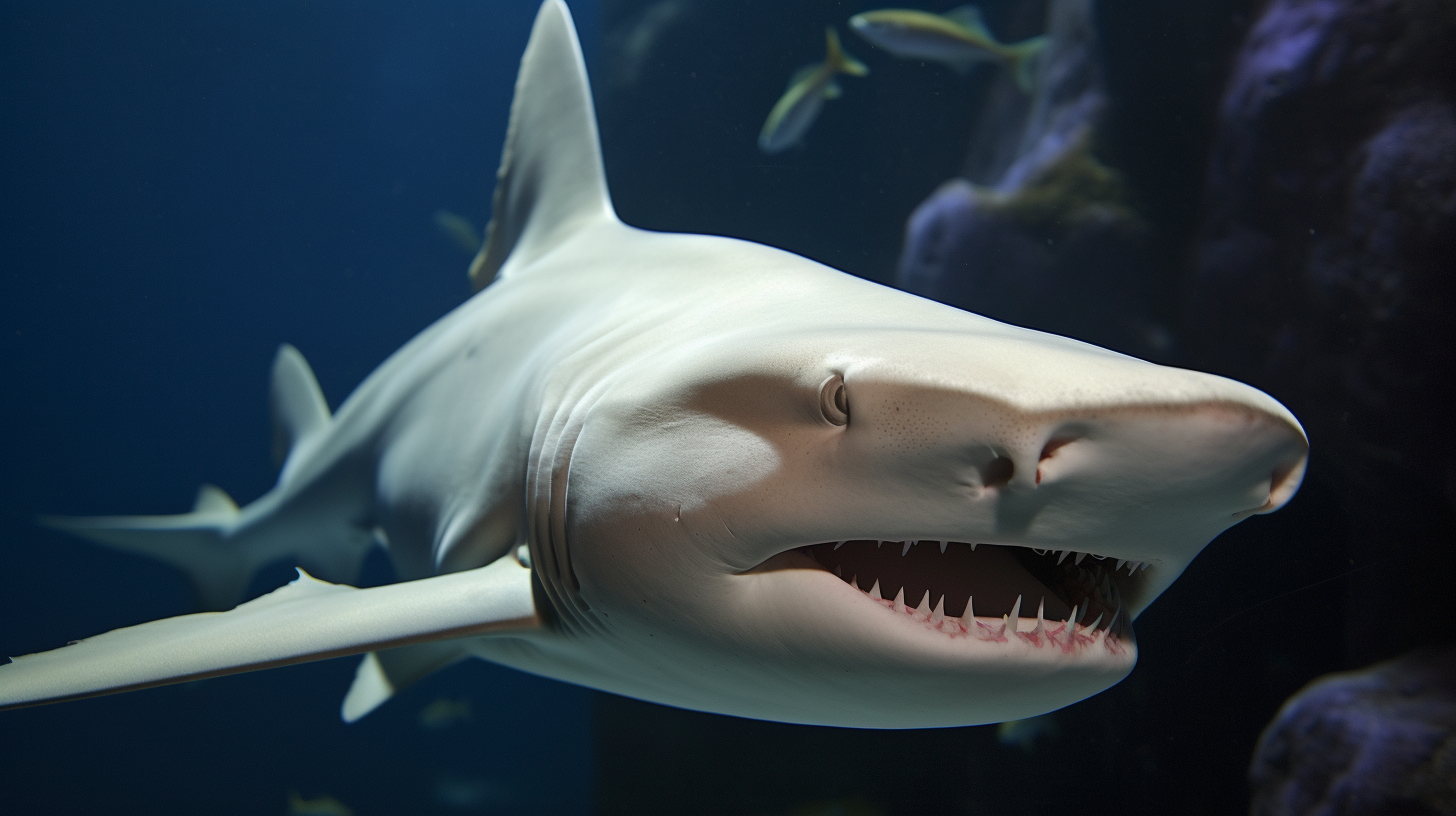
White Apex Shark
"A ghost in the deep, a legend on the surface, the White Apex Shark is both the nightmare of sailors and the guardian of the sea’s balance."The White Apex Shark is one of the ocean’s most formidable predators, renowned for its power, intelligence, and precision hunting. As an apex predator, it dominates marine ecosystems, using speed, stealth, and razor-sharp teeth to ambush prey with deadly efficiency. Despite its fearsome reputation, the White Apex Shark is also a highly curious and adaptable creature, capable of long migrations and complex social interactions. It is not only a symbol of raw oceanic power but also a vital component of the ocean food web.
Basic Information
Genetics and Reproduction
Little is known of this species mating habits. It is believed that males become sexually mature at about 20 years of age and females at about 25 years of age. Gestation takes about 10 months with the eggs developing and hatching inside of the mother until birth, which takes place in the late spring.
Growth Rate & Stages
These sharks hatch from eggs that are inside of the mother. When they are finally born they are about 4 feet in length and will grow about 10 inches each year under ideal conditions.
Ecology and Habitats
These far ranging sharks can be located in almost all coastal and offshore waters around the world. They are often found in the warm waters, ranging between 55℉ and 75℉ degrees, near large supplies of food. They do seem to congregate in coastal and island areas that provide shelter for them as well as harboring their prey items, but these opportunistic sharks will leave the coastlines to seek larger prey in the open ocean. They usually stay within their territory but will migrate to follow food sources, to mate, and to give birth.
Dietary Needs and Habits
Records indicate that the White Shark is resourceful predator with a wide ranging diet. These sharks tend to focus on the more fatty and energy rich meals and avoid any thin and body prey items. These sharks tend to feed at the surface, often striking from below at high speeds of up to 25 mph that often allow the shark to breach completely out of the water.
These sharks usually hunt and feed in the morning within the first two hours of daylight. They often target various fish, tuna, rays, sharks, dolphins, porpoises, whales, seals, sea lions, sea turtles, sea otters, and sea birds but will take any injured or slow moving animal in the water. Whale carcasses seem to be their favorite as they contain a high fatty energy content, but will also attack small boats, hoping to feed on whatever is inside of them.
Small sharks tend to eat the smaller prey items like fish, while medium sized sharks will hunt marine mammals. The larger sharks often specialize in a particular type of prey, perfecting their hunting techniques over the many years of their life. Very large sharks will feast on any discovered whale carcass in order to sustain themselves in between long periods without food.
Behaviour
The White Apex Shark is a highly intelligent and adaptable apex predator, known for its strategic hunting behavior and complex social tendencies. Though often solitary, it exhibits a degree of social flexibility, sometimes forming loose hierarchies when feeding, where larger and more dominant individuals assert priority. As an ambush predator, it relies on stealth, speed, and surprise to strike its prey, often launching powerful attacks from below and breaching the surface in spectacular displays. Despite its formidable reputation, the White Apex Shark is also an inquisitive creature, frequently testing objects with bites or bumps to assess their nature.
While it demonstrates territorial behavior in certain hunting grounds, it remains an exceptionally mobile species, capable of migrating thousands of miles across oceans, likely in pursuit of seasonal prey. Unlike indiscriminate hunters, White Apex Shark are selective in their feeding habits, often taking cautious, investigative bites before fully committing to a meal. When multiple sharks feed on the same carcass, they adhere to a structured hierarchy, allowing the largest individuals to feed first. Their intelligence extends beyond hunting, as they have been observed displaying problem-solving abilities and even engaging in playful interactions with their environment. Striking a balance between aggression and caution, instinct and learning, the White Apex Shark stands as one of the ocean’s most formidable and fascinating predators.
Additional Information
Domestication
So far it seems that it is impossible to domesticate this species in any way. All attempts to capture and house live specimens has resulted in the death of the shark within a few days at most.
Facial characteristics
At the end of its strong, pointed, cone shaped head, is its sensitive nose and a mouth filled with row upon row of huge triangular teeth with razor sharp serrations. When these teeth are inevitably lost, the deeper teeth will rotate out to replace any that are missing. Just behind the snout are the large eyes of the shark with deep blue irises. Around the head, nose, and mouth of the shark are tiny electroreceptor pores that enable it to detect the electrical impulses of its prey.
Geographic Origin and Distribution
The tremendous range of these sharks allows them to live and thrive in a variety of waters around the world and can be found in nearly every warm water ocean and even in some of the cooler waters if they have warm water currents. These sharks are often found in close to shore as well as out scouring the open ocean for food. This species is most often located in the Vastus Ocean, Daria Ocean, Eldoris Ocean, and Hladno Ocean, as well as the Ples Mora and Ko Mora seas, where they will frequent the Shadow Coast, Blood Coast, Haggard Coast, Coral Coast, and Carcass Coast.
Average Intelligence
Once believed to be a thoughtless eating machine, careful surveillance has shown that this creature is actually quite intelligent. Some believe that these sharks can communicate through displays, slight color changes, and electromagnetic signals. They seem to show curiosity and when young, have at least temporary clans with ranks, leaders, and a hierarchy, as well as developing pack tactics.
Perception and Sensory Capabilities
White Apex Sharks have highly developed perception and sensory capabilities, making them exceptional predators. These highly refined senses make them an apex predator, capable of detecting and striking prey with precision.
Keen Sense Of Smell: Can detect a single drop of blood in millions of gallons of water and track prey from miles away.
Electroreception: Due to the Ampullae of Lorenzini, these special sensory organs detect the electrical fields of living creatures, allowing it to locate hidden or wounded prey.
Highly Developed Eyesight: Excellent vision in low light and murky waters, crucial for detecting movement in dim environments.
Hearing: They can detect low-frequency sounds and vibrations from long distances, helping them locate struggling prey or disturbances in the water.
Lateral Line System: A network of fluid-filled canals along their body detects water pressure changes and movement, allowing them to sense nearby prey or predators.
Taste & Touch: While not their primary sense, great whites use their mouths to "test bite" unfamiliar objects, helping them determine if something is edible.
Scientific Name
Carcharodon Magnus Alba
Lifespan
The estimated lifespans of these fish are estimated to be about 70 years and possibly more if they are able to survive for that long.
Conservation Status
There is no governmental conservation effort put towards these dangerous creatures as there is more fear than appreciation for these predators. While they are not outwardly evil, they are at the top of the food chain and consider anything smaller or slower than themselves, a prey item. Despite being considered extremely dangerous and to be avoided at all times, many top fishermen target them as a prize catch and legendary meal.
Average Weight
Adults can weigh between 1,200 and 1,700 pounds for average sized sharks. However mature females are known to reach 1,500 to 2,500 pounds, with the largest females being logged from 4,000 to 4,500 pounds.
Average Length
The typical male shark ranges from about 11 to 13 feet long with females growing to about 15 to 16 feet in length. The largest females have been noted to reach around 20 feet in length.
Average Physique
This is an enormous fish with a very pointed and aquadynamic shape. Its head is cone shaped and tapers to a point and its powerful tail has a keel fin at its base. The skin consists of a very tough hide and it has cartilage instead of bones, making it very flexible and maneuverable.
Body Tint, Colouring and Marking
Although these sharks are completely white in color there are subtle differences between individuals. Color variations among this species tend to be various shades of white or off-white. These deviations are often thought to be due to either diet, birthplace, or its home environment.
Threats:
Natural threats to these sharks may occur in locations where the prey items of this and another apex predator overlap or perhaps if these giant fish would be considered a rare prey item itself. The only true threat to this species is other larger, White Sharks, Tiger Sharks, Hammer Sharks, Black Surf Shark, and Orcas as they compete for food and for dominance. Additionally, these sharks may be targeted as food by humanoids, Giant Kraken, Giant Orcas, Sea Serpents, Sea Dragons, Sea Dragon Turtles, and the Valkoinen.Abilities:
Exceptional Swimming Speed: Can reach speeds of up to 30 mph in short bursts, making it a formidable ambush predator. Powerful Bite Force: With a bite force it can crush bone and tear through flesh with its serrated, razor-sharp teeth that continuously regenerate. Deep Diving Capability: Can dive to depths of over 3,500 feet enabling it to hunt in both shallow and deep waters. Ambush Hunting Tactics: Uses stealth and burst speed to attack prey from below, often breaching the surface in spectacular attacks. Endothermic Adaptation: Unlike most sharks, White Apex Sharks maintain a higher body temperature than the surrounding water, giving them increased muscle power and endurance. Resilient & Adaptive: Can travel long distances across oceans, adapting to various temperatures and food sources. Survival Instincts & Intelligence: Exhibits curiosity, problem-solving skills, and strategic hunting behaviors, sometimes working in loose cooperation with other sharks."Some call it a monster, others, a marvel. The truth? The White Apex Shark is simply nature at its most perfect."

Comments