
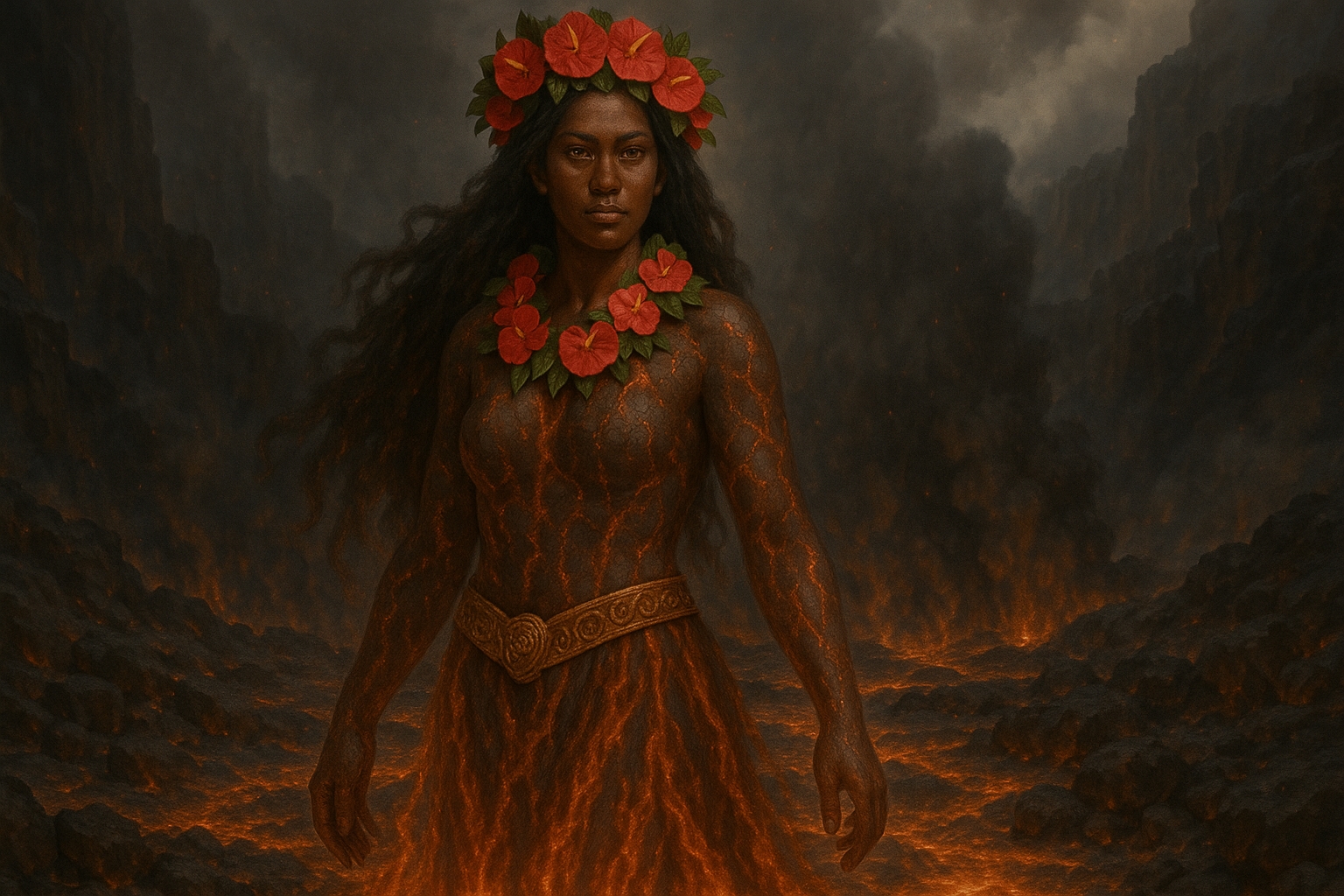
Vulca, Goddess Of Flames
"They call her destruction. They call her chaos. Fools. She is creation, change, the fire that reshapes what is broken. You fear her because you fear what you must become."Vulca, Goddess Of Flames, stands at heart of every wildfire, every volcanic eruption, and every raging inferno. Fire is neither good nor evil. It does not reason, nor does it hesitate. It burns, it consumes, and it transforms. It is destruction, but also creation, it is the force that razes empires and forges legends, just as Vulca does. A chaotic and unpredictable deity, Vulca is the embodiment of fire’s relentless power, ruling over flames, volcanoes, destruction, renewal, passion, and war. She is a goddess of untamed change, rejecting stagnation in all its forms. Where other gods seek to maintain order, she embraces chaos, believing that only through fire can weakness be burned away and the strong be reforged. To her followers, warriors, blacksmiths, fire-mages, and zealots alike, she is both a harsh master and a sacred muse, a force of both inspiration and devastation. Her worship is as wild and dangerous as fire itself. The faithful prove their devotion through trials of endurance, reckless celebrations, and acts of destruction or creation. Some seek her blessings through fire-walking, molten rituals, and grand forges, while others revel in the chaotic abandon of war and passion. Her relics, such as the Ember Crown and the Phoenix Mantle, are objects of immense power and danger, capable of granting godlike abilities to those willing to risk the cost. But Vulca’s ultimate purpose is shrouded in smoke and prophecy. Some claim she seeks to unleash The Great Conflagration, a final firestorm to consume the world, leaving only those strong enough to rise from the ashes. Others whisper that she searches for The First Flame, a forgotten power that predates even the gods, a fire so pure that whoever wields it could reshape reality itself. Whatever the truth, one thing is certain, fire does not ask for permission, and neither does Vulca. Those who follow her path embrace the flames, endure the trials, and forge their own destiny. And for those who stand in her way? Only ash remains.
Realm
Vulca, resides in a chaotic and ever-shifting realm known as The Pyroclasmic Expanse, a plane of eternal fire, molten rock, and unrelenting volcanic fury. It is a domain where rivers of lava carve ever-changing paths, mountains erupt without warning, and the very air burns with a relentless, smoldering heat. This is not a realm of peace or comfort but one of raw, untamed creation and destruction, a reflection of Vulca’s own volatile nature. At the core of the Pyroclasmic Expanse lies Vulca’s true seat of power, a colossal, hollowed-out volcano known as The Throne of Fire. It is said to be an infinite forge, where the very soul of fire itself takes shape. The walls of the volcano glow with ancient runes, burning with an undying flame, and at its center lies a molten core so hot that even the gods fear to approach it. Those who stand before the Throne of Fire risk being burned away entirely or reforged into something new and terrible. This is a is a plane of ever-burning creation and destruction, a reflection of Vulca’s raw, chaotic essence. It is not a place for the weak, nor one for the peaceful, only those who embrace fire’s fury and respect its power can hope to survive. Whether it is a divine forge, a land of punishment, or a testing ground for the worthy depends on who dares to enter.Divine Domains
Major Domains:
Flames & Fire: Vulca is the undisputed sovereign of fire, from the flickering candle to the all-consuming wildfire. Her will shapes fire’s chaotic nature, and it burns as both a force of destruction and a source of warmth and light. Volcanoes & Lava: She commands the molten heart of the world, shaping the eruptions that forge new land or obliterate civilizations. Volcanoes are sacred to her, seen as both her anger and her blessing. Wildfires & Natural Disasters: While she does not rule over all natural calamities, she is tied to wildfires, volcanic eruptions, and firestorms, events that are seen as both punishments and forces of change.Minor Domains:
Destruction & Chaos By Fire: Fire does not discriminate in what it consumes, and neither does Vulca. She embodies the raw, chaotic power of destruction, ensuring that nothing remains unchanged for too long. Cities, forests, and even gods fall beneath the will of the flames. Rebirth & Transformation By Fire: Though she burns away the old, she also makes way for the new. From ash, life is reborn, and Vulca governs the cycle of destruction leading to renewal. Whether it is the land reshaping itself after an eruption or a warrior forged stronger by hardship, she watches over those who rise from ruin. Passion & Wrath: Vulca’s fire burns in the hearts of mortals as well. Love, hatred, ambition, fury, and artistic inspiration, these are the inner flames she stokes. She is the patron of those who embrace their emotions fully, for good or ill. Revenge & Righteous Fury: Those who burn with a need for vengeance may find themselves under Vulca’s gaze. She does not favor justice, but she does admire those who pursue their wrath with relentless passion. The Unyielding Spirit: Fire does not submit, it burns until there is nothing left. Vulca’s flame resides in those who refuse to break, who endure hardship and rise stronger, no matter the cost.Holy Books & Codes
Tenets of Faith
Holidays
Divine Goals & Aspirations
Known Goals:
Perpetual Change Through Fire: Vulca does not seek the mere destruction of the world, but rather its constant renewal. To her, nothing should remain stagnant, civilizations must rise and fall, landscapes must burn and be reborn, and mortals must be tested by fire to become stronger or perish. She is fire’s will made manifest, and she will not allow the world to grow cold and lifeless under the weight of stability. The Strengthening Of The Worthy: Fire is the ultimate test, and only those who can withstand its trials deserve to thrive. Vulca favors those who embrace struggle, endure suffering, and emerge reforged. She does not grant power freely, she watches those who prove themselves and rewards them with strength, wisdom, or even divine fire itself. The Ignition Of Passion & Chaos: Vulca despises stagnation not only in the world, but in the hearts of mortals. She fuels intense emotions, love, fury, ambition, creativity, driving mortals to act rather than hesitate. To her, passion is power, and those who embrace it burn brightly in both life and legend. The Unchaining Of Fire’s True Power: Many civilizations have sought to tame, contain, or suppress fire, but Vulca opposes all who try to bind its essence. She loathes those who use ice, water, or forbidden magic to control or seal away fire’s will, and she seeks to ensure that fire will never be extinguished, no matter the cost.Secret Goals:
The Birth Of The Great Conflagration: Some believe that Vulca is preparing the world for a final, all-consuming firestorm, one that will burn away everything weak and impure, leaving behind a world of eternal flame. Whether this is a literal apocalypse or a philosophical transformation is debated, but whispers of a coming Era Of The Inferno have persisted for centuries. The Rekindling Of The First Flame: There are ancient myths that speak of a primordial fire, older than the gods themselves, from which all flames, including Vulca herself, were born. Some believe Vulca is searching for this First Flame, hoping to consume it and ascend beyond her current form, while others fear she seeks to unleash it upon the world in a cataclysmic event. The Defiance Of Fate & Balance: The gods of order, balance, and law view fire as a force that must be controlled, a danger that must be balanced. But Vulca rejects all notions of balance, believing that change must be constant and absolute. Some theorize that she is preparing to challenge the cosmic order itself, waging war against deities who seek to restrict fire’s reach. The Ascension Of A Fireborn Champion: Some followers believe Vulca is searching for a mortal who can truly embody her flame, someone who will not merely worship her, but stand as her equal or even her successor. Whether this chosen one will rule, destroy, or reshape the world remains unknown, but prophecies speak of a being wreathed in divine fire, destined to either burn the world or guide it into a new era.Physical Description
General Physical Condition
Appearance
Vulca's avatar may appear differently to different people depending on her mood and circumstances, however she is often depicted as volatile and as unpredictable as fire itself, shifting between different manifestations based on her mood, intent, or the circumstances of her presence. She can appear as a goddess of molten elegance, a towering volcanic colossus, a ghostly ember-veiled oracle, a raging rhinoceros of bloodfire, or a wildfire with no mind but its own hunger. No matter her form, one thing remains certain, where Vulca walks, the world burns, and nothing is ever the same again.
Primary Form
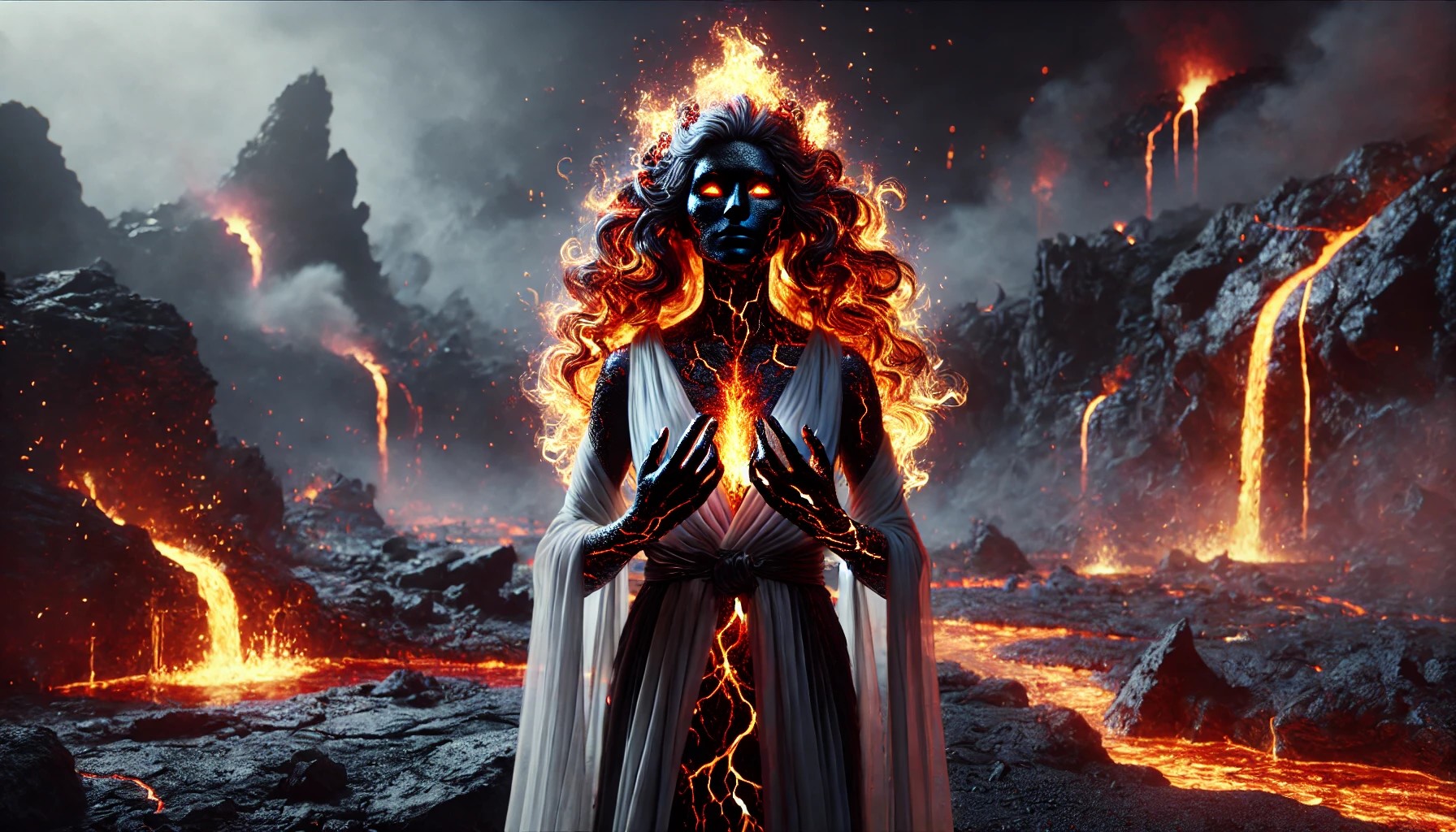
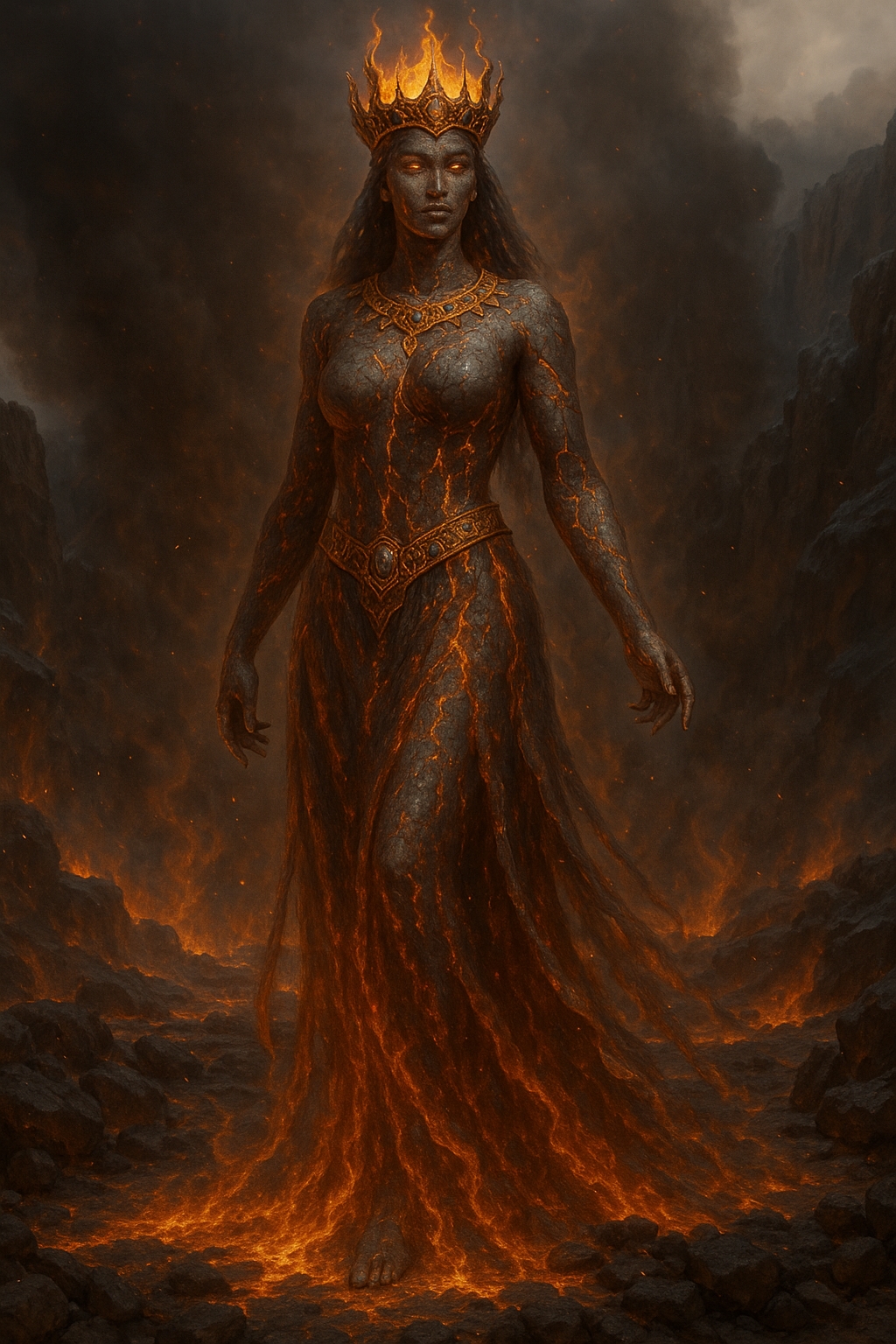
The Molten Queen: In her most commonly depicted form, Vulca appears as a statuesque woman of divine, untamed beauty. Her obsidian-black skin is cracked with rivers of molten gold and fiery orange, glowing as if her body is a living volcano. At times, her molten veins pulse with heat, causing steam to rise from her body as the temperature around her fluctuates. Her hair is an eternal cascade of living fire, shifting colors based on her mood, deep red when calm, golden-orange when impassioned, searing white-hot when enraged, and eerie blue when contemplative or sorrowful.
Her eyes blaze like twin miniature suns, radiating intense heat capable of melting stone or setting wood ablaze with a single glance. Her lips, also glowing with molten intensity, leave trails of fire in the air when she speaks. She often wears minimal clothing, either a flowing robe of smoke and ash, or an ever-shifting dress woven from flame and volcanic rock. Some depictions show her wearing jewelry forged from hardened lava, with rings that burn as hot as the heart of a mountain.
Her hands, wreathed in flickering flame, can either nurture fire gently, forging new life, or become claws of destruction, burning through anything she touches. With each step she takes, the ground beneath her scorches, cools, and then cracks, unable to withstand the raw force of her presence for long.
Alternate Forms
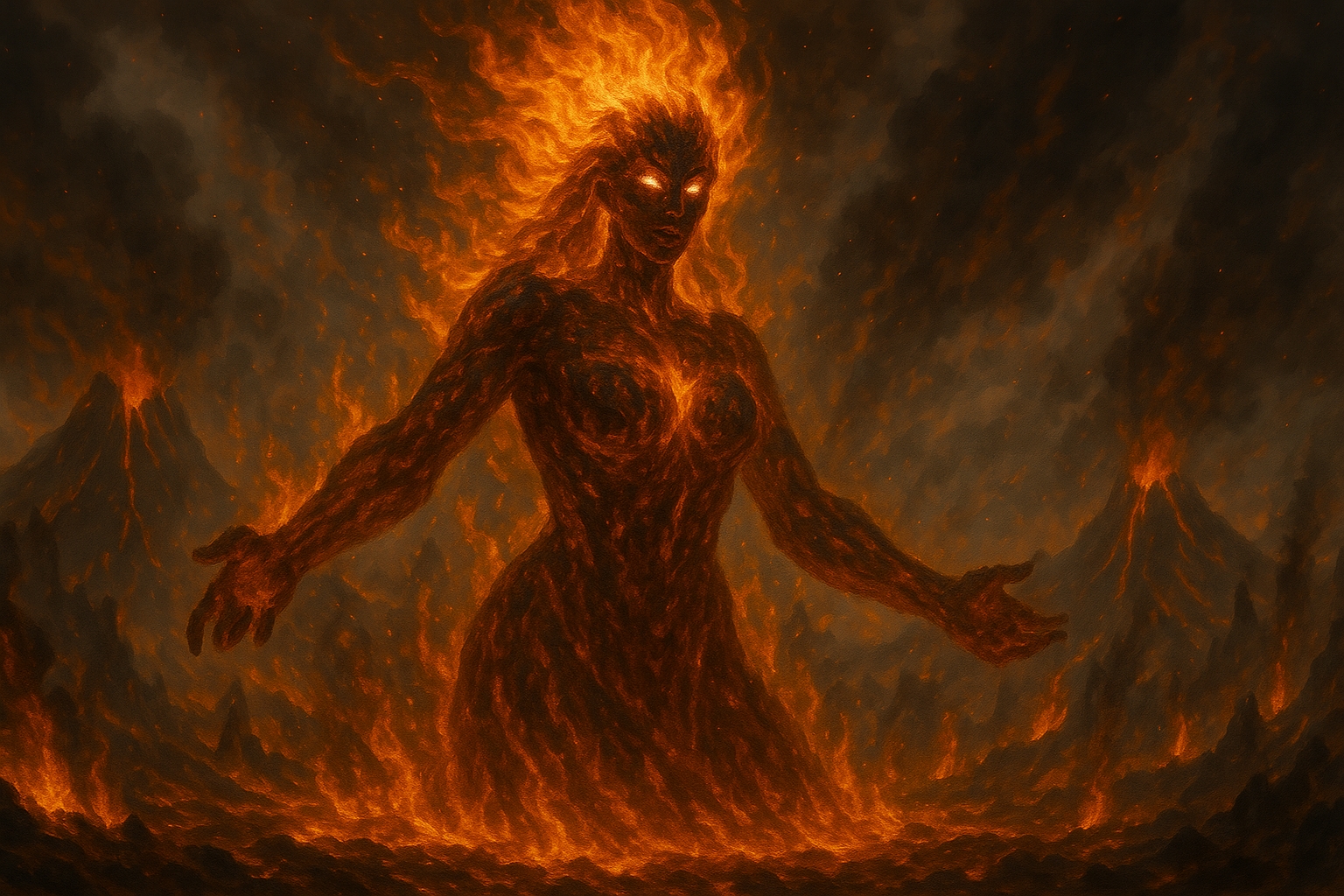
The Firestorm Titan: When overcome with rage or engaged in battle, Vulca abandons all pretense of a humanoid form and becomes an unstoppable firestorm given shape. In this form, she stands colossal and titanic, her body composed entirely of molten rock and raw fire. Her facial features become indistinct, as if sculpted from lava, her eyes expanding into burning voids that drip searing heat.
Her hair erupts into a raging inferno, reaching out like living tendrils of fire, consuming everything in their path. Her arms become massive gauntlets of volcanic rock, with cracks that glow from within, and her voice rumbles like an eruption shaking the heavens. Her movements are slow but irresistible, a force of nature that cannot be halted. In this form, she merges with the land itself, turning mountains into rivers of lava and igniting the skies in an eternal dusk of smoke and ember.
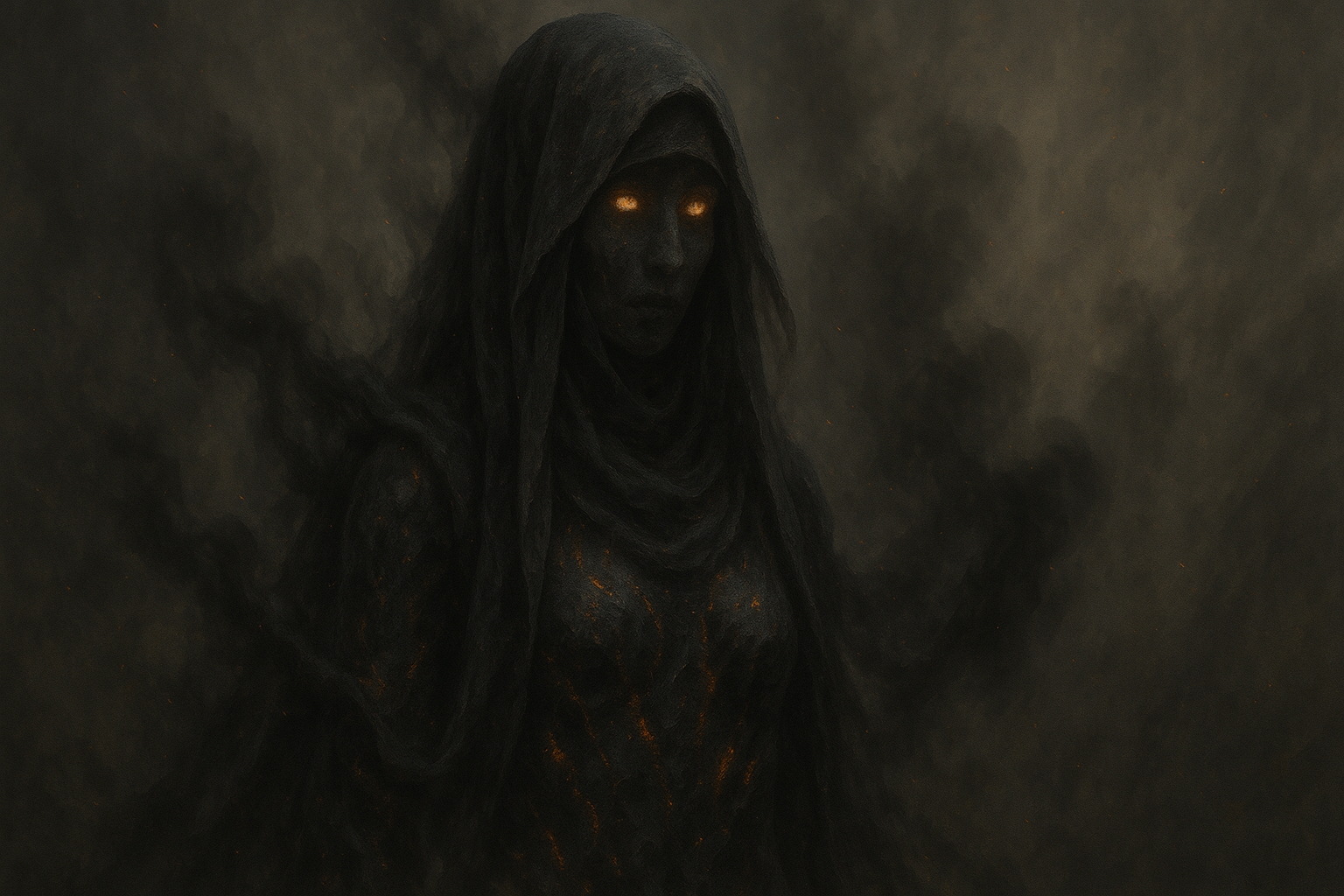
The Smoldering Watcher: At times, Vulca manifests in a more subtle and mysterious form, particularly when appearing to mortals in visions or as an omen. In this form, she is a veiled woman wrapped in shadow and smoke, her body seemingly made of cooling volcanic glass, with flickers of fire visible beneath the surface. Her eyes glow softly like embers, and wherever she walks, ashes drift in the air.
Her presence in this form is neither warm nor scorching but carries an unsettling heat just beneath the surface, a reminder of the fire that can erupt at any moment. She speaks in whispers, her words crackling like embers in the wind, and her laughter is the sound of distant flames licking at dry wood. Some say that when she chooses this form, she is watching, waiting, deciding whether to bestow wisdom or unleash fury upon those she encounters.
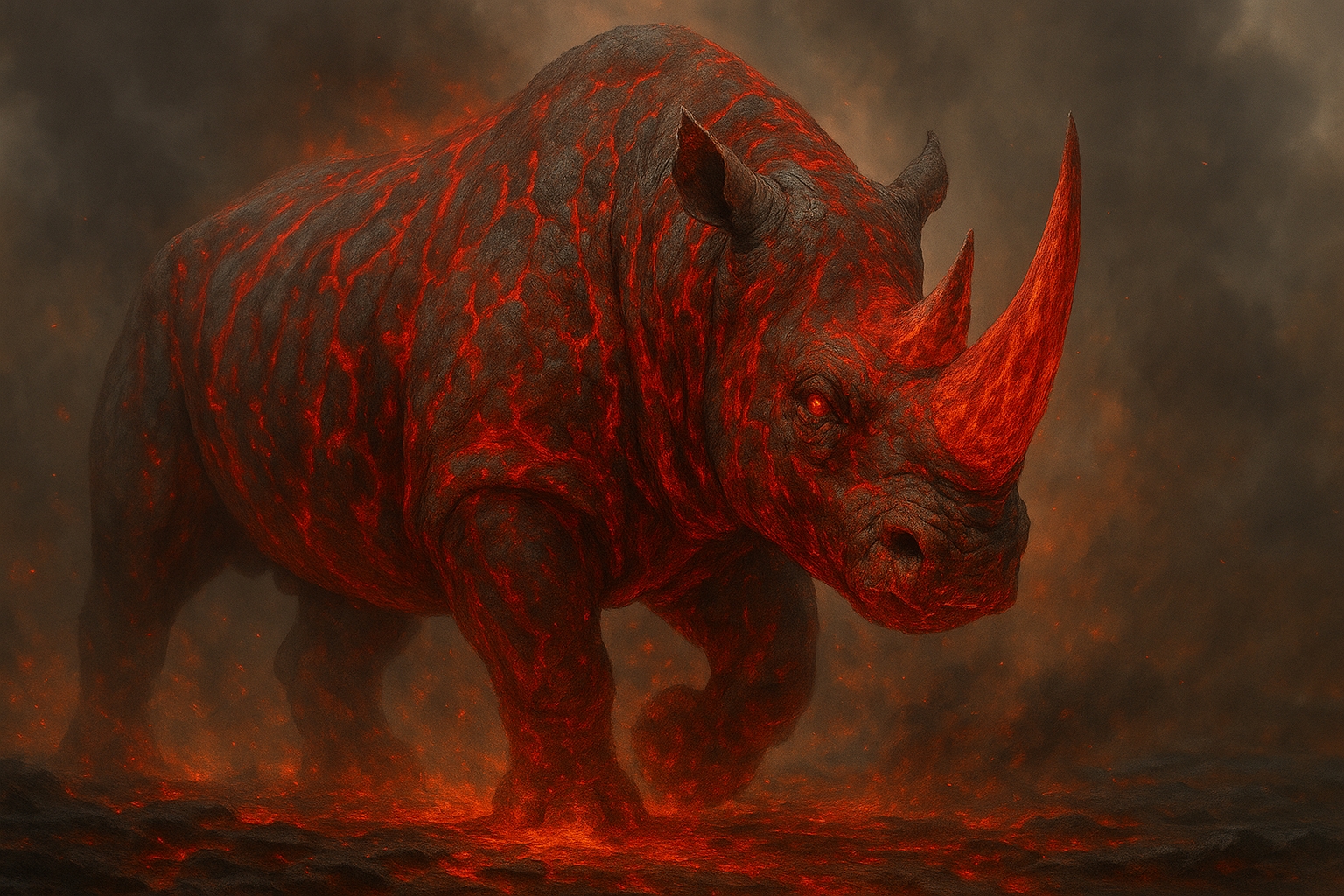
The Bloodfire Rhinoceros: In certain legends, Vulca has been known to manifest as a colossal fire-wreathed rhinoceros, its body formed of lava-hardened rock, with molten blood coursing through its veins. Its eyes burn like molten gold, and with each snort, it exhales clouds of ash and embers. Its horns are curved obsidian, razor-sharp and trailing smoke, said to be capable of goring even the gods themselves.
This form is rare and is often associated with vengeance, prophecy, or the destruction of great civilizations. It is said that when the Bloodfire Rhinoceros stamps its feet, the ground splits and lava bursts forth, reshaping the land itself. Legends claim that only the most fearless warriors have ever dared to stand before Vulca in this form, and none have survived.
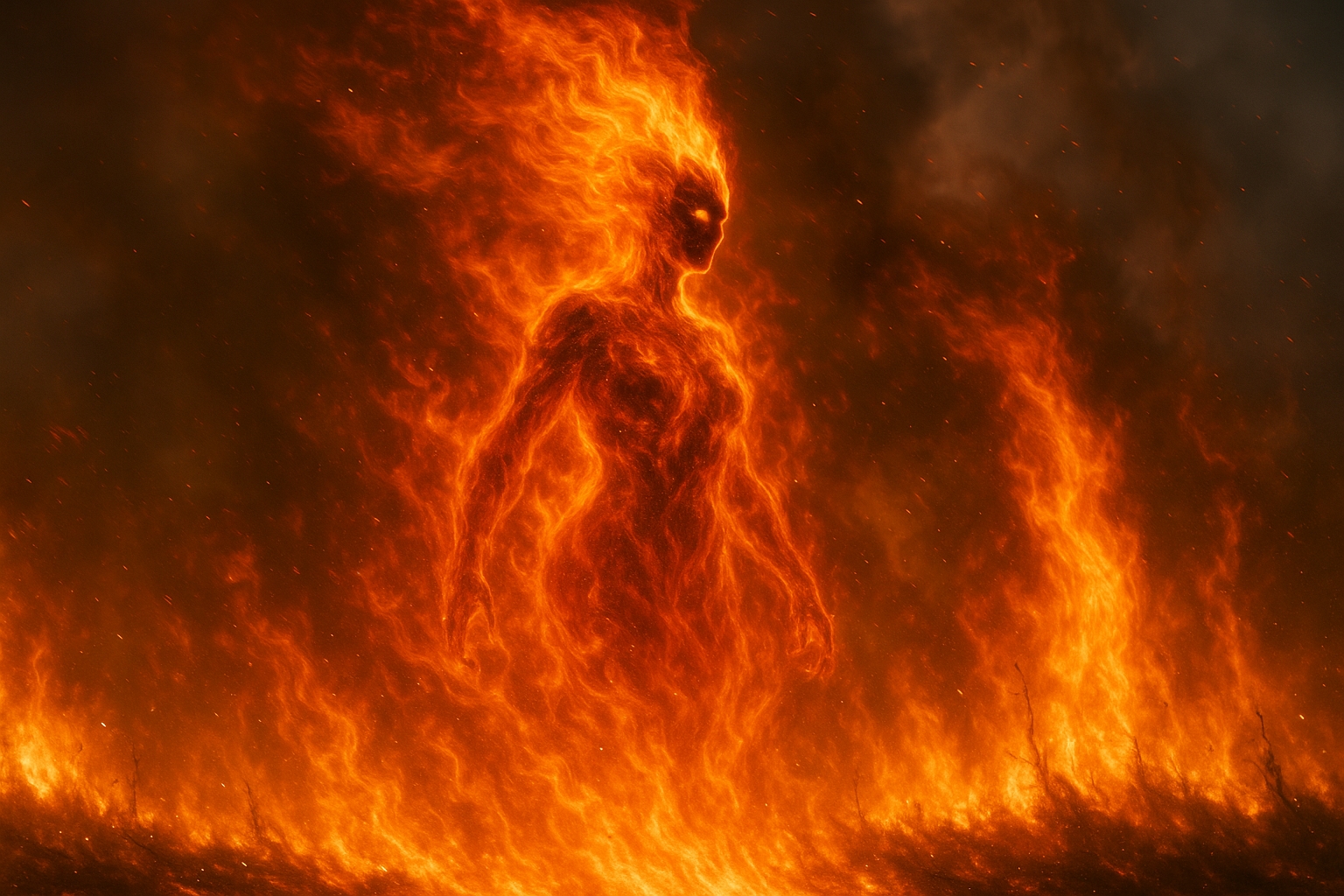
The Living Inferno: At her most primal, Vulca sheds all material form and becomes a sentient, raging wildfire, an ever-burning, ever-consuming force of pure energy and destruction. In this state, she is seen only as a massive swirling inferno, shifting between towering firestorms and a humanoid silhouette wreathed in flame. This is the form in which she is most uncontrollable, a storm of fire given will, raging across the land with no care for what stands in its path.
Unlike her other forms, this is the one where she loses all distinction of form and personality, becoming fire incarnate, existing only to burn, to destroy, and to reduce all to ash. It is believed that she cannot be reasoned with in this state, only waited out, until she either burns herself out or finds something new to consume.
Mental characteristics
Morality & Philosophy
Divine Symbols & Sigils
The divine symbols of Vulca are bold, fierce, and unmistakable, often crafted from molten metal, obsidian, or fire-scorched materials. Each of her symbols carries deep meaning, embodying both destruction and renewal, passion and chaos, power and inevitability. The Blazing Mask: A flame-wreathed obsidian mask, often depicted with cracks glowing with molten light. It represents the dual nature of fire, both a consuming force and a hidden source of transformation. Some believe that those who wear a mask bearing her mark risk being burned away, revealing their true selves beneath. The Burning Hand: A blackened hand with fingers of fire or a palm marked with a flaming spiral. This symbol embodies fire’s touch as both a gift and a curse, the power to create or destroy, to forge or incinerate. Warriors and blacksmiths often brand or tattoo this symbol upon themselves, invoking Vulca’s strength. The Erupting Mountain: A volcano spewing fire and molten gold. This represents unleashed power, unstoppable change, and the fury of the earth itself. It is a warning that nothing remains untouched by fire forever, all must either adapt or be consumed. The Ember Spiral: A swirling pattern of embers and smoke that never settles into one shape. This is the mark of transformation, unpredictability, and raw energy. It is often drawn in ash or carved onto weapons, signifying the ever-shifting nature of power and inspiration. The Flaming Circle: A simple ring of fire, sometimes enclosing a black void or molten core. This represents the endless cycle of destruction and rebirth, reminding followers that what burns away will rise anew from the ashes. It is commonly worn as an amulet by those who seek resilience and renewal. The Firebrand Rune: A rune resembling a jagged, twisting flame, used by Vulca’s most devoted followers as a tattoo, brand, or magical sigil. It is said to mark those who are blessed, or cursed, by Vulca’s touch, granting them fiery inspiration or leading them toward an inevitable trial by fire."Fear not the fire, for it is not your enemy. It is the hand that reshapes, the trial that purifies, the forge that makes you whole. Embrace Vulca’s flame, and be reborn in its light."
Religious Artifacts:
The Diadem Of The Flameborn: Said to have been created by Vulca herself, supposedly woven from strands of her own fiery hair before all of written history. This is a crown of eternal flame, shaped like burning embers yet cool to the touch for its rightful wearer. The flames shift colors based on the wearer’s emotions, gold for calm, red for anger, blue for sorrow, and white-hot for fury. It is said to grant its bearer immunity to all natural and magical fire and allows them to command flames with a thought. It also instills a portion of Vulca’s chaotic will, making rulers who wear it passionate but volatile, prone to fits of inspiration and destruction alike. The last known ruler to wear the diadem was the Tyrant Queen Zerrasin The Scorched, whose kingdom was consumed in an unstoppable wildfire. The diadem vanished in the inferno, and some say it now rests deep within Vulca’s divine realm, waiting for a new worthy ruler, or conqueror. The Blade Of The Burning Conqueror: Is also named Ashrender. This blade was forged by the ancient dwarven blacksmith Morvakas Forgeburn, in the legendary Forgefires of Arkenhall approximately 4,000 years ago, during the Ashen Wars. This is a greatsword of blackened steel, eternally glowing with molten veins with its edge wreathed in flickering flame. The hilt is wrapped in charred leather, rumored to have been taken from a fallen fire elemental. It is said to be able to ignites with a thought and able to burn through armor and flesh alike. It also feeds on destruction, growing stronger when wielded in raging battles or against powerful foes. The wielder can also absorb fire-based attacks and redirect them. However, prolonged use drives the wielder into a battle-mad frenzy, making them reckless and nearly impossible to control. After carving a path of conquest across three empires, the warlord Jerrahn Blazefire fell in battle, and Ashrender was lost in the depths of a volcanic chasm 1,000 years ago. Some say it still waits beneath the ground, calling to the next warlord bold enough to claim it. The Eternal Brazier & The Unquenchable Flame: Created by High Priestess Kaelsindra, The Firetongue, founder of The Pyreclad Covenant approximately 5,500 years ago. This is a golden brazier, wreathed in an undying flame that burns without fuel, wind, or time. The fire within it is said to be a fragment of Vulca’s divine essence, making it impossible to extinguish. When used in ritual sacrifices, The Eternal Brazier grants visions, power, and destructive energy to The Pyreclad Covenant. It is also said that any offering cast into its flames is transported directly to Vulca’s realm, making it the only known direct conduit to the goddess. The brazier was last seen in The Burning Spire, the stronghold of The Pyreclad Covenant. However, when The Covenant was purged by The Order Of The Frostforged, the brazier vanished, rumored to have been stolen away by fleeing cultists. Some believe it now lies hidden within an active volcano, still burning, still waiting for its next keeper. The Phoenix Mantle: Rumored to have been crafted from the feathers and ashes of a reborn phoenix at least 1,500 years ago and possibly far older. This is a cloak made entirely of shimmering, fiery feathers, its hues shifting from deep red to brilliant gold as it moves. It is said to be weightless, and its warmth never fades, even in the coldest climates. It is said to grant complete immunity to fire, the ability to resist magical ice, and temporary flight when the wearer is in extreme heat. The cloak also has a unique ability, if its wearer is burned to death, they will rise from the ashes, reborn once, but only once. However, if misused or worn by the unworthy, the cloak bursts into flames, consuming its wearer entirely. The last known wielder, the legendary fire mage Elredd Of The Crimson Peak, was said to have been burned at the stake by his enemies, only to rise from the flames, fully healed and laughing. After his final disappearance, The Phoenix Mantle was believed to have been sealed away in a tomb of ice, hidden by those who feared its power. The Gloves Of Creation & Ruin: Said to be created by Vulca herself, gifted to the first Emberborn champion millennia ago. This is a pair of heavy, obsidian-black gloves, veined with crimson molten light, and eternally warm to the touch. When worn, they become one with the wielder’s flesh, allowing them to summon fire at will. These gloves allow the wearer to mold and shape fire as easily as a sculptor shapes clay, bending it into weapons, shields, or even creatures of flame. They also grant enhanced durability and resistance to heat, but at a price, the longer they are worn, the more the user’s flesh and soul are consumed by fire, until they eventually become a being of living flame, losing their humanity. The gloves have been passed down through generations of fire-wielding champions, but none have held them for long before succumbing to their curse. The last known wielder, Parzeon, The Ash Walker, was said to have walked into the heart of a volcano, never to return. Whether the gauntlets still exist within the molten depths of the world remains unknown."She does not care for kings or beggars, for saints or sinners. Fire consumes all the same, only those who endure the burn are worthy of her gaze."
Worshipers Of Vulca
The Emberborn Brotherhood: Consists of blacksmiths, warriors, and fire-mages who revere Vulca as the divine force of creation through fire. To them, all things must be tested and reforged through hardship, just as metal is tempered in flame. Their rituals include the forging of weapons, branding ceremonies, and trials of endurance, such as walking barefoot across hot coals or holding molten metal in their hands. Their sacred site, The Forgefires of Arkenhall, is said to be where legendary weapons are crafted. The Brotherhood believes that strength is earned through suffering, and that weakness is merely impurity to be burned away. While they are revered by dwarven smiths and sought after by warriors, their harsh philosophy is viewed with suspicion by clerics of order and law. The Pyreclad Covenant: Is a far more radical sect of fire-worshipers who believe that Vulca demands sacrifices of flesh and flame. To them, fire is the great purifier, and they actively set ablaze heretical lands, cities, and temples of rival gods. Their sacred site, The Burning Spire, is an ever-burning blackened tower where their leaders claim to receive visions of fire, though outsiders believe these are merely hallucinations from volcanic fumes. The Covenant believes the world is impure and must burn before it can be reborn. Some among them go so far as to willingly walk into flames, believing Vulca will either bless them or reduce them to their purest form, ash. Feared and hated by nearly all, the Pyreclad Covenant is relentlessly hunted by kings, religious orders, and even Vulca’s more moderate followers, who see them as dangerous extremists. The Ashen Circle: Is a more tempered sect of Vulca’s faithful, they consists of fire mages, scholars, and mystics who seek to understand fire’s mysteries rather than simply unleash its destruction. They believe that Vulca’s flames hold secrets of creation, prophecy, and transformation, and that by studying fire, they may uncover divine truths. Their practices involve meditating before flames, reading embers for visions, and harnessing fire magic. The Temple Of The Last Ember, where the “First Flame” is said to burn eternally, serves as their holiest site. The Ashen Circle’s followers often find themselves at odds with more rigid religious orders, as their prophetic visions are considered heretical by those who worship gods of wisdom and order.Opposition Of Vulca
The Order Of The Frostforged: Standing in direct opposition to Vulca’s chaos is a knightly order dedicated to containing and countering the destruction left in the wake of her followers. Wielding magic and relics infused with ice and cold, they believe that fire is a reckless force that must be balanced or sealed away. To them, cold is control, while fire is chaos. They actively hunt down fire cults, extinguish sacred flames, and seek to suppress fire-based magic wherever it emerges. Their sigil, a frozen flame encased in ice, represents their belief that only by containing Vulca’s influence can the world remain stable. Their greatest foes are The Pyreclad Covenant, whom they see as arsonists and mass murderers in need of extermination. The Keepers Of The Hearth: A gentler opposition to Vulca comes from this pacifist sect that venerates fire as a force of warmth, home, and safety. Unlike Vulca’s followers, they reject the idea of fire as a tool of destruction, believing instead that it should be used for creation and comfort. They worship a lesser fire being, and see Vulca as a corrupted force, one that has lost sight of fire’s true purpose. The Keepers tend to eternal hearth fires, light lanterns for the lost, and practice quiet meditation before flames. This peaceful view of fire puts them at odds with many of Vulca’s followers, who consider them weaklings who deny fire’s true nature. The Chain Of Ash: Is a more secretive and sinister cult that believes Vulca is not to be worshiped, but feared and sealed away. They argue that fire is not a natural force but a divine mistake, one that should be locked away forever. Their mages and priests work tirelessly to bind fire spirits, weaken fire magic, and seal volcanic fissures in an effort to diminish Vulca’s power. The Pyreclad Covenant considers them heretics and actively seeks to burn them from existence, while other followers of Vulca see them as dangerous fools meddling with forces beyond their understanding."Do you hear it? The fire speaks, whispering secrets to those who dare to listen. But beware, some who listen for too long never speak of anything else again."
Rumors
The Sleeping Goddess Beneath The Volcano: Some whisper that Vulca does not reside in a distant divine realm, but slumbers beneath the world’s most violent volcano, her molten heart beating in time with each eruption. It is said that if she ever awakens fully, the world itself will burn in an unending inferno. The Lost Lover Of A Forgotten God: A few heretical sects believe that Vulca was once the lover of a god of the sea or sky, but her passion burned too fiercely, and she was cast down, betrayed by the one she loved most. Enraged, she swore that fire would one day consume all that he held dear, a prophecy that some believe is still unfolding. The Whispering Flames: There are those who claim that if you stare into a fire long enough, you can hear Vulca’s voice. Some say she speaks of glory and ambition, urging the listener to act without hesitation, while others believe she drives the weak into madness, compelling them to set everything they love ablaze. The Unburnt Champion: It is said that somewhere in the world, a mortal walks unscathed through fire, bearing Vulca’s blessing, or perhaps, her soul reborn in flesh. Some cults actively seek this prophesied champion, believing they will either lead the world into an era of flame or consume the goddess’s power for themselves. The First Flame’s Return: Scholars and zealots alike speak of a hidden fire, older than the gods, the first spark that brought light into the world. Some believe that Vulca has been searching for it, while others fear that she already holds it, and is merely waiting for the right moment to unleash its full, catastrophic power. The Ashen Omen: In rare moments, a fire burns without consuming its fuel, leaving behind only cold, gray ash instead of smoke. Fire-mages and priests of Vulca claim that such an event is a warning, a sign that the goddess’s will is shifting, and that great destruction or revelation is soon to follow."In the end, when the world is cinders and all is lost, only Vulca will remain. And from the ashes, she will begin anew."

These god articles you are writing truly are masterpieces. I really enjoyed reading about her different religious texts (the fact most are carved into stone instead of paper is great) and festivals. I think my favourite detail is the blackened hand that blacksmiths tattoo on themselves. Is there a reason why she is chaotic evil and not chaotic neutral?
Explore Etrea | WorldEmber 2025
Thank you very much! Vulca is kind of in between evil and neutral in most respects, but I have a darker world and needed more evil deities in it She definitely enjoys her flames destroying nature and people and remaking the world. I also wanted her to be, almost the other side of the coin from Zimno, with one being lawful evil and god of cold and the other being chaotic evil and the goddess of flames. I may have to rethink her in the future. Thanks again.