
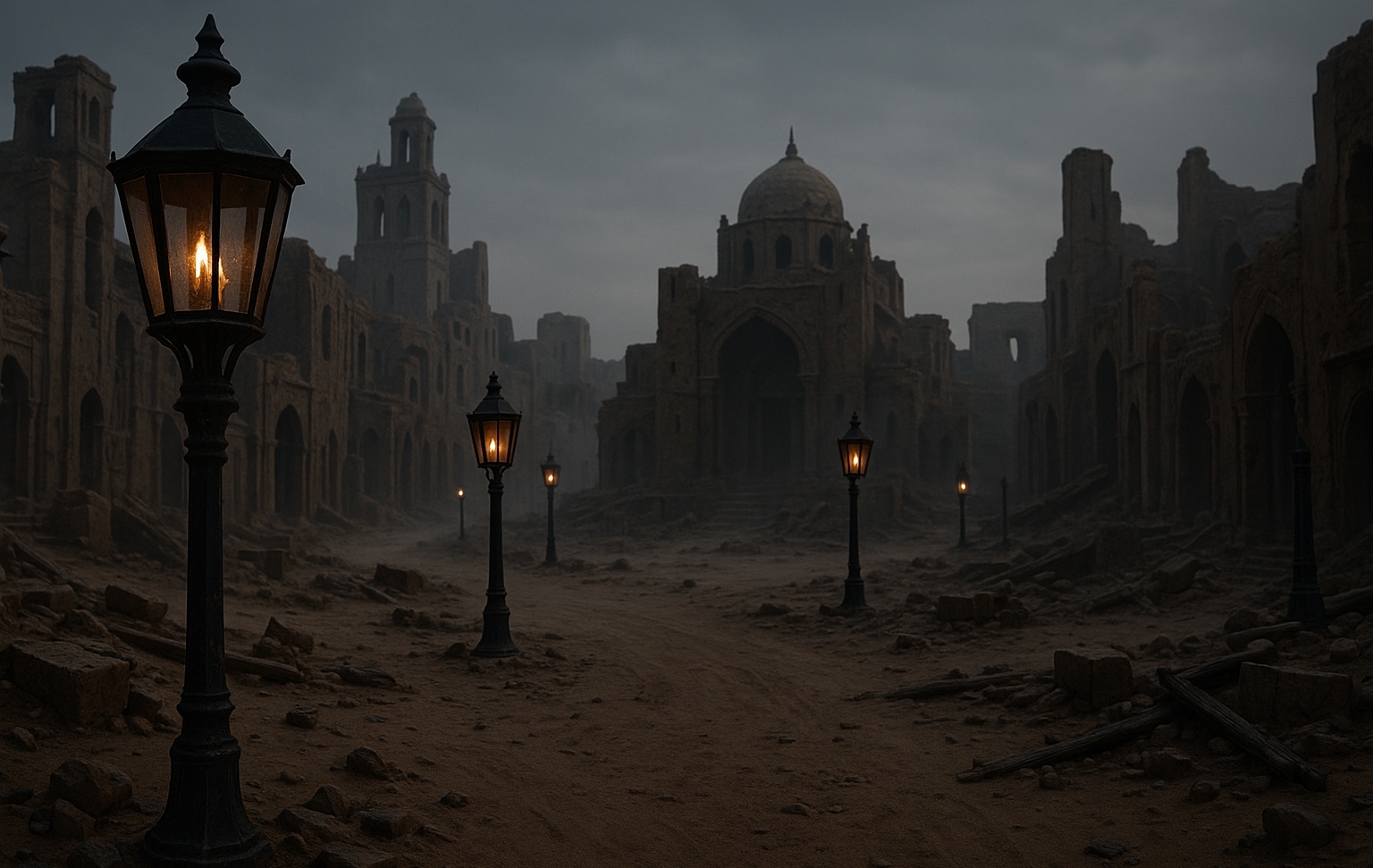
The City Of Black Lanterns
“The lanterns burn without oil, without warmth, without mercy. Step into their light, and the city will remember your name, long after the desert has forgotten your bones.”Once, Roshan stood as the “Jewel of the Dunes”, a desert city whose long avenues shimmered beneath the eternal glow of tall, wrought-iron streetlamps. These lanterns were fueled not by mundane oil, but by Dawnstones, rare crystals that captured the very first light of morning. It was said that no shadow could cross a Dawnstone’s flame, and for centuries, the lanterns kept the horrors of the night-sands at bay, Sandwraiths, Bonewalkers, Moon Scorpions, and the eyeless jackals that prowled beyond the walls. The magic had its price. Each Dawnstone drank faintly from its Keeper’s vitality, stealing years in slow, unnoticed sips. The city’s elders accepted this cost as the unseen tithe for safety. But when a foreign merchant arrived with a wagon of blackened, still-warm Dawnstones, spoils taken from a distant battlefield, the city’s mages saw a rare opportunity. If they could rekindle the stones, Roshan’s light would never fade. They succeeded… but the light returned wrong. The lanterns flared with a cold, pale brilliance that gave no warmth. Shadows deepened rather than retreated, clinging to walls like tar. And then came the sickness. It began with the Lantern Keepers, bloodshot eyes, weeks without sleep, whispers to things unseen. Soon, every household felt it, the murmuring voices that knew secrets they should not know. The whispers coaxed, promised, demanded. Those who listened too long either vanished entirely, or were found standing still for hours, staring into the cold flames until their shadows detached and slithered away. The plague spread quickly, its victims drawn not to the dark but to the light itself. Survivors called it the Lantern Plague, claiming it was not a sickness of the body but of the soul, an infection carried on light that had been starved of true dawn. The city bled its population in three months. Some households locked their doors and never opened them again, the silence within absolute. Others fled into the desert, braving the beasts they had once feared more than death. When the last cries faded, Roshan was gone. In its place stood the City Of Black Lanterns, a dead husk where the flames still sway, burning without oil or tending. It now lies silent beneath a cold and watchful light. Its streets, once lined with radiant Dawnstones, are choked with sand and shadow. Those who dare to enter speak of whispers in familiar voices, shadows that move without their owners, and streets that twist and change beneath the eerie glow. Most who wander too far never return, except for their footprints in the dust, and the faint echo of their names carried on the desert wind.
Demographics
Before its fall, Roshan’s population was a diverse mix of desert-born peoples and long-term settlers from distant trade routes.
The majority were native desert folk, adapted to the harsh climate, skilled in water conservation, and deeply tied to Dawnstone traditions. Alongside them lived merchants, artisans, and mages from across multiple continents, drawn by Roshan’s wealth and reputation as a beacon of safety in the desert.
Ethnically and culturally, the city was a tapestry of native clans who had settled the basin for generations, often serving as Lantern keepers, guards, and caravan guides. Foreign traders from distant coastal and river kingdoms, many of whom established permanent merchant houses. Scholars and mages specializing in light-based wards, mineral magic, and desert cartography. Craftsmen and builders from various lands, responsible for the city’s distinctive mix of architectural styles.
Religiously, the people honored a blend of imported gods and Dykuma, Goddess of the Desert, though a strong reverence for the Light At Dawn, a semi-religious philosophy centered on the Dawnstones, was common to nearly all.
Government
Before The Fall Of The City
Before its fall, Roshan was governed by a Council Of Light, a ruling body composed of seven elders drawn from the city’s most influential groups, native desert clans, merchant houses, mage guilds, and artisan guilds. The High Lantern Keeper served as the council’s symbolic head, overseeing the city’s network of Dawnstones and presiding over major decisions. Beneath the council were appointed magistrates responsible for trade regulation, water allocation, and dispute resolution, as well as the Wardens Of The Flame, a guard force tasked with maintaining order and protecting the lantern network. Decision making was a careful balance between tradition and commerce, native elders guarded ancient customs tied to the Dawnstones, while merchant and mage representatives pushed for expansion and profit. The system functioned for centuries, but when the Dawnstone supply began to dwindle, political unity fractured, merchant factions argued for importing blackened stones, while traditionalists resisted. The final vote to accept the foreign shipment passed by a single seat, sealing the city’s fate.Final Months Of The City
In the final months before the Lantern Plague, Roshan’s political climate was fractured and tense, with the Council Of Light split between desperation and caution. The merchant faction, facing economic collapse from dwindling Dawnstone reserves, pressed for immediate adoption of the blackened stones brought by the foreign merchant, arguing that without them the city’s light would fail and trade would vanish. The traditionalist elders warned that stones stripped of their dawnlight were an affront to centuries of custom and could bring unknown dangers. Mages on the council were divided, some eager to prove their skill by restoring the corrupted stones, others urging more research before risking the city’s safety. Meanwhile, the Wardens Of The Flame reported rising anxiety among the populace, with markets closing early and whispers spreading about strange behavior in lantern lit districts. The final decision to rekindle the blackened stones passed by a narrow majority, leaving deep resentment among dissenters. In hindsight, survivors recall the council chamber that night as being unusually cold, with shadows pooling in the corners long before sunset.Final Decree
The Final Decree of the Council Of Light, issued just two weeks before the Lantern Plague began, was known as The Ordinance Of Eternal Flame. It declared that all public lanterns in Roshan would be rekindled using the restored blackened Dawnstones, beginning in the central plaza and spreading outward until every street, gate, and tower was lit. The decree framed this as an act of triumph, a sign that Roshan’s light would never falter, a promise of safety to the people and stability to the trade routes. The High Lantern Keeper read the proclamation aloud from the palace balcony at sunset, as the first of the black flames were lit across the plaza. Witnesses later claimed the new light seemed wrong from the first breath, cold, sharp edged, and casting shadows that did not match the people who made them. Survivors later called it The Last Lighting, a moment when hope turned to horror, and the city’s fate was sealed.Industry & Trade
Roshan’s location in a resource-poor desert basin forced its people to rely on magic from the very beginning. With little fertile soil, scarce water, and almost no wood, they turned to the one treasure the land offered, Dawnstones, as both a practical safeguard and the foundation of their economy.
The stones provided light that kept night predators away, but they also became a substitute for resources the city lacked. Magical lanterns replaced costly oil imports, enchanted irrigation channels coaxed limited crops from brackish wells, and protective wards reduced the need for large standing armies to guard against raiders.
This dependency created both prosperity and vulnerability. When the Dawnstone veins began to dwindle, Roshan’s trade faltered, and its people faced the choice of dwindling light or risking corrupted stones from unknown sources. Their deep reliance on magic meant they had no sustainable fallback, once the light was poisoned, the city’s fate was sealed.
History
The City Of Black Lanterns, once known as Roshan, was founded about 560 years ago around a rare deposit of Dawnstones, crystals able to capture the first light of morning and drive back the desert’s night predators. Over the centuries, Roshan grew into a wealthy trade hub, its tall wrought-iron lanterns and endless glow earning it the title “Jewel Of The Dunes”.
For centuries, the city thrived under the Council Of Light, balancing the traditions of native desert clans with the ambitions of merchants, mages, and artisans. Dawnstones lit every street, powered magical wards, and fueled Roshan’s prosperity. But the resource was finite, around 180 years ago, the nearby veins had nearly run dry, forcing the city to rely on costly imports.
About 140 years ago, a foreign merchant arrived with a wagon of blackened Dawnstones, still warm from some distant war. The council, divided but desperate, voted to restore them through magic. The stones reignited, but their light burned cold, casting deep, oily shadows. Within days, the first cases of the Lantern Plague appeared, an affliction of whispers, sleeplessness, and vanishing shadows that consumed the population in just three months.
Survivors fled into the desert, and Roshan was abandoned. The Black Lanterns still burn without fuel, their pale flames swaying as if breathing, and the city’s true name has faded from all but the oldest records. Today, travelers know it only as the City Of Black Lanterns, a cursed ruin avoided by all but the most desperate or foolish.
Architecture
The City Of Black Lanterns is built from warm-hued sandstone and dark desert basalt, its structures weathered but still imposing after centuries. Tall, narrow streets wind between multi-story dwellings with arched doorways, latticed windows, and shaded balconies once draped in silks. Grand plazas are flanked by colonnaded arcades and domed temples, their facades carved with geometric patterns and sunburst motifs, remnants of Roshan’s reverence for light.
Many buildings feature flat rooftops once used for night markets and stargazing, now dusted with windblown sand. The wrought-iron lantern posts, ornate with curling desert vine motifs, still stand at every major crossroad. Though some towers have collapsed, the central palace and its great domed gate remain largely intact, looming over the deserted streets like a silent sentinel.
Appearance
By day, the City Of Black Lanterns is a sun-bleached ruin, sandstone facades dulled to pale gold, shadows sharp and honest under the desert sun. The intricate carvings fade into the stone, half-buried windows stare blankly, and the streets are quiet except for the hiss of wind through broken archways. But when the sun sets, the transformation is unnerving. The black lanterns flare to life, their cold, pale flames spilling a light that gives no warmth. The glow twists the streets into a labyrinth of oily shadows that cling to walls and pool unnaturally in corners. Carvings that were muted by day seem to deepen, the sunburst motifs warping into jagged, almost predatory shapes. Reflections dance in broken windows, but never in sync with the flame that casts them. The domed rooftops gleam faintly, as if wet, and the ironwork of the lantern posts seems to writhe when viewed from the corner of the eye. Sounds, footsteps, murmurs, faint laughter, drift from the darkened buildings, even when no one is there. By night, the city feels less like a ruin and more like something watching, waiting, and breathing.Geography
The City Of Black Lanterns sits in a low, wind-carved basin surrounded by rolling dunes and jagged sandstone ridges. To the north lies a stretch of salt flats that shimmer like water in the heat, often deceiving travelers with deadly mirages. The south and west are bordered by tall dune fields that shift constantly, sometimes swallowing whole caravan tracks overnight.
A narrow dry riverbed, the Sef-Ahl Wadi, winds past the eastern gate, its banks marked by stunted thornbrush and the bones of long-dead palms, evidence that the region once held more water. The surrounding land offers little shelter from the sun or storms, making the city’s basin appear from a distance like an island of stone in a sea of sand.
“The flame does not burn you. It… looks through you. It searches for something it knows you have.”
Climate
The City Of Black Lanterns lies in a harsh hot desert climate, marked by scorching days, frigid nights, and minimal rainfall.
Daytime temperatures often soar high enough to warp metal and bleach stone, while the nights can drop to near freezing. Sandstorms are common in late summer, scouring the streets and burying structures in drifts. Winds carry fine dust that stings the eyes and clings to skin. Rain falls only a handful of times each year, usually in sudden, violent storms that flood the lower streets before the water vanishes into the sand.
The arid air and strong desert sun preserve the city’s bones, leaving its black iron lanterns and stonework intact even after centuries, though the endless shifting sands have begun to reclaim its outskirts.
Natural Resources
The region around the City Of Black Lanterns holds few natural resources, making survival harsh. The most valuable is the rare Dawnstone, once found in shallow veins beneath the surrounding sandstone ridges and in the dry bed of the Sef-Ahl Wadi. These luminous crystals were the lifeblood of Roshan’s magic and trade.
Other resources are meager, scattered pockets of brackish well water, patches of thornbrush for firewood, and small deposits of desert salt harvested from the northern flats. Occasional veins of iron-bearing rock lie deep in the dunes, but shifting sands make them dangerous to reach. Wildlife is sparse, mostly hardy reptiles, scorpions, and desert hares, offering little in the way of sustainable food.
Since the fall of Roshan, the once-prized Dawnstones are no longer mined here, the surviving stones in the city’s lanterns burn on without being touched, their source long forgotten or cursed.
“Roshan died in three months, but its lanterns will burn until the last traveler answers their call.”
RUINED SETTLEMENT
603 A.S. about 140 years ago.
Founding Date
183 A.S. about 560 years ago.
Alternative Name(s)
Formerly known as Roshan, The Jewel Of The Dunes
Type
City
Population
Abandoned
Traveler’s Caution: The Black Lantern Road
“Hear this and remember: We ride within sight of the dead city, and the lamps will see us. Do not look directly into their flames after dusk. Do not listen if a voice calls your name, whether it is the voice of friend, kin, or lover. If the lantern nearest you flickers, keep your eyes to the road and your tongue behind your teeth. Shadows in that place are not your own, they are older, hungrier, and will gladly trade places. We ride swiftly, we do not speak until the lamps are behind us, and if one of you strays from the road, we do not turn back.”
Dangers Of The City
The City of Black Lanterns is a place where danger seeps from every shadow and even the light itself is a predator. The cold flames whisper in the voices of long lost loved ones, luring travelers to answer, those who do are never seen again. Prolonged exposure to the lantern light can cause a person’s shadow to detach and vanish, leaving them weakened, hollow, or soulless. The lingering curse of the Lantern Plague still hangs in the air, bringing sleeplessness, hallucinations, and compulsive urges within hours of entering the city. Figures in scorched black robes, thought to be Spectral Lantern Keepers, are sometimes glimpsed moving between the lamps, vanishing when pursued. The harsh desert climate only compounds the danger, with scorching days, freezing nights, and sudden sandstorms claiming the lives of the unprepared before they even reach the gates. Once inside, the Black Lanterns light twists streets and alleys into a shifting maze, drawing intruders ever deeper into the dead city and making escape nearly impossible.“It whispered in the voice of my sister, dead two years by then. She asked me to help her find her hands. I do not know what she meant, and I did not stay to ask.”
Black Lanterns
A Black Lantern in the City is a tall, wrought-iron post, its surface darkened with centuries of heat and desert wind. The iron is worked into curling vine and flame motifs, now warped and twisted as if the metal itself tried to flee its own light. At its peak hangs a heavy, six-sided glass enclosure, its panes clouded, cracked, or faintly soot-streaked from within. Inside, the cold flame burns with a pale, bluish-white core ringed by faint black edges, swaying as though it breathes. The light spills unevenly, creating deep, oily shadows rather than dispelling them. When the wind passes, the flame bends but never flickers out, and for a heartbeat, shapes like faces can be seen in the glass, gone the moment they are looked at directly. Up close, a Black Lantern gives off a faint, irregular whispering hum, like breath drawn through a narrow reed or the distant murmur of voices underwater. The sound rises and falls without rhythm, sometimes seeming to echo words just beyond comprehension. The smell is subtler but just as disturbing, a dry, metallic scent laced with something faintly sweet, like flowers left too long in a sealed tomb. When the flame sways, a sharper note cuts through, the acrid tang of scorched stone, as if the light itself were burning the air. Some travelers claim that if you linger too near, you’ll catch the scent of someone you knew, an old lover’s perfume, a parent’s favorite spice, the leather of a friend’s armor, always tied to the voice that calls your name from the flame.“We left before sunset. We did not speak, we did not look back. But still, the shadows followed us for three nights before they let go.”
Rumors
The Shadow Market: Some claim there is a night only once every ten years when the lantern flames turn crimson and merchants of shadow walk the streets, trading in stolen years, lost voices, and the faces of the dead. The Keeper’s Bargain: Relic-hunters say a figure in black iron robes can be bargained with if you offer a Dawnstone. He will trade you anything in the city, but the price is always something you will miss more than the object you gain. The Flame That Knows Your Sin: Caravanners warn that the lantern nearest you will flare brighter if you have killed someone and never confessed. Those whose flames flare are sometimes dragged from the road by their own shadows. The Children’s Choir: A persistent tale says that if you stand in the central plaza at midnight, the lanterns hum in unison until you hear the sound of children singing. Those who follow the song vanish forever. The False Caravan: Some travelers report seeing a full caravan pass through the city after dusk, camels, riders, wagons, all lit by the black lantern glow. But the caravan is silent, and when followed, it turns into the nearest lamp and disappears. Lantern Ash: Certain alchemists claim that if you scrape the soot from the base of a black lantern and mix it into ink, anything you write will come true, once. Others say using it dooms the writer to walk the city’s streets in death. The Returning Dead: An especially feared rumor insists that people lost to the lanterns eventually come back. Not as corpses or ghosts, but walking, breathing, smiling, except their shadows are wrong, and they always try to lead you back to Roshan.“My father was the last Lantern Keeper in our street. When the light turned cold, he told me to run before I could hear what it was saying. I have not stepped in shadows since.”

This is such a great article. I got chills reading it, and thinking about how that one vote doomed everyone.
Explore Etrea | WorldEmber 2025
Thank you. It was fun to do.