
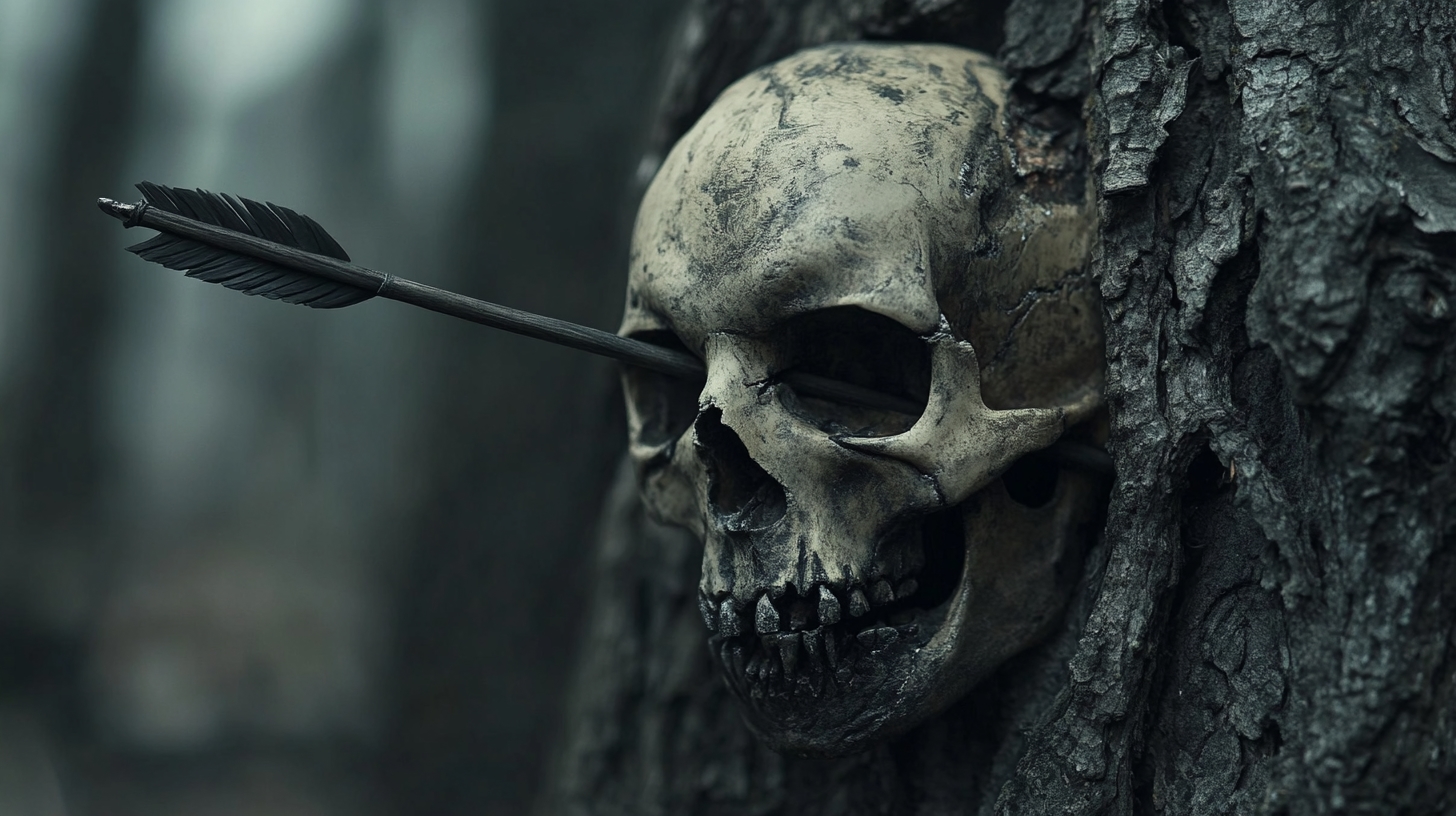
The Black Arrow Of Al Londar
“It is not the arrow that kills you, but the promise it carries, a promise that death is watching, and it knows your name.”Few objects have stirred as much unease among gravewalkers and curse-breakers as the so-called Black Arrow Of Al Londar. First documented pinned through the skull of a wandering priest in the woods near Red Larch, the artifact has since appeared, or perhaps reappeared, across centuries, always accompanied by a trail of unrestful dead and whispered madness. Though some dismiss it as a grim calling card or cruel hoax, those who have studied the arrow firsthand know better: it is a beacon, a curse, and a herald of the one called Al Londar, whose name has become synonymous with doomed fate. This document gathers what little is known, and what should not be known, of the arrow’s origin, power, and the dark force that seeks those who carry it.
“Touch it, and your soul glows like a lantern to the dead.”
Description
The arrow is ancient, yet impossibly intact, a long, gnarled shaft of charred blackwood, smoother than any mortal carving could achieve. It’s unnaturally cold to the touch, as though it’s been resting in a crypt for centuries. Faintly glowing gray runes, written in an unknown script, spiral from the fletching to the arrowhead, barely visible beneath a spiderweb of bone splinters lashed with dried sinew. The fletching is made from raven feathers, stiffened and oily, with a sheen that absorbs light rather than reflects it. The arrowhead itself is forged from a strange gray metal, painted in a blackened obsidian coating, but cracked, leaking thin tendrils of dark mist that vanish when looked at directly. A closer inspection reveals traces of dried blood along the shaft, too old to be human, and a faint whispering sound only heard when no one else is speaking. Anyone gazing into the shaft too long sees vague, flickering visions of skeletal hands, clutching it from beyond the veil.“It does not poison the blood, nor rot the flesh. Its wound is older than death, and deeper than bone.”
The Curse Of The Black Arrow
The curse carried by the Black Arrow of Al Londar is not instantaneous. It is not loud. It waits. Once touched, not even wielded, the arrow forms a bond with the victim's soul, invisible and unshakable. This bond does not ask for permission. It does not care for wards or lineage. It simply is. The following effects unfold in predictable, and increasingly terrifying, stages: Stage I: The Night Tether (Day 1) The very first night after contact, the cursed individual begins experiencing vivid, harrowing nightmares of screaming skulls and shadowed figures. These dreams are not abstract but deeply personal, often reflecting suppressed guilt, traumatic memory, or hidden fears, always watched over by a figure cloaked in shadow, never approaching, always watching. Stage II: The Soul Beacon (Days 2–10) From the second night onward, the curse begins to emit a metaphysical “scent”, a beacon that draws the attention of the dead. Undead creatures become unnaturally aware of the cursed individual’s presence and move towards it. Even intelligent undead speak of "the mark" or “the invitation.” Clerics and paladins may detect an unnatural “pull” around the character, especially those attuned to divine forces. Stage III: The Last Laugh (Day 10 or upon death) On the 10th night, or sooner if the cursed character dies, the final effect of the curse manifests. The cursed soul becomes claimed. If the creature dies while cursed, they cannot be resurrected by any means short of a Wish or Divine Intervention. Their soul is dragged into the ethereal hunting ground where Al Londar waits with bow in hand. A new skull appears wherever the arrow was originally found, pinned to a tree or stone, with a the Black Arrow lodged in its eye socket. A new note is found nearby:“The Last Laugh. You’ll be next.” — Al Londar
Breaking the Curse
The curse cannot be removed by common magical means. Traditional uses of Remove Curse or Greater Restoration fail, often with disturbing side effects to both the caster and afflicted. Known methods of breaking the curse include:- Destroying the arrow in consecrated fire, under the light of a full moon.
- Confronting the ghost of Al Londar in his lair (if such a place can be found).
- Atoning for the guilt that summoned the arrow in the first place, often requiring a deeply personal quest or sacrifice.
- Reversing the mark by offering the arrow to a willing undead target and binding it with blood.
- Delivering the final blow to 13 undead beings, releasing them from undeath.
“It is not a curse. It is a covenant. You broke it when you picked it up, now he means to collect.”
Manufacturing process
The precise method of crafting the Black Arrow remains shrouded in myth, but scattered accounts across apocryphal texts suggest a ritualistic process rather than traditional smithing. The arrow is said to be assembled through necromantic rites, each piece collected from the remains of a cursed soul:
- The shaft is carved from the heartwood of a tree that grew in a battlefield soaked with unburied dead.
- The arrowhead is forged not by fire, but by binding obsidian shards with soul-ichor, a black ichor extracted from tormented spirits.
- The fletching comes from ravens that fed on carrion under a blood moon.
- Each rune etched into the shaft is written with the bone-dust of the maker’s enemies, using the tip of a cursed dagger as quill.
“No forge births it. No hammer shapes it. The arrow is not made, it is gathered.”
Item type
Ammunition
Rarity
This is said to be a unique one of a kind artifact, however rumors report that there may be 13 Black Arrows in total.
Origin Theories
No confirmed account exists of the arrow’s forging, yet among the ashes of forgotten orders and the scribbled margins of excommunicated texts, a few origin theories persist, each darker than the last. The Revenant’s Craft: The most commonly accepted theory among field scholars posits that Al Londar was once a mortal ranger or undead hunter, betrayed and slain by those he served. Refusing the quiet sleep of death, he returned as a revenant driven by vengeance, forging a singular weapon, the Black Arrow, to mark those he would one day hunt. These cursed marks are not mere threats, but a death sentence. According to this view, each arrow is a soul-bound contract: once claimed, it binds the bearer to Al Londar’s attention until the pact is fulfilled in blood.“One arrow, one soul. The arrow does not miss, it waits.”The Gift Of The Shadowed Fey: A rarer, more esoteric theory links the arrow to the Unseelie Fey, dark spirits who trade nightmares for favors. In this version, Al Londar was not a revenant, but a living man who made a pact with a fey lord of decay, granting him the arrow as a gift: a living curse that feeds on fear. The whispering heard when holding the arrow is thought to be the fey’s voice, laughing through the thin veil between worlds.
“It sings in the dark, for those who dare to listen.”Artifact Of The Mourning War: Still another hypothesis places the arrow’s origin in the time of the Mourning War, a little-remembered conflict between necromancer kings long before the founding of Waterdeep. According to this view, the arrow is not unique, but one of thirteen “Soul Arrows” forged by a lich-general known only as The Bonewright, each intended to carry a fragment of a soul bound in torment. Al Londar may have been the first victim, or perhaps the last, cursed to carry one of these arrows until all others are reclaimed.
“There are twelve more. We’ve only found one.”
RUMORS
The Arrow Once Struck a God: "They say it pierced the eye of a minor death god, and that’s why the dead follow it now." A fringe cult believes the arrow was the very weapon that blinded or slain an avatar of Myrkul during the Time of Troubles. In retaliation, the god cursed it to become a magnet for the dead. No One Holds It Twice: "Every soul who’s touched the arrow dies, and their bones are used to make the next one." While it appears as a single artifact, some believe the arrow re-manifests itself after each death, incorporating the remains of its last victim. This could explain why it’s been "found" in multiple locations over the centuries. The Ghost Ranger Carries It: "There’s a hunter in the woods who never speaks. Only follows. When you see him, it’s already too late." Locals near Red Larch speak of a silent, spectral ranger glimpsed among the trees. Some say it’s Al Londar himself, others say it’s the soul of someone who tried to use the arrow and was bound to serve it instead. A Duke Disappeared: "The Duke of Daggerford once bought the arrow at auction. He vanished two weeks later." Nobility often collect cursed objects for curiosity or power. One noble is rumored to have bought the arrow, only to vanish after several undead attacks. Some say his family line is still cursed, hunted every generation. The Arrow Points the Way: "If you carry it long enough, it turns toward something. A tomb? A gate? A prison?" Some adventurers believe the arrow is a compass, not a weapon, that it ultimately points toward something buried, sealed, or long-forgotten. Maybe Al Londar is just the first guardian. Or the warning. A Bard Survived It: "A man once broke the curse by laughing back." One tale speaks of a mad bard who, cursed by the arrow, accepted his fate and mocked Al Londar in song every night. Supposedly, the nightmares stopped, and the undead left him alone. The bard’s lyrics are lost… or maybe no one dares repeat them. A Dragon Hunts It: "A white wyrm in the Spine of the World offers gold for any who bring the arrow. Not to use, but to destroy." If true, this suggests the arrow’s curse reaches even draconic consciousness, and that some beings fear its spread enough to hoard or obliterate it.“He waits for the ones who take his arrow, not to reclaim it, but to follow it home.”

Hey, I loved this! It hits all the right spookiness chords for me, and the inclusion of extra lore/tidbits was excellent! I've added this as a worthy addition to my list of favourite spooktober articles! Thank you for creating it!
Thank you very much. I based it off of an arrow we found in a dnd campaign. It had no back story so I tried to make one here.