

Shambling Mound
The Corpse Gardens: Shambling Mounds of Grizburg
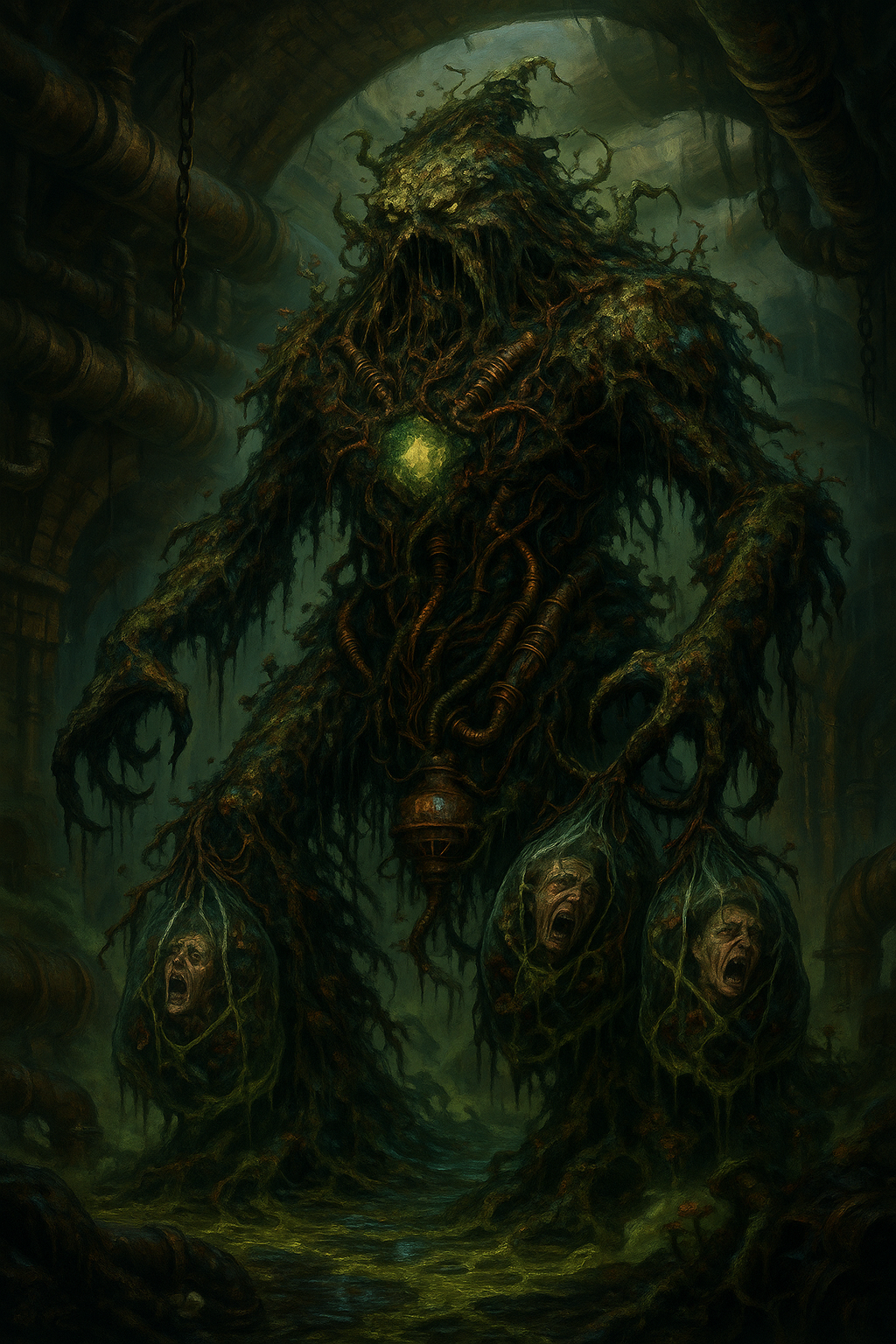 Deep beneath Grizburg's industrial sprawl, where the city's toxic veins empty into forgotten cisterns and collapsed subway tunnels, the Shambling Mounds represent nature's vengeance corrupted beyond recognition. These are not the verdant giants of distant swamps but industrial aberrations—masses of mutated vegetation fused with corpses, chemical waste, and the detritus of a dying city.
The first Corpse Gardens emerged during the Night of Poisoned Rain, when a catastrophic breach at three separate alchemical refineries flooded the undercity with mutagenic compounds. The runoff pooled in the mass graves beneath the Greendocks, where plague victims from the Third Cholera Uprising had been hastily interred. What grew from that unholy marriage of death and chemistry defied all natural law.
Deep beneath Grizburg's industrial sprawl, where the city's toxic veins empty into forgotten cisterns and collapsed subway tunnels, the Shambling Mounds represent nature's vengeance corrupted beyond recognition. These are not the verdant giants of distant swamps but industrial aberrations—masses of mutated vegetation fused with corpses, chemical waste, and the detritus of a dying city.
The first Corpse Gardens emerged during the Night of Poisoned Rain, when a catastrophic breach at three separate alchemical refineries flooded the undercity with mutagenic compounds. The runoff pooled in the mass graves beneath the Greendocks, where plague victims from the Third Cholera Uprising had been hastily interred. What grew from that unholy marriage of death and chemistry defied all natural law.
Shambling Mound Stats
In the deep places where the city's poison flows eternal, where chemical runoff meets ancient rot, there grows a horror that was never meant to be. Not plant, not corpse, but something between—fed on industrial waste and the forgotten dead, it shambles through darkness, collecting souls for its endless hunger.
The Birth of Abomination
The roots drank deep of corpse-liquor and chemical brine, while spores from the Kalnith Jungle found purchase in flesh made soft by decay. What rose was neither plant nor undead, but a third thing—hungry, patient, and aware.
Anatomy of Industrial Horror
A Grizburg Shambling Mound stands twenty feet tall when fully extended, though it often compresses itself to pass through sewer tunnels and maintenance corridors. Its body consists of several distinct layers, each more horrifying than the last: The Outer Shell comprises industrial detritus—rusted pipes, chemical-soaked rags, lengths of corroded chain, and fragments of factory machinery—all held together by thick ropes of mutated kelp and fungal strands. This shell constantly weeps a viscous, petroleum-like substance that burns exposed skin and corrodes metal at an alarming rate. Beneath lies the Flesh Garden, where partially digested corpses hang suspended in transparent sacs of vegetable matter. These bodies remain visible through gaps in the outer shell, their faces frozen in eternal screams. Some retain enough nervous system function to twitch and spasm when the mound moves, creating the illusion that the entire mass is trying to escape from within itself. At the creature's core pulses the Void Heart—a mass of crystallized toxic waste that serves as both brain and soul. This pulsing green-black organ generates the electromagnetic fields that allow the mound to sense prey through walls and coordinate its vine attacks with uncanny precision. Those who have gazed directly into a Void Heart report visions of an infinite garden where all flesh becomes root and all thought becomes hunger.The Sewer Territories
Each Shambling Mound claims a territory within Grizburg's vast sewer network, transforming maintenance tunnels into nightmarish gardens. They spread their influence through corpse seeds—small pods containing liquefied remains that sprout into toxic vegetation. Over time, entire sections of the undercity become impassable forests of flesh-eating vines and poison-sweating fungi. The largest known territory belongs to Old Rot-Throat, a Shambling Mound that has grown so vast it can no longer move from its lair beneath the Rustwater District. Maintenance workers speak in whispers of the thing's domain—miles of tunnel transformed into a living digestive system, where the walls pulse with peristaltic motion and the air itself burns the lungs.They sent twelve men down to clear the blockage in Sector Seven.
We heard screaming for three hours.
When it stopped, we sealed the tunnel with concrete and marked it on no maps.
Some places, you don't reclaim.
You just try to forget.
Feeding Patterns and Prey Selection
Unlike their wilderness cousins, urban Shambling Mounds have adapted to hunt the city's unique prey. They position themselves beneath grates and manholes along heavily trafficked streets, especially near taverns and opium dens where intoxicated victims make easy targets. A single vine, no thicker than a child's finger, extends upward through the grate. When someone passes overhead, the vine strikes with cobra-speed, injecting a paralytic toxin before dragging the victim below. The mounds show disturbing intelligence in their hunting. They've learned factory shift patterns, positioning themselves along worker routes during shift changes. Some coordinate attacks with other sewer predators, using their bulk to drive prey toward waiting dire rats or crawler swarms. Most disturbing are reports of mounds that mimic mortal voices—using absorbed vocal cords to call for help, luring would-be rescuers to their doom.The Engulfing Sack: Industrial Digestion
The creature's engulfing sack differs significantly from natural specimens. Rather than simple vegetation, these pouches incorporate salvaged industrial materials—rubber gaskets create airtight seals, brass valves regulate internal pressure, and copper tubing circulates digestive acids with mechanical efficiency. Victims pulled into these sacks face a uniquely horrible fate. The acids don't simply dissolve—they preserve consciousness while liquefying flesh, incorporating the victim's nervous system into the mound's own neural network. Some scholars of the forbidden theorize that every person consumed adds their memories and knowledge to the collective, explaining why older mounds seem to understand machinery, recognize individuals, and even operate simple industrial equipment.I saw it work the pump controls, knew which valve would flood the chamber with scalding steam. That weren't no mindless plant—that thing had been an engineer once, or eaten enough of them to remember.
Industrial Adaptations
Centuries of feeding on contaminated corpses and chemical waste have granted Grizburg's Shambling Mounds unique abilities absent in their natural kin: Chemical Synthesis: They can combine absorbed toxins to create new compounds within their bodies—acids that dissolve stone, gases that cause hallucinations, or adhesives stronger than industrial cement. Electrical Absorption: The copper and iron integrated into their forms allow them to channel electricity. Mounds near the Cable Car power grid have learned to tap into electrical lines, using the current to accelerate their growth or deliver shocking attacks. Mechanical Integration: Older specimens incorporate so much machinery that they become part construct. Gears and pistons enhance their movement, while integrated boilers allow them to vent superheated steam as a defense mechanism.The Brass Quarter Experiments
The consciousness-transfer researchers of the Brass Quarter have taken particular interest in Shambling Mounds, seeing them as potential vessels for mass consciousness storage. Project Verdant Mind attempts to upload multiple mortal consciousnesses into specially cultivated mounds, creating hybrid entities that combine mortal intelligence with vegetal immortality. These experiments have produced the Scholar Mounds—aberrations that retain the full memories and personalities of the academics fed to them. They lurk in abandoned libraries and university basements, surrounding themselves with water-damaged books and continuing their research through vine-manipulated instruments. Their scientific knowledge makes them far more dangerous than common mounds, as they understand chemistry, engineering, and mortal psychology.The Revolutionary's Gambit
Desperate revolutionary cells have attempted to weaponize Shambling Mounds against the Rust Barons. They feed the creatures the corpses of executed comrades, hoping the absorbed memories will create anti-authoritarian mounds. The results are mixed—while some mounds do seem to target industrial infrastructure and Rust Baron forces preferentially, they remain fundamentally alien entities driven by hunger rather than ideology. The notorious Red Garden Incident saw revolutionaries successfully direct a mound into the Brinkburn compound's lower levels. The creature devoured seventeen guards and caused massive structural damage before industrial flamethrowers drove it back into the sewers. The revolutionaries celebrated until they realized the mound had also consumed their safe house locations from the guards' memories and began hunting their former allies.Economic Exploitation
Despite their danger, Shambling Mounds have economic value in Grizburg's twisted markets: Toxin Harvesting: Their digestive acids and synthetic poisons sell for premium prices to assassins and alchemists. Specialized hunters risk the sewers to milk venom from sleeping mounds. Waste Disposal: Some factory owners deliberately cultivate mounds in their sub-basements, using them to dispose of bodies and industrial waste that would otherwise require expensive treatment. Corpse Recovery: The transparent sacks sometimes preserve valuable items—jewels, mechanical augmentations, or important documents. Corpse-fishers use long poles to extract these treasures, though many become prey themselves.The Deep Mounds
In the Whispering Depths, where dead god energies warp reality, Shambling Mounds undergo terrifying apotheosis. These Divine Mounds absorb not just flesh but souls, growing into massive entities that exist partially in spiritual realms. They speak prophecies through consumed tongues and weep tears that show visions of other worlds. The largest, known as The Cathedral of Flesh, has grown so vast it's become architecture—its body forms chambers and corridors that explorers must traverse to reach deeper sections of the Depths. Those who survive report that the mound is aware of their passage, that the walls whisper their names, and that some chambers contain perfectly preserved scenes from consumed victims' memories made manifest in vegetable matter.Cultural Impact
Shambling Mounds have become bogeymen in Grizburg folklore. Parents threaten misbehaving children with being "fed to the gardens," while workers paint vine patterns on sewer entrances as warnings. The annual Night of Burning Vines sees citizens throw plant matter into bonfires, a symbolic warding against the vegetable horrors below. Street artists have adopted the mound as a symbol of how the city consumes its citizens. Graffiti depicting workers being pulled into mechanical maws or factories growing vine-tendrils appears on walls throughout Rustwater. The Rust Barons have banned such imagery, but it proliferates faster than their enforcers can remove it.Methods of Control and Destruction
The Grizburg Sanitation Department maintains a special unit trained in mound containment. They use industrial flamethrowers, chemical defoliants developed from Kalnith Jungle toxins, and sonic disruptors that shatter the creature's crystalline core. Still, for every mound destroyed, two more seem to emerge from the depths. Some districts have made devil's bargains with their local mounds. The Greendock Feeding Compact sees dock workers regularly deliver corpses from maritime accidents to specific sewer grates. In exchange, the mounds avoid hunting in those areas and even attack rival gang members marked with special pheromones.Appearance
"Massive shambling mound made of industrial waste and corpses, toxic sewer environment, transparent vegetable sacks showing trapped screaming bodies inside, rusted pipes and chains woven through plant matter, dripping petroleum-black ooze, mechanical parts integrated into vegetation, glowing green-black crystalline heart visible through gaps, twisted urban gothic horror, poisonous fungi and mutated vines, chemical burns and corrosion effects, towering twenty-foot height in underground tunnel, brass valves and rubber gaskets forming digestive sack, copper wiring running through vine systems, background of industrial sewer architecture, toxic fog, bioluminescent decay"Shambling Mound Stats

Comments