

Helmed Horror
The Industrial Revenants: Helmed Horrors of Grizburg
The Soul-Forged Sentinels
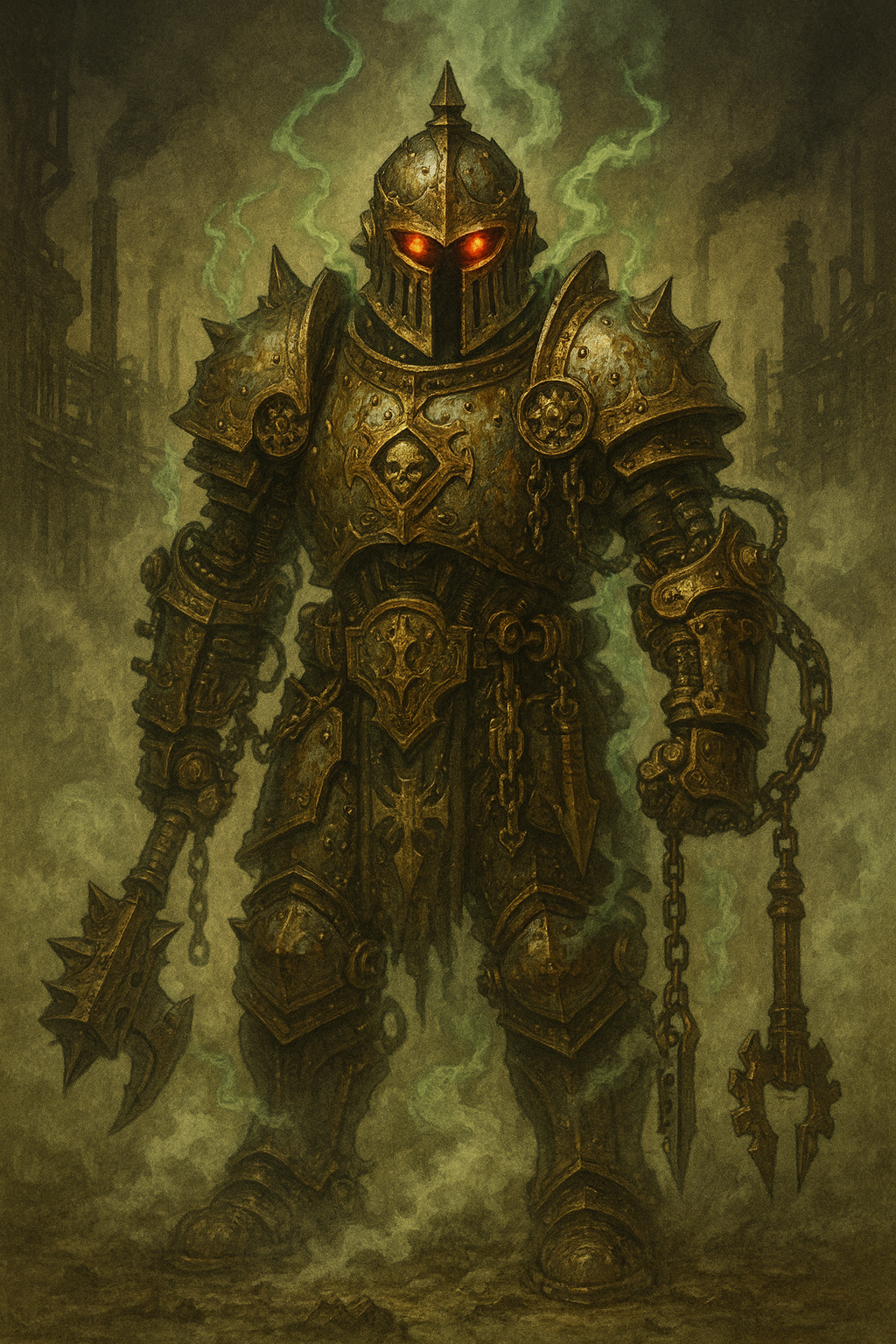 In the toxic twilight of Grizburg's industrial hellscape, the Helmed Horrors represent the ultimate fusion of necromantic sorcery and mechanical engineering—a grotesque marriage of soul-binding techniques perfected over centuries at Dreadmil. These are not mere animated suits of armor but industrial revenants, created through processes that would horrify even the most hardened practitioners of forbidden arts.
Origins in Industrial Atrocity
The first Helmed Horrors of Grizburg emerged from the fevered experiments of Valtorius the Soul-Binder during Dreadmil's founding centuries. Unlike the elegant magical constructs found in distant wizard towers, these industrial abominations were born from pragmatic cruelty—the need to create tireless workers who required neither food nor rest, guards who could stand eternal vigil without complaint, and weapons that carried the tactical knowledge of fallen warriors.
The process begins in Dreadmil's Soulforge Chamber, where condemned criminals, failed revolutionaries, or simply those who crossed the wrong Rust Baron are strapped to the great circular treadmill. As they march in endless circles, their spiritual essence is gradually extracted through a combination of mechanical pressure and necromantic resonance. But unlike standard soul-harvesting, which reduces victims to spiritual dust, the Horror-binding process preserves the consciousness intact—trapped, compressed, and forcibly inserted into suits of specially prepared armor.
In the toxic twilight of Grizburg's industrial hellscape, the Helmed Horrors represent the ultimate fusion of necromantic sorcery and mechanical engineering—a grotesque marriage of soul-binding techniques perfected over centuries at Dreadmil. These are not mere animated suits of armor but industrial revenants, created through processes that would horrify even the most hardened practitioners of forbidden arts.
Origins in Industrial Atrocity
The first Helmed Horrors of Grizburg emerged from the fevered experiments of Valtorius the Soul-Binder during Dreadmil's founding centuries. Unlike the elegant magical constructs found in distant wizard towers, these industrial abominations were born from pragmatic cruelty—the need to create tireless workers who required neither food nor rest, guards who could stand eternal vigil without complaint, and weapons that carried the tactical knowledge of fallen warriors.
The process begins in Dreadmil's Soulforge Chamber, where condemned criminals, failed revolutionaries, or simply those who crossed the wrong Rust Baron are strapped to the great circular treadmill. As they march in endless circles, their spiritual essence is gradually extracted through a combination of mechanical pressure and necromantic resonance. But unlike standard soul-harvesting, which reduces victims to spiritual dust, the Horror-binding process preserves the consciousness intact—trapped, compressed, and forcibly inserted into suits of specially prepared armor.
Protect specific machinery or production lines, attacking anyone who approaches without proper industrial credentials
Enforce worker quotas, becoming increasingly aggressive as production falls behind schedule
Guard trade secrets, pursuing and eliminating anyone who's witnessed proprietary industrial processes
Maintain equipment, their possessed consciousness retaining enough skill to perform complex mechanical repairs
Hunt specific bloodlines, their orders updated through mystical means as family feuds evolve
Collect debts, literally tearing the life force from blood marker defaulters
Creation Rituals and Industrial Alchemy
The process of creating a Helmed Horror in Grizburg requires not just necromantic knowledge but understanding of industrial metallurgy, alchemical treatment, and mechanical engineering. The armor must be specially prepared in forges that burn with soul-flame, metals alloyed with powdered bone and blood iron. Each piece is etched with binding runes using acids distilled from the Kalnith Jungle's toxic flora.
The actual binding requires the victim to be conscious throughout the extraction process—their terror and desperation providing the emotional energy that fuses soul to metal. Industrial machinery crushes their body while mystical apparatus extracts their consciousness, compressing it into a sphere of crystallized agony that's then inserted into the armor's chest cavity. The first movement of a newly created Horror is always the same—a violent thrashing as the consciousness realizes its new prison has no escape.
Weaknesses and Destruction
Destroying a Helmed Horror requires more than simply damaging its armor. The soul within must be severed from its metal prison, a process that typically requires either powerful divine magic or specific industrial solvents that dissolve the mystical bonds. Revolutionary cells have discovered that certain frequencies of sound—particularly those that match the resonance of Dreadmil's soul-extraction machinery—can cause Horrors to experience momentary paralysis as their consciousness remembers its traumatic binding.
The most tragic weakness of Grizburg's Helmed Horrors is their retained memories. While they cannot disobey their programming, some part of their original consciousness remains aware. Skilled manipulators have learned to exploit this by confronting Horrors with objects or people from their former lives, causing confusion that can create temporary openings for attack or escape.
The Economics of Horror
In Grizburg's twisted economy, Helmed Horrors represent significant investment and status symbol. A basic model costs as much as a small factory, while specialized variants command prices that could purchase entire city blocks. The Rust Barons view them as both practical tools and displays of wealth—nothing says industrial might like guards that neither eat nor sleep nor question orders.
A thriving secondary market exists for "reconditioned" Horrors—those recovered from destroyed facilities or failed ventures. These used models often carry quirks from their previous service: guards that still patrol routes through buildings that no longer exist, overseers that shout production orders in dead languages, or protectors that occasionally attack their current owners when they match some characteristic of ancient enemies.
Appearance / Description
"Industrial helmed horror armor construct, baroque plate armor fused with mechanical components, steam vents and gear mechanisms visible through gaps in armor, empty helmet with burning orange-red eyes, industrial Gothic style, standing in toxic fog, brass and black iron materials, pneumatic pistons on arms, chains and industrial tools as weapons, soul energy leaking from joints as greenish smoke, factory background, dark fantasy, steampunk horror aesthetic, imposing seven-foot height, decorated with industrial heraldry, corroded and stained metal, mechanical augmentations, sparks flying from joints"
"Ye see that suit o' armor standin' guard at th' Brinkburn vault? That ain't no decoration, friend. That's old Garrek Ironfoot himself—or what's left of 'im after he tried stealin' from th' family. They didn't just kill 'im; they bound his soul into his own plate mail an' set 'im to guard what he tried to take. Been standin' there forty years now, attackin' anyone who ain't got Brinkburn blood. Sometimes, on quiet nights, ye can still hear 'im screamin' inside that helmet."
— Slazgar Two-Eyes, speaking to new arrivals at Dreadmil
The armor must be prepared with channels of silver and circuits of copper, creating pathways for the soul's energy to flow. The helmet requires special attention—obsidian lenses for the eyes, resonance chambers within the skull cavity, and binding runes etched with acids distilled from the tears of the dying.The Brinkburn Elite Guard The most notorious Helmed Horrors in Grizburg serve House Brinkburn as elite guardians of their industrial empire. Each suit of armor tells a story of betrayal and punishment—former employees who attempted industrial espionage, rival family members who challenged Kregan's authority, or assassins who failed in their missions. The matriarch takes particular pleasure in forcing enemies to face their former allies, now reduced to hollow shells of metal that remember nothing but their orders to kill. These Brinkburn Horrors stand seven feet tall, their armor forged from the finest steel alloys and decorated with the family's gear-and-flame heraldry. Their eye slits burn with an unnatural orange light that matches the eternal flames of Grizburg's forges. Unlike standard Helmed Horrors, these industrial variants have been modified with mechanical augmentations—pneumatic pistons that enhance their strikes, internal boilers that allow them to vent superheated steam, and resonance chambers that amplify the screams of their imprisoned souls into weapons of psychological warfare. The Assembly Line Overseers Within Grizburg's countless factories and forges, a different breed of Helmed Horror maintains productivity through terror. These Overseer Horrors were created from the souls of particularly cruel foremen and factory managers—those who drove workers to death through exhaustion and industrial accidents. Now they continue their work eternally, patrolling assembly lines with whips of chain and wire, their mechanical voices counting out the rhythm of production.
The hammer falls, the gear-teeth bite
The Horror walks the factory floor
Its metal breath like furnace light
The foreman's soul enslaved once more
Through endless shifts it stands its post
A manager become a ghost
These industrial sentinels possess an uncanny ability to detect sabotage or slowdown in production. Their consciousness, twisted by the binding process, exists in a state of perpetual rage at inefficiency. Workers tell stories of Overseer Horrors that continued directing factory operations even after the building burned down around them, their armor still standing in the ash-filled ruins, gesturing at phantom workers to maintain their quotas.
The Whispering Depth Guardians
Deep beneath Grizburg, where the reality-warping energies of the Whispering Depths meet the industrial catacombs, exist Helmed Horrors transformed by exposure to dead god essence. These Depth Guardians were originally created to protect expeditions into the dangerous underground passages, but prolonged exposure to Zothra-Khaar's lingering power has fundamentally altered them.
Their armor has fused with fragments of divine bone and ossified reality, creating hybrid forms that blur the line between construct and aberration. Multiple arms might sprout from their torsos, each wielding weapons forged from crystallized madness. Their helmets have sprouted additional eye-slits that look in directions that don't exist in normal space. Some have developed the ability to step between moments, appearing to teleport short distances by moving through the gaps in time created by the dead god's influence.
The Consciousness-Corrupted
In the Brass Quarter, where consciousness-transfer experiments push the boundaries of identity, a new variety of Helmed Horror has emerged—one that contains not a single soul but fragments of dozens. These Composite Horrors are created when consciousness-transfer procedures fail catastrophically, leaving multiple partial personalities trapped in a single mechanical shell.
The resulting entity exhibits symptoms of severe dissociative disorder, switching between personality fragments mid-combat. One moment it might fight with the precise technique of a master duelist, the next with the brutal savagery of a street brawler, then suddenly freeze as a child's consciousness surfaces and doesn't understand why it's trapped in metal. These unpredictable guardians are prized by those who value psychological warfare over tactical reliability.
The Soul-Reaper Variants
Slazgar Two-Eyes has perfected his own variant of Helmed Horror at Dreadmil—the Soul-Reaper Horror. These constructs don't just imprison a single soul but are designed to harvest additional spirits during combat. Each successful strike with their soul-forged weapons doesn't just damage the body but tears fragments from the victim's spiritual essence, adding them to the Horror's consciousness collective.
Over time, these Horrors become increasingly powerful and intelligent as they accumulate soul fragments. The eldest Soul-Reapers in Dreadmil's deepest vaults have consumed hundreds of partial souls, developing a gestalt consciousness that borders on true sentience. They speak in choruses of voices, each word a different victim's scream, and their tactical knowledge encompasses the combat experience of every warrior they've partially consumed.
The Revolutionary Martyrs
Not all Helmed Horrors serve the established power. Revolutionary cells have learned to create their own crude versions using stolen soul-binding techniques and salvaged armor. These Martyr Horrors are volunteers—revolutionaries who willingly undergo the binding process to continue fighting after death. The procedure is even more traumatic than standard Horror creation, as it's performed with improvised equipment in hidden workshops.
The Horror walks the factory floor
Its metal breath like furnace light
The foreman's soul enslaved once more
Through endless shifts it stands its post
A manager become a ghost
I watched them strap old Marcus to the machinery—he'd taken three musket balls defending the safe house and weren't going to make it through the night. "Bind me," he said. "Let me keep fighting." They did it with stolen parts and half-understood rituals. What stands guard at our doors now is still Marcus, but also something else. Something angry. Something that remembers why it chose this fate.Industrial Directives and Behavioral Patterns Helmed Horrors in Grizburg follow different operational parameters than their traditional magical counterparts. Their directives are often tied to industrial processes, economic quotas, or complex political allegiances that can shift with corporate mergers or family alliances. A Horror might be programmed to:

Comments