

Aboleth
Aboleths of Grizburg
Appearance
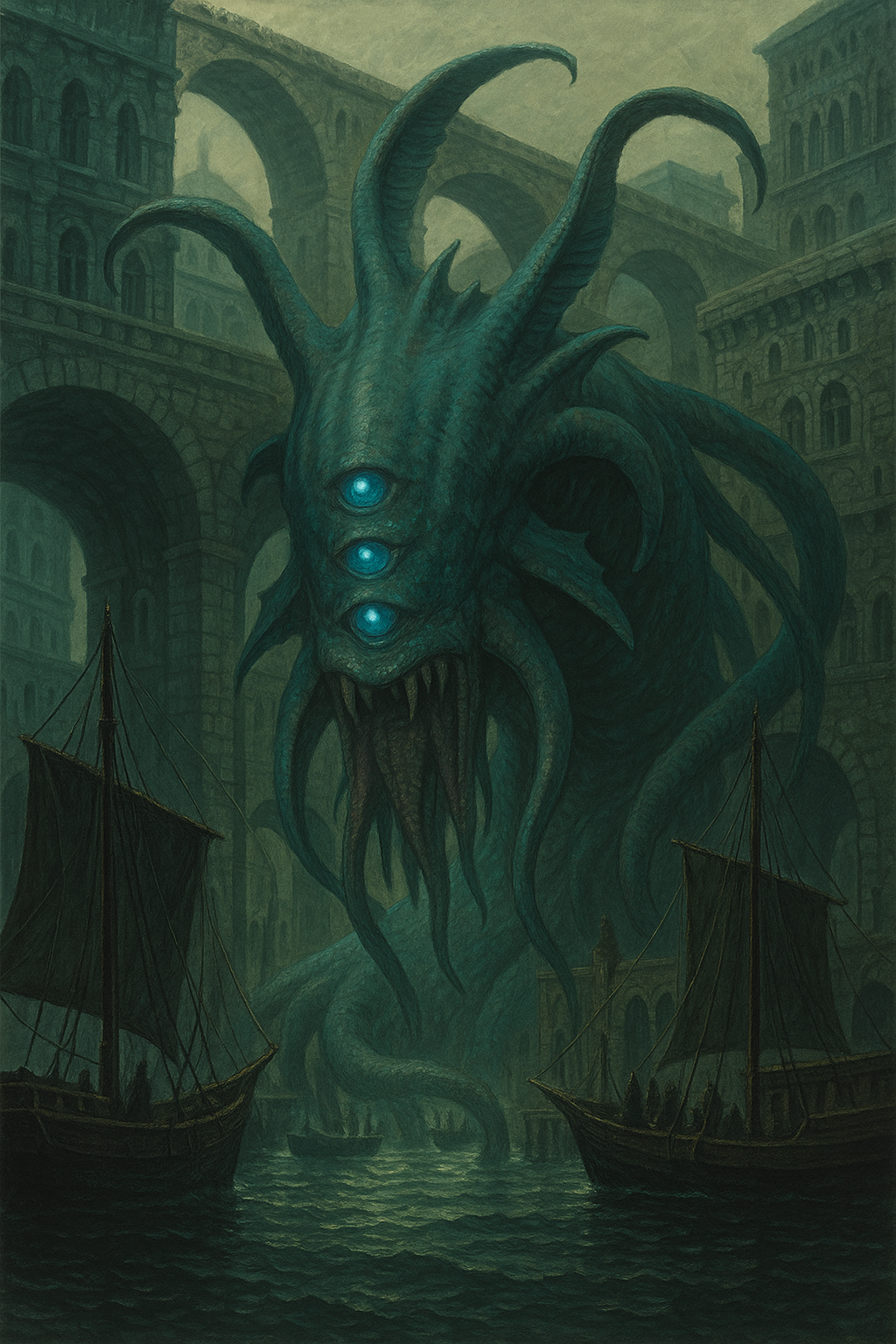
An aboleth glides through the Sko like a cathedral of flesh: a pallid leviathan draped in veils of mucus, three emerald eyes burning with drowned memory. Its four oared fins beat without ripples; its tail scythes silt into spirals that look like writing if you stare too long. The smell is copper, brine, and old lightning—stormwater trapped in stone lungs.It swam without moving the water. We moved for it.
Origins
The aboleths of Grizburg are not immigrants; they are recollections wearing meat. They claim the city is a scab across their ancient seabed empire. In their telling, our streets are reefs grown wrong, and our prayers are echoes of edicts they sang before the first bell was forged. Whether truth or venom, the Depths remember their shape.Domains Beneath
They lair in collapsed cistern-halls, in vaults whose mosaics drown when the river fattens, and in pressure-black tunnels where lanterns burn green. There, the aboleth reshapes its mile of water: slime blooms in the mortar, wells turn sour, and dreams taste of salt.I drank from a pump near Greendocks. My lips never dried again.
Memory and Rule
An aboleth never forgets. It counts your eye-blinks, files your heartbeat, and keeps a ledger of your oldest shame. With a brush of thought it tastes your desires—cheap, raw ore smelted into chains. It does not speak orders; it suggests inevitabilities. By the time you kneel, you think you’ve chosen to.Thralls and Proxies
Kuo-toa become ushers. Chuuls become ushers with teeth. Canal-folk become ushers with keys. The aboleth arranges them like vertebrae around its will: a tax of relics, a vanished inspector, a sluice opened at the wrong bell. A city may think it resists; it is merely digesting more slowly.The Mucus Covenant
Its slime is a treaty you can’t afford to sign. Touch the cloud and your skin learns to drown; breath becomes a canal that only water can fill. Healers call it a curse. The aboleth calls it citizenship.He gasped for air and asked for a bucket instead.
Temples of the Un-Sea
An aboleth builds no altars. It turns rooms into gulfs. Ceiling vaults drip like stalactite tongues; mosaics slick over with living film that glimmers when it thinks. A citizen walks in, sees a warehouse, and leaves with river on the brain. The next night they return with offerings: bones, documents, maps of locks and debts.Schemes in Practice
A barge route collapses because a ledger goes missing; the ledger goes missing because a clerk dreams of warm water; the clerk dreams of warm water because, three nights ago, something asked what his father promised and never paid. The aboleth does not topple walls. It convinces bricks to resign.The Whispering Depths Connection
Depths cults do not worship aboleths—they audition for them. A chant here, a relic there, a willingness to breathe water for a minute too long. If the mind pleases, the aboleth will make room. If not, the canal makes room.We offered iron. It wanted names.
Entanglements with Factions
Rust Barons fear aboleths because contracts fail underwater. Some try to hire them with relics; others fund “de-salination teams” of war-divers and frost-slingers. Smugglers, fools or visionaries, sometimes accept a thought-tithe in exchange for silent currents. The price is paid later, when a cousin opens the wrong gate at dawn.Tactics and Signs
Before it strikes, dreams in a ward synchronize—shared nightmares of light flickering through ribs. Then wells foul; then chains rattle at low tide with no wind. In a fight, the aboleth never raises its voice. You simply run out of yours, one memory at a time.It asked me what I wanted most. I told it. It agreed. That’s when I knew I’d already drowned.
Countermeasures
Salt sanctified with thunder, flowing wards etched into stone at waterline, bells tuned to break a thought’s surface tension—these help. Fire harms its servants more than it harms the master. The only true defense is refusing its question before it asks it: Why not obey?Relics and Research
Aboleths hoard maps of the city’s underskin: culvert schematics, saint-bones, lists of debts owed by men long dead. Scholars prize the slates they etch with cilia—fluid geometries that calculate flood, famine, and civil panic with insulting accuracy.Legends and Wounds
Old divers swear there is a wound beneath Grizburg where the river falls forever, and at its lip the “Archivist” aboleth waits, copying the city into itself. Another tale, the Gilded Thirst, claims an aboleth once turned every fountain to coppery blood for a single day—payment for a broken oath no one recalls.Adventuring Hooks
• A district wakes speaking the same sentence in sleep: “Open the eastern gate at the ninth bell.” Who wrote it into them?• A Baron’s heir returns from a dive “blessed,” skin slick and lungs thirsty—now he funds a new temple at waterline.
• Kuo-toa drag a chain of relic-shrines toward a drowned archive; the current runs upstream.
• A frost-slinger unit disappears under Greendocks; their bells keep ringing from the well.
Closing Words
An aboleth is not a monster in the river; it is the river’s memory of ruling. Break its body and it will dream another. Break its city and it will simply inherit what remains.You don’t kill an aboleth. You convince the water to forget it.

Comments