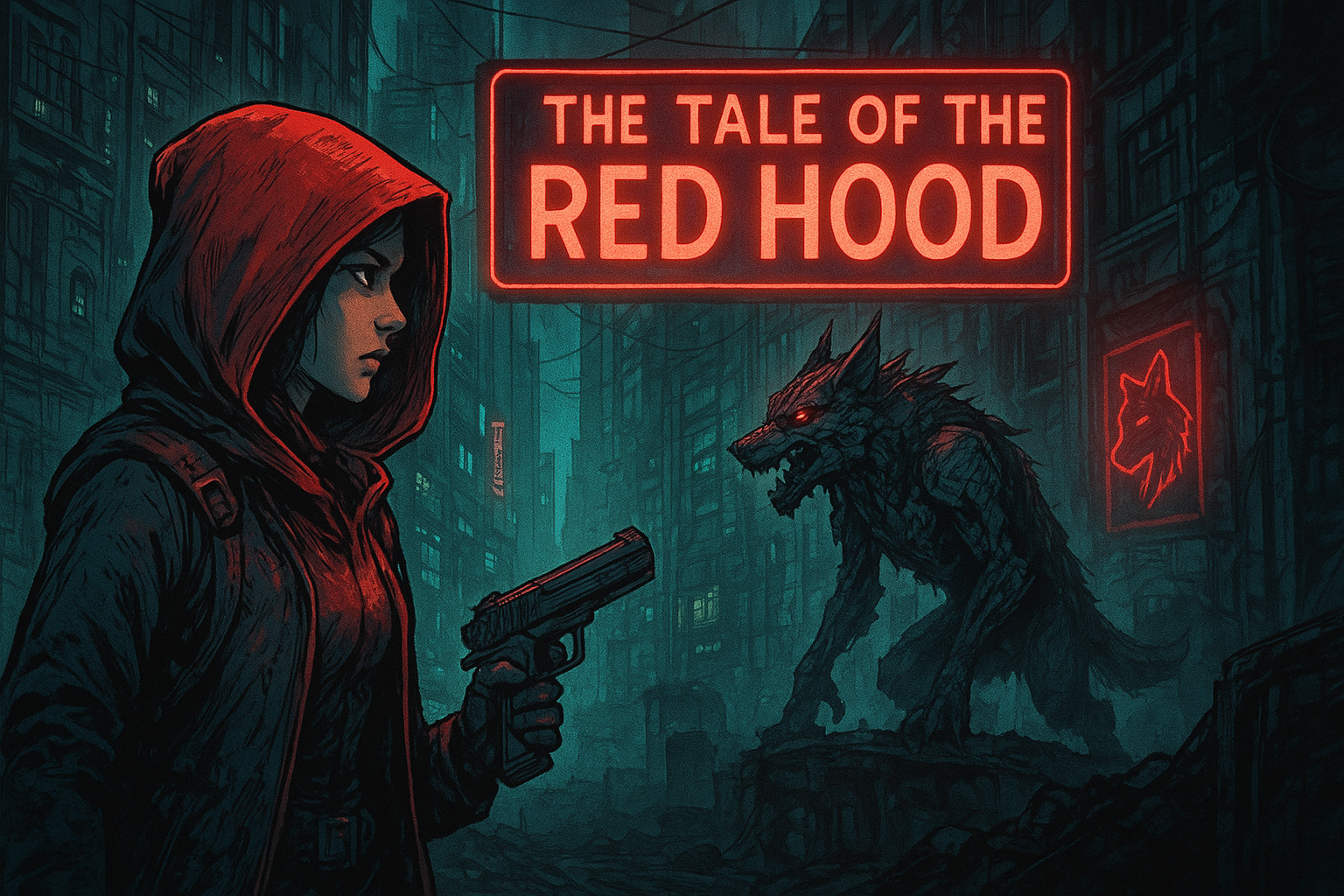
The Tale of the Red Hood
Long ago, before the Fall, when towers of glass still gleamed and the streets of the cities thrummed with endless lights, there lived a girl known to all as the Red Hood. Her true name is forgotten, for stories such as these care little for what one was called in life; it is the name the people gave her that endures.
The Red Hood was not trained in the science of the Doctors or the prayers of the Church. She was, instead, a child of the broken streets. Her mother stitched together coats from the ruins of shops, and from scraps of cloth she had woven a hood of brilliant crimson—a color that glowed even in the dim light of the neon haze. When the girl walked the fractured avenues, scavengers and beggars knew her by that hood, bright as blood and sharp as firelight.
Now, it was the way of things in those days that the city was divided by the shadows of once powerful machines. Deep in the subway tunnels lurked the Others—mutants shaped by science gone wrong, their skin crackling with sparks and their jaws plated with chrome. They prowled the forgotten rails, hunting for flesh, and all children were warned: never wander alone beneath the city’s bones.
But the Red Hood was bold. Her grandmother, who lived across the broken bridges in a tower where the wind whistled through shattered windows, had fallen sick. The girl’s mother placed a ration box into her hands—cans of preserved beans, a flask of filtered water, and a vial of pills scavenged from the ruins of Albany Medical Center. “Take these to your grandmother,” she said. “But mind you walk the surface streets, and do not stray into the tunnels.”
The Red Hood agreed. Yet boldness is often tempted.
She set out, her crimson hood fluttering like a beacon as she passed graffiti-smeared walls and burned-out husks of cars. The neon signs that still flickered cast strange halos on her face, like spirits whispering warnings. Still, her steps were quick, and her heart full of purpose.
But as she crossed the edge of Union Square, where the ground yawned open to reveal the darkened subway below, a voice rose from the shadows.
“Where are you walking, little flame?” it hissed and clicked with mechanical menance.
It was am Other, its eyes glowing like hot coals, its body half-hidden in the gloom. Its jaw was plated with scavenged metal, and sparks hissed where its teeth met. The girl’s heart leapt, but she remembered the tales her mother told—that the Others were more clever than hunger alone.
“To my grandmother’s tower,” said the Red Hood. “She is sick, and I carry food and medicine.”
The Other grinned and sparks spat from its teeth. “So dutiful! But the tunnels are faster. Step down here, and I will guide you. We will beat the wind and rust together, and your grandmother will see you all the sooner.”
But the Red Hood remembered her mother’s warning, and though the Other’s voice was soft as oil, she shook her head. “The streets are long, but they are safe. I’ll not step into your shadows.”
“Then perhaps,” hummed the Other, “I shall go myself, to greet your grandmother while you trudge along above.”
Before the girl could answer, the Other melted back into the tunnel, vanishing like smoke.
The Red Hood hurried, her boots striking broken pavement, her hood a flame against the dusk. But though she was swift, the Other was swifter still, racing along the rails and climbing the rusted shafts of forgotten elevators. By the time the girl reached her grandmother’s tower, the Other had already slipped inside.
Now, the grandmother was fierce. She had lived since the first years after the Fall, and her bones were harder than iron. She saw the Other and cried, “Begone, shadow-beast! This place is not yours!” She fought valiantly, but the Other had teeth of steel and a hunger stoked by centuries, and it fell upon her.
When at last the Red Hood climbed the crumbling stair, the door hung open. She entered, and in the dim light she saw her grandmother’s shadow seated upon the bed. Yet the air stank of ozone, and sparks hissed in the dark.
“Grandmother?" she called, her voice trembling.
"Come child," the Other answered.
“Your voice is rough, like wires grinding,” she said.
“So it is, little flame,” hummed the Other, hidden in the bedclothes.
“And your eyes—they burn like furnaces.”
“So they do,” the Other hissed.
“And your teeth,” she whispered, “they gleam like knives.”
“Better to cut you with,” roared the Other, leaping from the bed.
But the Red Hood was not so foolish as the children of older tales. For in her hand she carried not only food and medicine, but a small pistol of plasma, salvaged from the ruins and gifted by her grandmother who had taught her to always be prepared. And as the Other sprang, she drew the weapon and fired.
The blast seared through the creature’s chest, and sparks scattered across the room like stars. The Other howled, its body convulsing, before it fell to ash and silence.






A nice take on the metamorphosis of an age-old story.
A lot of unofficial Challenges
Thank you!