
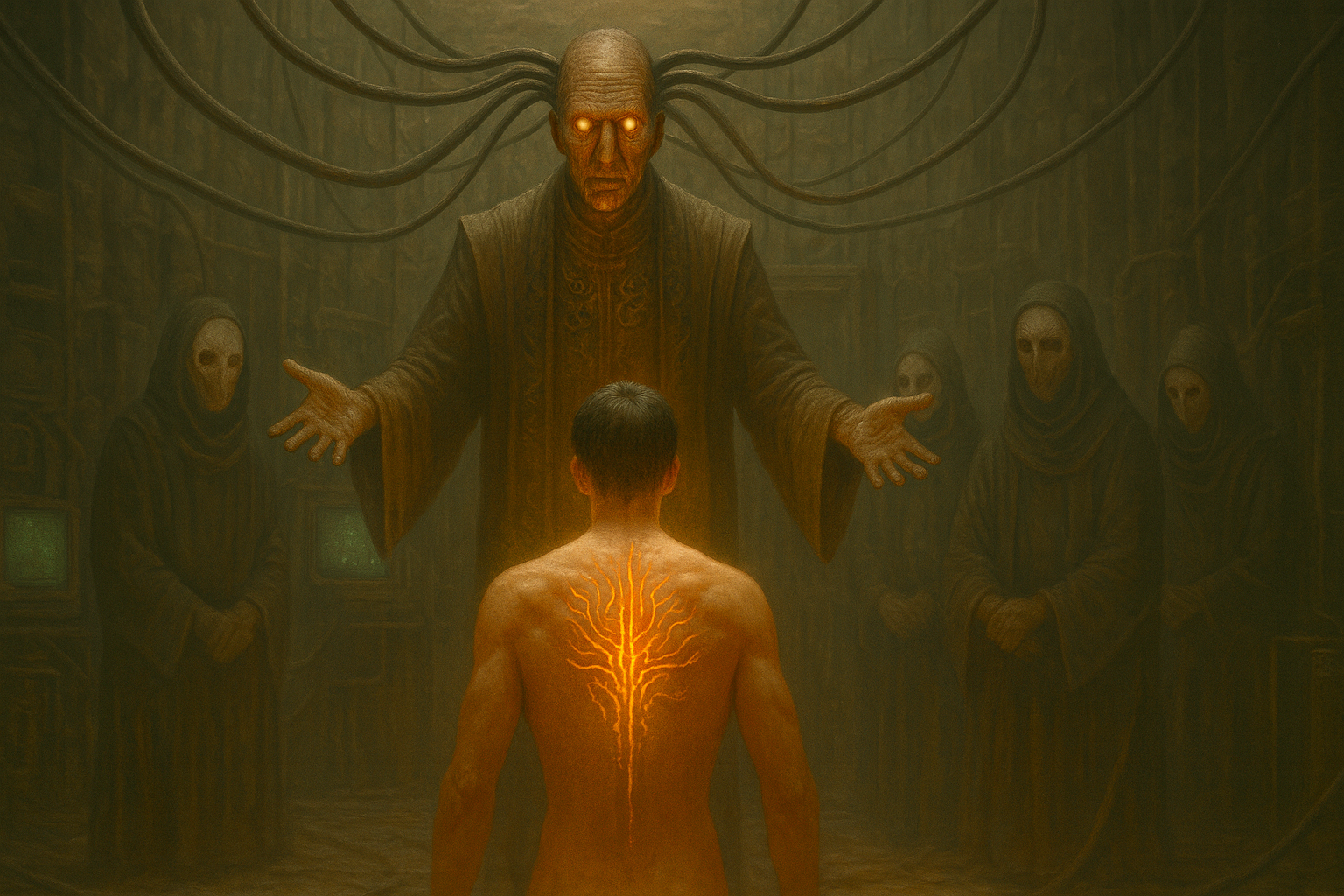
The Ritual of the Tuning
I have written autopsy reports on bodies half-dissolved by Thresher Mist. Cataloged medical texts, diagrams so brutal they were locked away. Interviewed Awakened, their bodies twisted by mutation, enough to unsettle even the senior Doctors. But none of that prepared me for what the Children of the Signal call The Tuning.
The name itself is gentle, almost melodic. A tuning. As if flesh could be coaxed into harmony. I had pictured needles, careful adjustments, the quiet work of Engineers. I was wrong. What I saw was not ritual, but rebirth by violence. Fanaticism made flesh. Conviction so absolute it pressed the air from my lungs.
The Children allowed me to witness the rite. Academic exchange, they called it. They welcomed the outside world, "to understand, if not to hear." We descended into a chamber beneath the ruins of a comms relay, north of the old Albany perimeter. One of their Listening Halls. Each step down cracked concrete felt like sinking into the grave of a forgotten world.
Dimness filled the hall. Dead monitors spilled alternating patterns of green and white. No programs, only static, pulsing lines of interference. The glow stuttered, flickering like the heartbeat of something sick, struggling to stay alive. The air crackled faintly, like a radio searching for a station that never comes.
Seven Children waited. Layered cassocks, cloth stitched with wires that trembled. Faces hidden behind Chorus masks, milky porcelain carved with spirals and grooves, like fossil shells. Only their eyes showed, dark slits watching me. Silent. Unblinking.
The initiate entered last.
Young. No more than twenty, maybe less. Their eyes turned inward, pupils wide, face emptied not by numbness but by surrender. Bare feet on concrete, unflinching. They stepped between old machine parts arranged in patterns. I recognized antenna fragments, melted processor housings, a rusted piece of satellite dish. To the Children, relics. Bones of the Sky, one had whispered when I arrived.
The air tasted metallic. The initiate knelt in the center. The humming in the walls grew louder. Later, I would learn the Children had activated old radio equipment deep below. In that moment, it felt as if the room itself had begun to breathe.
When the Children began the ritual, they did so without a single word. The entire rite was communicated through Static Sign: sweeping motions, tight hand flicks, and rotational gestures that carried layers of meaning I could not interpret.
I did not need translation.
The first of them approached the initiate. In their hands they carried a coil of thin, silver wire, looped like a rosary. Beside them walked a second figure carrying a pair of bone-handled suture needles, curved like cruel smiles. The initiate lifted their chin without prompting.
I had read about this part. I had been told, quietly but firmly, that speaking was sacrilege. Only in silence could the Signal speak. I knew, in theory, that some gave up their voices willingly. But knowledge is thin compared to witnessing.
The first needle pierced the soft flesh just below the initiate’s lower lip.
They did not flinch.
The second needle pierced the upper lip. The Children stitched slowly, deliberate and precise. Wire drawn through flesh in tight loops. Metal gleamed in the flickering light. Each pass drew blood, pooling, then running in thin lines down the chin.
I realized, with a growing sense of dread, that each stitch corresponded to a gesture made by the attendant Children. Each movement (twist, loop, knot) was a sign, a call, a doctrine expressed in gore rather than scripture.
The initiate breathed through their nose, shaking only once when the wire pulled taut at the corner of their mouth. But they did not cry out. They could not. The stitching lasted perhaps five minutes, though it felt much longer. When it was done, their lips were closed, sealed with metallic thread like the binding of a sacred tome.
One of the Children placed a hand on the initiate’s forehead and held it there. Not a comforting gesture. A checking one. As though confirming the silence was complete.
My stomach twisted. I swallowed hard.
Then the second phase began.
A heavy surgical crate was dragged forward; pre-Fall design, clearly salvaged and repurposed. The Children opened it with reverence, and inside lay a device I struggled to identify at first. It resembled a horseshoe of gleaming alloy, with filament-thin wires spiraling from its edges. A receiver, though unlike any I had ever seen among our own Engineers. This one pulsed faintly, emitting a subliminal hum that made my teeth ache.
Two Children flanked the initiate, steadying the head. Another approached with a manual drill, hand-cranked, the bit dark with old stains. They placed it against the skull, just above the ear.
I opened my mouth to object, some attempt at protest, but the nearest Child placed two fingers against the front of their mask in a gesture universal enough to require no translation.
Silence.
I obeyed.
The drill bit into bone. A sickening crunch. The initiate’s body tensed, muscles locked, but they did not resist. Blood ran along the jaw. A second hole on the other side. The Children lifted the receiver, pressed its curved ends to the wounds, guiding the prongs into bone.
The initiate trembled. The device fused slowly to bone, adhering with a wet, sticky sound that made my throat contract. I saw pale membranes (nanofibers? biological threads?) extend from the receiver into the wounds, knitting themselves into the skull. The Children murmured something I could not hear; perhaps it was only their breath hissing behind porcelain masks.
A vial of black, viscous fluid. Dripped onto the receiver. It hissed, smoked, and the device came alive. A faint oscillating tone vibrated through the air. The monitors flared, static lines rearranging into patterns that felt deliberate, almost sentient.
The initiate gasped through their sealed mouth, chest heaving. Their eyes rolled back. For a moment, I feared they would seize. Two Children held them upright.
Then the tone stabilized.
Their eyes refocused.
The Children stepped back.
Blood streaked the initiate’s neck. The receiver gleamed, still damp with whatever conductive substance had been used to activate it. The wounds would heal. Or perhaps they wouldn’t. Perhaps the Children considered perpetual bleeding part of the tuning. I could no longer guess.
But the ritual was still not complete.
The final stage was the most disturbing.
A wide table was brought forward, covered in metal rods, etched plates, and small vials of pigments that shifted strangely under the monitor light. The initiate was laid on their stomach, with their upper garments removed to reveal a canvas of pale skin, marked only by faint scars and old bruises.
The Children selected long, thin blades. Some metal, some glass, some of a material I could not readily identify. At first, I assumed they would tattoo the initiate. Some sign-based cultures do, marking major milestones with permanent symbols. But this was far more invasive.
The blades cut into the skin in long, sweeping lines; curves that resembled sickle blades cut into skin. Long, sweeping lines; curves like sine waves, loops echoing frequencies, jagged strokes like interference. With each cut, pigment was pressed into the wound. The substance seeped in, glowing before settling into a shimmer beneath the skin or amplifying transmissions. A living antenna etched into the body.
Shallow cuts, but countless. The skin became a trembling constellation of glowing lines, each pulsing in rhythm with the receiver in the skull. The more they carved, the more the patterns aligned. Symbols blooming like circuitry across shoulders, down the spine, along the ribs.
Some lines branched outward, channels like rivers. Others crossed, forming nodes of light. At each node, a Child pressed a metallic stud into the wound. The implants clicked softly as they settled.
The initiate quivered continuously now. Their breath came in ragged bursts through their nose. Yet still, they remained silent. This fact horrified me more than the wounds themselves. In any reasonable sentient being, pain demands noise. It demands expression, release. The Children had stolen even that.
When they finally finished the mapping, the initiate’s back looked less like human flesh and more like a topographical map of some alien signal. Symbols shimmered faintly, shifting as though responding to wavelengths beyond my comprehension.
The Children stepped away, forming a circle around the initiate. They raised their hands in static-defined gestures, forming shapes and motions that I could not understand. The receiver pulsed. The lines across the initiate’s skin flickered. For a moment, the entire chamber vibrated with an invisible resonance that I felt in the bones of my jaw.
And then, silence.
Perfect, absolute, crushing silence.
The monitors went blank. The flickering light froze into stillness. The receiver dimmed. The initiate exhaled long and slow.
A Child helped them rise. Movements stiff, deliberate. Eyes glowed faintly with static, as if something new and terrible and wondrous had opened behind them. They touched their sealed lips. Traced a sign in the air with trembling fingers.
I did not need training in Static Sign to know what it meant.
I hear.
The Children responded in unison with a sweeping gesture: wide, slow, reverent.
My escort signaled it was time to leave. The initiate did not look at me. Their eyes fixed on a horizon I could not see, listening to frequencies beyond my reach.
I climbed the stairs in a daze. Night air above, cool and still. Even after miles, I could not shake the sense that silence itself had become a presence, trailing close behind.
I will submit this account to the Archives with the recommendation that the Children of the Signal’s rituals be approached with extreme caution. Their devotion is absolute, their silence a form of power, and their transformations, if I am honest with myself, something far beyond the reach of simple belief.
What I witnessed was not surgery.
It was consecration.
And I fear that those so consecrated no longer consider themselves merely human.
A field account recorded by Scribe D. Avern, transcribed two days after the event.


Comments