
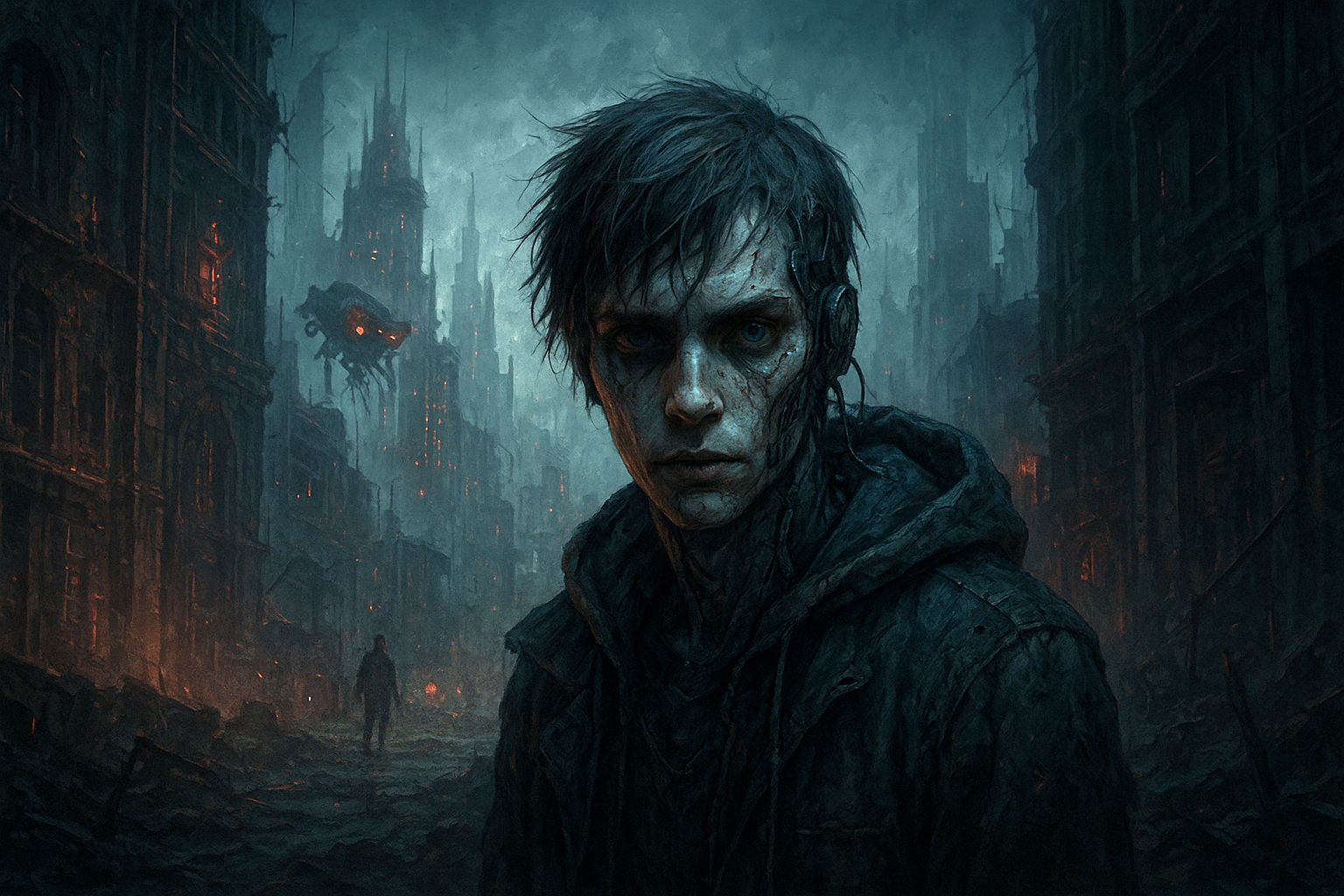
A Child of the Covenant
Levi Aislin Power was not born into freedom. He was claimed.
In Dark Syde, birth was not a beginning but a transaction. When a child exhibited the smallest sign of resonance—an unexpected flicker of energy in the air, a shift in shadows, the hum of arcane vibration—the Covenant of the Mecha was alerted. Levi’s resonance came early, when he was still swaddled in rags. His mother might have gasped in wonder, his father might have smiled with pride. If so, Levi never remembered it. Those memories were cut away, like everything else that tied him to a life outside the Covenant.
The apostles arrived within hours, faces hidden behind chrome masks etched with runes. They named him beatified, the word wrapped in reverence, but their hands were cold and surgical as they carried him away. His parents, if they resisted, were not mentioned again.
Levi’s childhood was one of steel and shadow. He grew up beneath the spires of the Covenant’s campus, a fortress of black stone and gleaming alloy. Holographic runes shifted across walls like restless spirits, casting their glow over dormitories that felt more like prison cells. Instructors spoke of destiny while tightening straps across his limbs. Researchers promised transcendence while plunging knives and wires into his flesh.
Scars blossomed across his body. He was told they were badges of progress. He learned to cover them in silence, hating the way they marked him as property. The augmentations that came later—neural filaments, reinforced tendons, cybernetic regulators—were presented as gifts. He recognized them as shackles. Every piece they added to him was another piece they owned.
Still, he endured. He learned the rules of their system, and he obeyed them. It was the only way to survive.
But even obedience had limits.
At nineteen, Levi was assigned to a field unit. The Covenant believed their work was reaching maturity. He was not yet perfect, but he was powerful, and they wanted proof.
The mission was routine: sweep the fringes of the wastes, capture Others, harvest viable tissue, destroy what resisted. For the Covenant, it was little more than an exercise in dominance. For Levi, it was the first time in years he’d stepped beyond the spires, breathed air not recycled through filters. The sky stretched overhead, endless and cold.
Freedom, even tasted at the edge of a leash, was intoxicating.
Their squad moved like shadows through broken forests and shattered towns. Drones circled above, their optics glowing crimson. Instructors walked with them, monitors embedded in their spines, issuing commands directly into their minds. Levi felt the commands like chains pulling at his thoughts: Advance. Strike. Capture.
That night, by a crumbled overpass, the Covenant’s unit was ambushed. A ragged band of fugitives struck, desperate enough to challenge even the Covenant’s blades. They came with rusted rifles, scavenged plasma pistols, and the raw hunger of those with nothing left to lose. Against the Covenant, it should have been suicide.
But to Levi, it was opportunity.
He had been waiting for months, maybe years, for something—anything—that would crack the Covenant’s perfection. The raid was chaos, but chaos was a weapon. He acted before he had time to doubt.
While the others clashed, Levi turned on his handlers. Their voices shouted in his mind, demanding compliance. He answered with blood.
The first instructor fell with a knife driven through his throat. Levi used the override codes he’d overheard in endless nights of half-sleep to freeze the augmentations of another, paralyzing him mid-command. The third instructor tried to flee, calling for reinforcements, but Levi’s cybernetic reflexes caught him before the signal could send.
For the first time in his life, Levi chose his own target. For the first time, his hands were not following orders but delivering his will.
When the dust cleared, the fugitives were gone, dead or scattered. The Covenant’s trackers searched the wreckage and found their unit decimated, their prized experiment missing.
Levi had fled into the wastes. Escape was not victory. It was only the beginning of survival.
The Covenant of the Mecha did not lose what they had built without pursuit. Their drones swept the plains. Their hunters rode with arcane-powered mounts. Their whispers carried in the wind: Find him. Retrieve him. Or, failing that, reclaim the implants.
Levi learned to run not just with his legs but with his mind. Every augmentation they had given him, he twisted to his own ends. He used his enhanced reflexes not to strike at enemies but to dodge their scanning lights. He used his neural implants not to process lessons but to calculate terrain and predict patrol patterns. They had built him to be a weapon. He chose instead to be a shadow.
Days bled into nights. Hunger gnawed at him. He drank from poisoned streams, vomited, and drank again. He smeared mud into the seams of his implants to mask their heat signatures. He slept in shallow graves, covering himself with ash and earth to escape the eyes of drones. Once, cornered against a collapsed structure, he tore open a corpse and hid within its hollow chest until the searchers passed.
He left a trail of scars across the wasteland—cuts, burns, frostbite. But scars were nothing new.
What kept him alive was not strength, nor augmentation, but hatred. Every step he took was fueled by memory: the straps across his limbs, the knives carving flesh, the cold voices telling him he was blessed. They had broken him so many times. He would not break again.
At night, when exhaustion pressed him near to collapse, he whispered to himself. “You are not their tool. You are not their tool.” It became a mantra, a weapon sharper than any blade.
Weeks later, Levi stumbled across the boundary where Dark Syde’s shadow ended and the lands of Camp Hope began.
He almost didn’t believe it at first. The walls rose like a mirage, built from scavenged steel and stone, patched and repatched over decades. Watchtowers bristled with weapons. Smoke curled from chimneys. And above it all flew banners proclaiming what he thought was the greatest lie of all: Hope.
He collapsed at the gates, half-dead, his body refusing another step. The guards found him sprawled in the dust, his mismatched eyes—one grey, one blue—staring up through tangled hair. They bound his hands, dragged him inside, and demanded answers.
He gave them only fragments: his name, a birthplace he no longer claimed, a refusal to kneel to any church.
The Doctors examined him with awe and disgust, muttering about implants they could not safely remove. The Church of Hope denounced him as tainted, an enemy of purity. The Town Watch eyed him like a wolf, waiting for the moment he bared his teeth.
Levi only smiled.
Camp Hope did not trust him. It did not welcome him. But it tolerated him, and tolerance was enough. He had survived the Covenant. He had outrun their hunters. Here, within these walls, he could begin again.
And as he looked across the streets filled with desperate faces, the sermons of the Church, the endless labor of the Farmers, the order of the Watch, Levi understood something none of them seemed to see.
Power was not in faith. Power was not in toil. Power was in hunger—the hunger for more, for risk, for the chance that fortune might finally favor you.
He would give them that chance.
Not today, not tomorrow. But soon.
As he lay in a rented room that night, his body aching and his mind racing, he whispered the words again, but this time they had changed.
“You are not their tool. You are not their tool.”
He smiled into the darkness.
“You are the dealer.”


Comments
Author's Notes