
Vilebulbs
It's been about a week and the bulbs are still holding onto their faces. Still making those... snapping noises. The little freaks keep turning and wobbling around... almost like they're trying to keep watch of something... Wait, oh God they're- they're moving! Oh God, send help! Send help!
Parasitism is a common occurrence among mortal creatures as it provides everything a living thing needs with a minimal amount of required effort. Not only does the suffering caused by these species sink down to the world of demon in due time, but a world as ruthless as that of the demonic is bound to adopt such a strategy for less ecological reasons. The most common theme among the demonic hordes is the corruption and alteration of systems and behaviors common among mortals, and the putrid vilebulb is the most infamous corruption of the already cruel system of parasitism.
The vilebulb is an interesting species in the way that it possesses a lust for power that many other demonic species see little to no value in. However, this quality is far less obvious when observed in isolation. These hideous creatures tend to live together in small groups floating about like abandoned balloons. In this state, the vilebulb is passive and spends a majority of its time sitting near-deathly still among its fellow bulbs. The only sign of life present in this state is the random shifting in the air as the vilebulb moves its thick proboscis.
Another true oddity of these creatures is the method in which they are produced. Though many originally believed the vilebulb required a host to reproduce, no such occurrences were recorded. Instead, a new bulb forms as ambient suffering forms into a small seed, burying itself beneath any kind of surface. Within seconds a thick fleshy vine with the appearance somewhere between an artery and a roundworm will sprout from the seeded area and form into a vilebud. Within a few minutes, this bulb will develop the proboscis the adult form is known for, which it will use to chew itself off the stem.
Though on rare occasion, the vilebulb may sometimes reach its adult form prior to the development of its ability to float. Because of this, there has been a handful of recorded cases where a vilebulb will free itself from its stem and simply splat onto the ground, forcing the beast to await its revival.
Taking Over Minds
As a species, the vilebulb has become specialized in its parasitism and typically they choose a specific species of demon to inhabit. The preferred host of the bulb, the lowly and primitive snailknight, possesses among the most crude nervous systems of the demon hordes. Such simple creatures do not recognize the threat posed by such puny demons and often actively seek them out as a food source. This is a terrible idea on the part of the snailknight, as the bulb allows itself to be eaten by the beast.
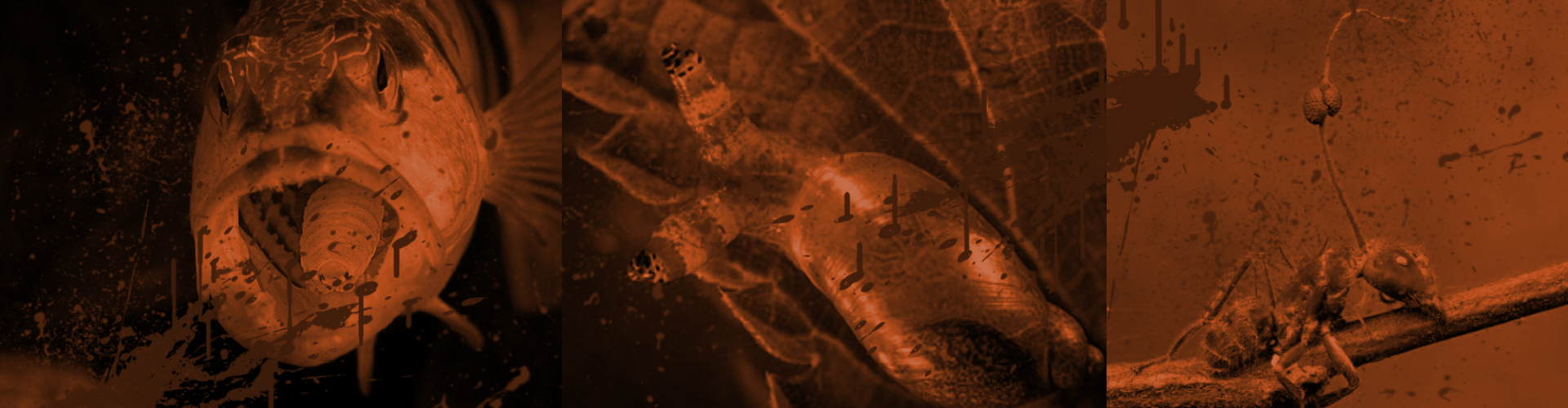
Once within the larger demon's throat and past its thick layers of chitinous armor, the bulb puffs itself up to clog its throat. Lacking even a basic level of awareness, this sudden blockage doesn't concern the snailknight as some even attempt to eat more food as its new parasite works its proboscis into the back of its throat up into its head. The squishy insides of this species allows for easy infiltration by a system of false nerves packed tight within the claws at the tip of the vilebulb's proboscis. Within minutes, the bulb will have worked its way into the head of its victim and completely taken over its nervous system.
It has been long disproven that the vilebulb uses this practice to produce more bulbs. There is no reason to believe such a theory as no other demon is known to reproduce and vilebuds have been seen growing into the adult demon. The current theory, albeit a crude theory, is that these parasitic demons infect creatures such as the snailknight is a means to strength. Once a bulb has secured total control over its host, it can utilize every aspect of the body with a frightening level of expertise. It is unknown how a species with such simple anatomy can command the flesh of creatures far more technically advanced than it. The vilebulb has exhibited fine-tuned movements, experience with various weapons, and seek out ways to conceal itself from others. Another reason the snailknight is a perfect host for this species is its cavernous mouth and large almost beak-like helmet help to conceal it when its mouth is closed.
They have been known to infect other demons as well, particularly low-level species such as the grunt or ripper. Unfortunately, many instances have been recorded in which mortal creatures have been infected by the vilebulb as well. The process of infecting a mortal creature is a bit more complicated than with its preferred target; the bulb catches its victim by surprise and latches onto their head or face with its clawed proboscis. Once attached, the bulb will form an airtight seal against the flesh with its mouth as its claws drill through the flesh to find a central nervous system.
In such a scenario, it often takes days for the vile creature to take over its host. During this time, the bulb will writhe about on occasion as its nerves worm their way through the host's body. When the process is complete, the possessed creature springs back to life, eager to serve the vilebulb.

Sketch of a vilebulb produced by Patrick Graham.

Comments