

Tanks
Tanks are volatile things, both physically and mentally. If you see one on the battlefield, know it'll be an active threat to both you and the enemy. I've seen one squash twenty other demons on its way to my squad just to go sprinting away when Jones fired a warning shot with his flamethrower. It must've punted another thirty demons trying to get away.
A penchant for violence exists within every species of lesser demon, but especially within the swollen heart of the tank. Among the most visceral of demons, the tank is a massive fatty tumor atop a pair of spindly porcine legs. Thick patches of itchy fur, vestigial bones, networks of veins that go nowhere and a number of bulging eyes on its body. These features tend to shift about the tank's central body as cancerous masses compete for space. As a result, the core of the creature's body tends to pulse and squeeze like a heart, forcing foul-smelling gasses from orifices and pustules formed from gas bubbles beneath the rotting skin.
The legs of these putrid demons, akin to those of a wild boar, possess an abnormal number of joints going down to its hooved feet. This anatomical anomaly produces a wobbly stance for these demons which is only exasperated by their large sizes. When they walk, as well as when they shift their bulbous weight, each of their leg joints produces a revolting symphony of cracks of pops as they attempt to shift into place. Unfortunately there is no proper place for said joints to shift into as everything about the tank was made wrong.
This is nothing new among demons, however.
Wild and Uncontrolled
It is due in large part to the battle strategies posed by demons such as the tank that the demonic hordes as a whole have earned a reputation for mindless chaos. Of course, encounters with more intelligent demons will reveal the strategy in bringing such wild cards onto a battlefield, but the tank in particular requires a lot of explaining to make any kind of sense. With not but a network of overworked nerves spread across its bulbous body, the tank contains not even a level of awareness to follow basic orders. This makes it an anomaly even among other weak lesser demons such as the grunt or ungroth.
Regardless of or because of this trait, tanks are always placed with the first few waves of a demonic army. They act as a boost of power to these initial waves of "fodder" demons as they flood into the battlefield and the invasion begins. This makes what would have been a pathetic introduction a unique threat of its own and allows these early arrivals to cause far more significant damage.
Though other demons may have an advantage from rampaging tanks, they also provide a significant threat. Tanks may not possess enough intellect to be ordered around by their superiors, but they are just sentient enough to possess a lust for violence. These sadistic beasts see any creature smaller than it as a new plaything. The result of this is hundreds of demon casualties by the hooves of a single demon. Tanks are also known to crush smaller demons as they walk among the horde, making them a passive threat as well as an active one.
A Walking Time Bomb
The flesh of the tank is trapped in a deadlock between putrefaction and metastasis which fills any cavities in the demon's body with a putrid and volatile gas. This gas tries to escape through tunnels and orifices, but the shifting of the demon's flesh closes any of these paths off. The gas builds up and forms into bubbles which crawls about its interior like worms burrowing in dirt.
When left alone, these bubbles play a major role in the anatomy of this species. It is believed they also exaggerate the movement of flesh as they attempt to breach the surface, forming into throbbing cysts on its body. They also flow into blood vessels and organs, though this causes little more than discomfort for the demon itself.
However, the biggest disadvantage it places on the tank is its high flammability. If the exterior of the demon's body is exposed to an open flame, the gaseous cysts across its body burst and set ablaze. Each orifice on its body opens at once as it is filled by a primal terror which only connects more of the gas with the flame. This causes a chain reaction as fire fills its body and gas expands until the beast explodes. It takes less than a minute for these events to take place, making the demon look like a gory naval mine on legs. Once a tank has been slain this way, its remains burn into ashes as its body returns to the demon world.
This has developed a deep fear of fire within the species as every tank has had the same reaction to an exposed flame. When presented a fire, a tank will enter a state of panic as it enters a state of fight-or-flight and does everything within its power to escape its greatest weakness. When in a horde, a spooked tank will not stop to consider the other demons around them before it turns tail. This only provides another challenge for the cannon fodder and makes getting trampled by one of these mindless monsters a far more likely occurrence.
Something Crawling Inside
With its main body being a giant tumor, the body of the tank should grow to absurd proportions to the point where its legs can no longer hold it up. In reality this does not occur, and it was first believed that this was merely in its nature as a demon. However, encounters with the demons had provided a different reason for their reasonable size limits; parasites.
For demons, the rotting cancerous flesh of a tank is a bottomless buffet and a species of parasite has claimed it as their own. Crawling within the rancid flesh clump that is the tank is a species of serpentine carnivorous worms simply known as gorewyrms. These unusual creatures have perfected a symbiotic relationship with the larger demon, feasting on and tunneling through its body as it wanders about to nowhere in particular. They tend to live in small groups within the demon, though they do not seem to live in any kind of social structure. Gorewyrms are yet another reason why their hosts pulsate with such intensity as they tunnel through the thick fatty flesh within and shove more solid structures around.
As long as the tank is still standing, the worms get all the food and shelter they could ever need.
The demon world is a ruthless place, however, so the innards of a lowly creature such as the tank can only be so safe. When the tank is attacked, the gorewyrms will sometimes assist their host by emerging via an orifice or simply by chewing their way out. Once outside, the worms will use their strong biting jaws and serpentine bodies to lash out at attackers who get too close the hulking beast. Their fight isn't over when the demon itself dies, either, as they burst out of its corpse like horror-movie-style aliens and rush at the attackers. Having lost their host, they are willing to fight to the death against any opponent.
Many battles against these belligerent beasts have revealed the gorewyrms survive the initial death of the tank even when it explodes. Once they are outside of the demon, however, they do not last long as their bodies dry up and, within hours, crumble to dust. It is unknown why they are so resilient while inhabiting the tank and why they become so fragile when the host demon is lost.
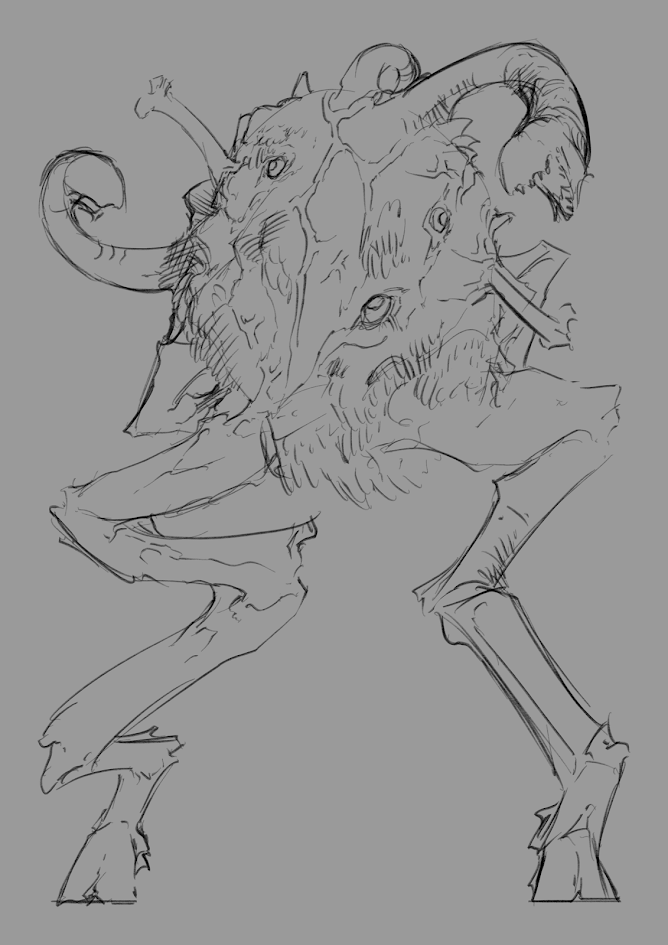
Sketch of a tank produced by Patrick Graham.

Comments