

Bickerbirds
What the hell do you mean those things ain't dangerous? That little fucker tried to bite my hand off while it was nabbing my watch! No, I don't give a shit about what the other ones look like, the big demon hasn't tried to run off with a goddamn five-thousand dollar watch! What? Uh, no officer, I did not see any other items when I killed it. Of course, officer, you have a good one.
All in all, demons are nasty and mean-spirited creatures down to the core of their beings. Most of the demonic hordes tend to go far beyond such childish forms of cruelty in a variety of ways, but the aforementioned description is perfect for the beasts. The demons within this rank tend to be far less cooperative than the militaristic demons of the third rank, and most prefer to live apart from demonic armies.
However, a preference for isolation from more sophisticated demons does not equate to a limited amount of interaction with mortals. Although demons within the rank of beasts receive all of the energy they will ever need from the ambient suffering generated by mortal worlds, they still work to generate more.
A prime example of this is the pitiful bickerbird, a bizarre avian beast with the mantle of a squid sticking out its back end. This species boasts two heads akin to those of a crane, though their beaks are lined with serrated edges along their beaks which real cranes do not possess. The unusual anatomy of this species produces a strange bow-legged posture which has a significant impact on the bird's ability to fly.
A far greater impediment the bickerbird experiences is the poor relations between their two heads. Neither head on the bickerbird possesses an understanding that the other head is part of the same organism and immediately sees it as competition. Brief but passionate squabbles between the heads of bickerbirds are common due to this trait, earning the demon its namesake. This cause of these fights can be as simple as one head finding food and the other being jealous or one head growing annoyed by a sound the other made.
Just as the bickerbird holds deep animosity between its heads, these little demons hold a hatred for all mortal life. When not watching their nests, this species is quick to use its beaks to carve into creatures that come too close. On a few occasions, the heads of an attacking bickerbird have forgotten about the creature they were pecking and started attacking one another. Such pitiful behaviors have produced the misconception that the bickerbird is among the first demons introduced to a soon-to-be-invaded world. Bickerbirds, like other bestial demons, only appear within a mortal world as a demonic incursion is about to reach its climax.
If you notice a bickerbird hiding somewhere in the area, it is far too late to stop the invasion.
Bickering Thieves
An unusual trait exhibited by the bickerbird is its penchant for stealing shiny objects. These demons spend a great deal of time around mortals, often hiding among large populations, for this reason. Unlike magpies or bowerbirds which prefer to utilize stealth to swipe their treasures, the bickerbird prefers to swoop down and tear any item they want in the way a seagull may dive at beachgoers or picnickers.
The items a bickerbird may be interested include a vast range of sizes and rarities. Some choose to swipe very specific types of items such as jewelry or fine dinnerware, seeking out these items within specific places, while others may be enamored by a pull tab off a beer can or a discarded scrap of aluminum. These preferences can change within an individual bird as its hoard grows.
When a desired object has been spotted, the heads of the bickerbird enter a brief moment of cooperation as one head attempts to grab the item while the other attacks the creature keeping said item away from the bird. Once an item has been stolen, the bickerbird will land nearby and the head with the item in its mouth will tuck it into the hood of the cephalopod-esque backside while the head without an item wobbles its head and squeals at its victim. If the item is difficult to stash away for any reason, the demon will hop about from side-to-side in an attempt to evade a creature regardless of whether it attempts to fight back.
The offending head pecks at the defending head once the item has been hidden and the demon will fly away to either search for more items or bring its haul back to its nest. Though it depends on the side of the hood as well as the size of the items taken, a bickerbird can typically stash five or six small items within its hood. This does not stop them from trying to fit more in spite of the various problems this may cause such as leaving the demon vulnerable for extended periods of time or causing minor structural damage to its hood.
Though described as a nest, the bickerbird's amassed collection does not function in any way the nests of mortal creatures are used. Closer to a dragon's hoard, bickerbird nests are comprised of a large pile of all the items the bird had stolen during its stay within its current location. While with its nest, the two heads of the snippy little demon keep watch of their treasures and will not hesitate to snap at intruders.
Of course, this provides a plethora of opportunities for the petty heads to fight one another. Outside of their heists, each head of the bickerbird tends to believe the other is trying to rob it, even when the offending head is trying to sort the shared treasures.
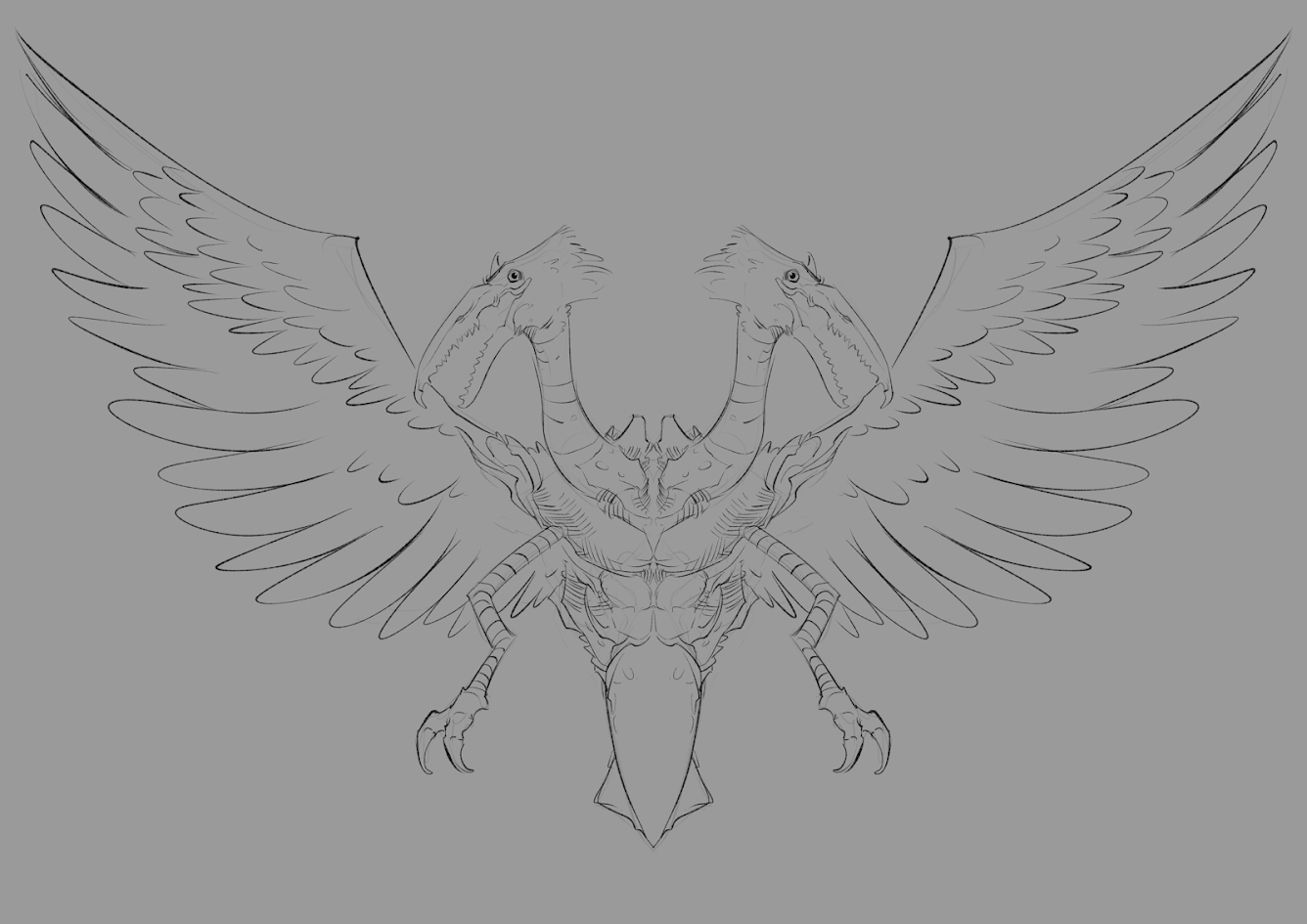
Sketch of a bickerbird produced by Patrick Graham.

Comments