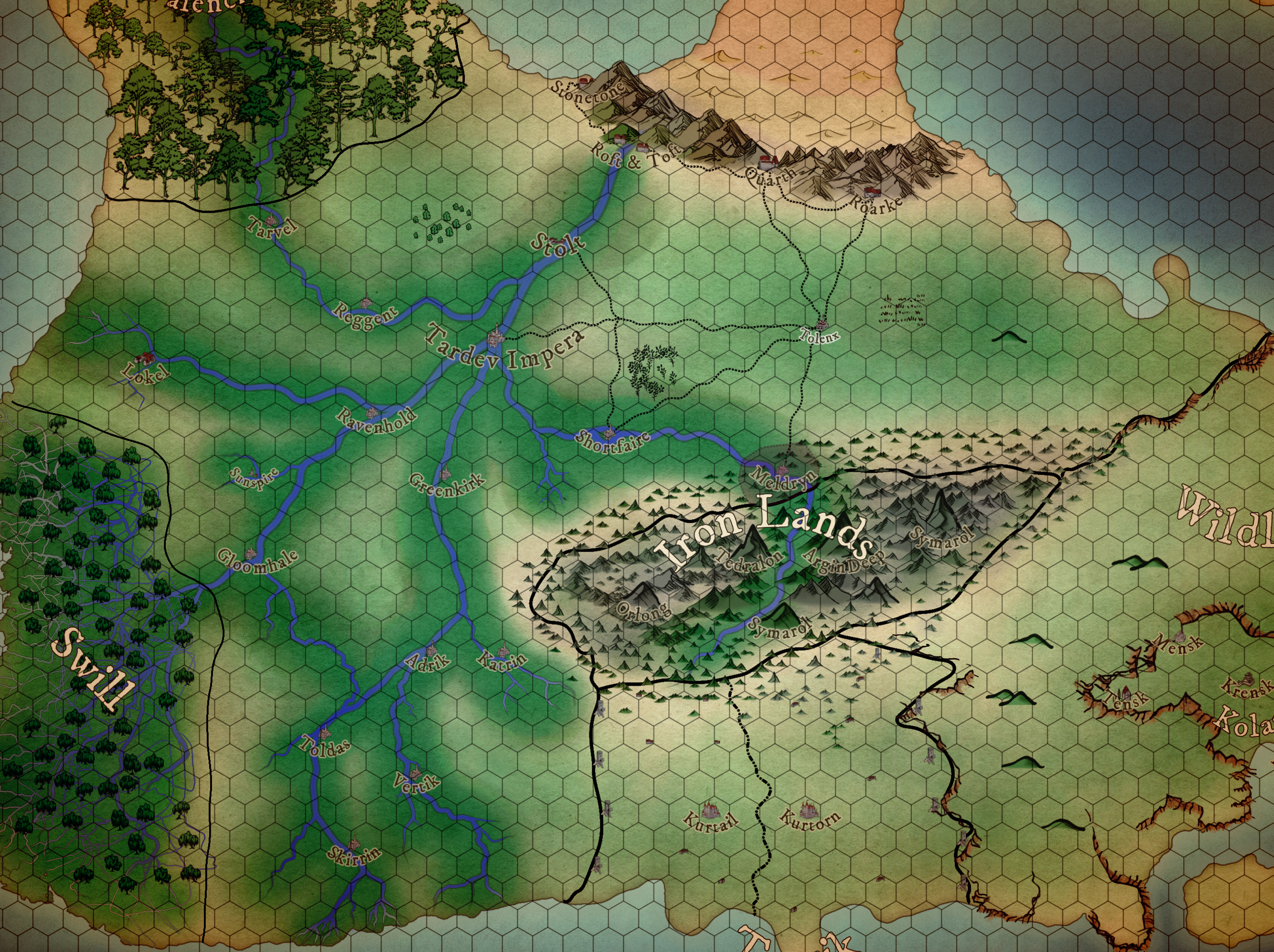
Republic of Tardev
in Nations of TavrusGovernment Type: Centralized Imperial Republic
Primary Population: Human (with integrated Elven, Dwarven, and Halfling minorities)
Overview
The Republic of Tardev is a vast river-bound state whose power is shaped by administration, military structure, trade, and education. Its influence radiates outward from the great Tardev River and its many branches, along which most major cities were founded, fortified, and enriched.
While imperial authority is absolute in law, geography and distance determine how strongly that authority is felt across the realm. Tardev favors continuity over charisma, and institutions over individuals. Records, precedent, and layered bureaucracy form the backbone of governance, allowing the Republic to endure political shifts with minimal disruption.
Tardev is predominantly human, though elven, dwarven, and halfling populations are deeply integrated throughout its cities. Cultural identity is civic rather than ethnic, shaped by loyalty to the Republic and its institutions.
Major Cities of Tardev
Tardev Impera
Imperial Capital
Tardev Impera stands as the rebuilt heart of the Republic, raised after the fall of the Old Capital centuries ago. Unlike its predecessor, the city was designed for governance rather than tradition. Wide avenues, monumental stonework, and carefully ordered districts reflect its administrative purpose.
The city houses the Imperial Arcane Institute, the most prestigious academic institution within Tardev. Scholars, administrators, and arcane officials move constantly through its halls, lending the city an atmosphere of debate, ambition, and quiet rivalry. Power here is exercised through law, precedent, and influence rather than spectacle.
Ravenhold
City of Libraries and Quiet Influence
Ravenhold is defined by knowledge and restraint. Vast libraries, sealed archives, and private collections dominate the city, many tied to long-standing institutions or noble patronage.
The Ravenhold Collegium is located here, lending the city a reputation for innovation, research, and technical mastery. Information moves carefully through Ravenhold, and influence is exerted subtly. The city’s reserved demeanor is deliberate—those who live here value discretion over display.
Gloomhale
The Blue-Lit Metropolis
Gloomhale is a gaslit city in everything but flame. Specially cut blue-bright stones, mounted in iron lampposts, illuminate its streets. Their glow cuts sharply through the city’s dense, ever-present fog, casting long shadows and lending Gloomhale its cold, watchful atmosphere.
Sound carries strangely through its narrow streets, and the mist rarely lifts. The Gloomhale Lyceum lends the city a reputation for rigor and controversy, and Gloomhale is widely associated with investigations, contracts, and the quiet enforcement of law.
Greenkirk
River City of Fields and Stone
Greenkirk sits where fertile land meets steady river trade. Surrounding farmlands supply much of the central Republic, while the city itself favors solid stone construction and defensible layouts.
Reliable rather than prestigious, Greenkirk is valued for stability, logistics, and efficiency. Supplies move cleanly through its warehouses, taxes are collected without flourish, and little goes to waste.
Shortfaire
City of Revelry and Canals
Shortfaire is often called a floating city. Built along branching canals and riverwalks, its districts are connected by bridges, barges, and narrow causeways rather than broad streets.
The city is known for festivals, performances, and frequent celebration. A notably large halfling population shapes its culture toward hospitality, trade, and communal life. While much of Tardev is rigid, Shortfaire’s excesses are tolerated as a necessary release within the Republic.
Meldryn
Gateway to the Iron Lands
Meldryn lies closest to the Iron Lands and maintains strong trade ties with the dwarven kingdoms of the mountains. It boasts the highest dwarven population of any major Tardevan city.
Ore, tools, weapons, and stonework flow constantly through its gates. Fortified and pragmatic, Meldryn values mutual benefit over ideology. Its loyalty to the Republic is reinforced by long-standing agreements and economic necessity.
Stolt
Legion Crucible
Stolt exists primarily as a training city. While recruits train throughout the Republic, Stolt houses specialized academies for officers, tacticians, and elite formations.
Drill yards dominate the cityscape, and its population fluctuates with training cycles. Discipline, hierarchy, and repetition define daily life. Many of Tardev’s most respected commanders began their careers here.
Tolenx
Eastern Frontier City
Tolenx stands as the largest city of the eastern plains and is largely disconnected from the main river network. Supplies arrive primarily by caravan, fostering a culture of independence and resilience.
Though loyal to the Republic, Tolenx experiences imperial authority at a distance. Law is enforced locally, and interpretation often depends on governors rather than direct oversight.
Quarth
The Old Gateway
Once the capital of a prosperous age, Quarth was built atop the Great Ridge, guarding the landbridge that once led to fertile farmlands now lost to desert wastes. Massive walls and gates still stand, though much of the city’s former grandeur has faded.
Today, Quarth is a fortified mining city. Its past lingers in monuments and abandoned districts, standing in stark contrast to its present role as a resource and border stronghold.
Roft and Toft
Twin Mountain Cities
Roft and Toft are ancient mining cities carved directly into the Great Ridge at the source of the Tardev River. Infrastructure is more stone than street, with tunnels and terraces forming the backbone of daily life.
Though distinct settlements, they are often spoken of together due to shared trade routes and defensive concerns. Their people are insular, pragmatic, and deeply tied to the mountains.
Stoneton
Where Mountain Meets Sea
Stoneton lies where the Great Ridge meets the coast. Fishing fleets share docks with ore barges, and the city’s economy balances between sea trade and mining output.
Culturally independent and outward-looking, Stoneton serves as both a maritime and industrial node within the Republic.
Roarke
High Ridge Frontier
Roarke is a small mountain city guarding lesser passes through the Great Ridge. It exists to hold ground rather than expand, serving as an early warning point against threats or unrest.
Life here is harsh and direct. Imperial authority is respected, but survival and self-sufficiency come first.
The Southern River Cities
Far downriver lie cities culturally distinct from the northern heartlands. Trade flows primarily between them rather than toward the capital, and imperial presence is lighter—though never absent.
Adrik
A regional anchor balancing agriculture and river trade, coordinating southern interests and acting as a stabilizing authority.
Katrin
Smaller but politically aware, closely tied to Adrik and influential within local governance.
Toldas
A major river junction city whose governing family is fiercely loyal to the Republic, maintaining strong order despite distance.
Vertik
An isolated city on its own river branch, administratively disciplined and personally loyal to imperial authority.
Skirrin
The southernmost major river city, pragmatic and weathered, shaped by distance, trade winds, and proximity to the sea.
World Codex
The Arcane Academy
The Arcane Academy is the foremost institution of higher magical education in the Republic of Tardev and one of the most influential scholarly bodies in the realm. Its purpose is the formal study, preservation, and advancement of arcane knowledge, alongside a broader mandate to educate the Republic’s future administrators, scholars, advisors, and specialists.
While best known for producing wizards, the Academy is not exclusively arcane in nature. Its colleges also teach history, philosophy, mathematics, law, political theory, alchemy, and statecraft. This breadth reflects the Academy’s belief that magic divorced from governance and reason is inherently unstable.
Admission is highly competitive. Magical aptitude alone is insufficient; candidates are evaluated on discipline, intellect, and suitability for higher study. Patronage, wealth, and political sponsorship play a significant role in advancement beyond preparatory institutions. As a result, the Academy functions as both a center of learning and a mechanism for elite social formation.
Though formally independent, the Arcane Academy wields considerable influence through its alumni, advisory roles, and control over advanced magical education within the Republic.
Colleges of the Arcane Academy
The Arcane Academy operates three primary colleges within the Republic of Tardev. Each represents a distinct educational philosophy and focus. Detailed treatment of each institution is recorded in separate entries.
The Imperial Arcane Institute
Location: Tardev Impera
The largest and most prestigious college of the Academy, serving as its primary administrative and political center within the Republic.
Ravenhold Collegium
Location: Ravenhold
A research-focused institution renowned for applied arcana, artificing, and magical item creation.
Gloomhale Lyceum
Location: Gloomhale
A rigorous and controversial college emphasizing applied magic, investigation, and practical fieldwork.
The Spell Collective
The Spell Collective is a loose but enduring society of spellcasters bound by shared practice rather than doctrine or centralized authority. It is neither a formal academy nor a governing body, but a cultural network of magical practitioners whose traditions often fall outside academic structures.
Its membership includes sorcerers, wizards, druids, warlocks, hedge-mages, and other casters whose power arises from instinct, inheritance, faith, or personal experimentation. Knowledge within the Collective is shared informally, without standardized curricula, ranks, or degrees. Reputation and demonstrated ability determine standing.
Politically, the Collective wields limited influence compared to the Arcane Academy. However, its breadth of magical perspectives grants it practical relevance. The Republic tolerates—and quietly monitors—the Collective as a means of keeping independent casters socially connected rather than entirely unaccountable.
Despite its internal diversity, the Collective presents itself as a unified society of magic, valuing autonomy, mutual respect, and voluntary association over hierarchy.
Known Spell Collective Sites
The Spell Collective does not maintain formal campuses. Instead, it operates through sites of gathering, tradition, and exchange. Some are permanent, others transient.
The Ash Vaults
Ravenhold
A discreet subterranean gathering site used primarily by enchanters, artificers, and experimental mages operating outside Collegium oversight. Knowledge shared here often borders on unsanctioned but remains technically lawful.
The River Cant
Shortfaire
A mobile and semi-permanent network of riverhouses and barges used by traveling spellcasters. The River Cant emphasizes oral tradition, ritual magic, and communal spellcraft tied to trade and movement.
The Stonebound Circle
Meldryn
A dwarven-influenced Collective site focused on runic magic, alchemy, and earth-aspected traditions. Heavily practical and insular, it maintains cordial but distant relations with both the Academy and the Magisterium.
The Quiet Reach
Tolenx
A frontier-aligned Collective presence serving self-taught casters, caravan mages, and rural practitioners. It operates primarily as a support and mediation network rather than a scholarly hub.
The Imperial Arcanum Magisterium
The Imperial Arcanum Magisterium is a civil authority of the Republic of Tardev responsible for the regulation, administration, and oversight of magic. Its role is to manage magical practice as a matter of public order, military readiness, and state security.
The Magisterium maintains registries of spellcasters, issues licenses and permissions, enforces restrictions on forbidden practices, and ensures compliance with imperial law. It governs magic through documentation, inspection, and legal authority rather than scholarship or tradition.
While the Magisterium maintains limited internal schools, these function as service academies rather than research institutions. Instruction focuses on discipline, doctrine, legal constraints, and operational use. Most candidates are already trained elsewhere and are prepared specifically for imperial service.
The Magisterium also sponsors promising individuals at external institutions, recalling them later for formal service preparation. Its personnel are drawn from Academy graduates, Spell Collective affiliates seeking legitimacy, military veterans, and sponsored civilians.
Though it holds little cultural prestige, the Magisterium acts with the full authority of the Republic. It exists in careful tension with other magical institutions, serving as the mechanism by which the state ensures that magic remains regulated, documented, and subordinate to law.