Target colonization first mirrored the leap-frog approach as early
wormhole gates and infrastructure to support them were limited. Quickly advancing technology motivated by economic incentives would soon allow otherwise too distant systems to be easily targeted with relativistic travel times being reduced from a generations to mere days. Population density as a result very quickly diminishes with distance from Arquia.
Settlement Regions
Old Worlds
The old worlds were the earliest colonized regions of space predating the use of wormholes as a method of accessing new regions of space. Expansion during this period was rather indiscriminate. Interstellar spacecraft, now deemed primitive, were the only way to travel between star systems until early wormhole technology allowed for permanent bridges to be made. Even so, ships were needed to access new systems for a while. Most of spacefaring history was done this way so these worlds have much greater populations and star systems are generally self-sufficient.
New Worlds
The New Worlds were targeted for colonization and accessed through the use of wormholes once single-gate travel was developed. These worlds are much less developed but were generally more suited to effective colonization and economic growth. Many of these worlds suffered immensely during
The Plague due to their reliance on the old worlds for resources. Some were abandoned or separated. Some died out completely and others were established in attempts to escape the Plague. The most notable of the new worlds is Chutar, the second naturally habitable planet.
Fringe Frontier
Following the Plague, hardly any real expansion was done. Most resources went towards establishing new political powers, often through military force, and reconstruction efforts happening behind the political squabbling. Quite nearly all post-Plague expansion in the Trea-Tome Galaxy was done chasing incredibly faint signals from the few functioning
String Repeater Nodes. The most notable of these worlds is Cerulean, the third naturally habitable planet and the only colonized world at the very fringe of the Trea-Tome Galaxy.
Structure
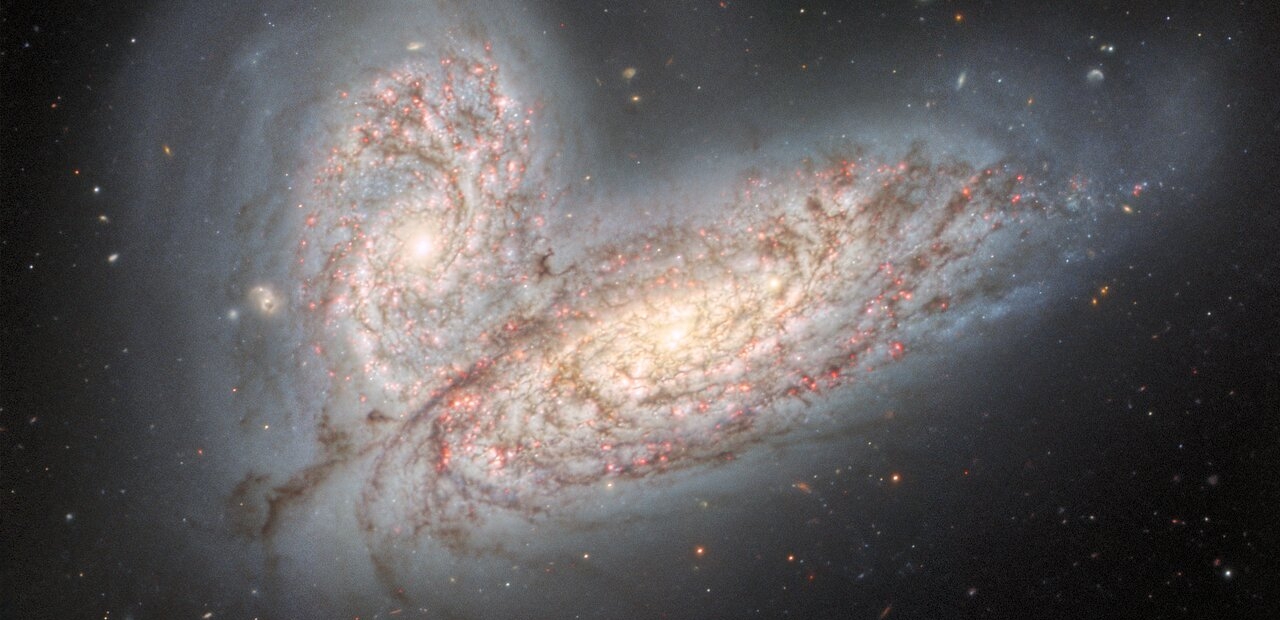
Both partner galaxies are barred spirals with distinct galactic cores. Gravitational interactions between the two, alongside minor tugs from the far larger
Protea Galaxy, warp the galactic disks of the pair so that opposite ends of both Trea and Tome are bent away from their galactic planes by as much as 5,000 light-years. This effect is more dramatic around the merging point. However, the effect of the colliding partners creates a cloudy region underneath the merging point that masks much of this distortion. In 500 million years, these galaxies will merge into an elliptical galaxy.
Merger Region
Trea-Tome's unique 'merger region' is the dense and chaotic region where the pair intersect with each other as they collide for the first time. Within this area, significant disturbances in gravity as well as the increased concentration of gas and dust have lead to a very significant increase in stellar formation. Many young stars of varying sizes as well as protostellar disks and protoplanetary disks have been discovered in this region. Because of all this, this region of space is far brighter than the surrounding galaxy and is opaque to a wide range of astronomy equipment.
The thin disks of the pair have passed through each other's side by about 8,000 light-years. They are significantly warped and appear foggy like the elliptical galaxy the Trea-Tome Galaxy will become at the end of the merger.
Galactic Cores
Each pair has a highly visible and bright core of older stars in highly inclined and elliptical orbits. A supermassive black hole is present in the center of both partners with Trea's being detected by the motion of stars nearest to the center. Tome's blackhole, however, had been observed when a large object fell into it and was torn apart into an
accretion disk that was visible for several hours.
The density of the galactic cores makes it somewhat difficult to view anything beyond them. For a while, a whole section of Trea was unobserved. Exploration and colonization of the Protea Galaxy would provide a small period where the entire disk of Trea could be viewed. Though from this vantage point, Tome would not be visible.
Galactic Halo
In what would otherwise be intergalactic space, stars and globular clusters of such exist in irregular orbits around their parent galaxy. These stars exist within a couple hundred thousand light-years of the center of the galaxy. At these distances it is more accurate to the refer to the Trea-Tome pair as if it were truly a single galaxy. The once distinguishable halos of the pair have effectively coalesced. Changes in the stellar density are imperceptible given how few stellar systems exist this far out. However, not all regions of the Halo are desolate.
Globular clusters, that is small pockets of mutually bound stars, drift through the cold and dim space within the very fringes of the galaxy. Some of these clusters are bright enough to appear visible to a trained eye. A lot of the stars in these structures tend to be incredibly old. Some clusters, in fact, may be populated by ancient stars older than most visible galaxies in the known universe and thus older Trea and Tome did as individuals.
Native Biology
Six worlds have been confirmed to have life with five of them being settled. Over 100 planets and moons are otherwise candidates for life showing signs of organic compounds typically produced by cellular processes. Of the six with life Arquia, Chutar, and Cerulean have complex oxygen respiring life with the former two hosting native sentient life. Aside from the Trozi, the Feuhang of Chutar exhibit abstract reasoning and complex emotions comparable to the Trozi but are severely limited by their biology which prevents complex language and a lot of tool usage.
There is debate on how pervasive complex life is in the galaxy. Although current statistics suggests that half of all planets should have complex life, it is far more likely the local space around Arquia is a cosmic outlier. Pervasive multicellular life is relatively obvious when viewed by certain astronomical instruments. Chutar and Cerulean were known to have life before any attempts at reaching them were possible. The moon of Preccyoba was also the subject of a test to see the fidelity of observatories by focusing on an object over two million light years away. The most advanced telescopes could make out with 70% certainty the presence of global ecosystems.
In very early drafts on the Celestial Grove there was another technologically advanced species known as the Taofimo. They were scrapped early on but initial ideas for their physiology helped create the Ngladeni and Preccyoyota. Several details of their home world were also reused in in Preccyoba's continental desert.

Comments