
Donkey
Once upon a time, donkeys were an integral part of Greek life. Basically, everyone had one, and above all, everyone needed one. But since the 1950s, the donkey population in Greece has declined sharply. Whereas there were around 500,000 donkeys at that time, estimates suggest that there are now only around 16,000 animals left. How did this happen, why are donkeys still important today, and what else is there to know about these animals? We would like to explain this to you in the following article and additionally give you some basic information about those adorable animals.
About donkeys in general
Donkeys, also called ass, are among humanity's oldest domestic animals. For thousands of years, they have accompanied us as beasts of burden, transport aids and loyal companions. But they are often underestimated: donkeys are much smarter, more cautious and more social than many people think. A look at their biology and way of life shows how adaptable and fascinating they really are.
Anatomy
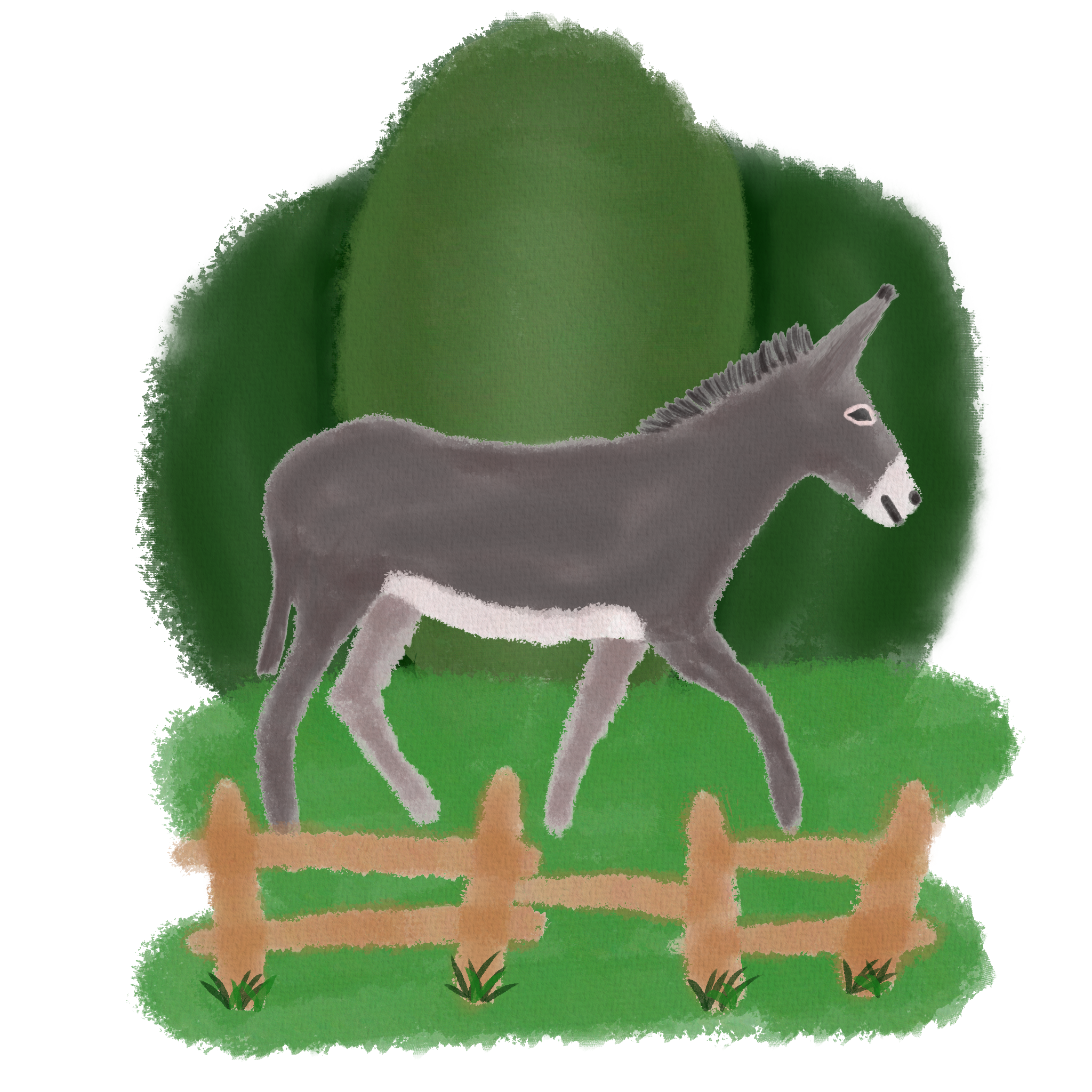
Due to their origins, donkeys are perfectly adapted to hot, arid climates. They have a strong build with powerful legs and hard hooves, which make them very sure-footed. Their coat protects them equally well from the sun's rays during the day and the cold at night.
Donkeys are known for their long ears, which they can rotate 360°. This gives them excellent hearing. Their ears also help them regulate their body temperature. Similar to dogs, donkeys also use their ears for communication.
Reproduction
Female donkeys are pregnant for twelve months and usually give birth to a single foal. As a precocial animal, the young donkey is able to stand on its own legs after a short time and then follows its mother everywhere for several months.
Diet
Donkeys feed mainly on grasses, herbs and shrubs. They can also derive a surprising amount of energy from nutrient-poor plants. Due to their metabolism, donkeys spend the whole day searching for food and eating small portions. Unlike their relatives, horses, donkeys should not eat vegetables or fruit, and bread is not good for them either.
Behaviour
The expression ‘stubborn as an ass’ can be attributed to the nature of donkeys, which is not actually stubbornness, but rather caution. The natural habitat of donkeys requires them to move cautiously, as a misstep on rough terrain, often in hilly areas, can have fatal consequences. Donkeys are therefore not flight animals, but remain still when danger arises, assess the situation and only then react.
Donkeys live in small groups consisting of one male and several females with their foals. They develop genuine friendships and mourn when they lose their best friend. For this reason, domesticated donkeys should never be kept alone.
Habitat
Donkeys originally come from the dry regions of North Africa. Nowadays, however, they can be found all over the world. Most of them, estimated at half, are native to Africa, especially in rural areas, closely followed by Asia with around a third of the population. The number is also high in South America, especially in mountainous and rural areas. There are significantly fewer donkeys in Europe. Here, they are mainly found in the south, i.e. Spain, Italy and Greece, as well as in the Balkans. There, they are still used as pack animals, while in the northern part of Europe they are kept more as a hobby or out of love for the animal. The fewest donkeys are found in North America, even though there are groups of feral donkeys there, and in Australia.
About donkeys in Greece
After this general insight into donkeys, we would now like to provide a few more exciting insights specifically about donkeys in Greece.
Donkeys in the past
For centuries, donkeys were the main means of transport in Greece. Due to the rough terrain, these sure-footed animals were the ideal means of transporting people and goods safely along the country's narrow paths. Farmers used the animals to plough their fields or to transport water and goods. Donkeys also had cultural significance. They are deeply rooted in Greek mythology and serve as symbols of humility and endurance.
In recent decades, however, their numbers have declined dramatically. Especially since 1950, with the advent of the automobile, donkeys have been increasingly replaced by tractors, trucks and cars. In addition, many people moved from the countryside to urban centres, where they could no longer keep donkeys. Without organised breeding programmes, the number of animals continued to decline. While there were half a million donkeys in 1950, there are now fewer than 16,000. Experts warned that the animals could disappear within a generation if this trend continued.
Donkeys in the present
Donkeys are and remain a lasting symbol of Greece, even though their numbers are steadily declining. They are a fundamental part of folklore, art and religious imagery, making them more than just beasts of burden. They are a living link to Greece's history. Fortunately, conservation organisations are now working to preserve these gentle animals.
Did you know?
On the island of Hydra, donkeys are the main means of transport, as motorised vehicles are prohibited here. They are essential for transporting people and loads through the steep, narrow streets to the houses located higher up.

The animals are an important part of sustainable tourism in particular, but this also leads to problems. For a long time, the animals were used to transport tourists without regard for their welfare. Nowadays, in many places there are upper limits on how much a tourist who wants to go on a donkey ride can weigh. Preserving donkeys means preserving a piece of Greek identity.
Comments