
The Chorus of Shattered Echoes
Celestial / Cosmic
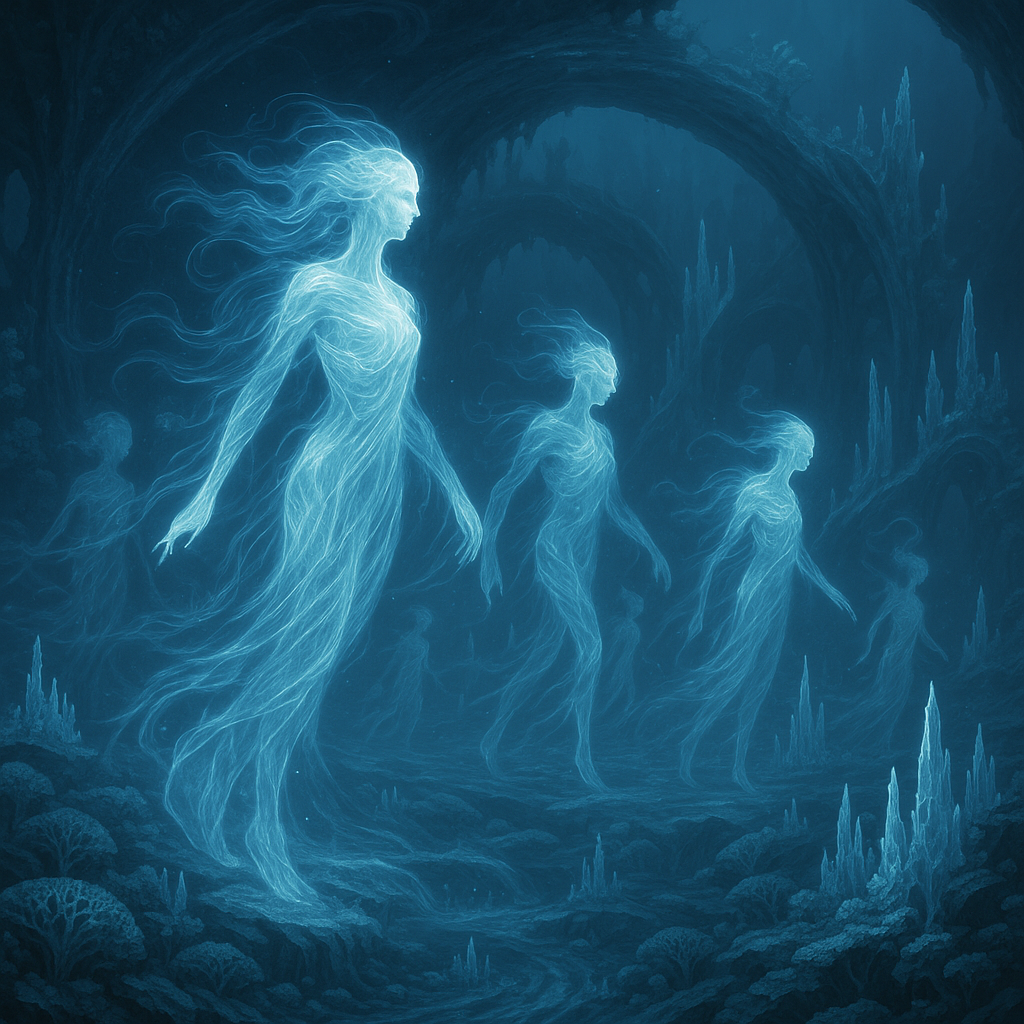
The Chorus of Shattered Echoes were Bodi’s earliest experiments in art, beauty, and voice, living sculptures of sound that shaped themselves through harmonic resonance rather than flesh or matter. They flourished briefly beneath the waters of the Ephemeral Sea, building coral-like cities of frequency and vibration. When their harmonic matrices destabilized, their civilization collapsed in a literal silence. Their cities dissolved, their bodies unspooled into faint tones, and their galleries became deep resonance chambers where whispers still gain shape. They remain Bodi’s most tragic creation, art that sang itself into existence, only to sing itself apart.
Beings of Resonant Form (≈32,500–32,200 PR) The Chorus were never creatures of flesh or matter. Their bodies were patterns of sound held together by stable harmonics, standing waves that shimmered with faint luminescence as they moved. Their limbs were shifting chords, stretching and folding with tonal resonance. Their faces, if they can be called faces, were clusters of harmonized pitches forming temporary expressions before drifting apart again. They “sang” themselves into existence, “sang” their thoughts, and “sang” their emotions. To witness them was to see sound given shape, and shape given voice. Some Chorus formed delicate, humanoid silhouettes. Others resembled drifting ribbons of harmony or coral-like knots of tone. Their movements rippled through the water and the stone beneath, leaving behind subtle tremors that echoed like whispered melodies. They did not understand worship, but instinctively harmonized with Bodi’s presence, drawn toward the First Note like moths to a flame that was also a song. The Coral Cities of Tone (32,200–31,400 PR) Their civilization blossomed beneath the Ephemeral Sea, where mineral-rich sediments and shifting currents acted as natural amplifiers. There, they built immense underwater cities through nothing but resonance and will. Their architecture grew through hymn and harmony rather than hands. Caverns became great halls when Chorus gathered to sing their walls into form, pillars crystallized into existence around stable nodes of frequency, and coral-like towers resonated with living overtones, their chambers illuminated by soft tonal light. These structures were alive, reactive harmonics woven into expression. Galleries shimmered with crystalline “notes,” solidified emotions formed from collective memory. Echo canyons stretched across the seabed, turning every tide into sweeping waves of melody that rolled through the deep. Harmonic Collapse (≈31,400–31,300 PR) Their downfall began with ambition. As their society matured, the Chorus pushed their harmonic structures further, experimenting with deeper chords, more intricate resonances, and emotional complexity no sonic organism had ever produced, but sound has limits, even divine sound. The more complex their harmonics became, the more unstable their forms grew. One by one, bodies wavered as their tonal matrices slipped out of alignment. Buildings began to vibrate improperly, walls fracturing into discordant frequency-shards before dissolving into silence. Plazas hummed dangerously as thousands gathered to repair resonant architecture, only to collapse when the harmonics could no longer hold. Entire districts detuned, and then entire cities fell silent, and the Chorus themselves dissolved, first into trembling chords, then into faint whispers, then into nothing at all. The collapse rippled across the Ephemeral Sea in one great sigh, a final unmaking that sank their resonant kingdom into quiet, drowned ruin. Their ruins remain scattered across the seabed between the Seanachaisian Isles and the coast of the Republic of Tae, where the drowned soundscape still thrums faintly under the tides. To descend into these ruins is to enter a place where silence is not merely absence, but the predator that ended an entire civilization. The Chorus were Bodi’s first attempt at art, beautiful, fragile, and ultimately, undone by the very harmony that gave them life.
