
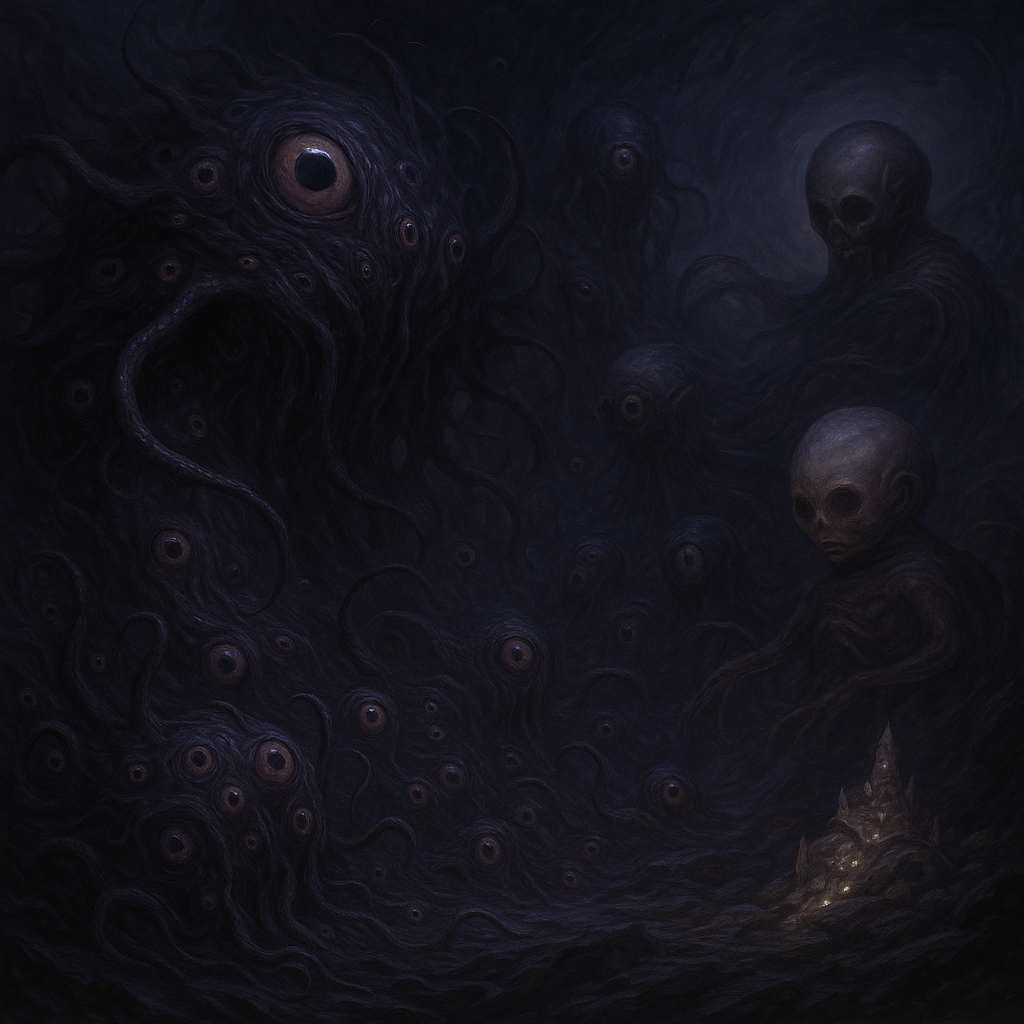
The Emergence of the Gloam-Tide Progeny
Celestial / Cosmic
In the final spasms of Vrokhanna’s death, before the young gods had fully awakened or even understood themselves, her subconscious nightmares bled into existence. These half-formed “children”, the Gloam-Tide Progeny, rose from agony rather than intention. Amorphous, multi-eyed horrors that whispered in dead languages and shaped the first caverns of Cairne, they drifted across the newborn world for nearly two millennia. They did not die so much as sink, drawn downward into deep dark places where thought, stone, and forgotten physics mingle. Their remnants still haunt the world in impossible fossils, psychic pressure zones, and stone eyes that watch without seeing. They remain Cairne’s oldest inhabitants, the first reminder that the world was birthed in terror.
When Vrokhanna’s colossal form cracked beneath the weight of her own demise, the universe shuddered. The newborn gods slumbered still within her collapsing divinity, too young even to dream of themselves. But Vrokhanna, vast, broken, and unraveling, dreamed instead. And in her final moments, those dreams became things. These manifestations were not offspring, they were never meant to be. They were the final exhalations of a consciousness dissolving into void, her fears, her memories, her half-formed regrets, her impossible, unnamed nightmares. From these psychic convulsions came the Gloam-Tide Progeny, the first entities to ever stir upon Cairne. The Progeny did not emerge as stable creatures, for they had no blueprint. They were dreams attempting to define themselves through a world not yet fully real. Some drifted like embryonic gods, too many limbs, too few, wrapped in spirals that did not obey direction or time, while others resembled embryonic worlds, spheres with tectonic ridges, oceans that existed only when observed, atmospheres of whispers and light. Most were simply amorphous horrors with layered eyes that blinked out of sequence, tendrils that behaved like thoughts rather than matter, and pulsing masses that shifted whenever language tried to describe them. To perceive them was to witness Vrokhanna’s subconscious trying (and failing) to remember what shape fear should hold. They communicated in dead languages, not “old” languages, for nothing existed yet to become old. These were languages Vrokhanna had never spoken, but had imagined she might, in eternities that never came to pass. Their presence warped the land itself. Where they drifted, the first caves shaped themselves into rib-like corridors. New fault lines bent around them in curves that made no geological sense. They built nests, or perhaps simply gathered, around huge mounds composed of bone-like stone and shards of cold starlight. Physics learned to say “no” for the first time while trying to correct the places they had stood. The Age of Wandering Nightmares (≈35,000–34,500 PR) For centuries, the Progeny wandered aimlessly across the forming world. They left trails of haunted topography. Caverns that echoed with memories rather than sound, pools of liquid shadow that reflected events not yet happened, ridges shaped like vertebrae from titans that never lived, and air pressure zones that “pressed back” against the living mind. Their movements were not purposeful. Their drifting was the involuntary twitching of a dreamer in her final sleep, yet their influence was vast. The later gods, once awakened, would spend ages attempting to smooth over their distortions. Some distortions resisted. Some still do. The Slow Sinking (≈34,500–33,000 PR) The Progeny did not die; they lacked the coherence for death. Instead, as Vrokhanna’s essence fully guttered out and the young gods opened their eyes, the Gloam-Tide Progeny began to sink. Not into earth or into water, and not into the void between worlds. Instead, they sank into deep places, hollow truths beneath matter, seams where reality had not quite fused. They slid down the cracks of creation, like nightmares receding upon waking, though they never dissipated. Some settled in caverns now sealed by geological ages, and some drifted into pressure-pockets in the substratum where sound cannot exist but thought echoes forever. Some lie still, coiled in the vast emptiness beneath mountain roots, still dreaming the remnants of Vrokhanna’s terror. A few may even remain awake, but none are gone. The world of Cairne retains their scars, found in impossible fossils, bones shaped by ideas rather than biology, stone “eyes” in caves that track movement yet are inert rock, psychic pressure zones where minds ache and reality feels thinner, and ruins without builders, structures of spiraled geometry left behind unintentionally, the areas where physics misbehaves, lingering inconsistencies in gravitational pull, acoustics, or temperature Explorers report that in the deepest tunnels, where light dies quickly, a soft whispering sometimes returns, syllables with no origin, a language that predated language. It is uncertain whether this is an echo of what once was, or a greeting from something that still waits beneath.
