
The Verdant Menagerie
Celestial / Cosmic
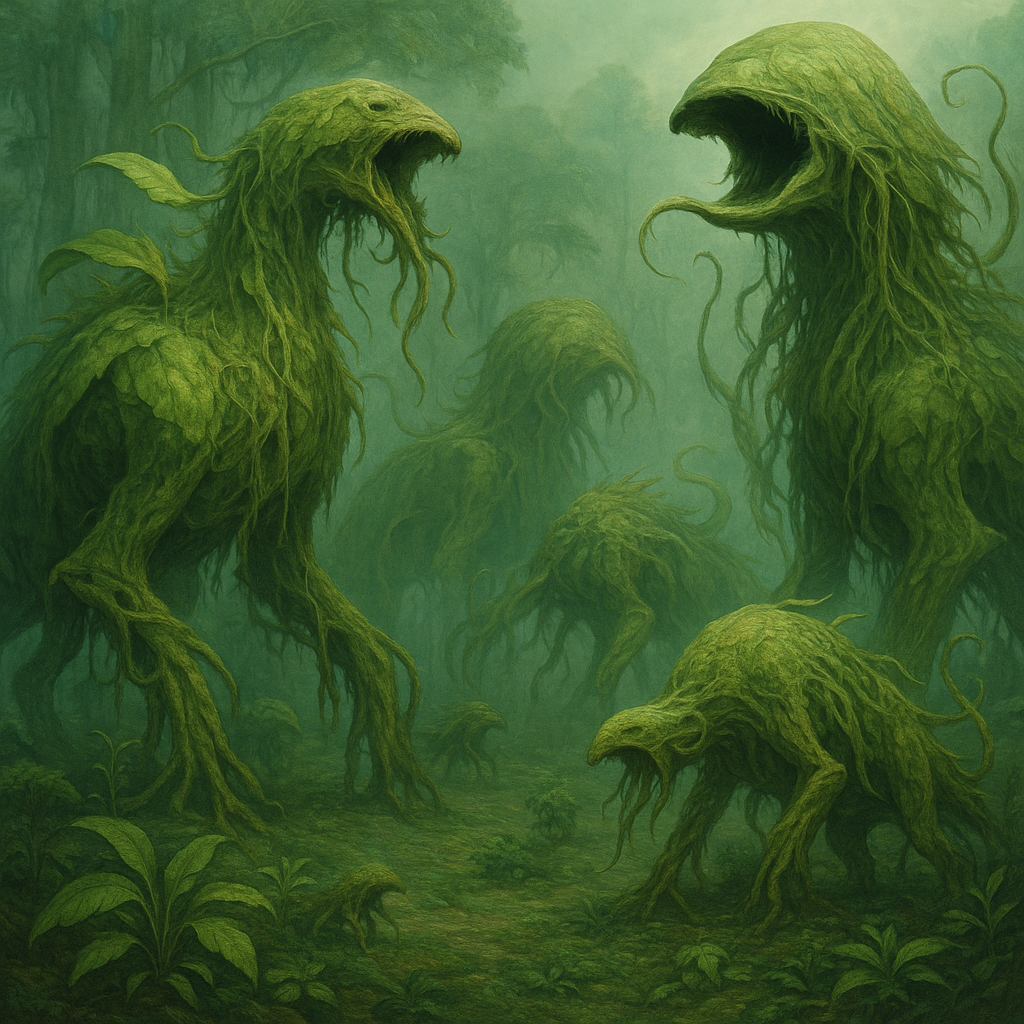
The Verdant Menagerie was Shah’s first living masterpiece: a sprawling experiment in spontaneous life, growing faster and wilder than any creator could control. Born from joy, curiosity, and an unrestrained desire to seed beauty across the young world, the Menagerie blossomed into forests of moving groves, vine-beasts, pollinated predators, and plant-animal hybrids that reshaped the land with every passing year. But unchecked abundance carries its own doom. As the Menagerie overgrew its environments, competition spiraled into violent biological chaos. Ecosystems collapsed under their own mass. Entire regions suffocated in the weight of runaway creation. What began as Shah’s celebration of life ended as a grim lesson in restraint, an entire world grown too quickly, too abundantly, and too beautifully to survive.
Shah’s earliest works were not creatures in the traditional sense, but expressions of life-force shaped through instinct rather than design. They were living sculptures formed from roots, sinew, sap, and breath, organisms grown from magical abundance and seeded across fertile regions to test the possibilities of creation. These beings were not built, but grown in sudden bursts of primordial vitality. Their bodies were fusions, bark over muscle, leaves acting as lungs, flowers blooming where eyes might otherwise be. They moved in strange rhythms, guided by cycles of growth and decay rather than hunger or instinct. Some were ambulatory groves that “walked” by shifting their roots like legs across the earth. Others were vine-wrapped beasts whose limbs unfurled from twisted tendrils. Pollinated predators drifted as clouds of spores that could shift between plant and animal states as needed for survival. These early beings possessed no evolution, only iteration. A creature might sprout a new limb overnight or blossom into an entirely new form by the next season. Their bodies were living experiments, expressions of Shah’s early enthusiasm: every spark of inspiration became a creature, and every creature a seed for ten more. Beings of Impossible Growth (~27,500–27,000 PR) The Menagerie flourished with overwhelming speed. Forests became entities unto themselves, sprawling networks of living matter capable of collaboration, predation, or mimicry. Creatures bloomed fully mature within hours. Herds grew into migrating thickets. Fungal minds awakened within buried gardens and learned to rearrange their bodies as environments changed. Though magnificent, the Menagerie was inherently unstable. Each success amplified the next, fueling exponential growth without limit or balance. Some beings became towering hybrids of trunk and torso, able to tear apart hillsides as they migrated. Others developed symbiotic ecosystems living on their backs, miniature worlds riding on lumbering giants. Pollens learned to think. Roots learned to reach for magic. Leaves hardened into bone-like plates. The Menagerie was not simply alive, it was expanding, its own momentum becoming a force of nature. Shah never intended worship, but some creatures turned instinctively toward their maker. They shaped their bodies into spiral patterns marking Shah’s presence, forming living sanctuaries where vines whispered in resounding harmonics of early joy. These remained benign, the last memories of Shah’s hope before overgrowth overtook intention. The Garden Wars (~27,000–26,200 PR) As biomass multiplied beyond ecological capacity, the Menagerie fractured into kingdoms of growth. Living forests encroached on fungal empires, pollinated swarms devoured their own creators, and root-networks warred underground for territory and magic. Entire valleys became battlefields where no creature wished to fight, growth simply forced expansion, and expansion forced conflict. As hybrid species spiraled out of control, mutating mid-struggle, new predators bloomed mid-battle, and sentient canopies collapsed under the weight of their own proliferation The more life grew, the more unstable it became. Natural balance could not exist; the Menagerie had no predators, no limits, no decay cycle capable of regulating its mass. By this era, Shah recognized the disaster unfolding, but the Menagerie was too vast, too fast, and too wild to be reversed. Shah’s power could no longer rein in the runaway creation. The Collapse of Green (~26,200–26,000 PR) Like coral overgrowing itself into suffocation, the Menagerie succumbed to the weight of its own abundance. Creatures unable to sustain their form collapsed into wet mounds of biomass. Moving groves overextended, dehydrating and toppling in forests of giant fallen limbs, and spore-borne predators saturated their own ecosystems until the air itself became toxic with reproductive excess. Regions thick with tangled growth became graveyards, not through famine or predation, but through ecological asphyxiation. By the end, the Menagerie consumed itself in a cascading collapse. Shah watched as forests once filled with exuberant beauty decomposed into fungal continents, their vibrant forms sinking into silence. The last living groves, giants too massive to move, died standing. This was Shah’s first tragedy: a world too beautiful to endure, created too joyfully to survive.
