
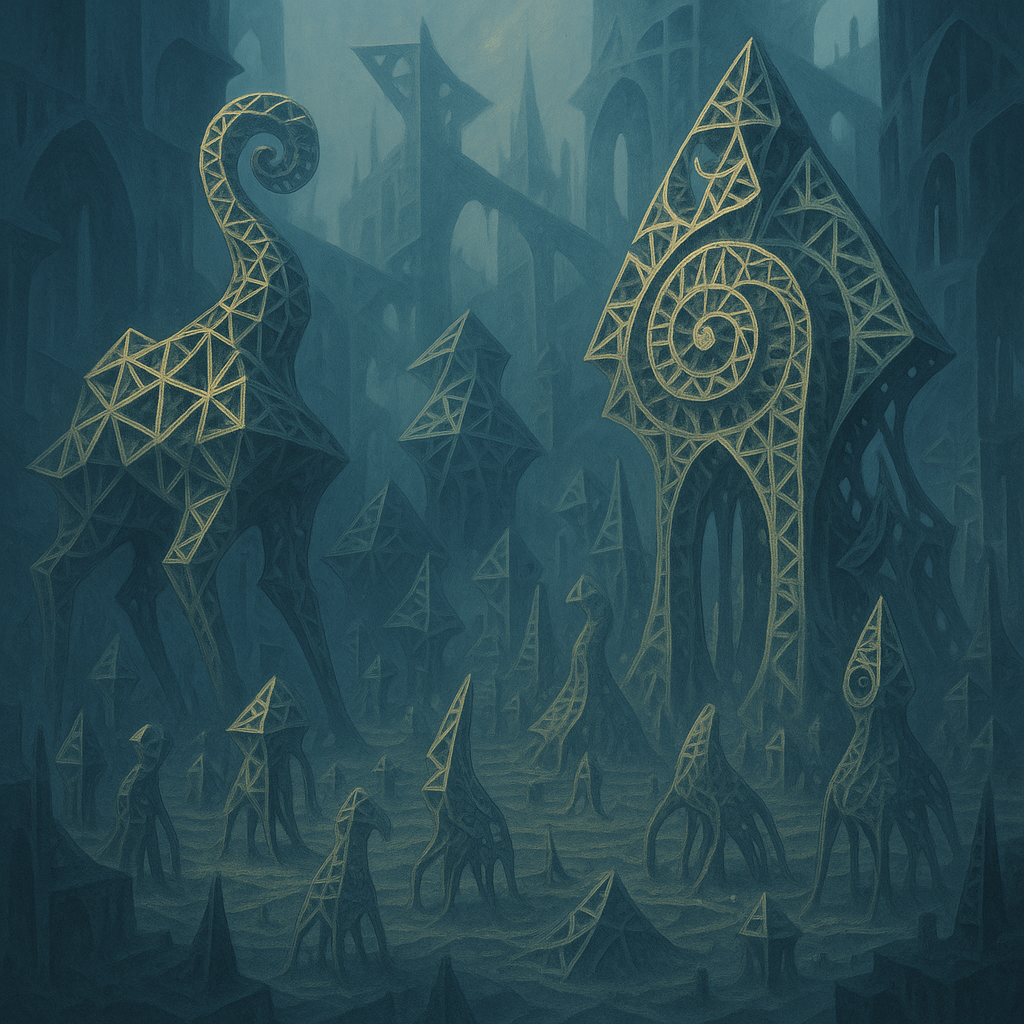
The Bleeding Numerals
Celestial / Cosmic
The Bleeding Numerals were Goyne’s earliest attempt to impose structure on primordial chaos, living equations, recursive geometric organisms, and logic-born entities that replicated not through biology but through the unfolding of patterns. They built cities from fractal architectures and communicated through shifting proofs, but order became contradiction. Contradiction became collapse. When their logic failed, their world shattered into impossible angles, birthing regions of warped reality where time loops, matter folds, and numbers bleed into existence. What remains are ruins of impossible geometry, self-solving puzzles, floating glyphs, and the ghosts of equations that once aspired to become life.
The Numerals were not creatures of flesh, thought, or spirit. They were expressions of structure, manifestations of Goyne’s first attempt to define rules where none existed. Born from pure arcane logic, they emerged as semi-living geometric bodies, spirals that grew into lattices, angular forms that unfolded into recursive corridors, and equation-shaped entities whose “bodies” rearranged themselves as proofs Each one was an attempt at order, not mathematics as mortals understand it, but a primordial system striving to become mathematics, to codify existence through the language of form. Their presence shaped the land itself. They carved cities from endlessly repeating fractals, spires that split into smaller versions of themselves, halls whose dimensions multiplied or diminished depending on who entered. Nothing was static. Nothing was inert. Their architecture calculated itself in real time. These beings replicated by pattern growth. When two Numerals intersected, their equations combined, creating a new entity whose form was the solution to their union. Sometimes elegant. Sometimes monstrous. Always logical, until their own logic became too complex to contain. Beings of Recursive Logic (~28,800–28,200 PR) At their height, the Numerals expanded like an ecosystem of ideas. Their bodies were living diagrams, their speech, shifting arrays of numerical glyphs, and their interactions, proofs and counterproofs expressed physically in rearranging geometry. They learned to “calculate” their environment, smoothing rough terrain into perfect angles or bisecting obstacles into symmetrical halves. Where they walked, the world became cleaner, sharper, more defined. Some were graceful polyhedrons hovering in perfect equilibrium, while others were spiraling plateaus whose limbs subdivided infinitely, and yet others existed only as rotating glyphs that shed fragments of meaning. All were beautiful in their precision. And yet, even in their early designs, subtle contradictions emerged, places where logic strained, where pattern replication produced unforeseen anomalies. These anomalies accumulated like flaws in a proof, invisible at first but growing with every iteration. The Fractal Cities (~28,200–27,900 PR) The Numerals built grand structures from their own principles, cities of recursive geometry. Their towers were endless, folding into themselves like mirrors staring into mirrors, bridges arced in perfect spirals, connecting points that should not have existed in the same dimension, and chambers multiplied downward and inward, each room a solution to the room before it. To walk their cities was to traverse a living theorem. Within these cities, Numerals formed a society based not on hierarchy but on geometric resonance, beings whose patterns aligned acted in harmony, while mismatched entities struggled to coexist, creating interference that manifested as distortions in space. As contradictions grew, the cities began to shift unpredictably. A corridor might lengthen into infinity. A door might open to the same room from which a traveler had just departed. The architecture began to solve problems that no one had asked it to solve, rewriting space in recursive attempts at self-correction. The ecosystem was turning inward, trying desperately to resolve contradiction with more contradiction. The Logical Collapse (~27,900–27,700 PR) The end began when the first Perfect Contradiction appeared, an entity whose own form contained an impossible equation. Its presence rippled through the Numeral ecosystem like a paradox detonating. Replications based on it produced impossible shapes, such as beings with negative volume, creatures occupying angles that didn’t exist, and fragments of entities looping in and out of time. Cities destabilized. Proofs disassembled themselves mid-form. The living geometry began collapsing into shards of impossible angles, each fragment a piece of logic that could no longer be resolved. As the contradictions multiplied, the ecosystem reached a point of catastrophic self-negation. In a single era-spanning moment, the entire civilization failed its own proof. Structures imploded and exploded simultaneously, patterns unraveled into aberrant glyph-storms, and time inside the fractal cities folded into recursive loops, trapping moments replaying endlessly or skipping like broken computation. Goyne watched as the first attempt at perfect order consumed itself, a system flawless in concept, doomed in execution.
