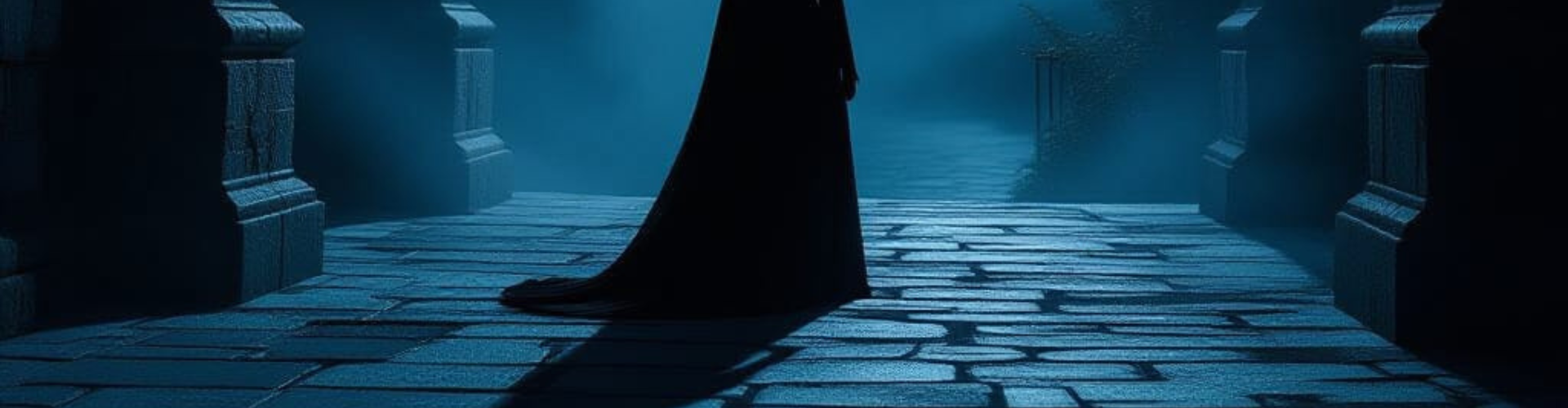
The Usurper's Shadow
Among peasants, they say the Baron’s shadow lingers to guard the land.
Among knights, they say it stands at their back in battle.
Among nobles, late at night with the doors barred and the servants dismissed, they tell a different story. They say the shadow does not belong to the Baron at all. They say it belongs to Seres.
The nobles say that Arridan was not simply a unifier, but the third to claim the title in those early, fractured years, and the only one whom the mountains allowed to live. They say the land chooses and that the choosing is always marked by the shadow.
The Choice at Kogogache
The first who dared to hold the title was Lord Hadrien of the Southern Pass, who seized the stronghold by force in a storm of steel and burnt banners. His rule lasted only three winters. His shadow, like the man, was thin, ordinary, and mean.
When hunger struck and the harvest failed, Hadrien demanded double tithes. The mountain village refused and hid their stores. Hadrien answered with fire and screaming children.
One night, as he walked the battlements, a lone guard swore the torches bent inward, as though the darkness inhaled. For a heartbeat, Hadrien’s figure stood alone against the wind but his shadow split. Two silhouettes spilled from his feet, one stretching forward, one backward, neither moving quite as he moved.
By dawn, his body lay broken on the rocks far below. No one could agree whether he jumped, slipped, or was dragged. Old soldiers still mutter, "A man may cast two shadows only once."
Next came Lady Maurelle of the Eastern Ridge bearing treaties and soft words. She promised a gentler rule, lowered taxes, restored feast days, and open storehouses. Seres prospered under her and peace returned. Then the raids began.
Villages vanished without smoke or scream. Whole hamlets empty by dawn. When the Council begged her to strike back, Maurelle hesitated. Rumors swelled that she traded secret grain shipments to raiders to spare her own lands and her bloodline.
One autumn evening she stood in her hall, candlelight trembling, and for the first time, courtiers noticed that Maurelle had no shadow at all.
The next morning, she lay in her bed, flesh sunken as if drained by a long illness, though she had been healthy the day before. Her body looked like a log hollowed out by rot.
Priests insisted it was plague. Nobles whispered, "The land reclaimed what she bargained away."
Thus the saying arose, "Better a baron with two shadows than one with none."
The Council convened to decide what to do next. The debate lasted for two days. Finally, it was decided that they needed to careful with the next choice. The Council put out the call for a new Baron.
The Trial of Arridan
Arridan climbed the steep road to the mountain keep without escort, breath smoking in the cold. His cloak was frayed at the hem, and mud clung to his boots from the last hour’s rain. No banner hung at his shoulder. No retainers followed. He walked like a man accustomed to being ignored.
The guards, wearied by weeks of fear and sleepless nights, let him pass. The Council had called for candidates, any candidate, and no one had answered but him.
The great hall of the keep was dim when he entered. Torches guttered low, their light thin and uncertain. Council elders huddled at the long table, faces drawn and hollow. The mountain wind keened through the shutters like a grieving woman. Arridan stopped at the center of the hall and bowed his head.
“You ask for a ruler,” he said, his voice steady but unpolished, “but what you need is a servant who remembers which side of the bowl the hunger sits on.”
A murmur ran through the gathering—some offended, some surprised. Grandmother Ilene, oldest of the elders, lifted one gnarled hand. The room quieted instantly.
“Words are wind. We have chosen wrong twice. We will not choose wrong again.” She pointed to the stone floor. “The land will choose.”
At her command, the torches were snuffed until the hall hovered in half-darkness. A single lantern, its glass warped with age, was set at Arridan’s feet. The shutters were thrown wide. Moonlight spilled in—pale, cold, sharp as a blade.
“Stand there,” Ilene instructed. “Between moon and flame.”
Arridan moved to the marked circle of stone. He did not square his shoulders like a noble. He simply stood, hands loose at his sides, waiting.
The elders rose. One by one, they walked slowly around him, watching how the two lights met his body. Their steps echoed in the hollow chamber... At first, nothing happened.
Arridan’s shadow lay behind him, stretched by the lantern’s glow. The moonlight gave it a faint silver edge. Nothing more. Then the lantern flickered.
A ripple seemed to pass along the floor, like breath moving across still water. The shadow split.
The first remained as it should—long, straight, cast neatly by the lantern. But the second… The second leaned away at a strange, impossible angle, slanting behind Arridan and to his right. Its outline was crisp and human-shaped, but it did not belong to him. It fell where no light touched. It obeyed no flame and no moon. It stood like a silent companion at his shoulder.
Several elders stumbled backward. One noble swore aloud.
Grandmother Ilene’s breath caught in her throat. “There,” she whispered. “There it is.”
Arridan looked down, neither startled or afraid. Only thoughtful, as if he had known for some time that something walked beside him and had simply never spoken of it.
The lantern guttered again, then died. Moonlight alone washed the hall. Yet both shadows stayed. The true one dimmed. The false one did not. It clung to him with the patience of a vow.
The hall fell utterly silent.
Then Ilene bowed, not a shallow nod but a full, reverent lowering of her body. “The land has spoken,” she said. “Seres has its Baron.”
Arridan did not smile. He did not speak. He simply stepped forward into the darkness, and both shadows followed him.
The Shadow’s Allegiance
Arridan’s reign began on the night the lantern died and the second shadow stayed.
In the years that followed, the keep grew quieter about such things. No one spoke openly of the shape that sometimes lingered a half-step behind the new Baron, faint as breath on cold glass. Yet servants swore that when Arridan passed, the torches did not flicker away from him as they had for Hadrien and Maurelle. Instead, they leaned subtly forward, as if bowing.
And when Arridan judged disputes in the old council chamber, his shadow, the true one, moved with him. The other did not. It stayed angled just behind his right shoulder, patient and watchful, like a scribe committing all things to memory.
Some nights it was faint, barely a smudge. Other nights it stretched sharp and clear, even when no lanterns were lit. It was said that when Arridan ruled with generosity, the second shadow softened, its edges blurring into the stone. When he condemned corruption, it sharpened again, dark as blade-oil.
The highborn took note. They began to shutter their windows more tightly on moonlit nights.
The Coronation Rite
What happened to Arridan in the Hall of Two Shadows became, in time, a quiet expectation. Few dared to speak it aloud, but each new ruler, upon the night of their coronation, was guided to the same circle of stone, the same high window, the same single lantern.
Most cast one shadow. The coronation would proceed, though a faint unease seeped through the hall, unspoken but shared.
A few cast none at all. Those ceremonies were delayed, postponed, sometimes forgotten entirely.
But once, and nobles lower their voices when they tell it, the double shadow returned.
It happened generations after Arridan’s death, during the rise of a ruler nearly forgotten before they had even begun. A quiet lord from a minor branch of a minor house, summoned only because all louder candidates failed to gather support.
He stepped into the hall reluctantly, his hands shaking as the lantern flame steadied. When the windows were opened and the moonlight struck the stone, two shapes bloomed behind him, not identical, but twinned in their tilt, pointed toward the same unseen place. A hush fell as thick as frost.
Some said the hall itself exhaled.
The elders bowed.
“Seres has decided,” one whispered.
That ruler would go on to mend roads, settle ancient feuds, and rebuild the granaries left abandoned since Maurelle’s day. And with each success, the shadow behind him waxed or waned as though marking its approval. It became clear to the nobles that the double shadow did not follow bloodlines, nor wealth, nor power. It followed worth. And it did not always stay.
The Shadow That Leaves
There was once, so the quietest noble circles claim, a Baron who inherited Arridan’s double shadow. He entered rule beloved, chosen, confident. For a time, he governed well. But years passed, and fear set deep roots.
He raised taxes beyond reason. He ordered dungeons expanded. He ignored the hunger of the foothills and spent lavishly on winter feasts. He filled his court with flatterers and dismissed those who spoke hard truths. Still, whenever he walked through the hall, two shadows followed.
He took this as proof of rightness. Then came the night of his coronation anniversary. He demanded the rite be performed again — but privately, without witnesses, save one old servant who could barely see.
The lantern was lit. The shutters opened. The Baron stepped into the center of the room, chin proudly lifted. He looked down. Two shadows stretched behind him. But as he watched, slowly, delicately, like a hand withdrawing from a promise, the second shadow slipped free.
It drifted across the stone, leaving him. It paused behind another figure in the gloom, whether a distant cousin, a bastard half-brother, or a young scullion no one ever noticed, but all agree on one thing: The shadow chose someone else.
The Baron gasped as though struck. His whisper cracked, “No… I am the ruler. I bear the Ledger. I—”
The lantern sputtered. The wind screamed through the window. The deaf servant dropped to his knees, unable to hear anything but the roaring dark.
When dawn came, the Baron was found stiff in his bed, eyes wide, hands clenched around the blanket. The cause was written as heart failure.
No one mentioned the shadow. The new heir was installed quietly the next morning.
In some households, this story is never told above a whisper. In others, it is denied so forcefully that servants suspect the telling is truer than the silence.
The Last Lesson
Across noble estates, behind barred doors, parents still murmur one warning to their heirs before sleep: “The throne of Seres is not inherited. It is borrowed. And the land remembers who breaks faith.”
Some say that a just ruler will see two shadows at unexpected moments. Some say that a corrupt one will see none. And some whisper, with a shudder, that when Seres grows displeased, the shadow steps forward first — as if preparing to choose again.
Why It’s Forbidden
Officially, the tale is dismissed as treasonous superstition. The Council calls it a “misuse of founding lore” and insists that legitimacy flows through oath, law, and the Red Ledger, not some wandering superstition about a living shadow.But nobles remember. They do not speak of it in the hearing of servants or knights but they pass it to their heirs with a quiet severity.
“Remember,” a father might murmur to his daughter in a silent corridor. “Our power is not a birthright. It is a loan. The Shadow can leave.”
Some families have mirrored their halls to watch for oddities in light. Others commission tapestries in which Barons stand with only one shadow, a subtle denial of the myth.
And still, on certain nights when the moon sits thin and sharp over Kogogache, there will be one young lord or lady, restless and alone, who will light a single lantern in their chamber, open the shutters, and glance down. Just to be sure.
How Nobles Use It
The forbidden noble version is not only a ghost story; it is a knife wrapped in velvet.- A Baron worried about an ambitious cousin might remark, “I wonder where the Shadow would stand, were we to light the hall tonight.”
- A discontented lord might whisper to allies, “The land has chosen poorly; if the Shadow could move once, perhaps it will move again.”
- A reform-minded heir might take comfort in the idea that the land itself prefers rulers who remember their people.
This is why it remains forbidden. Not because it is frightening but because it suggests that Seres itself is watching… and that one day, in a hall lit by lantern and moon, someone may look down and see a second shadow that is not theirs. And know that everything is about to change.


Comments