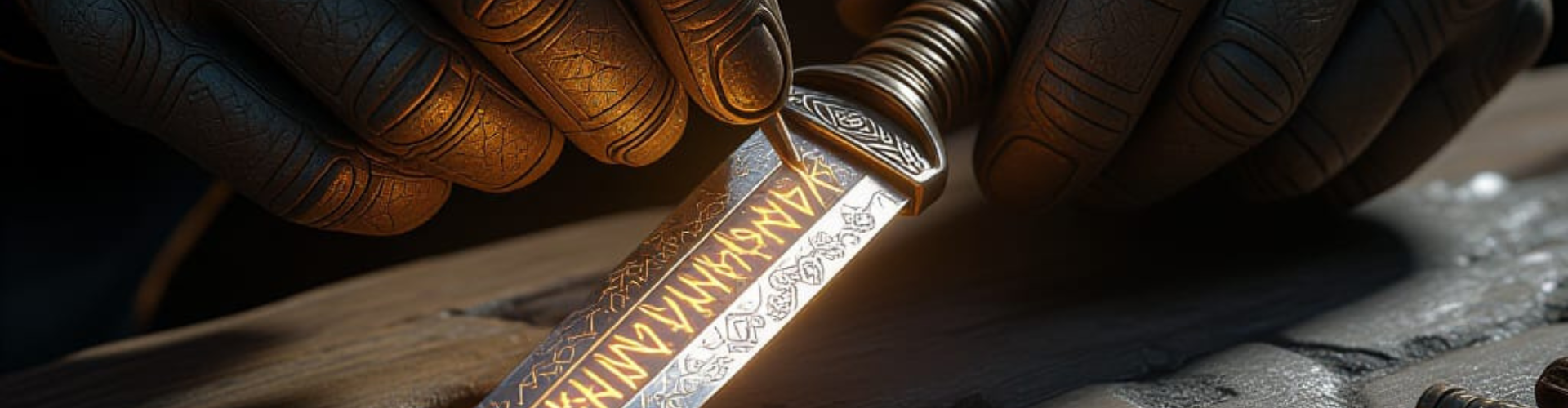
Ta Craft Pockets
Raw materials & Components
- Stone
- Bronze, copper, or iron housings
- Tiny hidden hinges or pressure locks, crafted with obsessive precision
- Masterwork fragments (often small carvings, gem chips, or inscriptions) stored inside
Tools
- Precision chisels
- Fine engraving picks
- Heat-and-pressure clamps for creating false seams in stone or metal
- Substitute: only possible by hand if skill level is extraordinary
Related Myths
Some say the greatest Ta secrets of stonecraft still lie sealed in Craft Pockets buried in abandoned mines.
A legend tells of the “Elder’s Hammer,” which carried an entire collapsed bloodline’s fragments within its hidden hollows.
Humans have misinterpreted them as “magickal caches,” not realizing they were memorial vaults.
Related Materials
Often paired with memorial stones (Ta burial markers) and guild insignia seals.
Mechanics & Inner Workings
Each Craft Pocket was seamlessly carved into the natural grain or forged vein of the tool, invisible to any but its maker. The compartment could only be opened through a pressure sequence—the artisan’s unique grip, pressing specific points along the handle or shaft. After death, the family or guild would perform a sealing ritual, fusing the mechanism permanently. The contents, usually a fragment of the artisan’s masterwork or a symbolic mineral, became part of their legacy.
Many Pockets incorporated false seams, counterweights, and metallic resonances to disguise their existence, ensuring that only those who truly understood the craft could even suspect they were there.
Manufacturing Process
A tool is forged or carved as normal. In the last stage a hollow chamber is cut along a natural grain line. A false wall or seam is then fitted with a tiny lock mechanism. Lastly, a fragment of the artisan’s masterwork (a sliver of carving, gem, or design) is placed inside before the pocket is sealed, sometimes ritually, with fire or binding chants.
Significance
Historical: The Ta Craft Pockets marked the highest expression of artisan lineage, a personal legacy embedded within the very tools of their labor. Each represented a sealed memorial of skill, grief, and endurance, often passed through generations until a master’s death, when it was sealed forever. To uncover one intact is to recover the signature of a single soul — their artistry, memory, and faith preserved in silence.
Religious: To the Ta, stone was sacred and memory eternal. Each sealed Pocket was an offering to the mountains themselves, a way for the artisan’s spirit to return to the earth through their craft. When sealed, families performed quiet rituals, pressing ash and metal dust into the seams to “feed” the mountain with the artisan’s last creation.
Personal: Owning a Pocketed tool was a privilege reserved for elder crafters’ guilds. To die with a sealed Pocket meant one’s craft had achieved permanence — the maker’s skill so complete it could no longer be added to. Breaking a sealed Pocket, however, was among the greatest taboos: a desecration of the dead and a symbolic destruction of a lineage’s memory.
Enduring Value: For archaeologists, surviving Craft Pockets are invaluable relics of extinct artistry. As they are the last true record of a civilization that believed creation itself was a sacred act. To destroy a Pocket is to erase not only a life but the mountain’s memory of it.
History
Origins: The Craft Pockets — or Kravet-puul (“hidden-hand hollows”) — first emerged during the Triad Wars, when Ta artisans feared that invading factions would plunder their forges and mines. In response, they began hiding fragments of their masterworks inside their tools, intending that their craft would outlive both conquest and death.
Postwar Evolution: As peace followed the Graven Pact, the practice endured but evolved. What had begun as an act of protection became an act of remembrance. Each Pocket sealed after its maker’s death carried not only a fragment of artistry but a symbol of humility — that mastery was meant to return to the mountain, not to the living. Tools containing Pockets were laid to rest beside the deceased or hung within ancestral halls, treated as both reliquary and tombstone.
Modern Understanding: Today, intact Kravet-puul are beyond price. Their discovery reshaped archaeological understanding of Ta culture — revealing a people who believed that the truest form of immortality was work sealed in silence. Fragments of translations in memorials reveal the following ancient vow: “Let the craft sleep.” Human archaeologists have yet to figure out how to open a Pocket without destroying the tool and everything inside.
Table of Contents
Compartments often no larger than a thumb’s length.
Weight negligible compared to the tool itself, though extra reinforcement made them slightly heavier.


Comments