Swift Beasts
Conservation Status
Some desert clans claim “echo herds” still run across the dunes under certain moons, but no living specimen has been confirmed.
Ta- miners considered fossilized bones sacred markers of lost migrations.
Human researchers debate revivification through genetic remnants found in desert strata.
Discovered by
First identified by human zooarchaeologists excavating desert strata.
Anatomy
Swift Beasts were quadrupeds with long, tendon-rich limbs and shock-absorbing joints. They had hollow bones (like birds) that were strong enough for desert running. Oversized nasal cavities assisted in cooling during high exertion. They had thick keratin hooves suited for shifting sands.
Biological Traits
They were endurance sprinters capable of reaching 95–110 km/h in bursts. Swift Beasts had herd instinct to synchronize movement, creating the illusion of a single blurring wave and were sensitive to vibrations in the sand, aiding navigation during storms.
Genetics & Reproduction
Swift Beasts were live-birthing mammals with litters of 1–2 calves. Mothers gave birth in sheltered dune hollows, calves could run within hours. Human zooarchaeologists found fossils that showed strong genetic bottleneck signs. They postulated that this may have contributed to the Swift Beasts sudden extinction.
Growth Rate & Stages
Calves: rapid development, running alongside herd in 3 days.
Juveniles: learning synchrony—falling out of sync was dangerous, often fatal.
Adults: prime speed and endurance.
Elders: slowed, protected at center of herd.
Ecology & Habitats
Swift Beasts were specialized desert runners, rarely straying to rocky regions. They were native to the Great Desert. It appears they were dependent on sparse oases and likely migrated between them seasonally.
Dietary Needs & Habits
As herbivorous grazers they te desert grasses, salt-sedge, and dune succulents. They had special molars adapted to grind gritty plants mixed with sand.
Biological Cycle
Seasonal migration keyed to rare desert blooms.
Fossils suggest synchronized die-offs—possibly tied to sudden drought or celestial phenomena.
Social Structure
Swift Beasts lived in herds of 30–70 with a dominant female (Lead Runner) who directed migration. They had sub-leaders who controlled flanks; calves and elders were protected in center.
Perception & Sensory Capabilities
They had acute hearing with low-frequency detection. Swift Beasts had exceptional motion perception; synchronized herd reactions within seconds. Humans theorize that they sensed geomagnetic fields for navigation.
Symbiotic & Parasitic Organisms
Carried small desert birds that picked pests from their hides.
History
Pre-Triad Era: Dominant herbivores of the desert ecosystem.
During Triad Wars: Culturally significant; some rituals and tactics imitated their synchronized running.
Extinction: Sudden disappearance centuries after the Wars. Fossil records show an abrupt end to tracks mid-migration route.
Modern Age: Fossilized trails attract scholars and archaeologists.
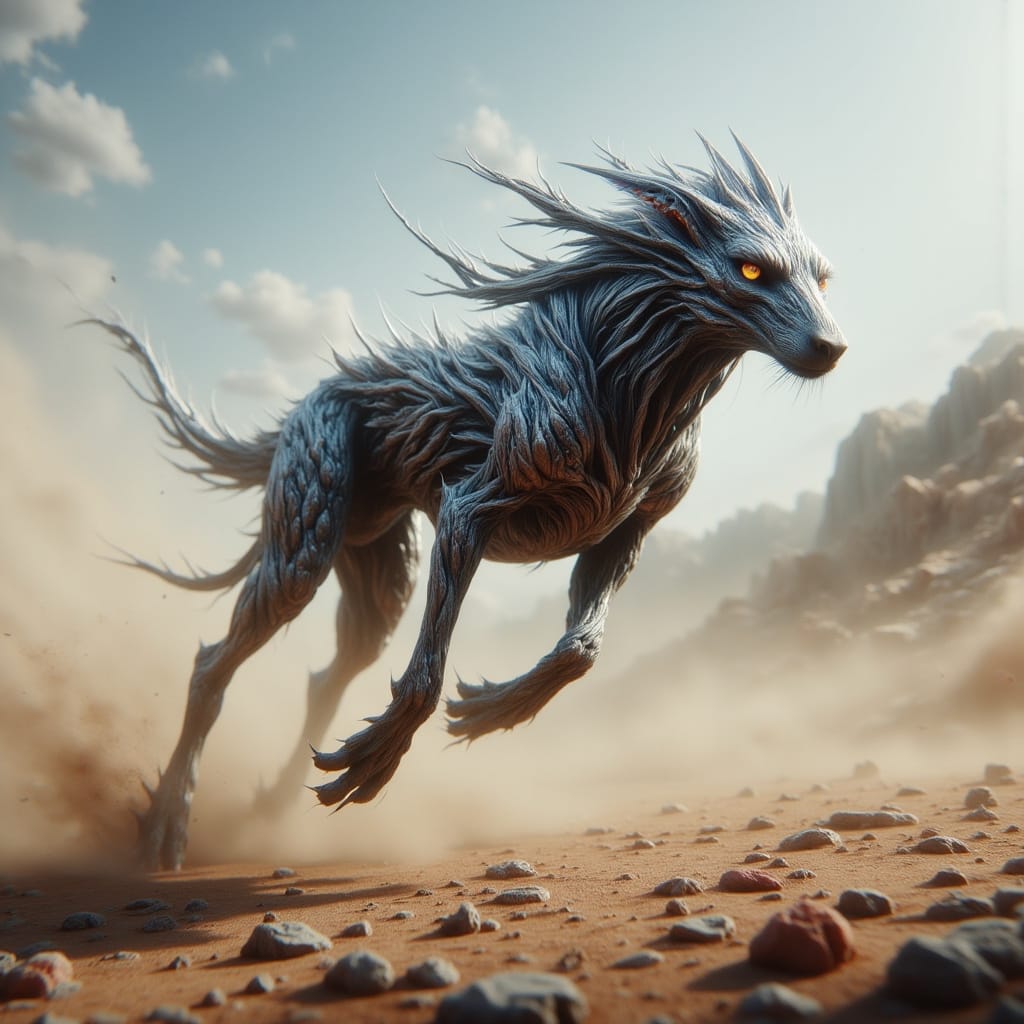
Table of Contents
Likely iridescent under sun, shimmering to confuse predators and make them appear “blurred.”
Some traditions describe them as “silver shadows.”
Complex herd-coordination behaviors suggest advanced instinctual “group intelligence.”
Footprint trails suggest they migrated in a circular path spanning hundreds of kilometers, vanishing suddenly.
Kiwta: Myth of “The Vanished Chase,” where the herds ran so fast they outran time itself.
Pecou: Whispered tales that their disappearance was punishment for pride—“to race against gods is to leave the world behind.”


Comments