Silverroot
Properties
Material Characteristics
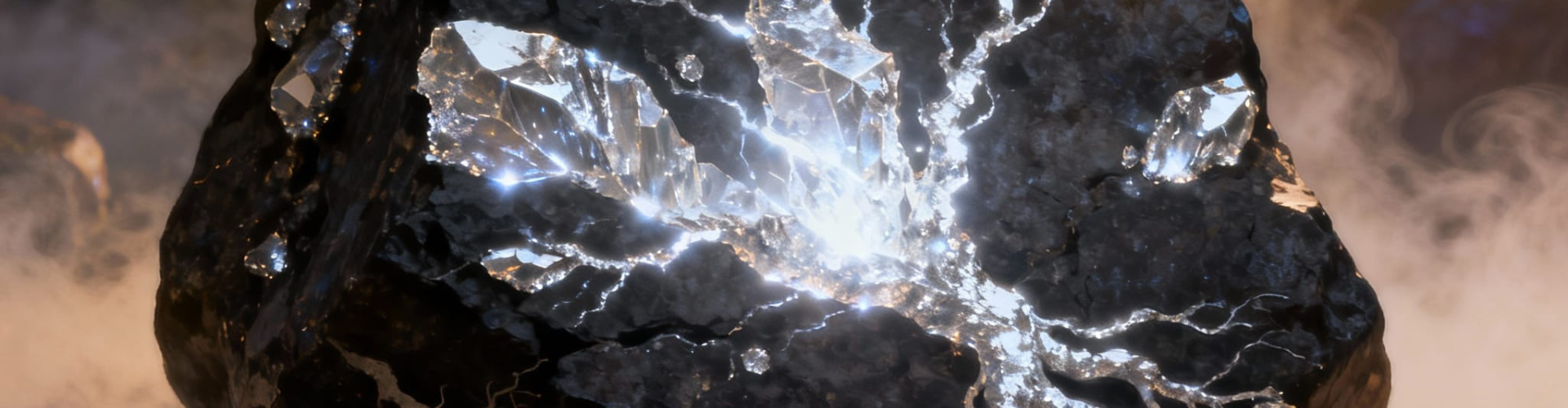
Silverroot resembles crystallized moonlight more than stone. Its branching, root-like structures give it its name: it appears to grow through rock in fractal patterns. When handled, it feels strangely cool and slightly soft, like firm wax, though it will not deform unless intentionally heated.
If held for too long, it leaves faint silver dust on the fingers—harmless, but slightly luminescent in the dark.
Silverroot emits a faint hum when near strong magickal fields.
Physical & Chemical Properties
Heat-sensitive: softens at mild warmth and will dissolve into vapor if heated too quickly.
Moon-reactive: glows faintly under moonlight; grows unstable during full moons.
Magick-conductive: channels magickal energy smoothly, making it excellent for catalysts.
Water-fragile: prolonged exposure to water erodes it into shimmering residue.
Spirit-affinity: Responds strongly during astral-alchemical work, sometimes too strongly.
Silverroot vapor is mildly intoxicating and induces brief euphoria and distorted color perception.
Compounds
Silverroot naturally contains:
- Argentic Ether: Reactive magickal compound responsible for its glow.
- Rootsilica: Structural mineral that forms its branching patterns.
- Trace moon salts embedded during geological formation.
Geology & Geography
Found only around Temislow, where the land sits on intersecting ley-lines and dormant volcanic channels. Silverroot forms when moon-saturated groundwater reacts with volcanic ash deposits over thousands of years.
Deposits “grow” outward extremely slowly—only a few millimeters per century.
Origin & Source
Harvested from shallow caverns or cliff-side seams. Because it forms like frost rather than rock, a poorly aimed pickaxe can destroy an entire cluster instantly.
Rootseekers harvest it with chilled chisels and enchanted gloves.
Life & Expiration
Silverroot is inherently unstable:
- After mining, it remains viable for 13–17 months before sublimating.
- Storing it in cold, dry environments extends its life.
- Exposure to sunlight accelerates decay dramatically.
History & Usage
History
First referenced in Old Temislow folktales as “the moon’s roots.” Early alchemists believed it was divine in nature and extremely dangerous. Over time, it became a cornerstone of several advanced formulas, especially in:
- healing accelerants
- astral projection rituals
- spirit-binding inks
Discovery
Discovered accidentally in 1780 AR when a collapse revealed glowing veins. Miner Hayden Mossk reportedly thought he’d found “frozen lightning.” Alchemists took decades to understand its properties.
Everyday use
Not used in daily life due to rarity, but small flakes appear in:
- high-value inks
- ceremonial charms
- noble-grade potions
Cultural Significance and Usage
In Temislow, Silverroot symbolizes:
- ancestral guidance
- cycles of decay and renewal
- the thin boundary between material and spirit
Industrial Use
A core ingredient in:
- astral distillation engines
- cryo-smithing catalysts
- stabilizing bases for volatile potions
Refinement
Requires chilling to -30° to prevent sublimation. Refined by:
- Delicately brushing off claystone.
- Cooling in a cryo-chamber.
- Coating in runic lacquer to stabilize surface.
Manufacturing & Products
Products include:
- Silverroot Filigree (protective amulets)
- Silverroot Vials used to hold unstable essences
- Glow-dust used in ritual paints
Byproducts & Sideproducts
Rootdust: silver powder left after sublimation; used in inks.
Moon residue: harmless but reflective powder used in cosmetics.
Hazards
Inhaled vapor induces mental confusion.
Direct heat exposure can cause sudden sublimation and pressure bursts.
Miners risk cave-instability; Silverroot weakens surrounding rock.
Environmental Impact
Removing Silverroot destabilizes certain spiritual flows around Temislow. Excess extraction has caused mild hauntings and disrupted local fauna patterns.
Reusability & Recycling
Sublimated Silverroot cannot be reclaimed, but rootdust can be collected and repurposed in inks and protective powders.
Distribution
Trade & Market
Only three licensed Silverroot merchants operate legally in Temislow. Black market sales are common due to tight restrictions. Prices fluctuate wildly depending on moon phase and recent discoveries.
Storage
Stored in:
- cold, warded vaults
- enchanted crystal boxes
- underground cryo-lockers
Law & Regulation
Temislow enforces strict control:
- Unlicensed possession = heavy fines or imprisonment
- Illegal extraction = exile from the region
- Transport requires Moonlight Permits
117Srʹ
117Table of Contents
Extremely high; valued not only for alchemical potency but its rarity and instability.
Legendary Rare. Only found in a narrow geological ring around Temislow, and even there in small, unpredictable patches.
When freshly mined: faint metallic sweetness, like rain hitting hot stone.
Alchemists who have sampled flakes describe an acrid, numbing tingle with a cold aftertaste.
Pale, luminous silver threaded with root-like veins of pale blue. When exposed to moonlight, the veins faintly glow.
Unknown. It sublimates into silvery vapor before reaching a true boil.
Melts at extremely low temperatures compared to other metals; begins softening at human body heat.
Lightweight; comparable to driftwood despite its metallic composition.
Found as delicate, branching mineral clusters embedded in claystone or volcanic ash layers.


Comments