
You take the hand
You take the hand.
It is cool, damp, and soft as packed earth after rain. Threads of moss creep across your fingers, curling at your knuckles, but they do not burrow or bite. They simply rest there, alive, testing the warmth of your skin. The creature gives the faintest squeeze—gentle, almost shy—before guiding you to the empty chair.
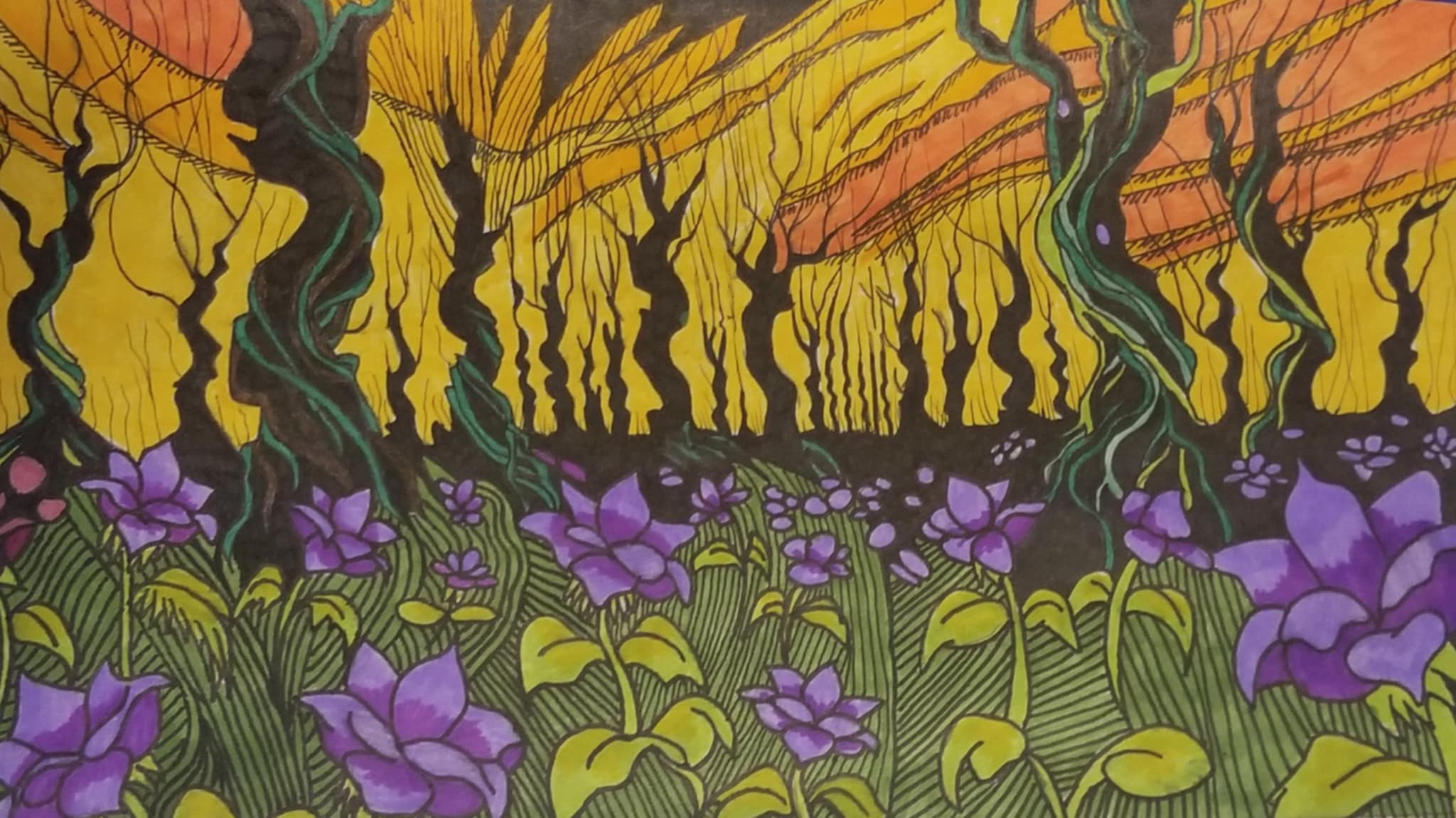
The flowers hush. Their restless swaying slows, their petals tilting just enough to watch. Their colors are too bright, bleeding into one another, but the weight of their attention presses against your shoulders as heavily as any gaze. You lower yourself onto the chair.
The wood creaks beneath you, but it holds. It feels… ordinary. Uncannily so. As though pulled from some inn you once passed in a different lifetime. The scent of whiskey is stronger now, carried up with the humid exhale of the moss-skinned figure.
The bottle waits between you, fat-bellied and sweating amber. The creature takes it in its other hand and pours. The liquid catches the light, sharp and golden, rolling into each glass with a low, steady sound.
One slides across the table to you. Its rim is smudged with fingerprints not quite human, faintly green with moss.
“Drink,” the creature says, in that damp voice. Its pink eyes swell with reflection—your reflection, fractured and strange. “It helps. It opens.”
You raise the glass. The whiskey burns your nose before it touches your lips. It is rich, deep, the scent of oak and fire, a smell that clings to memory. You taste it. Heat blooms down your throat, spreading into the lattice of your chest, through your marrow. For an instant you almost cough, the sharpness catching on the broken ridges inside you. But then it softens. Warms. Spreads.
You drink again. And again.
The moss-creature smiles—or something like a smile. Roots curl inward and outward around its lips. It lifts its own glass and tips it toward you before swallowing. The amber catches in its mossy throat, disappearing into the shifting green.
When it speaks again, its voice is quieter. “I was like you. Once.”
You lower your glass. The words linger.
The creature’s pink eyes drift upward, unfocused. Its moss stirs in a breeze that is not there. “I walked here with a body I thought was mine. With a name I thought would last forever. But it… slipped. Melted. Was taken, given back, remade.” Its moss fingers twitch faintly, stroking at the table’s worn wood. “I remember that I was human. But I do not remember what it felt like.”
The whiskey burns again in your gut.
Grief fills the silence. Grief unspoken, grief you have carried in your marrow since the brood split from your ribs. Grief older still—the memory of who you were before the forest took you in its arms. You think of the self you expected to become, the life you imagined stretching forward like a neat path. Each one of those selves is gone. Dead. Eaten by flowers and insects and roots.
The creature seems to read the thought in your posture. Its moss hand extends again, covering yours where it grips the glass. The touch is grounding. It smells of soil.
“Grieving is the only honest thing we do,” it says. “We grieve what we lose. What we outgrow. We even grieve the versions of ourselves we will never be.” Its pink eyes tilt, solemn. “You are grieving. I can taste it.”
You swallow, the whiskey rough in your throat. “It hurts.”
The creature’s moss ripples faintly, like wind passing through grass. “Yes.”
It takes another slow drink. Its glass clinks gently against the table. “Do you think I did not grieve? I wept until roots split my face. I screamed until the moss grew thick enough to choke the sound. And still it did not stop. Change never stops. It only teaches us to stop resisting.”
You stare into your glass, the amber light rippling across the warped wood. The forest presses close at the clearing’s edge, silent except for the whisper of flowers. They lean closer. Listening.
“I thought I was meant to fight,” you say softly.
The moss-figure tilts its head. “And did you?”
“I fought.” You remember your nails digging into soft flesh, the faceless head bending toward you, the futility of it. “I fought until I had nothing left. Until it gave me something else.”
“And now?”
Your ribs ache at the memory of the brood stirring, hatching. Of the way you sagged when the last of them slipped free, and how quiet your body has been ever since. The emptiness inside is not loss—it is space. Space waiting to be filled.
You drink again. The whiskey burns, but you do not cough this time.
“Now,” you say slowly, “I don’t know what I am.”
The moss-creature leans closer. Its vast pink eyes glow faintly, twin moons swollen with sorrow. “You are not human. And you are not alone.”
The words land in you with the weight of stone and the gentleness of rain. Not human. Not alone.
For the first time since you stumbled into the clearing, you allow yourself to breathe without fear. The air fills you like it belongs to you.
The creature’s moss hand strokes your wrist, leaving faint green streaks. “This field is your home now. The forest has chosen you, as it chose me. It will keep choosing you, until the shape of you is unrecognizable to anyone who remembers what it was to be human.”
You set your glass down. The sound of it on the table is final, like a bell rung for mourning.
“You don’t miss it?” you ask.
The moss-creature’s mouth curls. “I miss every version of myself. I keep them in my chest like ghosts. But I do not wish them back. They would wither here. They would rot with longing. The shape I am now… fits.”
The thought coils around you like roots tightening. Grieving not just what you were, but what you thought you might be—the human future that is gone. That grief has teeth, yes, but it also has wings.
The creature rises, tall and green, moss trailing from its limbs like a mantle. It rounds the table, glass in hand, and comes to stand beside you. Its pink eyes tilt down toward you, impossibly kind.
“Stand,” it says.
You obey.
It places one moss-covered hand flat against your chest. Its roots brush the hollowed lattice of your ribs, the scars where the brood once nested. The contact is neither invasive nor cruel. It is steady, grounding.
“You belong,” it murmurs.
Something in you breaks. Not like bone, not like tearing flesh—more like a dam crumbling, more like breath finally loosed. You sag forward, into its chest of damp moss, and it holds you. It does not matter that its arms are not skin, that its heartbeat is the slow pulse of sap. It holds you as though you are something worth holding.
You stay like that for a long time. The flowers do not move. The field is utterly still, as though honoring a funeral rite.
At last, the moss-creature pulls back. Its roots unwind from your shoulders. It tips your chin gently upward, its enormous eyes filling your vision.
“Say it,” it whispers.
You know what it means.
“I am not human.”
The words leave your lips like ash. Like seed. They fall into the soil between you, and the field itself seems to exhale. The flowers tremble faintly, their petals twitching in approval.
The creature smiles, its moss rippling. “Good. Now you are free.”
You breathe, and the air is different. Not the air of a stranger wandering through rot and ruin, but the air of something rooted here, something claimed. The forest does not watch you now—it embraces you.
The moss-creature pours the last of the whiskey. It hands you the glass, and you take it. The two of you drink in silence, companions at the end of one world and the beginning of another.
When the bottle is empty, the moss-creature sets it gently on the grass. It presses its mossy palm to yours once more.
“Stay,” it says. “This field has more to show you. The forest has more to teach.”
And you realize: you want that. You want to remain, not as the human you once were, but as the changed thing you have become. Not fighting, not running. Belonging.
The flowers bow as you and the moss-creature turn back toward the table. Their petals rustle like applause. Their colors sharpen in the fading light. You sit once more, and for the first time since the forest claimed you, the grief does not choke you. It breathes with you.
You are no longer human. You are not alone.
The field is your home.
The forest waits.
And you are ready to discover what it has in store.


Comments
Author's Notes
Ending Number 8