
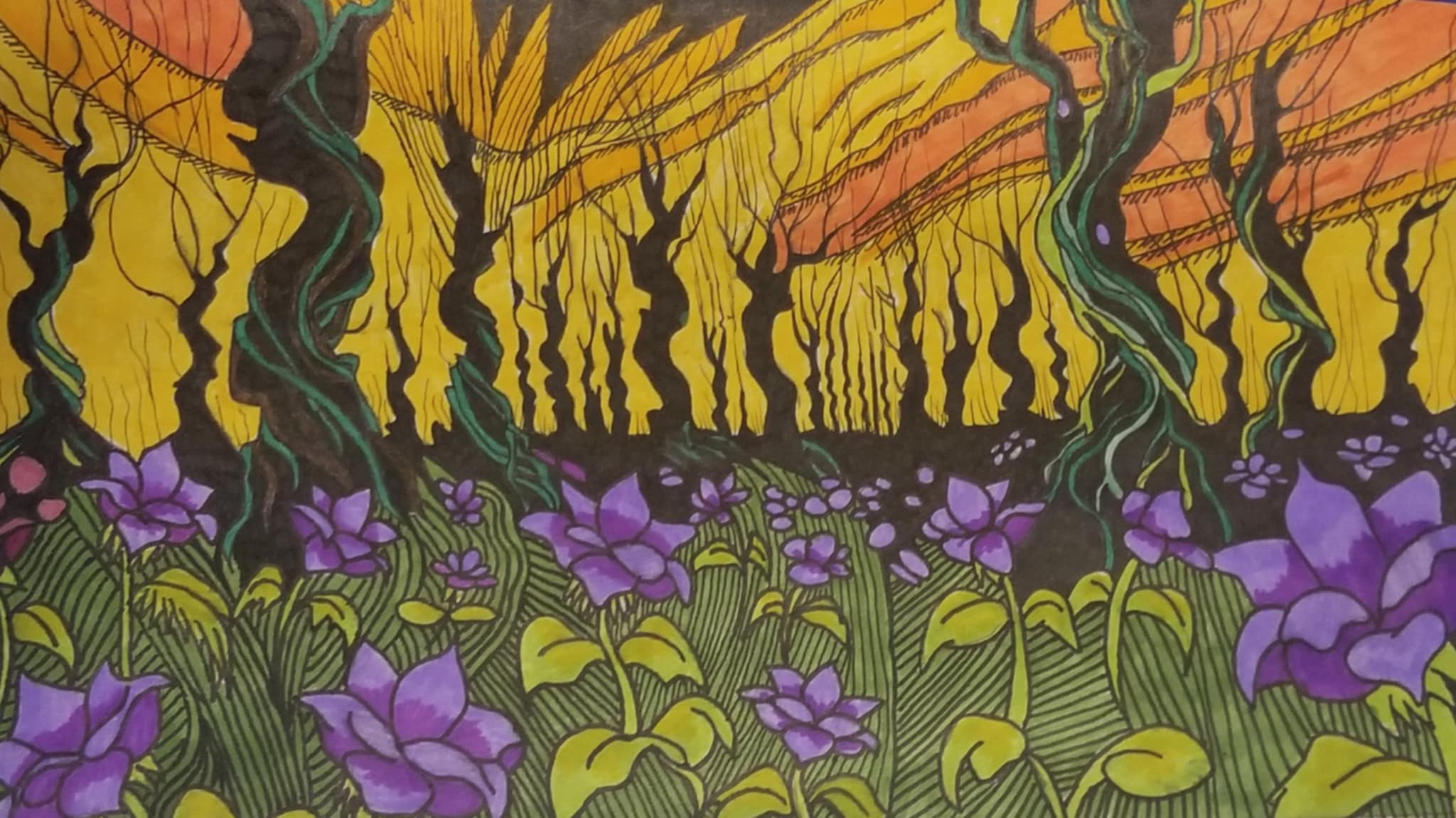
You refuse the hand
You do not take its hand.
The moss-skinned thing holds its gesture for a moment longer, then lets it fall, the sound of its damp palm against the wooden table oddly loud in the flower-thick silence. It does not move to stop you. Its pink eyes watch, unblinking, while you shift your weight forward, away from the circle, past the table, down the other side of the hill.
You do not look back.
The creature speaks anyway. Its voice follows you, soft and wet, like moss soaking up rain. “You will not be human again.”
The whiskey glass clinks against wood. The bottle breathes as it is tilted, amber liquid gurgling into the waiting cup.
“No one leaves unchanged. The forest gives, and it takes. To ignore grief is to rot standing.”
You keep walking.
The path ahead plunges into flowers once more, red and yellow and black blossoms craning toward you as though desperate to taste what you carry. You push into them, ignoring the scrape of their petals against your ribs, ignoring the whispers of stamen filaments stroking your scars.
Behind you, the moss-voice drifts like fog. “Change is not cruelty. It is the only kindness this world knows. Come back when you are ready.”
You do not answer.
The path winds deeper into the field. The blooms grow larger, stranger. Their colors dull from bright to bruised. Petals grow thick as tongues, wet with mucous sheen. Some blossoms yawn wide as you pass, their throats hollow caverns lined with barbs that glisten faintly with old blood.
One flower bends too far, and the barbs scrape your shoulder. You hiss. The pain is sharp but shallow—no worse than the forest’s many other gifts. You push forward, refusing to notice how the barbs cling to the strip of skin they’ve taken, pulling it free like bark peeled from a tree.
You leave it behind.
The ground tilts downward, the soil looser, damper. A tree line waits ahead, trunks rising like pillars, black bark glossy with sap. Relief almost touches you—trees mean solidity, order, shelter. But the moment you brush against the first, reality unravels.
The bark snags on your ribs. You feel it drag, rough as stone. And then your skin tears free—fragile, already more membrane than flesh. A long sheet of it peels from you, fluttering to the ground like dead parchment. Beneath it, the bone-lattice of your chest gleams, white as worms, open to air.
The tree drinks it.
Where the strip of skin lands, roots shiver. Fine tendrils erupt, pulling it down into the soil. The bark swells faintly where your blood smears across it, drinking, pulsing, dark veins spreading outward.
You stagger. For a heartbeat, you expect to collapse—expect the marrow of your body to come spilling out into the dirt. But you remain upright, though lighter. More hollow.
You keep walking.
The trees crowd close. Each one brushes you as you pass. Each time, more of you comes away—scraps of flesh, flakes of bone, tufts of hair clotted with blood. Some peel without you noticing, only realized when you glance back and see a breadcrumb trail of yourself scattered across the roots.
The forest eats you piece by piece.
You deny it.
You walk faster, as though momentum alone could keep you intact.
The flowers still follow. They bloom between tree roots, lean from branches, creep across bark in parasite clusters. They hunger openly now, no longer coy.
A blossom shaped like a trumpet fastens around your thigh. Its throat contracts, teeth sinking just shy of bone. You kick it off, leaving behind a torn chunk of meat. It flops on the ground, chewing what it holds, a satisfied hum vibrating its petals.
Another, violet and slick, brushes your arm and takes your hand whole—skin sliding away like a glove, leaving bone shining wetly. You wrench free, skeletal fingers clicking. The flower shivers in delight.
Still, you press on.
You tell yourself you are still human.
You straighten your spine, though it grinds in protest. You set your jaw, though teeth fall loose, clicking down your chest to vanish in the loam. You breathe, though your lungs are a shredded ruin.
Each step is a declaration: I am unchanged.
But you are lying.
The forest seems to know. It presses in closer, conspiratorial, whispering its rebuttal in every scrape of bark, every nibble of bloom.
Your reflection in a pool of rainwater confirms what the forest knows. The face that looks back is not yours. It is a ruin, a scaffold of bone, a lattice of scar. Hollow sockets. Teeth missing. Skin clinging only in patches, flayed thin by trees and flowers alike.
You lean over the pool, stare hard.
You tell yourself: This is temporary. This is injury, not transformation.
The reflection ripples as if laughing.
You stand and stumble forward. The trees here stand wider apart, their branches laced overhead like fingers interlocked. Flowers bloom high, dangling like chandeliers. Their long tongues reach for you as you pass, brushing your crown, leaving trails of slime that sting.
One latches to your skull. Its tongue curls under the ridge of bone, probing the seam where flesh once held tight. With a snap, it pulls free a fragment of yourself—a plate of bone, old and thin. Your head lightens. Air whistles through gaps it should not.
You stumble, but catch yourself. Keep walking.
You tell yourself: I can endure.
Endure. As if endurance could stitch you back together. As if denial could undo the brood, the clearing, the moss-skin’s warning.
But grief is heavier than flesh.
You know what you lost: not only body, not only the frail husk now crumbling. You lost the idea of being whole. You lost the possibility of returning to what you were.
And still you insist: If I walk far enough, if I leave this place behind, I will be myself again.
You do not believe it.
But you repeat it, like a prayer, like a spell, every step through the dark.
The forest responds with laughter.
A tree ahead splits open as you near, its trunk peeling into a wet mouth. It breathes on you, warm, fragrant with sap and rot. From within, roots twitch, white and eager.
You skirt around it, fast, though the roots stroke your legs in passing, tugging loose more shreds of yourself.
The laughter follows, in rustle of leaves, in creak of branches, in chorus of blossoms sighing.
Every piece you lose, the forest claims. Nothing wasted. Nothing ignored.
Except you.
Your denial is a shield made of paper. Each step tears another hole.
By the time you break from the trees again, into a new clearing, you are half-gone.
Your arms are bare bone, wrapped in veins like drying ropes. Your chest is a cage, empty but for faint scraps of tissue clinging stubbornly, humming with memory. Your skull is half-bared, eyes sunken but still seeing. Somehow, impossibly, you move.
The clearing holds no table this time. No moss-skin, no whiskey. Only silence.
The flowers around its edge sway lazily, watching you enter. Their stamens glisten. Their throats gape. None bother to reach for you. You have nothing left to take.
You stagger to the center. Collapse to your knees.
You tell yourself again: I am still human.
Your voice rattles hollow in your chest, a whisper through bone.
The flowers lean forward, listening.
You repeat it until the words crack, until the silence swallows them whole.
Until even you cannot pretend to believe.
And still you do not weep.
You are too empty for grief.
You only kneel there, denying until denial is the only thing left that belongs to you.
The forest waits.
It has all the time in the world.
Slowly, you crumble and fade to ash. Your fine powder drifting through the forest, still impossibly aware.


Comments
Author's Notes
Ending Number 9