
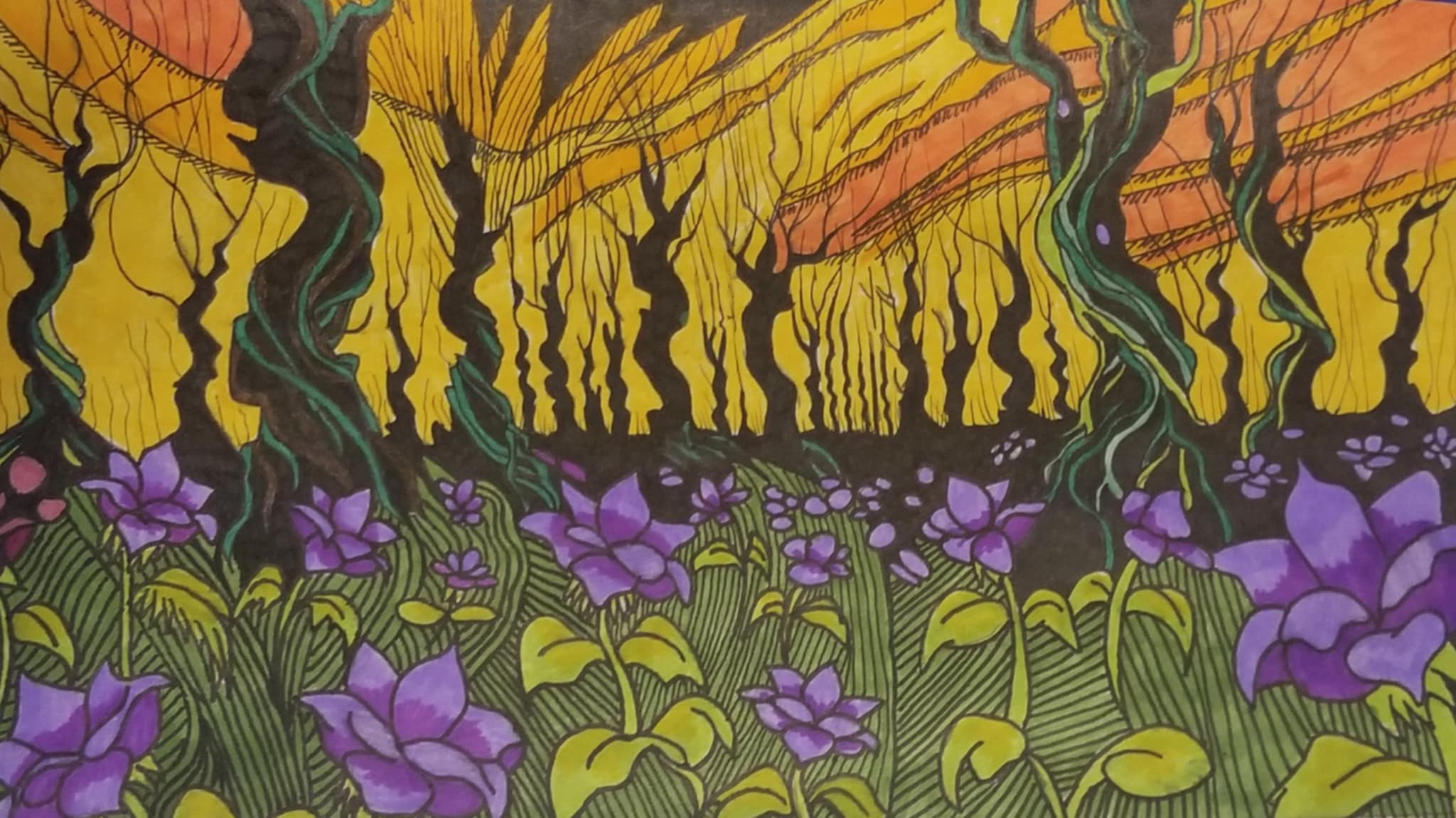
You Continue on the Narrow Trail
You draw a breath that tastes of copper and soil and step into the scar of a path.
It feels like crossing a threshold.
The branches close in immediately. Their limbs are not just wood; they are claws, fingers, antlers, all at once. Bark rubs against your shoulders as you squeeze between trunks too narrow for a trail, yet somehow a trail persists. Every surface here has a damp sheen, as though the forest is sweating.
The silence is immense. It swells around you like water, pressing at your eardrums. Every step you take sounds muffled, as though your boots sink into felt instead of earth. No birds. No wind. Even your breathing seems swallowed, muffled down into a hush.
Light filters through but changes color. Not the weak grey you left behind but a greenish glow, like bruised skin. Shadows stretch long and crooked, crossing the path in spidery bars. Some move when you move. Others do not. One clings to your foot for three steps before tearing free like wet paper.
You tell yourself to keep walking. The path is so narrow now you must duck, push aside hanging moss, lift your knees high over snarled roots. The ground is slick, almost pulsing. You cannot tell if you are climbing or descending, only that the air grows warmer.
A sound breaks the silence.
At first you think it’s a faint hiss of steam, or maybe your own blood in your ears. But it sharpens. High-pitched. Reedy. The sound of wings. Not one pair. Many.
You stop.
The hiss continues. It swells. It has a rhythm like breathing. Something is coming.
Ahead the trees part just enough to show a hollow. Its floor glistens with some sticky secretion that coats the roots like amber. Dozens—no, hundreds—of tiny shapes crawl across it, glinting. They are not ants. They are not bees. They are something between: thin, segmented, needle-limbed, their bodies translucent, faintly glowing with a sour yellow light. Their wings beat so fast they look like smoke.
You take a step back. The insects pause as one, their tiny heads turning toward you. They have no eyes, only tapered points like the heads of sewing pins. Yet you feel them look.
The hiss rises to a shriek.
They lift into the air together, a single column of stinging smoke. The sound claws at your teeth.
You turn to flee but the path behind you is gone—sealed by branches knitted together like muscle. The only way out is through.
You press forward.
The first wave hits you like hail. Tiny bodies strike your arms, your face, your chest. They are so light, almost nothing, yet each impact leaves a needle of fire. You swat at them and your hand comes away wet—your own blood in fine droplets.
They circle you in a funnel. Wings rasp against your skin. Their bodies smell of vinegar and rot. They land on your neck, your wrists, the soft inside of your elbow, and drive their pin-heads into you.
The pain is sharp at first, then dull, then something stranger. The stings do not burn like venom; they hum. The hum spreads beneath your skin, a vibration you can feel in your teeth.
You rip one off and its body splits like overripe fruit, oozing a clear gel. The gel soaks into your palm and the sting there stops hurting. It begins to tingle instead.
You stagger forward through the swarm. They follow, not chasing but surrounding, herding. Their formation shifts like a living veil.
Another sting at your ribs. Another at your throat. You slap and tear but there are too many. Their wings brush your lips. One crawls up into your hair and disappears against your scalp. You feel it burrow.
The hum deepens.
It is not sound now but pressure. It moves through your blood like an echo. You clutch at your arm and feel something moving under the skin—tiny ridges like sand shifting beneath cloth.
You push on. The path widens into another hollow. The ground here is soft, spongy. With each step you sink deeper, your boots making no sound. The trees lean inward so far their branches mesh above, forming a ceiling. Strips of moss hang like curtains. The insects cling to them in clusters, their bodies quivering.
You look down and realize the ground is not soil at all but a carpet of discarded husks—shed skins, papery and translucent, thousands of them, crunching faintly beneath you. Each one is shaped like the insects but larger, their pin-heads split open like flower buds.
You are trembling.
Not from fear.
From the vibration in your blood.
Another sting.
And another.
Your skin is alive with it. The hum becomes a thrum, a pulse. Your heartbeat wavers, syncs to it, then stutters. You gasp. It feels as though something inside you is calling to them, or answering.
You claw at your sleeve and see your forearm mottled with tiny red welts. Beneath the welts something stirs—threads of pale movement, too fine to be veins.
You stagger to your knees. The insects descend. They are not attacking now. They are landing on you in neat rows like stitches. They march across your arms, your chest, your face. You try to brush them away but your limbs feel heavy, distant, as though you are underwater.
One crawls across your lips and pricks the corner of your mouth. The taste is metallic, sweet. Another wriggles against your ear. You feel its head press inward.
The hum becomes a lullaby.
You are so tired.
You close your eyes and see shapes—hexagons of light, endless and perfect, a hive without walls. In the center is you, but you are not alone. You are part of something. Not lost. Not unwanted.
Your stomach cramps. A wet sound escapes your throat. You open your shirt and see the skin there ripple. The insects’ gel glistens across your chest like sweat but thicker, stringing between welts. It hardens into fine filaments that pull tight, drawing lines across your ribs.
You dig at it with your nails but the skin beneath is numb now. Your fingers slide off as though you are touching wax.
The path tilts. Or you tilt. You can’t tell. You lurch forward and catch yourself on a trunk. The bark yields like flesh beneath your palm. It throbs faintly, echoing the thrum in your blood.
You realize you can hear the insects inside you now. Not their wings. Their thoughts. A sound like rain on glass, like many tiny mouths whispering at once: not alone. not alone. not alone.
You stumble deeper into the hollow. The air smells thick and sweet, like honey gone sour. In the far corner a massive cocoon dangles from a branch. It is shaped almost like a human curled into a ball. Its skin pulses with dim yellow light.
The insects guide you toward it.
Your legs move without command. Your arms hang heavy. Each step squelches through husks and slime.
By the time you reach the cocoon your chest is tight. The filaments across your ribs have drawn together, forming a lattice. Your skin bulges between the gaps. Something beneath pushes outward, testing the weave.
You touch the cocoon and it is warm. Softer than you expect. It shudders under your hand.
The insects rise from you all at once, leaving your body covered in welts and threads. They spiral upward, then settle onto the cocoon, covering it completely. Their wings beat in unison, a single breath.
The cocoon splits.
A thin seam opens down its length, weeping fluid. Inside you glimpse nothing clearly—just a mass of limbs and wings and teeth that are not teeth. A smell like rot and nectar rushes out, dizzying.
You fall to your knees.
Your chest splits—not skin tearing but threads pulling apart. The filaments open you along the sternum, just a hand’s width, enough for a gust of hot air to escape. Your heart is pounding but you do not feel pain. Only pressure. Only inevitability.
The insects crawl into the opening. Not dozens. Hundreds. They pour inside like smoke, filling the cavity. The pressure becomes fullness. Your head tips back.
You should be screaming.
You are not.
You are humming.
The cocoon trembles as if in answer. The swarm inside you hums louder. The lattice across your chest hardens, knitting shut again, trapping them within.
You stagger upright. You feel them moving in you—not biting, not feeding, just being, threading through your blood, curling around your bones.
You take a step. The forest tilts again. The path extends forward, a narrow scar of black earth, and you follow it without thinking.
Your arms tingle. The welts there have opened into tiny mouths, each exhaling a thin ribbon of vapor. Your breath smells like honey and vinegar.
The insects are quiet now. But you can feel them listening. Waiting.
You walk. Because there is nothing else to do. Because turning back is impossible.
The trees ahead lean closer, their knots like watching eyes. Shadows stretch long and wrong. The ground pulses faintly with each of your heartbeats.
You do not know if you are walking deeper into the forest or deeper into the hive that has grown inside you.
But for the first time, you do not feel entirely alone.


Comments