
You Choose to Remain Human
The decision sits heavy in your chest, a cold weight that tastes of iron. You’ve chosen to remain what you are—human, fragile, finite. You expect disappointment in his eyes, maybe even pity. Instead, you are met with rage.
A snarl rips through the air, raw and animal, and before you can step back, his hand—no, his claw—lashes out. The sound of fabric tearing is drowned beneath the wet, visceral rip of flesh. Heat blooms across your chest, hot and slick, your own heartbeat pounding in your ears. The world contracts to the sharp agony where his talons have carved through you, five burning lines etched deep into skin and muscle.
You cry out, the sound jagged, breaking from your throat in a shuddering gasp. But his voice—his scream—rises with yours. It is not a predator’s triumphant roar. It is something wilder, more unhinged. There is pain there, raw and echoing, so deep it rattles the air between you. It’s as though your wound has cut into him, too, as though the act has torn something from both of you.
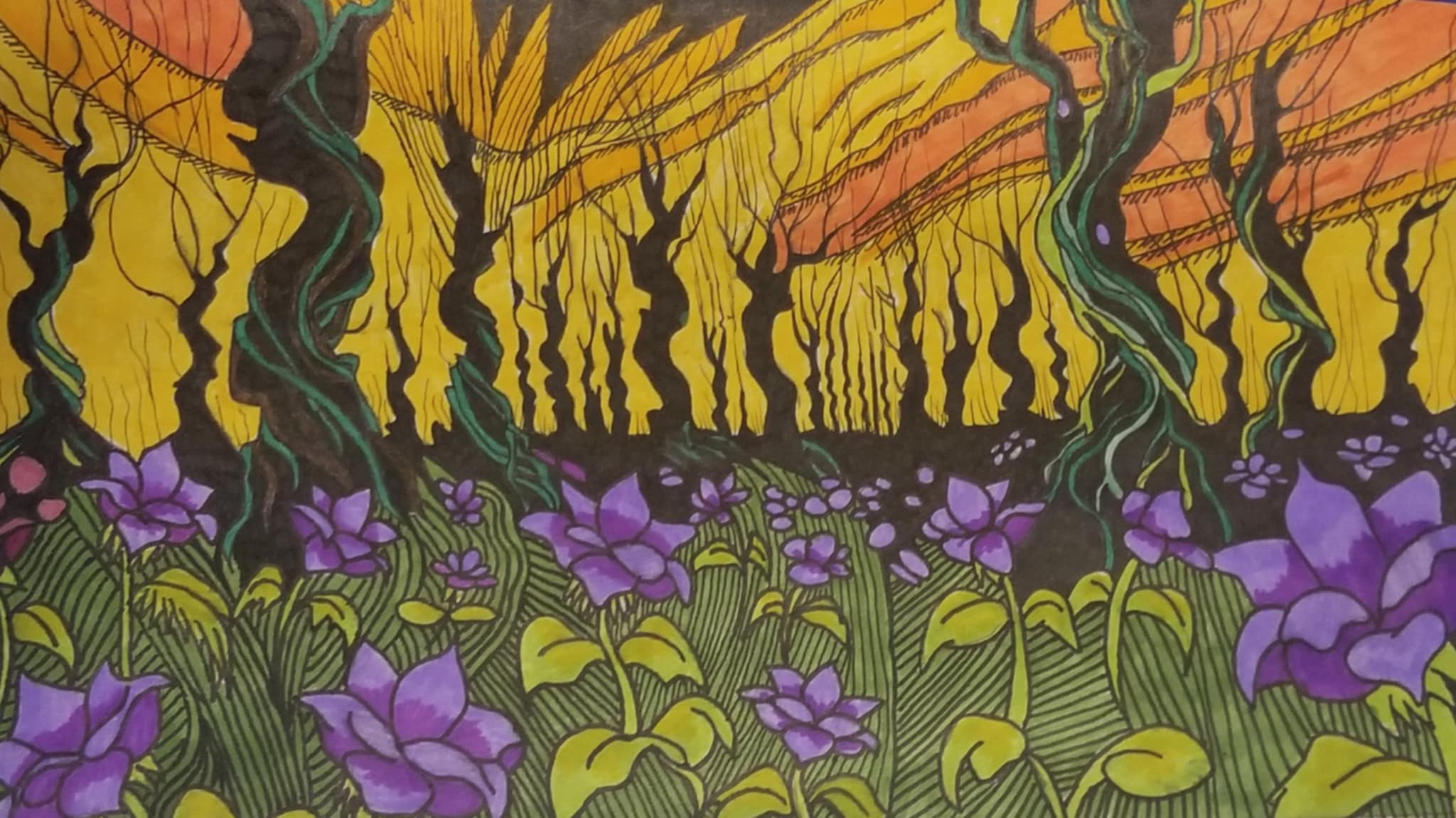
The trees shiver, their branches clawing at a sky suddenly gone dim. Then—
“Ursa,” a voice calls.
Soft. Thin. But clear enough to cleave through the air like a blade of ice.
The bells in the distance stop ringing. The forest exhales a long, cold breath, and all sound dies in its wake.
You feel his body go rigid, his face turning—not away from you entirely, but toward the dark seam of trees beyond the stone circle. He is still impossibly close, close enough that the steam of his breath mingles with yours, close enough that his clawed hand trembles near your torn shirt. The stone circle still hums with invisible force, its unseen wall holding you fast, as though you were prey trapped in an ancient snare.
You follow his gaze.
The forest parts. Something emerges—not with the sure-footed grace of a hunter, but with the halting, uneven gait of someone too weak to bear the weight of their own body.
A woman.
She shuffles forward, the movement slow, labored, as though each step must be coaxed from failing muscles. Her skin is pale—too pale—and tinged with a faint blue that deepens in the hollows of her cheeks, at the curve of her throat, at the shadow beneath her sunken eyes. Ice clings to her like a parasite—fragile, flaking shards that fall with every movement, drifting to the stone with soft, crystalline taps. Her hair is brittle, the color of frozen ash, strands breaking as they brush against her cheeks.
The closer she comes, the more wrong she looks—not simply sick, but hollowed out, as if something vital has been bleeding from her for years. The air around her smells faintly of winter rain and something older, like wood rot trapped beneath frost. She stumbles, knees buckling beneath her, and collapses just shy of the circle’s boundary.
Her breath fogs the air in shallow bursts. She lifts her head enough to meet his eyes, her voice barely more than a frost-bitten whisper.
“They could change their mind,” she says.
Her words linger in the stillness, fragile and almost unreal. You don’t know who they are, or what mind might yet be changed, but the sound of them stirs something unsettled in your chest.
His jaw clenches. The storm in his expression breaks into something else—something you can’t quite name, but it pulls at you in ways that feel dangerous. He shoves you backward with one hand, and the barrier of the circle gives way. The force of it drops you onto the damp earth outside the stones, pain flaring through your ribs. You scramble back, sucking in sharp breaths, and press your hands against your chest to slow the bleeding.
He doesn’t look at you again.
Instead, he crosses to her, the woman who called his name. The anger that burned so hot a moment ago has gone out, replaced by a strange, fierce tenderness. He kneels, gathering her into his arms as though she might shatter under her own weight. She leans into him, too weak to hold herself up, her fingers curling faintly in the fabric at his shoulder.
“There is no more time,” he whispers.
The words are meant for her, not for you, but they echo through you all the same. No more time. You do not understand what is happening here—who she is to him, what doom ticks away in the marrow of her bones—but you can feel it: she is dying. The knowledge cuts through the fog of pain and confusion, sharp and unyielding.
And somehow, you know it is your fault.
You could have stopped this.
You don’t know how, not exactly, but the truth hums in your bones like the stone circle’s magic: you had been offered a choice, and your refusal has set this in motion. A part of you wants to explain yourself, to speak, to apologize—but no words come. Just the hot press of blood through your fingers and the weight of regret clawing at the edges of your mind.
You shake your head, as if to dislodge it all, and push yourself to your feet. No. You don’t owe them this—not your pain, not your life, not your loyalty. You turn away from them, from the strange and heavy magic in the air, and begin walking into the trees.
Each step is harder than it should be. The wound burns, your shirt sticking to your skin with the tacky heat of drying blood. You press harder, trying to keep the pain from stealing your breath, and keep moving. You do not look back—at least, not until you break free of the treeline.
You stumble forward, out of shadow and root, and fall hard onto something unyielding. Pavement. The sudden normality of it feels jarring, obscene, like waking from a dream mid-sentence. The road stretches in both directions, empty, gray, edged with patches of brittle grass.
You twist to look over your shoulder.
The forest stands there as it always has—just trees, ordinary and mute. No stone circle. No impossible man. No dying woman cloaked in frost. It’s as though they never existed.
And yet the ache in your chest—both the wound and something deeper—tells you otherwise.
Regret grips you with iron fingers. For a heartbeat, you wish—fiercely—that you had stayed, had stepped into whatever destiny he meant to thrust upon you. You wish you had taken the change, whatever it was, if it meant you could have remained in that place where the air hummed with ancient magic and the trees spoke in whispers you almost understood.
But no. That’s gone now. That path is closed.
You draw a ragged breath, forcing the thought away. The road stretches ahead. It must lead somewhere—anywhere but here. You pull yourself upright, each step a dull throb of pain, and begin to walk. The sky above is an indifferent gray, and the wind carries no scent of frost. Only the road remains.
You follow it.
Because there is nothing else left to do.


Comments
Author's Notes
Ending number 2.