
Shadow fell
The Shadowfell, also known as the Plane of Shadow, was one of the planes of existence in various cosmological models. Its purpose and characteristics evolved as new cosmologies were formulated. Other names for this plane included Shadowland, the Demiplane of Shadow, the Shadow Deep,and simply Shadow.
It existed as sort of a counterpart to the Feywild, in the sense that it was a reflection, or "echo", of the Prime Material Plane. Unlike the Feywild, it was a bleak, desolate place full of decay and death.
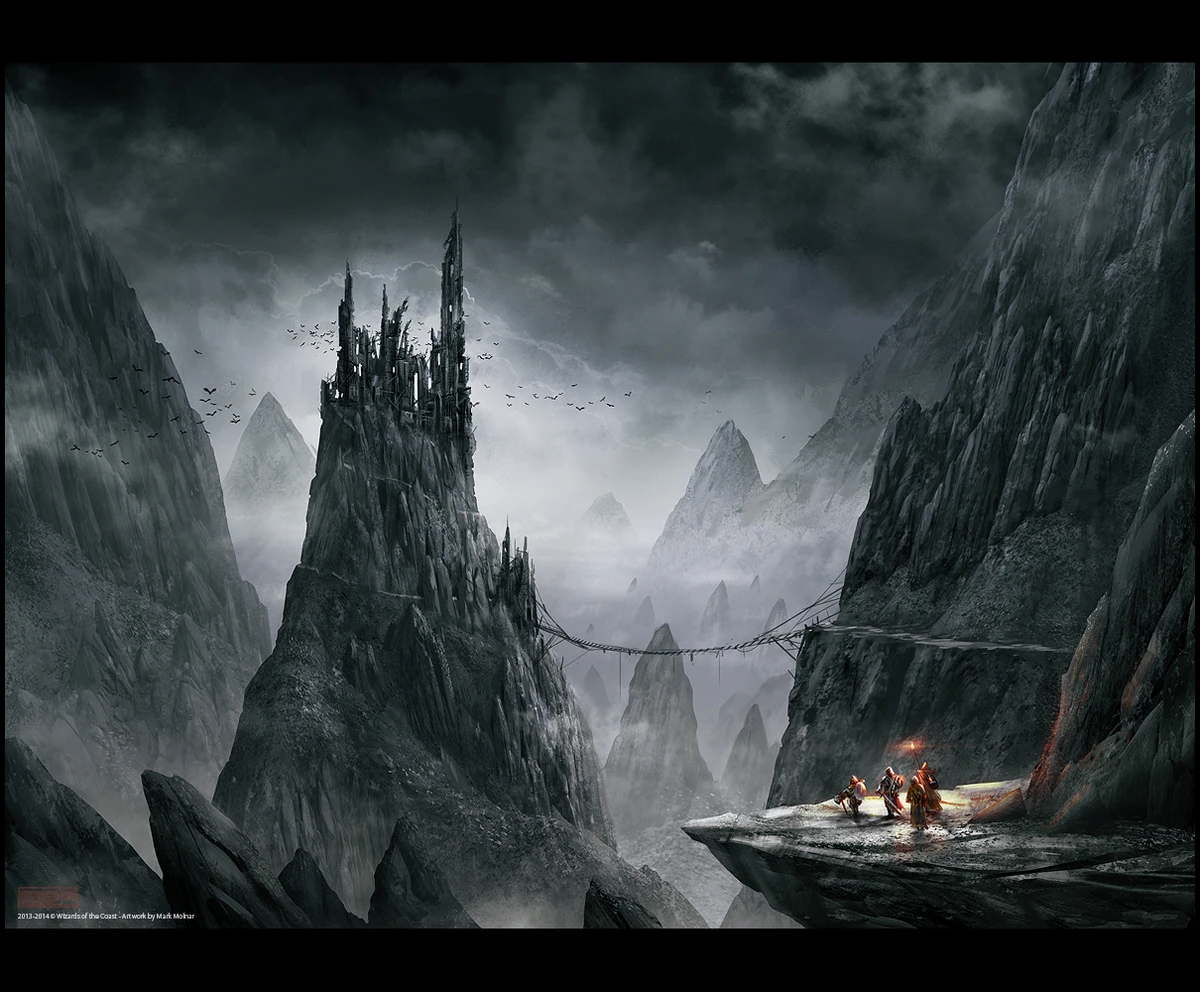
The most striking and immediate impression a visitor to the Plane of Shadow experienced was the lack of color and light; no sun, moon, or stars adorned the vault of the inky black sky, and all things looked as if the color had leeched out, leaving nothing but black and white, which in the dimness were more like "dark black" and "light black". A light source only illuminated half the distance it normally would, flames and fires put out less heat, and spells that dealt with light or fire were less predictable and prone to failure, whereas shadow spells were enhanced. On the other hand, although it would not illuminate as far, any light source on the plane could be spotted at a distance of up to ten times its normal range of illumination, such was the contrast to the constant gloom, similar to a star in the night sky. Even a light source that only put out shadowy illumination, like a darkness spell or a lantern burning shadowlight oil, could be seen up to five times its range of illumination.
Gravity and time were the same on the Shadowfell as on the Prime, but because the Shadowfell was magically morphic (and divinely morphic in the realms of Shar and Mask) the landscape was a dark, twisted echo of what existed on the Prime. Upon entering the Plane of Shadow, the local features were usually quite similar: casting shadow walk in a forest put you in a shadow forest; casting it under water dropped you in a similar body of water, etc. But from that starting point, the landscape diverged rapidly away from the familiar, and on subsequent visits from the same starting point it diverged in different ways, making mapping the Shadowfell a useless endeavor. Landmarks were usually recognizable but altered in some bizarre way: buildings might be constructed in a different style, built with different materials, at a different location, and/or in any condition from dilapidated ruins to its normal appearance, for example, or otherwise strange and distorted. Similar sites were sometimes called "shadow-analogues".
Due to the ever-changing landscape, the Plane of Shadow was subject to relatively frequent but very small earthquakes (called shadow quakes) that resembled an earthquake spell in an area about two hundred feet (sixty meters) in diameter. For those on the ground, damage was equivalent to a Prime earthquake, but shadow quakes could also disrupt the shadow walk spell and dump unfortunate travelers onto the Shadowfell in the middle of the disturbance at a place very likely unknown and far from their destination.
Some areas on the Plane of Shadow seemed to have an affinity with the Negative Energy Plane and life-draining undead such as shadows, ghosts, and vampires. These "darklands" had a minor negative-dominant trait and unprotected visitors immediately felt the life force being sucked from their bodies—unless they exited the darkland quickly, all that was left of them was a pile of ash. Someone with protection from negative energy could stop and admire the utter desolation in an otherwise forlorn landscape, and perhaps make the acquaintance of the truly inimical undead. Thankfully, no natural vortices opened into darklands regions, preventing the unwary from stepping through into almost certain death, and keeping the creatures that thrived there from having easy access to other planes. Material Plane locations such as desecrated burial mounds, haunted battlefields, and necromantic foci frequently had a darkland echo on the Shadowfell.
Other less dangerous but quite unsettling echoes occurred in areas analogous to towns and cities in the Prime Material Plane. They were nothing more than mirages, but familiar faces and places seen through the macabre mirror of the Shadowfell could be very demoralizing. Structures might appear altered, dislocated, destroyed, or replaced entirely by something else. Mirages of the living had visages of distorted nightmares, but were still recognizable enough to give travelers a jolt of fear and revulsion.
Air, water, and food existed on this plane, supporting plants, animals, and some humanoids adapted to the shadow environment. Visitors could survive indefinitely if they were willing to endure thick, foul-smelling water, food that oozed dark blood, and a pervasive nip of cold in the air. A visitor could never feel warm, would often hear or sense the presence of things that weren't there, and could never shake the feeling of being watched. It was a constantly unsettling place. Over time, exposure to the Plane of Shadow altered living things, increasing various traits and abilities but also some vulnerabilities. Emotions and the ability to experience them seemed to fade over time for those imbued with shadowstuff.
The morphic nature of the Shadowfell could produce strange effects, mainly in areas like the Black Rift that were especially morphic, and with events that had a particular affinity with the plane, like death. For example, in the Black Rift alone, a pile of bodies caused more skeletons to appear, until there were thousands. More bizarre were the strange biers upon which dead bodies spontaneously appeared, apparently drawn from wherever they rested, anywhere in existence, only to disappear after a few seconds, presumably to wherever they'd come from. Stalactites in a cave dripped ephemeral shadowstuff, which was reabsorbed into the plane rather than form a puddle. Even common mushrooms bore realistic humanoid faces, capable of twitching or blinking. More significantly, forests of grasping tendrils sprouted from some surfaces and reached for passersby, similar to the black tentacles spell.
Known as "shadowstuff", the material of the Shadowfell could be manipulated by illusionists to form semi-real monsters and quasi-real evocations that were still effective (to a lesser degree) even if the target successfully disbelieved the illusion.
Another tool of illusionists was the shadow well spell, which could turn a creature's shadow into a temporary gateway into the Shadowfell. If successful, the victim was sucked into the Shadowfell through his or her shadow and spent a few moments in a pocket realm (a very tiny demiplane attached to the Shadowfell) being terrorized by dark phantasms. No physical harm resulted from this spell, but mental and emotional trauma resulting in a fear response was possible.
An unsuccessful attempt to build a gate to the Shadowfell could result in what was termed a failed Shadow Gate. A being that stepped through one was taken only momentarily to the Plane of Shadow, but in that moment a "seed of shadow" was implanted in their flesh. This could cause their flesh to be subsumed by shadow, and they would see it mist away into darkness. Many died, reduced to bare skeletons, but those who survived acquired the powers of a dark creature.
The special and unique nature of this plane caused not only cosmologists to speculate about its origins, but visitors and planar travelers as well. Some believed the Plane of Shadow had spontaneously formed as a demiplane out of the Ethereal Plane.
However, most cosmologists and planewalkers with a sense of adventure liked to talk about the legend of the Shining Citadel. Briefly, the legend postulated that the Plane of Shadow was once bright and colorful like the Material Plane, but at some point in the distant past a mysterious group who worshiped the plane's creator took all of the light, color, and most of the life-force from the rest of the plane and concentrated it into a mighty citadel. One would think that a structure containing most of the energy from an entire plane of existence would be hard to miss, but no one has ever found the Shining Citadel, except perhaps, as the legend states, those who venture into the deepest parts of the Plane of Shadows and never return.
A theory bandied about among sages stated that the Underdark was bottomless because it eventually became the Plane of Shadow. The only evidence supporting this hypothesis was that permanent portals to the Shadowfell were increasingly common the deeper one delved.
Gloomwrought
A port city.
Mulsantir
Travel between the Shadowfell and the Prime Material Plane was possible in certain places in Mulsantir at certain times of day. Shadow Mulsantir contained a Temple of Myrkul, in the place where a Shrine to Kelemvor stood on the Prime. Within this temple was found a portal leading to Kelemvor's domain, the Fugue Plane.
Shadow Swamp
The Vast Swamp between Cormyr and Sembia had a Shadowfell counterpart, called the Shadow Swamp. Although the environment was similar in many ways, it was a great black swamp, where the water was dark and still and only moved sluggishly through the channels. Nevertheless, the landscape was different; there seemed to be more water than in the fast-growing Vast Swamp. Sites in the Vast Swamp had echoes here the Lost Refuge in the material world had a counterpart in the so-called Shadow Citadel, which followed the same plan but was even more ruined. A portal called the Dusk Lord's Passage linked the two. On the other hand, a flooded fissure that formed an ordinary lakebed in the Vast Swamp was reflected in an empty canyon in the Shadow Swamp, known as the Black Rift. Swamp water flowed in on all sides, yet the water at the bottom never rose and never seemed to drain out, an entirely unexplained phenomena of the plane. The Black Rift was especially morphic—although it remained more-or-less the same shape overall, local changes in terrain were extreme and bizarre. The interplay between the magical Weave and the Shadow Weave was especially malleable, a trait which attracted the followers of Shar.
Only three deities were known to have claimed the Plane of Shadow as their home:
Mask, the Master of all Thieves and Lord of Shadows had a realm on this plane called Shadow Keep. It was made out of shadowstuff and was extremely difficult to see even when standing right next to it.
Shar, Mistress of the Night and Lady of Loss, once resided in a high tower called the Palace of Loss. It had no apparent means of entry or exit, but her followers had no trouble gaining access. She sometimes kept prisoners there so she could enjoy their suffering. she moved her abode to the Towers of Night and left behind a deep dark hole guarded by evil creatures. This Foundation of Loss exuded palpable grief and was reported to contain a portal to her home in the Towers of Night.
Null, draconic god of death, had realms named the Mausoleum of Chronepsis and the Mausoleum of Pain in the Outlands and Carceri, respectively. Parts of these were thought to exist on the Plane of Shadow at the same time.
Domains of Dread
In remote corners of the Shadowfell there were demiplanes created by the Dark Powers which served as prisons to trap creatures of extreme evil to serve as sustenance.
One such demiplane was the valley of Barovia, ruled by the vampire Strahd von Zarovich, himself a prisoner of the Dark Powers. Passages to Barovia were rumored to exist somewhere in the Misty Forest, based on reports of werewolf attacks and Vistani presence in Daggerford and surrounding areas.
Elminster, the Sage of Shadowdale, had shown himself aware of count Strahd and his mist-filled domain, as well as how to journey to-and-from there somewhat freely. He briefly sent Volothamp Geddarm to Barovia to explore the valley, although Volo was initially unaware of the dangers.
The Shadowfell was home to a mysterious form of undead called shadows, other "shadow" creatures such as the shadow mastiff and shadow dragon, and a race of humanoids known as shades. In addition to those, there were numerous other inhabitants, such as communities of shadar-kai, Shadovar, and dark ones. Ordinary mortals who were born and raised in the gloom of the Shadowfell were known as shadowborn.
Probably the most dominant race of beings on the Plane of Shadow were the shades—descendants of ancient Netherese humans who resided on the plane in their floating city for centuries and acquired many abilities from immersion in shadow essence. Malaugryms may have been superior to shades, having the advantage of being shapeshifters and practically immortal unless killed in some fashion; but their small numbers, fierce independence, and difficulty in mastering interplanar travel made them much less organized and effective.
Other creatures that were either native to the plane or attracted to it included bodaks, cloakers, darkweavers, ephemera of all kinds, veserabs, liches, nightshades,shadar-kai, shadurakul, spectres, and wraiths. Occasionally, animals and monsters would wander or fall into a vortex to the Shadowfell and become trapped there. Those that survived eventually took on shadow-given abilities, carved out a niche in the ecosystem, and preyed on whatever attracted their attention. Examples included apes, basilisks, bears, owlbears, rats, umber hulks, and wolves. Such creatures could give rise to dark creatures, shadowy counterparts of natural creatures.
Shadow demons also inhabited this plane. These fiends were responsible for the creation of the race known as krinth, having interbred with Netherese slaves.
Shadow sea serpents were not native to the Plane of Shadow but were bred there by the Shadovar, crossing warm-blooded carnivorous orcas with vile shadow creatures. These serpents hunted in packs both in the sea and on land.
The Shadowfell became also prominently populated with dead creatures such as ghosts, specters, and other undead who for whatever reason refused to leave the Shadowfell and continue on to the Fugue Plane.
Ambergris, dwarf Shadovar cleric of Dumathoin and former member of Cavus Dun.
Afafrenfere, human Shadovar monk, former member of Cavus Dun, former member of Brothers of the Gray Mists, and former member of the Monastery of the Yellow Rose.
Dark Powers, vestiges of ancient dead evil gods that either dwell on the plane or were banished there, and feed on evil creatures that become trapped in the Shadowfell.
Drasek Riven, a godling, had his fortress here, where he hid from Rivalen the Nightseer and the archdevil Mephistopheles, both of whom shared a piece of the divine essence Drasek himself had.
Draygo Quick, a Netherese lord and powerful warlock.
Effron the Twisted, tiefling Shadovar warlock, and former student of Draygo Quick.
The Ghost King, a composite being formed from: Hephaestus a dracolich; Crenshinibon and its seven disembodied liches; and the sentience of Yharaskrik, an illithid; which had powers over the undead denizens of the Shadowfell.
Glorfathel, elf Shadovar wizard and member of Cavus Dun.
Herzgo Alegni, tiefling Shadovar warlord, who wielded Charon's Claw.
Jermander, a tiefling Shadovar warrior and member of Cavus Dun.
Parbid, tiefling Shadovar monk, member of Cavus Dun, and the Brothers of the Gray Mists.
Parise Ulfbinder, a Netherese lord.
Ratsis the Spider Farmer, a human male shade and member of Cavus Dun. The Raven Queen had a divine realm known as the Fortress of Memories here.
It existed as sort of a counterpart to the Feywild, in the sense that it was a reflection, or "echo", of the Prime Material Plane. Unlike the Feywild, it was a bleak, desolate place full of decay and death.
Description
The most striking and immediate impression a visitor to the Plane of Shadow experienced was the lack of color and light; no sun, moon, or stars adorned the vault of the inky black sky, and all things looked as if the color had leeched out, leaving nothing but black and white, which in the dimness were more like "dark black" and "light black". A light source only illuminated half the distance it normally would, flames and fires put out less heat, and spells that dealt with light or fire were less predictable and prone to failure, whereas shadow spells were enhanced. On the other hand, although it would not illuminate as far, any light source on the plane could be spotted at a distance of up to ten times its normal range of illumination, such was the contrast to the constant gloom, similar to a star in the night sky. Even a light source that only put out shadowy illumination, like a darkness spell or a lantern burning shadowlight oil, could be seen up to five times its range of illumination.
Gravity and time were the same on the Shadowfell as on the Prime, but because the Shadowfell was magically morphic (and divinely morphic in the realms of Shar and Mask) the landscape was a dark, twisted echo of what existed on the Prime. Upon entering the Plane of Shadow, the local features were usually quite similar: casting shadow walk in a forest put you in a shadow forest; casting it under water dropped you in a similar body of water, etc. But from that starting point, the landscape diverged rapidly away from the familiar, and on subsequent visits from the same starting point it diverged in different ways, making mapping the Shadowfell a useless endeavor. Landmarks were usually recognizable but altered in some bizarre way: buildings might be constructed in a different style, built with different materials, at a different location, and/or in any condition from dilapidated ruins to its normal appearance, for example, or otherwise strange and distorted. Similar sites were sometimes called "shadow-analogues".
Due to the ever-changing landscape, the Plane of Shadow was subject to relatively frequent but very small earthquakes (called shadow quakes) that resembled an earthquake spell in an area about two hundred feet (sixty meters) in diameter. For those on the ground, damage was equivalent to a Prime earthquake, but shadow quakes could also disrupt the shadow walk spell and dump unfortunate travelers onto the Shadowfell in the middle of the disturbance at a place very likely unknown and far from their destination.
Some areas on the Plane of Shadow seemed to have an affinity with the Negative Energy Plane and life-draining undead such as shadows, ghosts, and vampires. These "darklands" had a minor negative-dominant trait and unprotected visitors immediately felt the life force being sucked from their bodies—unless they exited the darkland quickly, all that was left of them was a pile of ash. Someone with protection from negative energy could stop and admire the utter desolation in an otherwise forlorn landscape, and perhaps make the acquaintance of the truly inimical undead. Thankfully, no natural vortices opened into darklands regions, preventing the unwary from stepping through into almost certain death, and keeping the creatures that thrived there from having easy access to other planes. Material Plane locations such as desecrated burial mounds, haunted battlefields, and necromantic foci frequently had a darkland echo on the Shadowfell.
Other less dangerous but quite unsettling echoes occurred in areas analogous to towns and cities in the Prime Material Plane. They were nothing more than mirages, but familiar faces and places seen through the macabre mirror of the Shadowfell could be very demoralizing. Structures might appear altered, dislocated, destroyed, or replaced entirely by something else. Mirages of the living had visages of distorted nightmares, but were still recognizable enough to give travelers a jolt of fear and revulsion.
Air, water, and food existed on this plane, supporting plants, animals, and some humanoids adapted to the shadow environment. Visitors could survive indefinitely if they were willing to endure thick, foul-smelling water, food that oozed dark blood, and a pervasive nip of cold in the air. A visitor could never feel warm, would often hear or sense the presence of things that weren't there, and could never shake the feeling of being watched. It was a constantly unsettling place. Over time, exposure to the Plane of Shadow altered living things, increasing various traits and abilities but also some vulnerabilities. Emotions and the ability to experience them seemed to fade over time for those imbued with shadowstuff.
The morphic nature of the Shadowfell could produce strange effects, mainly in areas like the Black Rift that were especially morphic, and with events that had a particular affinity with the plane, like death. For example, in the Black Rift alone, a pile of bodies caused more skeletons to appear, until there were thousands. More bizarre were the strange biers upon which dead bodies spontaneously appeared, apparently drawn from wherever they rested, anywhere in existence, only to disappear after a few seconds, presumably to wherever they'd come from. Stalactites in a cave dripped ephemeral shadowstuff, which was reabsorbed into the plane rather than form a puddle. Even common mushrooms bore realistic humanoid faces, capable of twitching or blinking. More significantly, forests of grasping tendrils sprouted from some surfaces and reached for passersby, similar to the black tentacles spell.
Phenomena
Known as "shadowstuff", the material of the Shadowfell could be manipulated by illusionists to form semi-real monsters and quasi-real evocations that were still effective (to a lesser degree) even if the target successfully disbelieved the illusion.
Another tool of illusionists was the shadow well spell, which could turn a creature's shadow into a temporary gateway into the Shadowfell. If successful, the victim was sucked into the Shadowfell through his or her shadow and spent a few moments in a pocket realm (a very tiny demiplane attached to the Shadowfell) being terrorized by dark phantasms. No physical harm resulted from this spell, but mental and emotional trauma resulting in a fear response was possible.
An unsuccessful attempt to build a gate to the Shadowfell could result in what was termed a failed Shadow Gate. A being that stepped through one was taken only momentarily to the Plane of Shadow, but in that moment a "seed of shadow" was implanted in their flesh. This could cause their flesh to be subsumed by shadow, and they would see it mist away into darkness. Many died, reduced to bare skeletons, but those who survived acquired the powers of a dark creature.
Rumors and Legends
The special and unique nature of this plane caused not only cosmologists to speculate about its origins, but visitors and planar travelers as well. Some believed the Plane of Shadow had spontaneously formed as a demiplane out of the Ethereal Plane.
However, most cosmologists and planewalkers with a sense of adventure liked to talk about the legend of the Shining Citadel. Briefly, the legend postulated that the Plane of Shadow was once bright and colorful like the Material Plane, but at some point in the distant past a mysterious group who worshiped the plane's creator took all of the light, color, and most of the life-force from the rest of the plane and concentrated it into a mighty citadel. One would think that a structure containing most of the energy from an entire plane of existence would be hard to miss, but no one has ever found the Shining Citadel, except perhaps, as the legend states, those who venture into the deepest parts of the Plane of Shadows and never return.
A theory bandied about among sages stated that the Underdark was bottomless because it eventually became the Plane of Shadow. The only evidence supporting this hypothesis was that permanent portals to the Shadowfell were increasingly common the deeper one delved.
Notable Locations
Gloomwrought
A port city.
Mulsantir
Travel between the Shadowfell and the Prime Material Plane was possible in certain places in Mulsantir at certain times of day. Shadow Mulsantir contained a Temple of Myrkul, in the place where a Shrine to Kelemvor stood on the Prime. Within this temple was found a portal leading to Kelemvor's domain, the Fugue Plane.
Shadow Swamp
The Vast Swamp between Cormyr and Sembia had a Shadowfell counterpart, called the Shadow Swamp. Although the environment was similar in many ways, it was a great black swamp, where the water was dark and still and only moved sluggishly through the channels. Nevertheless, the landscape was different; there seemed to be more water than in the fast-growing Vast Swamp. Sites in the Vast Swamp had echoes here the Lost Refuge in the material world had a counterpart in the so-called Shadow Citadel, which followed the same plan but was even more ruined. A portal called the Dusk Lord's Passage linked the two. On the other hand, a flooded fissure that formed an ordinary lakebed in the Vast Swamp was reflected in an empty canyon in the Shadow Swamp, known as the Black Rift. Swamp water flowed in on all sides, yet the water at the bottom never rose and never seemed to drain out, an entirely unexplained phenomena of the plane. The Black Rift was especially morphic—although it remained more-or-less the same shape overall, local changes in terrain were extreme and bizarre. The interplay between the magical Weave and the Shadow Weave was especially malleable, a trait which attracted the followers of Shar.
Realms
Only three deities were known to have claimed the Plane of Shadow as their home:
Mask, the Master of all Thieves and Lord of Shadows had a realm on this plane called Shadow Keep. It was made out of shadowstuff and was extremely difficult to see even when standing right next to it.
Shar, Mistress of the Night and Lady of Loss, once resided in a high tower called the Palace of Loss. It had no apparent means of entry or exit, but her followers had no trouble gaining access. She sometimes kept prisoners there so she could enjoy their suffering. she moved her abode to the Towers of Night and left behind a deep dark hole guarded by evil creatures. This Foundation of Loss exuded palpable grief and was reported to contain a portal to her home in the Towers of Night.
Null, draconic god of death, had realms named the Mausoleum of Chronepsis and the Mausoleum of Pain in the Outlands and Carceri, respectively. Parts of these were thought to exist on the Plane of Shadow at the same time.
Domains of Dread
In remote corners of the Shadowfell there were demiplanes created by the Dark Powers which served as prisons to trap creatures of extreme evil to serve as sustenance.
One such demiplane was the valley of Barovia, ruled by the vampire Strahd von Zarovich, himself a prisoner of the Dark Powers. Passages to Barovia were rumored to exist somewhere in the Misty Forest, based on reports of werewolf attacks and Vistani presence in Daggerford and surrounding areas.
Elminster, the Sage of Shadowdale, had shown himself aware of count Strahd and his mist-filled domain, as well as how to journey to-and-from there somewhat freely. He briefly sent Volothamp Geddarm to Barovia to explore the valley, although Volo was initially unaware of the dangers.
Inhabitants
The Shadowfell was home to a mysterious form of undead called shadows, other "shadow" creatures such as the shadow mastiff and shadow dragon, and a race of humanoids known as shades. In addition to those, there were numerous other inhabitants, such as communities of shadar-kai, Shadovar, and dark ones. Ordinary mortals who were born and raised in the gloom of the Shadowfell were known as shadowborn.
Probably the most dominant race of beings on the Plane of Shadow were the shades—descendants of ancient Netherese humans who resided on the plane in their floating city for centuries and acquired many abilities from immersion in shadow essence. Malaugryms may have been superior to shades, having the advantage of being shapeshifters and practically immortal unless killed in some fashion; but their small numbers, fierce independence, and difficulty in mastering interplanar travel made them much less organized and effective.
Other creatures that were either native to the plane or attracted to it included bodaks, cloakers, darkweavers, ephemera of all kinds, veserabs, liches, nightshades,shadar-kai, shadurakul, spectres, and wraiths. Occasionally, animals and monsters would wander or fall into a vortex to the Shadowfell and become trapped there. Those that survived eventually took on shadow-given abilities, carved out a niche in the ecosystem, and preyed on whatever attracted their attention. Examples included apes, basilisks, bears, owlbears, rats, umber hulks, and wolves. Such creatures could give rise to dark creatures, shadowy counterparts of natural creatures.
Shadow demons also inhabited this plane. These fiends were responsible for the creation of the race known as krinth, having interbred with Netherese slaves.
Shadow sea serpents were not native to the Plane of Shadow but were bred there by the Shadovar, crossing warm-blooded carnivorous orcas with vile shadow creatures. These serpents hunted in packs both in the sea and on land.
The Shadowfell became also prominently populated with dead creatures such as ghosts, specters, and other undead who for whatever reason refused to leave the Shadowfell and continue on to the Fugue Plane.
Notable Inhabitants
Ambergris, dwarf Shadovar cleric of Dumathoin and former member of Cavus Dun.
Afafrenfere, human Shadovar monk, former member of Cavus Dun, former member of Brothers of the Gray Mists, and former member of the Monastery of the Yellow Rose.
Dark Powers, vestiges of ancient dead evil gods that either dwell on the plane or were banished there, and feed on evil creatures that become trapped in the Shadowfell.
Drasek Riven, a godling, had his fortress here, where he hid from Rivalen the Nightseer and the archdevil Mephistopheles, both of whom shared a piece of the divine essence Drasek himself had.
Draygo Quick, a Netherese lord and powerful warlock.
Effron the Twisted, tiefling Shadovar warlock, and former student of Draygo Quick.
The Ghost King, a composite being formed from: Hephaestus a dracolich; Crenshinibon and its seven disembodied liches; and the sentience of Yharaskrik, an illithid; which had powers over the undead denizens of the Shadowfell.
Glorfathel, elf Shadovar wizard and member of Cavus Dun.
Herzgo Alegni, tiefling Shadovar warlord, who wielded Charon's Claw.
Jermander, a tiefling Shadovar warrior and member of Cavus Dun.
Parbid, tiefling Shadovar monk, member of Cavus Dun, and the Brothers of the Gray Mists.
Parise Ulfbinder, a Netherese lord.
Ratsis the Spider Farmer, a human male shade and member of Cavus Dun. The Raven Queen had a divine realm known as the Fortress of Memories here.
Geography
According to early versions of the Great Wheel cosmology, the Plane of Shadow was considered only a demiplane. Demiplanes formed out of the proto-matter that ebbed and flowed about the Ethereal Plane, creating a finite plane with its own Border Ethereal whenever a critical mass was achieved. The largest of these was called the Demiplane of Shadow, and was made up of both positive and negative energy in equal measure.[17] For those traveling through the Ethereal Plane, the "curtain of vaporous color" for the Demiplane of Shadow was the color silver. Wizards could shadow walk directly to the edge of the Shadowfell and travelers could use this plane as a transitive plane to traverse many Prime Material miles/kilometers very quickly. Clerics could use the plane shift spell to travel to this plane. If any were brave enough to cross the Demiplane of Shadow, it was possible to find the borders of other planes of reality. Very little was known about the Demiplane of Shadow other than it was a dim and dismal place.

Comments