
Fire
The Elemental Plane of Fire was an Inner Plane or Elemental Plane of the Great Wheel cosmology and the World Tree cosmology models Fire is one of the four elements and two energies that make up the known universe and more than any other element has fascinated sentient beings since the beginning of time. The flickering of a candle, the spark of a flint and steel, or the dying embers of a campfire, all have the potential to grow and engulf the world in flame—can a drop of water, a breath of air, or a mote of dust do the same? Elemental fire is pure flame that does not require air or fuel to burn and can take on a solid, liquid, or gaseous state, yet it will ignite and consume anything flammable and unprotected from fire.
Arriving on the Plane of Fire was like stepping into the flaming maw of an ancient red dragon; if one didn't have protection or immunity from temperatures high enough to melt stone then death was swift. The following discussion assumes a visitor and all their clothing and gear had this capability and either did not need to breathe or could compensate for a superheated, often toxic atmosphere that could immolate one from the inside (think cloudkill plus incendiary cloud). In general, the more fluid the elemental fire, the hotter it was and the more damage it did to unprotected material. Permanent physical structures were very rare.
Plane of Fire
Efreet
Unlike the other three elemental planes, the Plane of Fire had normal gravity and a landscape, although most of the "ground" was made primarily of loosely packed elemental fire and felt like walking in a swamp of hot coals. The rivers and oceans were filled with a more liquid version of the same stuff and swimming worked normally as a mode of transportation. Non-native flying creatures found the atmosphere thin and therefore did not have their usual speed or maneuverability. Visibility was hampered by the smoke coming off the flames engulfing, but not consuming, nearly every solid, liquid, or gas (and creature) on the plane. What one could see was usually distorted by heat ripples. Geographic features such as hills, mountains, and cliffs did not have a geologic lifespan because even the more solid areas slowly moved like a subterranean magma flow as seen on the Prime Material Plane. While rare, the plane was home to a native plant known as the flame flower.
If the Plane of Fire had weather, it was of course hot and deadly. Rains of hot ash moved about like thunderstorms, threatening those on or near the ground with hot embers and blinding ash. Those in the air had to watch out for clouds of superheated steam blowing around and condensing scalding water on exposed surfaces. The water quickly evaporated and the cycle began anew. Easier to avoid but just as deadly were the rivers of magma and "firefalls". Matter from other planes either evaporated, burned to ash, or melted into magma. Magma mixed with elemental fire formed a rapidly moving, incredibly hot slurry that coursed around the terrain and occasionally cascaded over a cliff edge to create a firefall, often manifesting an elemental vortex in the spectacular display. The Great Wheel cosmology model explained these hazards and others as pockets of elements from all the other elemental, para-, and quasi-elemental planes that got sucked into the Plane of Fire and cast adrift to face their fate. Cold spots could even be found where it felt like the middle of the Raurin desert at midday. With a guide, a traveler could approach the borders with the other planes, where the smoke finally choked out the fire, or the fire became nothing but cold ash, or the molten earth absorbed the fire, or the radiance ultimately outshone the fire.
The dangers of the plane could not be overstated, but those that survived the trip saw wonders and beauty at nearly every turn. Flame colors spanned the rainbow, from the vermilion of a forge hearth to the yellow-white of heated iron, from the blues and greens of alchemical reactions to the familiar candle-flame yellows and oranges. The conflagration formed fountains, jets, sheets, rivers, waves, walls, rains, cascades, clouds, swirls, and pits of brilliant incandescence on a scale found nowhere else.
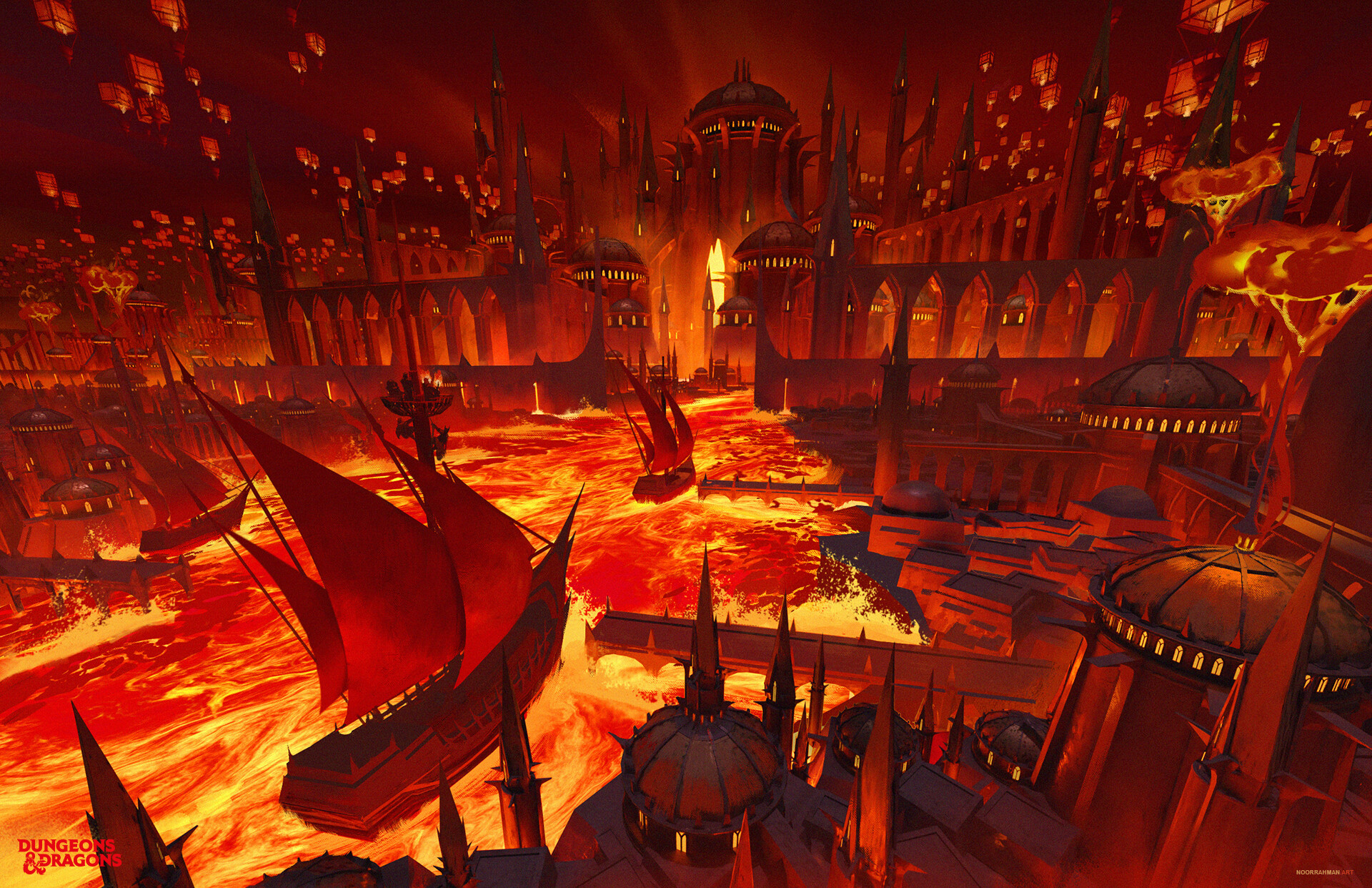
City of Brass One famous refuge from the destructive heat was the City of Brass, home of the efreet. At the will of the grand sultan, the city was protected from the pervasive smoke and flames, and visitors enjoyed unrestricted vision and uncomfortable yet tolerable temperatures, but walls and surfaces were still hot enough to burn unprotected flesh on contact. The city sat in a bowl of golden brass 40 miles (64 kilometers) in diameter that floated about the plane or hovered over a huge disk of obsidian that was cracked from the heat. Architecture included soaring towers, grand minarets, and everything from tool sheds to palaces made of brass. The treasure vaults of the grand sultan, and his wrath towards any who attempted to acquire even a single piece, were legendary.
Onyx Tower
An important feature of the plane was the Elemental Foundation of Fire, one of four magical switches (one in each of the four elemental planes) that when activated caused the Onyx Tower to rise on the Prime Material Plane.
Surprisingly many creatures and races could tolerate and even thrive in the Elemental Plane of Fire. First and foremost were the fire elementals, of course, being constructed directly from the substance of the plane itself. They could assume the form of animals or monsters from the Prime Material Plane,mimic humanoid shape, or create composites with elemental shapes: a lava lion with a flaming mane and charcoal eyes, or a man-shaped torso with fire jets for arms and legs and a tiny tornado of flame for a head, for example. Fire elementals could usually be distinguished by the different colors of flame coming off their bodies, but when standing still they could blend into the background just as a rogue could hide in shadows. Fire bats, fire snakes, harginn, phantom stalkers, and salamanders were also thought to be natives of this plane, but the origins of magmen (or magmin) and the azer were hotly debated.
Visitors and immigrants to the Plane of Fire included brass and gold dragons; the efreet; fire giants; hell hounds;some janni; mephits of the fire, magma, and steam varieties; pyrohydra; rast; and thoqqua. Trading missions and diplomacy brought many peoples to the City of Brass, such as the mercane and devils from the Nine Hells.
The language spoken by the natives was called Ignan and it resembled the hisses and clicks of green wood being consumed by a burning campfire.
Kossuth, the Lord of Flames, the Firelord, Tyrant among Fire Elementals, the Fire Tyrant, once had a palace made of elemental fire here, called the Crimson Pillar. After the Spellplague, it was revealed that he was a primordial and he created a new realm in the Elemental Chaos called the Undying Pyre.
Amaimon, King of the Azer, had no specific palace but traveled with his court from tower to tower (the azer were marvelous metalworkers and built grand towers scattered about the plane), holding feasts and fetes with dancing.
Marrake al-Sidan al-Hariq ben Lazan, Sultan of the Efreet, the Lord of the Flame, the Potentate Incandescent, the Tempering and Eternal Flame of Truth, the Smoldering Dictator, and other titles, lived in his Charcoal Palace in the City of Brass.
Imix, the Prince of Evil Fire Creatures, once dwelled in a tremendous active volcano on this plane.
There were several permanent connections to the Plane of Fire on the Material Plane.
In his lair beneath Zhentil Keep, the banelich Stallac Benadi constructed an open, one-way gate to the Elemental Plane of Fire. It was used for disposing of mining rubble and incinerating unused corpses.
In the lair of the black dragon Harondalbar in the Sunset Mountains, Faren Starlight created a furnace that vented magically to the Plane of Fire. This was used for cooking, heating, and magical experimentation.
Across the River Agis from the city of Memnon laid the ruins of the ancient efreeti city of Memnonnar. Deep beneath these ruins was the Great Brass Gate, a vertical ring of solid brass about 100 ft (30 m) in diameter, that formed a two-way portal to the Fire Plane. Seepage from this portal filled nearby passages with toxic smoke and heated the surrounding ruins to such a degree that some of the walls glowed.
Description
Arriving on the Plane of Fire was like stepping into the flaming maw of an ancient red dragon; if one didn't have protection or immunity from temperatures high enough to melt stone then death was swift. The following discussion assumes a visitor and all their clothing and gear had this capability and either did not need to breathe or could compensate for a superheated, often toxic atmosphere that could immolate one from the inside (think cloudkill plus incendiary cloud). In general, the more fluid the elemental fire, the hotter it was and the more damage it did to unprotected material. Permanent physical structures were very rare.
Plane of Fire
Efreet
Unlike the other three elemental planes, the Plane of Fire had normal gravity and a landscape, although most of the "ground" was made primarily of loosely packed elemental fire and felt like walking in a swamp of hot coals. The rivers and oceans were filled with a more liquid version of the same stuff and swimming worked normally as a mode of transportation. Non-native flying creatures found the atmosphere thin and therefore did not have their usual speed or maneuverability. Visibility was hampered by the smoke coming off the flames engulfing, but not consuming, nearly every solid, liquid, or gas (and creature) on the plane. What one could see was usually distorted by heat ripples. Geographic features such as hills, mountains, and cliffs did not have a geologic lifespan because even the more solid areas slowly moved like a subterranean magma flow as seen on the Prime Material Plane. While rare, the plane was home to a native plant known as the flame flower.
If the Plane of Fire had weather, it was of course hot and deadly. Rains of hot ash moved about like thunderstorms, threatening those on or near the ground with hot embers and blinding ash. Those in the air had to watch out for clouds of superheated steam blowing around and condensing scalding water on exposed surfaces. The water quickly evaporated and the cycle began anew. Easier to avoid but just as deadly were the rivers of magma and "firefalls". Matter from other planes either evaporated, burned to ash, or melted into magma. Magma mixed with elemental fire formed a rapidly moving, incredibly hot slurry that coursed around the terrain and occasionally cascaded over a cliff edge to create a firefall, often manifesting an elemental vortex in the spectacular display. The Great Wheel cosmology model explained these hazards and others as pockets of elements from all the other elemental, para-, and quasi-elemental planes that got sucked into the Plane of Fire and cast adrift to face their fate. Cold spots could even be found where it felt like the middle of the Raurin desert at midday. With a guide, a traveler could approach the borders with the other planes, where the smoke finally choked out the fire, or the fire became nothing but cold ash, or the molten earth absorbed the fire, or the radiance ultimately outshone the fire.
The dangers of the plane could not be overstated, but those that survived the trip saw wonders and beauty at nearly every turn. Flame colors spanned the rainbow, from the vermilion of a forge hearth to the yellow-white of heated iron, from the blues and greens of alchemical reactions to the familiar candle-flame yellows and oranges. The conflagration formed fountains, jets, sheets, rivers, waves, walls, rains, cascades, clouds, swirls, and pits of brilliant incandescence on a scale found nowhere else.
City of Brass One famous refuge from the destructive heat was the City of Brass, home of the efreet. At the will of the grand sultan, the city was protected from the pervasive smoke and flames, and visitors enjoyed unrestricted vision and uncomfortable yet tolerable temperatures, but walls and surfaces were still hot enough to burn unprotected flesh on contact. The city sat in a bowl of golden brass 40 miles (64 kilometers) in diameter that floated about the plane or hovered over a huge disk of obsidian that was cracked from the heat. Architecture included soaring towers, grand minarets, and everything from tool sheds to palaces made of brass. The treasure vaults of the grand sultan, and his wrath towards any who attempted to acquire even a single piece, were legendary.
Onyx Tower
An important feature of the plane was the Elemental Foundation of Fire, one of four magical switches (one in each of the four elemental planes) that when activated caused the Onyx Tower to rise on the Prime Material Plane.
Inhabitants
Surprisingly many creatures and races could tolerate and even thrive in the Elemental Plane of Fire. First and foremost were the fire elementals, of course, being constructed directly from the substance of the plane itself. They could assume the form of animals or monsters from the Prime Material Plane,mimic humanoid shape, or create composites with elemental shapes: a lava lion with a flaming mane and charcoal eyes, or a man-shaped torso with fire jets for arms and legs and a tiny tornado of flame for a head, for example. Fire elementals could usually be distinguished by the different colors of flame coming off their bodies, but when standing still they could blend into the background just as a rogue could hide in shadows. Fire bats, fire snakes, harginn, phantom stalkers, and salamanders were also thought to be natives of this plane, but the origins of magmen (or magmin) and the azer were hotly debated.
Visitors and immigrants to the Plane of Fire included brass and gold dragons; the efreet; fire giants; hell hounds;some janni; mephits of the fire, magma, and steam varieties; pyrohydra; rast; and thoqqua. Trading missions and diplomacy brought many peoples to the City of Brass, such as the mercane and devils from the Nine Hells.
The language spoken by the natives was called Ignan and it resembled the hisses and clicks of green wood being consumed by a burning campfire.
Realms
Kossuth, the Lord of Flames, the Firelord, Tyrant among Fire Elementals, the Fire Tyrant, once had a palace made of elemental fire here, called the Crimson Pillar. After the Spellplague, it was revealed that he was a primordial and he created a new realm in the Elemental Chaos called the Undying Pyre.
Amaimon, King of the Azer, had no specific palace but traveled with his court from tower to tower (the azer were marvelous metalworkers and built grand towers scattered about the plane), holding feasts and fetes with dancing.
Marrake al-Sidan al-Hariq ben Lazan, Sultan of the Efreet, the Lord of the Flame, the Potentate Incandescent, the Tempering and Eternal Flame of Truth, the Smoldering Dictator, and other titles, lived in his Charcoal Palace in the City of Brass.
Imix, the Prince of Evil Fire Creatures, once dwelled in a tremendous active volcano on this plane.
Connections
There were several permanent connections to the Plane of Fire on the Material Plane.
In his lair beneath Zhentil Keep, the banelich Stallac Benadi constructed an open, one-way gate to the Elemental Plane of Fire. It was used for disposing of mining rubble and incinerating unused corpses.
In the lair of the black dragon Harondalbar in the Sunset Mountains, Faren Starlight created a furnace that vented magically to the Plane of Fire. This was used for cooking, heating, and magical experimentation.
Across the River Agis from the city of Memnon laid the ruins of the ancient efreeti city of Memnonnar. Deep beneath these ruins was the Great Brass Gate, a vertical ring of solid brass about 100 ft (30 m) in diameter, that formed a two-way portal to the Fire Plane. Seepage from this portal filled nearby passages with toxic smoke and heated the surrounding ruins to such a degree that some of the walls glowed.
Geography
According to the Great Wheel cosmology model, the Elemental Plane of Fire could be reached via the Ethereal Plane, an adjacent elemental plane, or by an elemental vortex. Two known vortices to adjacent elemental planes were the Iron Crucible that led to the Elemental Plane of Earth and a vortex to the Plane of Air atop Jabal Turab, the Mount of Dust. If traveling through the Deep Ethereal, a red curtain of vaporous color indicated the boundary of the Plane of Fire's Border Ethereal region. Once in the Border Ethereal, a traveler could observe the Plane of Fire and be detected by its denizens. Using the spherical model, this plane was adjacent to the para-elemental planes of Smoke and Magma and the quasi-elemental planes of Radiance and Ash. Elemental vortices could occur wherever a high concentration or nearly pure form of an element was found, and could be temporary or permanent. Vortices to the Plane of Fire could often be found in pools of molten lava or the upwelling of magma in active volcanoes. Temporary gates could be created by the plane shift spell or the abilities of high-level druids.

Comments