
The Starwake Expanse
Geography
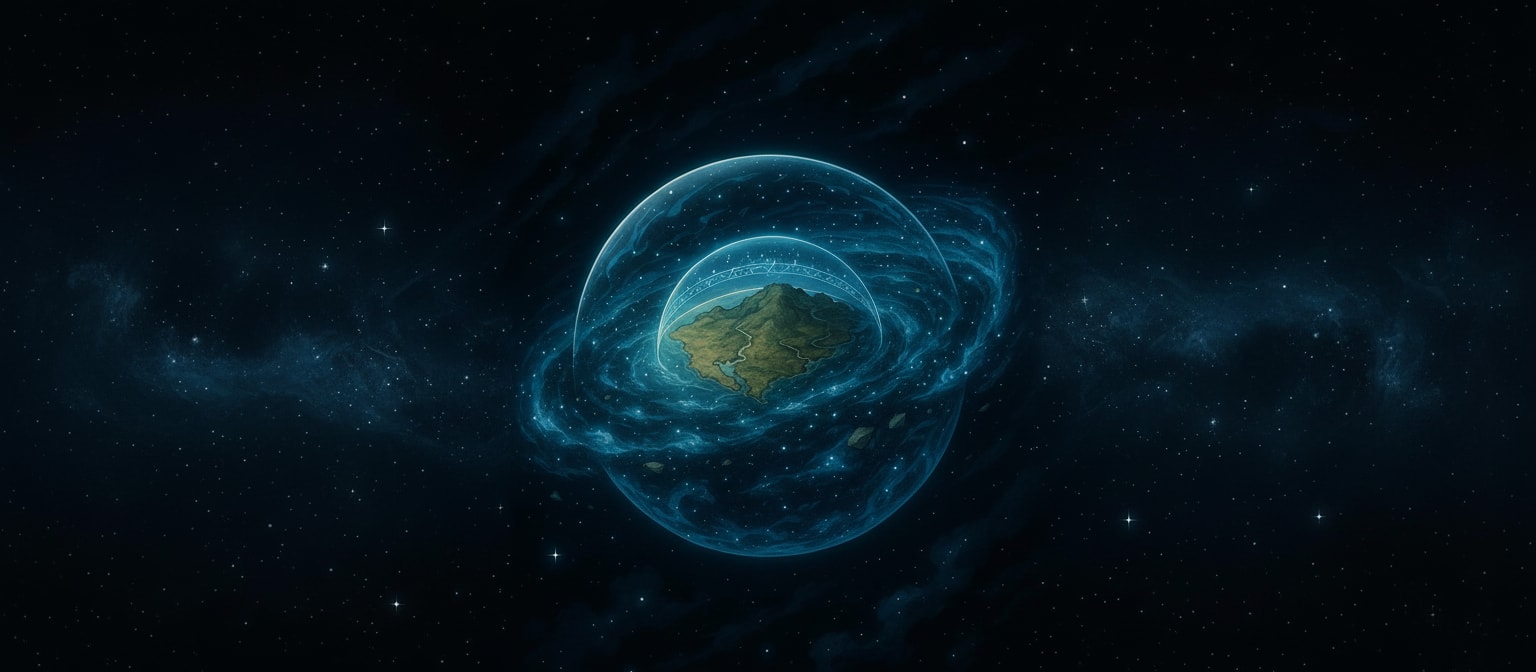
The Starwake Expanse is a vast cosmic ocean that surrounds Aureth in all directions, filling the space beyond the world with shimmering astral dust and luminous currents of pale light. Though it contains no water, it behaves with the rhythm and structure of a sea. Its surface layers drift gently like calm tidewater, while deeper regions fold into swirling fogs and radiant pressure, giving the Expanse a sense of true depth and motion.
Countless floating islands drift within this astral ocean. Each island is a self-contained fragment of existence, held together by the strange buoyancy of the Expanse. No two islands are alike. Some are no larger than a farmhouse porch, a single cottage, or an abandoned barn with fields only meters across. Others are sprawling meadows, forests, crags, or full stretches of broken countryside large enough to sustain weather and ecosystems of their own. Rarer still are the vast drifting landmasses with horizon lines, inner lakes, or remnants of once-inhabited settlements.
The islands are carried along by the starwake currents, great rivers of radiant flow that thread through the astral sea. These currents create drifting routes and slow, predictable migrations. Explorers who learn to read the starwakes can often determine where an island will travel in the seasons ahead, while others simply appear, vanish, or slide quietly into deeper layers of the Expanse.
The space between islands is a dark, silver-hazed void lit by drifting auroras, glimmering particulate, and the faint glow of distant celestial formations. The horizon is never fixed; it rolls and shifts with the density of astral dust and the movement of the currents. Gravity itself is localized, adhering to each island rather than the Expanse as a whole, so travelers feel grounded only while standing upon solid surfaces. Stepping or sailing away from an island means entering a medium more like buoyant air than empty space.
Because of its cosmic nature, the Expanse is shaped less like an open sky and more like a layered ocean. The upper reaches near Aureth are lighter, filled with slow-moving islands and gentle luminous flow. Deeper strata grow dimmer and denser, filled with thick astral clouds, drifting debris, and echo-like structures that shimmer in and out of view.
Despite its alien qualities, the Starwake Expanse possesses a quiet rhythm that feels almost tidal. It is a place defined by motion and drift, where islands wander like ships on an endless sea of starlight, and where explorers chart their journeys by the gleam of the starwake currents rather than by stars or constellations.
Ecosystem
Life in the Starwake Expanse moves according to rules that resemble natural law only at a distance. The astral medium that fills this cosmic ocean is dense enough to sustain drifting creatures and buoyant fragments, yet light enough to shimmer in response to motion or thought. Plants and animals that make their homes here are shaped by that tension. Some float freely through the currents, their bodies ribboning in slow arcs of bioluminescence, while others cling to the undersides of fragments or burrow into patches of stable ground as if the island were an anchored reef. Creatures navigate less by vision and more by resonance, sensing shifts in flow and density the way ocean life senses pressure.
Even the smallest fragments—whether a patch of soil, a single cottage, or a sliver of overgrown farmland—develop the beginnings of an ecosystem. Moss glows softly along exposed surfaces, drawing nourishment from the particulate drifting around it. Tiny scavengers gather beneath abandoned doorframes or broken fences, feeding on drifting motes that settle like astral pollen. Larger fragments form entire microclimates, where forests sigh with slow, luminous breaths and herds of gentle grazers drift from edge to edge as though the land were remembering what a horizon used to feel like.
Predators move more quietly in the Expanse. They do not stalk by scent but by disturbance. A single misplaced footstep can send ripples through the medium, and some creatures lurk at the edges of those ripples, patient as stone. Life here does not exist in defiance of the astral sea; it exists in conversation with it, adapting not to weather or season, but to the ebb and pulse of a world made of drifting light.
Ecosystem Cycles
The Starwake Expanse does not turn through seasons the way Aureth does. Instead, it follows great luminous rhythms known to travelers as Brightwake and Dimwake. These cycles shape every drifting island, every creature that glides through the medium, and every spell cast beneath the shimmering haze.
Brightwake is a time of motion and brilliance. The currents swell with energy, flowing faster and glowing with a warm, radiant shimmer. Islands drift nearer to one another, sometimes forming temporary chains that explorers treat as migratory paths. Creatures stir with unusual vitality, riding the strengthened currents as though caught in a joyful tide. Even magic behaves differently; light spells bloom into extravagant spectacles, evocations flare with vibrant color, and summoning becomes strangely eager, as if the Expanse itself is lending strength to any act of creation. Travelers describe Brightwake as a period when the Starwake feels wide awake, attentive, and restless.
Dimwake follows like a long exhale. The glow softens and the currents slow into gentle, subdued flows. Islands drift apart, leaving long stretches of quiet silver mist between them. Sound becomes muted, absorbed by the thickened medium, and creatures withdraw into calm, measured patterns of behavior. Spellcasters notice the change immediately; magic grows sluggish, heavy, and contemplative, producing muted effects or occasionally reshaping itself into unfamiliar forms. Where Brightwake feels vivid, Dimwake feels thoughtful, as though the Expanse is settling into a reflective mood.
Localized Phenomena
The Starwake Expanse is not an empty void. It is a medium with weight, texture, temperament. Travelers who expect stillness quickly learn the Expanse behaves more like a vast, thinking ocean than a sky. Its particulate currents generate weather-like effects, influence gravity, bend light, and – more unsettlingly – respond to magic as if magic were simply another kind of wind brushing across its surface.
These phenomena shape every voyage through the Expanse. Some are navigational tools, others navigational nightmares, and a few lie somewhere between beauty and threat, depending on who encounters them and when.
Below are the best understanding scholars and navigators have been able to piece together, though even these observations shift with time and depth.
Starwake Currents
The foundation of all Expanse phenomena is the starwake current itself. These slow, luminous flows of particulate act like rivers in the astral sea. They move islands, guide creatures, and shape nearly every other phenomenon. A current has color, brightness, texture, and even a faint hum when approached with the right instruments. Pale gold indicates a gentle drift. Deep blue is steady and slow. Sharp violet warns of instability or collision points. Navigators swear currents have moods; some welcome travelers, others feel cold and resistant, pushing vessels off course.
Driftstorms
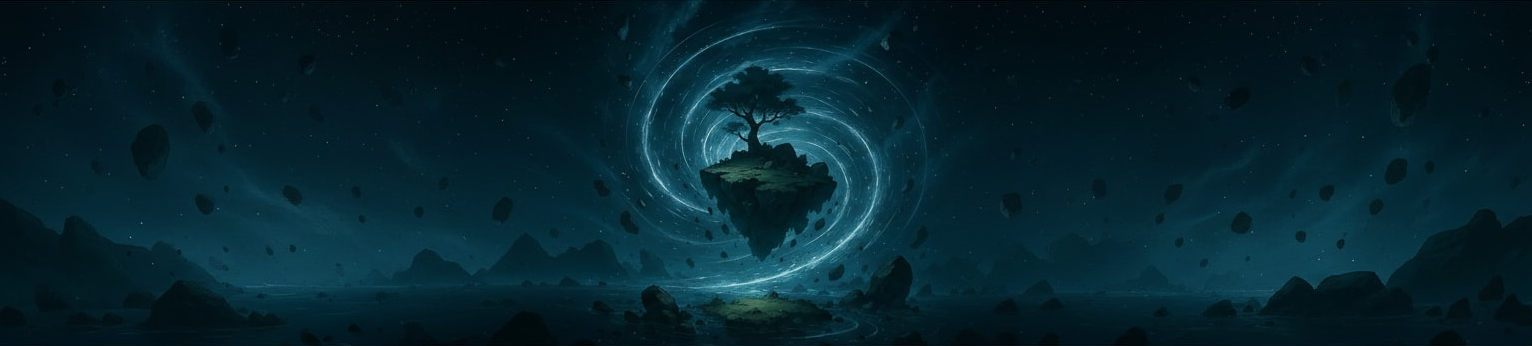
A Driftstorm forms when two or more starwake currents meet with incompatible flows. The result is a spiraling column of particulate, churning like a cosmic hurricane. Inside a Driftstorm, nothing behaves correctly. Light bends in slow arcs. Sound lags behind its source. Time feels stretched, like walking through a dream where you can’t quite catch up with your own actions. Gravity wobbles between directions. Magic becomes wildly expressive in Driftstorms. A simple cantrip may scatter itself into dozens of flickering illusions. Larger spells may gain unexpected volume or mutter strange harmonics as if the Expanse is singing back. Driftstorms are not common, but they leave a strong impression on those who survive them.
Wakefall Cascades
Wakefalls are gentle, mesmerizing events where pockets of astral particulate condense into drifting “rain.” Each droplet falls slowly, glowing with soft silver or blue light, and dissolves on contact with anything solid. The dissolution releases a faint shimmer that clings to skin or fur like fireworks in reverse. Wakefalls are harmless, even pleasant, but there is a strange undertone: individuals report brief sensations of recognition, as if remembering something half-dreamed. Observers studying Wakefall dust note that it reacts to thought patterns, shifting color when held by someone experiencing strong emotion. The Expanse seems to exhale during Wakefalls, shedding built-up potential before larger events form.

Luminal Echoes
Echoes appear as translucent shapes moving across the particulate medium, like reflections of landscapes or creatures that exist elsewhere — or moments that once happened but left an imprint in the Expanse. An Echo might show a tree bending in a wind that does not exist, or a line of figures walking silently across an invisible road. Sometimes entire building facades shimmer in the distance before flickering out. They cast no shadows, make no sound, and have no substance, yet they often mimic the world with eerie fidelity. Spellcasters find that Echoes subtly distort their magic. Illusions occur with greater clarity. Summoned creatures occasionally take on the form of an Echo rather than the intended appearance. Echoes do not interact with the living, but the living interact with them whether they want to or not.
Astral Mirage Fields
When particulate density becomes too high, the Expanse folds upon itself, creating Mirage Fields. These regions blur the distinction between distance and direction. Objects appear closer or farther than they are. Islands appear duplicated. Travelers swear they sometimes see versions of themselves in different poses or paths. Mirage Fields are dangerous not because of hostility, but because of disorientation. A vessel caught in one may circle for hours without realizing it. Voices sound doubled. Footsteps fall out of sync with motion. Some Mirage Fields dissolve quickly. Others persist for years, becoming navigational hazards marked on starwake maps with ominous notation.
Gravity Wells
Certain islands or clusters exert enough resonant mass to generate localized gravity. This creates “wells” where movement becomes heavy and particulate draws inward like cosmic tidewater. Within a gravity well, debris, creatures, and even smaller fragments spiral gently toward the center. Travelers often experience weighty steps, shortened leaps, and a faint pressure behind the eyes. Gravity wells are rarely aggressive; they feel more like a slow sinking feeling than a threat. But drifting too close can be dangerous if the well belongs to a large, predatory creature or an unstable fragment that tilts without warning.
The Starwake Effect
Magic behaves differently in the Expanse because the medium itself responds. The astral medium reacts to spellwork the way water reacts to a thrown stone, rippling outward in patterns of light and drifting particulate that seem almost alive. Spells rarely manifest exactly as their casters intend. A simple incantation may bloom into a cloud of shimmering motes, lingering long after the spell should have faded, while a burst of fire might scatter into floating embers that refuse to burn anything at all. Other times, magic becomes more focused, as if the Expanse chooses to reinforce a caster’s intent, tightening the spell into a cleaner, sharper expression than they expected. Emotional states bleed into the process; fear tangles magic, anger sharpens it, and joy sends it spiraling outward in radiant arcs. In the deepest reaches, the medium grows so responsive that casting feels like negotiating with a living presence. The Expanse does not simply allow magic; it mirrors it, reshapes it, and occasionally answers with a flicker of its own imagination.
Climate
The Starwake Expanse has no weather in the way Aureth understands it, yet travelers still speak of its climate as though it were alive. Instead of air, the Expanse is filled with a buoyant astral medium that moves in subtle waves and pulses. Temperature does not shift with seasons or latitude but follows the rhythm of the currents themselves. During periods of strong flow, the medium feels faintly warm, carrying a soft, tingling sensation across exposed skin. In calmer cycles it cools into something crisp and still, like standing in the shadow of deep water. Climate is less a matter of heat or cold and more a matter of density and resonance. Some islands feel warm and welcoming, their vegetation bathed in soft radiance. Others feel hushed and heavy, the surrounding medium clinging close like thick water. In Brightwake cycles the glow intensifies, lending a vibrant, almost celebratory atmosphere. In Dimwake the Expanse grows contemplative, its muted palette creating a sense of distance and quiet.
Natural Resources
Resources within the Starwake Expanse are unlike anything found upon Aureth. They do not form from soil or stone or the slow grinding of natural forces, but from the movement, pressure, and resonance of the astral medium itself. The Expanse is constantly shifting, folding, and recombining its particulate, and in those moments of change, unique materials condense into forms stable enough for travelers to harvest.
Starwake Resin
One of the most sought-after substances is starwake resin, a slow-forming secretion that gathers where strong currents meet. It resembles molten glass suspended in drifting droplets, glowing faintly from within. Resin is warm to the touch, pliant while fresh, and hardens into translucent plates that hold enchantments with remarkable clarity. Shipwrights and artificers alike covet it, claiming it binds to the intentions of its maker more readily than mundane materials ever could.
Fragment-Stone
Fragment-stone forms the bones of most drifting islands. Though it may appear like familiar rock or soil, it holds deeper resonance shaped by the fragment’s origin, giving it subtle magnetic or harmonic properties. Builders value fragment-stone for its stability, for structures made from it often adapt themselves to the Expanse rather than resisting its flow. It is not unusual for walls carved from fragment-stone to hum softly when starwake currents intensify.
Mist Glass
A rarer material drifts between the islands — something harvesters call Mistglass. Mistglass does not form in solid sheets but condenses out of thick astral fogbanks into delicate, floating panes as thin as frost on a window. These panes are cool, weightless, and nearly transparent, yet far stronger than they appear. Mistglass reacts to motion rather than sound or heat: a hand waved beside it sends ripples across its surface like water disturbed by a fingertip. Carried aboard vessels, it serves as a natural interference detector; sudden trembling in a sheet of Mistglass can warn of approaching creatures, density shifts, or an unseen current that could drag a ship off-course. Some cultures carve lenses or windows from it, claiming that Mistglass offers clearer sight in the Expanse than any mundane glass ever could.
Astral Particulates
Astral particulate itself is another resource, collected with woven nets that sweep the medium like fishermen drawing from calm tides. Alchemists grind it into luminous dust for inks, brews, arcane circuitry, and strange pigments that respond to thought. Many Expanse cultures treat particulate as both a tool and a companion; it drifts into patterns when stirred gently, almost as though curious about the shape of a voyager’s intentions.
Comments