
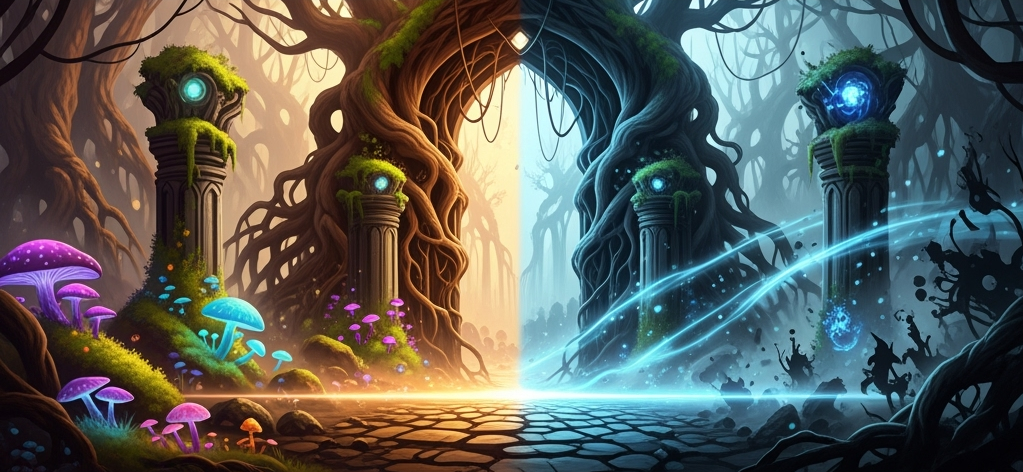
The Process of Threshold
Along Brightcoast’s misted cliffs, fog swallows the line between land and sea. Voices echo without source, and shapes drift between real and imagined. From this uncertainty rose the Threshold Process—a recognition that boundaries are not barriers but definitions. To step across one should be choice, not accident. The people of Brightcoast learned that survival depends on knowing where you end and the world begins.
The Threshold is the Process of edges and permissions. It governs every crossing: the door that must be knocked upon, the secret that must be earned, the oath that must be spoken before entry. Its observance keeps the known intact against the endless pull of what lies beyond. Threshold is what lets “here” and “there,” “me” and “you,” mean anything at all. Without it, identity frays; the familiar dissolves into the formless.
To honor the Threshold is to acknowledge that even welcome must have a gate. It demands mindfulness of passage—the ritual of pause before movement, of awareness before action. The Process-keepers teach that this moment of decision is sacred; it is where meaning resides. Everything that exists does so because something else does not.
When the Threshold weakens, the edges of the world grow porous. Dreams bleed into waking life, doors open to wrong places, and the living speak to those who should not answer. Thought becomes intrusion, love becomes possession, and danger no longer knocks before entering. The fog thickens; names lose precision; even the stars wander from their constellations.
The Threshold is the world’s first defense against chaos, but also its most compassionate restraint. It teaches that exclusion is not cruelty—it is clarity. To keep it is to protect the difference between peace and peril, between self and storm. To break it is to let everything—truth, shadow, and madness alike—walk in uninvited.
Comments