

Nulvian Glider
Nulvian Glider from Amphiaraus 88I
The Nulvian Glider as a Pet and Pest Control
1. As a Pet
The Nulvian Glider1 is a brightly colored, small, flying insectivorous reptile from the dense jungles of Nulvailea.
Its vibrant scales and delicate wing-like flaps, along with its inquisitive nature and relatively low-maintenance care, made it an extremely popular pet across the explored universe.
Pet owners liked it could glide around living spaces, its vibrant color patterns, and its generally calm temperament when hand-raised.
However, the Nulvian Glider’s growing popularity as a household pet led to unintended consequences when it escaped or was released into non-native environments.
Pet Characteristics
Appearance
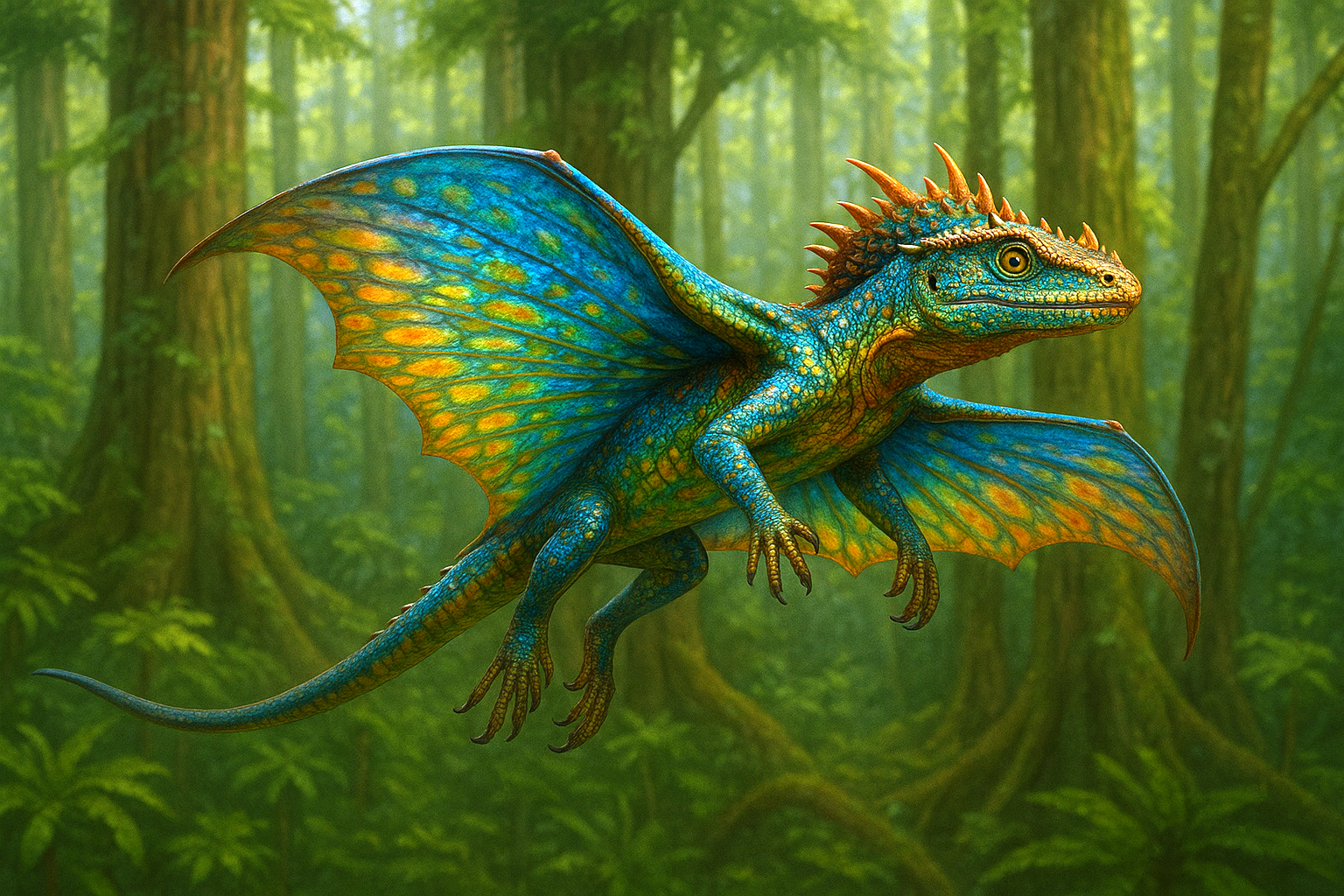
About 40-50 cm long with vivid, iridescent scales that change color based on its mood or environment. The head is covered in cranial ornamentation, comprising low tubercles and spikes, including a horned frill. Males are brightly colored and slightly larger than the plainer dark green females.
The teeth are simple and conical in shape and packed into a dense row. Teeth get progressively smaller as they are arranged from front to back. People sometimes call Gliders Nulvian dragons because they resemble fictional Western fantasy dragons.
The Glider has a short neck and a long flattened thorax with a long whiplike tail. Its gliding membranes, with a width of 55-60 cm, stretch between its limbs and sides, resembling butterfly wings, making it visually striking.
Temperament
Generally mild-tempered, they can become skittish if startled, but they bond with their owners. They rarely bite, unless cornered, preferring to run or glide away. They are highly curious and will explore their environments constantly.
Diet
Primarily insectivorous, feeding on small flying insects like flies, mosquitoes, and gnats but will eat small rodents and reptiles. Some owners even bred the Gliders to consume specially formulated insect-based food pellets.
Popularity
Nulvian Gliders were once adored by space station and habitat dome dwelling colonists for their low-maintenance diet and colorful appearances, but they soon gained a reputation for being escape artists. Once loose, they are very hard to recapture because of their gliding ability and ability to nest in hard-to-reach areas.
As Pets Gone Awry
Escape Artists
The Nulvian Gliders became notorious for escaping enclosures and rapidly establishing feral populations in space habitats and planetary colonies. They adapted quickly to living in tight, artificial spaces like ducts and walls in space stations.
Outcompeting Native Fauna
In bio-dome ecosystems with small insect-eaters, they quickly out-competed local species, disrupting food chains. Their ability to reproduce quickly and hide in nearly inaccessible spaces made them difficult to eradicate.
Gliders particularly enjoy eating stinging insect such as hornets and wasps, but decimates bee hives. Usually, a Glider cannot get into a well-constructed beehive because they are not strong enough and their claws are suited for clinging to tree bark, not ripping open beehives. Gliders will perch near a beehive opening and snatch bees as they leave and return to the hive. Bees will eventually drive the Glider away by stinging it repeatedly, but its scaly hide is highly resistant to the bee's stinger.
2. As Biological Pest Control (and Why It Failed)
The Nulvian Glider’s rise as a biological solution for controlling pests like cockroaches, rats, and mice was initially seen as a promising idea.
Space stations infested with vermin sought a way to control pest populations without relying on harmful pesticides or mechanical traps.
People introduced the small predator reptile Gliders, voracious insect eaters, to several space stations hoping they would control the pest problems.
Reasons for Failure as Pest Control
Dietary Preferences
While the Nulvian Glider ate some pests, like cockroaches and smaller insect species, it was not effective at controlling larger pests like rats or mice. Gliders will eat small rodents and reptiles, but most space station rodents were too large for the small lizard. These rodents often outmaneuvered the Gliders or hid in places the reptiles couldn’t reach, such as deep inside machinery or inaccessible compartments.
The giant mutated cockroaches had grown too big to be consumed by the Glider. The Glider enthusiastically ate the smaller cockroaches.
Niche Specialization
The Glider's natural prey in the wild were tiny insects and tiny reptiles, not larger vermin. While they could occasionally catch young or small rodents, they lacked the size and strength to reduce effectively the overall rat or mouse population.
Behavioral Issues
Unlike traditional biological control agents like cats or ferrets, which actively hunt and kill rodents, Nulvian Gliders are more opportunistic hunters, often ignoring pests when satiated.
The Gliders preferred to feed on smaller, easier prey such as space station flies, mosquitoes and gnats, meaning larger pest species continued to thrive.
Adaptability of Vermin
Cockroaches, rats, and mice quickly adapted to avoid the Gliders. They shifted to areas less frequented by the reptiles, such as deep inside ventilation systems, making it difficult for the Nulvian Gliders to reach them.
Additional Problems Introduced
Infestation Spread
Instead of solving the pest problem, Nulvian Gliders became a new infestation many times. They began breeding rapidly in space stations and colonies, using the same hidden spaces as their prey. With few to no natural predators in these environments, they proliferated unchecked.
Despite belief to the contrary, Gliders found enough food and water on their own. Older stations have enough leaking pipes and dripping condensate for lizards to drink.
Invasive Species
The Nulvian Glider became an invasive species on several colonies and stations, contributing to ecosystem imbalances. Their population boomed, often far beyond the control of the stations' limited resources. The gliders nested in ductwork, power conduits, and life support systems, damaging vital infrastructure in their search for nesting sites.
All cargo coming and going from infested stations are checked for Gliders and eggs. Stations notorious for their Glider infestation such as Alpha Prime (aka Nán Mén Èr) in the Alpha Centauri system tried repeatedly to purge the lizards and failed every time.
Some starship captains refuse to hook personnel transfer gangways, accommodation or pneumatic tubes to stations infested with Gliders for fear that their ship will get infested.
Resistance to Space Exposure
In some attempts to eliminate both the Gliders and the pests, stations tried depressurizing their interiors, exposing the station to the vacuum of space. However, the Nulvian Gliders proved to have a surprising ability to survive extreme conditions for brief periods, and many could find pockets of survival within the station or simply reproduce again after re-pressurization.
Unhygienic Activities
Gliders poop on everything, leaving some heavily infested space stations to call the Gliders "space pigeons." Infested stations installed anti-lizard netting, electrified filter screens and even low-powered lasers protecting food areas with mixed results.
Because of the mess that Gliders leave, a robust industry creating anti-Glider devices has risen. Small round cleaning robots, called Rumbas by ancient tradition, are moderately effective at cleaning Glider feces from most flat surfaces but struggle with round surfaces such as pipes and cannot climb in to the small nooks and crannies that the Glider can.
Laser armed drones have mixed results controlling Glider populations. Sometimes a injured Glider would crawl away and die leaving a rotting corpse. The smell of several rotting Glider bodies prompted some infested colonies to stop using armed drones.
3. Conclusion:
The Nulvian Glider, once introduced as a beloved pet and later a biological pest control solution, turned into a problematic invasive species in many space habitats. Its escape into the wild, coupled with its rapid reproduction and limited effectiveness in controlling pests, led to widespread infestation problems on several space stations.
Despite many attempts to rid stations of the pests (both rodents and Gliders), the creatures adapted too well to artificial environments, becoming nearly impossible to fully eradicate.
The Nulvian Glider—once a symbol of Nulvailea's rich biodiversity and human adaptability—now serves as a cautionary tale of the unintended consequences of biological solutions in artificial habitats.
- Inspired by Coelurosauravus elivensis.


Comments