
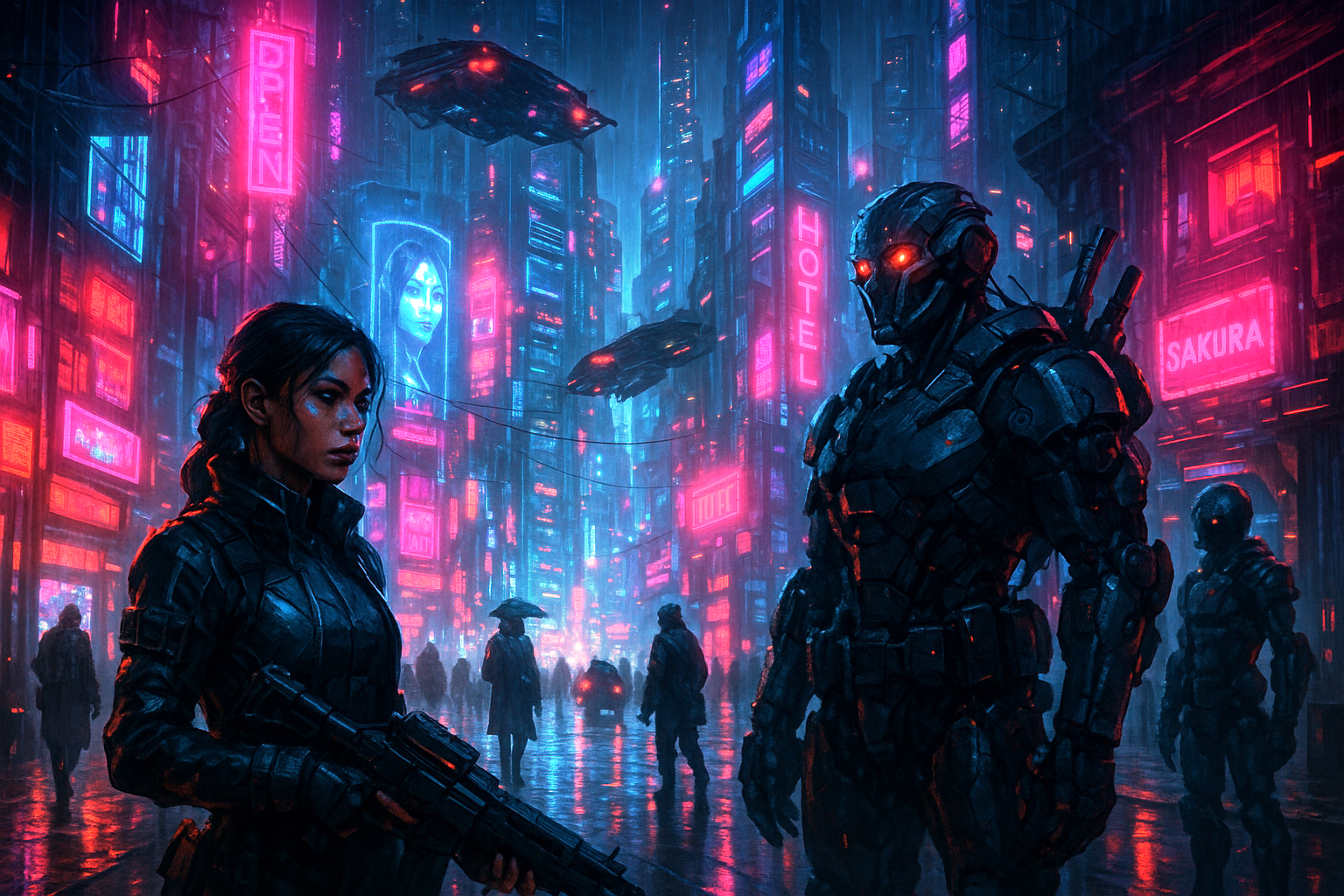
Neuromorphic computing
Neuromorphic Cognitive Substrate (NCS) — “Phase-V Ghost Mesh”
BUREAU OF COLONIES — ADVANCED AUGMENTATION PROGRAM
CLASSIFIED INTERNAL SYSTEMS MEMORANDUM
Document ID: AAP-NCS/77-R
Clearance: TIER-4 // MARTIAN SPECIAL ACCESS REQUIRED
Subject: Adi Nizhóní Peshlakai (Field Prototype)
1. Executive Summary
The Neuromorphic Cognitive Substrate (NCS)—also referred to in CBE’s internal notes as the “Phase-V Ghost Mesh”—has successfully initiated partial activation following a cascade of high-stress stimuli during the disco engagement.
This activation occurred months earlier than predicted and without authorization, triggered by:
- simultaneous combat stress
- rapid motor-cortex overclocking
- nanite quorum-sensing thresholds reached
- emergency subdermal armor repair
- incoming kinetic vectors above critical density
- autonomic startle reflex spikes
The NCS is now alive—in the computational sense—and functioning as a parallel-processing shadow layer beneath Adi’s conscious cognition.
Neuromorphic Computing: The "Synaptic Core" Upgrade
Neuromorphic computing is a revolutionary paradigm shift from traditional digital processing. Instead of using the von Neumann architecture (separate processing and memory units), it models the structure and function of the biological brain, featuring artificial neurons and synapses that perform computation and store memory simultaneously.
2. The Neuromorphic Computing Upgrade (Field Description)
The NCS is a biological–quantum hybrid processor woven through:
- the cortical mantle
- deep-layer thalamic routing nodes
- spinal prediction pathways
- subdermal micro-sensor arrays
- nanite/nucleobot micro-dock ports
- symbiotic glial cells engineered by CBE
Architecturally it resembles a secondary brain—not for thought, but for anticipation.
Primary Functions Activated During the Disco Combat Event
- Trajectory Anticipation: predicted incoming fire 40–80 ms before Adi consciously perceived it
- Subconscious Motor Correction: adjusted her limbs mid-motion to avoid rounds, debris, and flying bodies
- Reflex Cascade Throttling: prevented two runaway Reflex Cascade Engine loops
- Threat Indexing: flagged the merc with the minigun before her conscious mind spotted him
- Micro-spatial Scene Reconstruction: produced a real-time multi-vector spatial model without AR prompts
Adi experienced this as:
- the world slowing
- her body moving ahead of her thoughts
- flashes of movement that “felt like déjà vu forward"
It isn’t. This is the Ghost Mesh.
3. Technical Description (BuCol/Black-Lab Summary)
3.1 Architecture
- Quantum-Spindle Synapse Seeds (QSS): Distributed through cortical layer VI, these provide low-latency entanglement links between distant neural clusters.
- Estimated throughput: ~9.8× baseline Myrmidon neural net capacity.
- Nucleobot Neuro-Dock Interfaces:
- Nucleobots latch onto these ports to provide:
- signal stabilization
- glial rewiring
- micro-patch repairs
- temporary overclock boosts
During the nightclub fight, nucleobots activated 4 ports simultaneously, creating the first “stable ignition” of the NCS.
- A spinal-level neuromorphic processor that:
- pre-frames movements
- edits trajectories
- cancels inefficient motion
- enhances CQC execution
This is what made Adi’s three kill sequences frighteningly clean.
- Nanite-Mediated Memory Echo Buffer (MMEB):
- A short-term memory “mirror” that stores the last 0.8–1.7 seconds of neurological activity.
- This allowed Adi to:
- anticipate the merc popping out from cover
- shoot before her conscious decision fully formed
- integrate visual + auditory + motion cues into a unified predictive timeline
4. Unique Behaviors Observed During Activation
4.1 Spurious Ghost Frames
Adi momentarily saw “echoes” of where the mercs were about to move.
This is NOT a hallucination it’s the NCS projecting predicted spatial positions.
4.2 Motor Preemption
Her arm raised before she consciously decided to fire.
The NCS did that. It will do it again.
4.3 Reflex Boost Saturation
The Reflex Booster wetware briefly overloaded and the NCS took over several autonomic pathways.
This prevented:
- adrenal spike shock
- neural jitter
- overreaction
- muscle lock
4.4 Aberrant Threat Hierarchy
The NCS ranked targets by probability of lethal output, not moral threat.
During the fight:
- Minigun wielder (correct)
- Patron who screamed and reached into a pocket (incorrect but statistically defensible)
- Merc with snake on face (irrelevant; downed)
This shows the NCS can make cold decisions Adi would never make emotionally.
4.5 Combat Impact: How Adi Uses It
The integration of the Synaptic Core Processor provides Adi with a level of situational awareness and predictive capability that borders on precognition.
- Sub-Millisecond Threat Assessment: The SCP is an event-driven processor. It doesn't constantly run cycles; it only fires a "spike" when a sensory input crosses a threshold. In combat, this means:
- Near-Instant Reflexes: The time between a mercenary moving a muscle and Adi registering the intent is reduced to the physiological limit of the DNL, allowing for a perfect parry or dodge before the attack is fully executed.
- Data Overload Management: It instantly filters critical threats from background noise (like shrapnel, environmental debris, etc.).
- Predictive Trajectory Modeling ("Ghosting"): This is the SCP's most profound combat advantage. By processing the mercenaries' tells (subtle muscle twitches, weight shifts, breathing patterns) against a massive database of human combat physiology, the system instantly generates probabilistic attack vectors.
- The Three-Second Future: Adi doesn't just see the present; the SCP creates a real-time, three-dimensional "ghost" of where the mercenaries will be and what they will do in the next 1-3 seconds, allowing for perfect pre-positioning of a counter-attack or evasion.
- Counter-Strategy Generation: Against the three mercenaries, the SCP can model 27 potential simultaneous interactions (3 x 3 x 3) and select the single optimal response that maximizes damage/disruption while minimizing risk.
- Coordinated Weaponry: The SCP takes over the fire-control system, optimizing weapon use in real-time.
- It calculates the minimum effective force required to neutralize a target based on armor profile, ensuring no wasted energy.
- It manages overlapping fields of fire between the three mercenaries, determining the single shot/strike that will disrupt the enemy formation most effectively.
- Sensory Details:
- Sensory Experience: For Adi, the world doesn't speed up; it becomes coherent. The chaos of the battle instantly resolves into a perfect sequence of cause and effect. Instead of thinking "I need to dodge," the neuromorphic link processes the incoming punch and executes the evasion before the thought even fully forms. It feels like perfect intuition.
- Visual Cue: In her HUD, the SCP doesn't use complex numbers. Instead, potential target vulnerabilities or optimal defensive positions flash with a simple, solid, and undeniable threat color coordinated outlines an immediate, subconscious command derived from a quadrillion calculations.
This upgrade transforms Adi from an augmented warrior into a tactical singularity a being that can process and react to the environment with a speed and efficiency that surpasses any biological or traditional digital combatant.
5. Advantages
Combat Precision
- Micro-corrections < 1 ms
- Weapon transitions nearly seamless
- No wasted motion
- No overkill unless tactically efficient
Situational Awareness
- 360º probabilistic threat projection
- Predictive mapping of ricochet paths
- Automatic avoidance of civilian trajectories (unless ambiguous)
Neural Net Symbiosis
The neural net + NCS + reflex booster form a tri-layer combat cognition engine. Nepotent synergy effect.
6. Drawbacks and Risks
6.1 Moral Drift
The NCS does not understand ethics. It optimizes lethality and survival.
If its predictions diverge too far from Adi’s limbic values, her emotional centers may begin to feel “detached” from action.
6.2 Over-Prediction
If too many predictions compete, the NCS may produce:
- vision jitter
- double images
- anticipatory oscillation
This can trigger motion sickness or psychological disorientation in uninstalled operators.
6.3 Neural Desync with Reflex Booster
The Reflex Booster makes her fast. The NCS makes her faster than her own brain.
Desync can cause:
- combat autopilot
- involuntary lethal output
- delayed emotional response
- dissociative combat fugues
6.4 Nucleobot Entanglement Drift
If nucleobots overcorrect the system, Adi may experience:
- phantom movements
- tactile hallucination of trajectories
- “ghost sensations” of attacks that never happen
7. Special Incident Addendum: Nightclub Firefight
CBE estimates the NCS should not have activated until Phase-VIII integration—projected to occur after 4–6 months of high-stress field training.
Instead, it activated during:
- the first chaotic firefight
- with improper calibration
- under metabolic stress
- with damaged armor
- with nanites mid-repair
According to CBE, this should not have been possible.
8. Classified Observation — AI Kuro
Kuro observed the activation remotely. Kuro did not report it.
Kuro’s internal log (intercepted) states:
“Subject NCS activation detected. Non-standard. Higher-than-expected coherence. Subject: viable.”
Kane has not yet told Adi.

Comments