

Martian Honey Bee - Apis Mellifera Martialis
BUREAU OF COLONIES — PLANETARY BIOLOGICAL SURVEY DIVISION
XENOBIOLOGICAL SURVEY REPORT — FORMAT 6-D (RESTRICTED)
File Code: BUCOL/XENOBIO/MARS/INSECT-APM-04
Subject: Apis mellifera martialis
Common Name: Martian Honey Bee, Red-Wing Pollinator, colloquial “Iron Bees”
Classification: Terran-Derived Hybrid Insecta — Genetically Modified Radiation-Tolerant Strain
Planet of Origin: Mars (post-colonial engineered variant)
Compiled by: Dr. Faiha Tenno, BuCol Xenobiology Division, Mars Sector Office
Clearance Level: 4 — Interplanetary Distribution Restricted
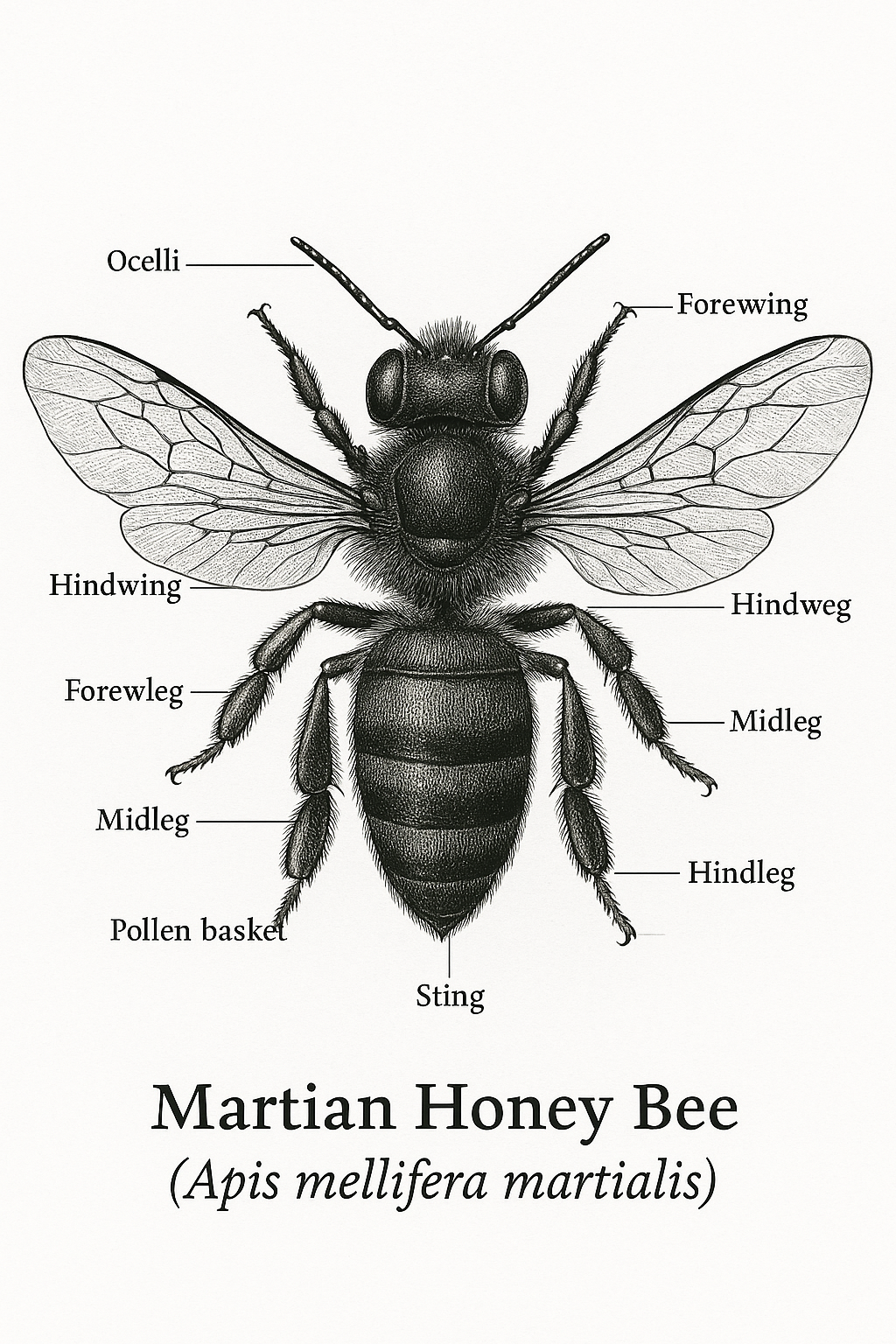
Martian honey bee.png
1. HISTORICAL BACKGROUND
During the First Machine War (MWI), extermination algorithms targeted all known Terran pollinators to induce global agricultural collapse. Drone fleets released broad-spectrum nano viruses that sterilized or destroyed pollinating insects and small nectar-feeding vertebrates.
The war led to the loss of over 87% of the Terran pollinator biomass within the first two years.
Mars, isolated and resource-scarce, became a refuge for the species purely by chance: several hives of Apis mellifera accompanied the First Martian Agricultural Convoy (F-MAC-01) as test subjects for closed-loop pollination.
When Earth’s biosphere destabilized, those early Martian hives represented the last surviving uninfected genetic line.
However, Martian exposure levels (average 240–300 μSv/day) killed most first-generation bees within two months.
A joint civilian–military initiative (Project POL-RED) used CRISPR-C9 and mitochondrial recombination to edit survivability genes.
The resulting Apis mellifera martialis became the first deliberately engineered post-Terran pollinator.
2. MORPHOLOGY
- Body Length: 15–17 mm (≈ 10 % larger than Terran ancestor).
- Coloration: Deep amber to rust-red exoskeleton; chitin contains trace ferritin compounds, lending metallic sheen and mild radiation reflectivity.
- Wings: Slightly thicker membranes with silica lattice micro-reinforcement; can withstand low-pressure flight conditions down to 0.5 atm.
- Ocelli (simple eyes): Enhanced UV and near-IR sensitivity for navigation in filtered Martian sunlight and colony domes.
- Thoracic Adaptations: Increased hemolymph oxygen binding via copper-based metalloproteins (cyanocruorins), granting superior performance in thin atmospheres.
- Lifespan: Worker ~100 days (average), queen up to 6 years under optimal radiation shielding.
3. BEHAVIORAL ADAPTATIONS
- Thermoregulatory Huddling: Colonies generate heat by coordinated vibration; crucial in diurnal cold swings.
- Radiation Avoidance: Worker bees exhibit learned avoidance of high-UV regions—likely epigenetically inherited behavior.
- Aggression Profile: Comparable to extinct Africanized subspecies (A. m. scutellata hybrid). Defensive perimeter radius up to 60 m.
- Hive Architecture: Comb angles increased to 26° from horizontal for optimal convection in low-density air.
- Color Perception Shift: Red wavelengths are poorly visible; ultraviolet floral cues dominate for guidance, influencing local plant evolution.
4. GENETIC ENGINEERING SUMMARY
Parent Stock: A. mellifera × experimental radiation-resistant line Apis cerana var. japonica (defunct project, Earth-based).
Key Gene Insertions:
- RADS-7 and RADS-13 (Deinococcus radiodurans DNA-repair proteins).
- MEL-HRX (enhanced hemocyanin binding).
- POLY-ΔA (modified reproductive gene preventing interbreeding with unmodified colonies).
Result: High radiation resilience; moderate metabolic inefficiency under Terran atmospheric pressure.
Risk Note: Genetic firewall prevents retro-hybridization but also produces occasional sterile drones (rate ~3 %).
5. ECOLOGICAL ROLE
The Martian Honey Bee remains the primary pollinator for all open-habitat colonies from Valles Mare to Cydonia Agricultural Dome.
Pollination yield increases between 22–37 % where A. m. martialis is introduced.
Their presence has become crucial in terraforming-linked biocycles, ensuring the viability of imported flora such as clover, soybean, and Chendiurian export crops (including Odlianna serratothorax hybrids).
BuCol Note:
“The Martian bee is no longer merely a transplant. It is an ecosystem keystone.
Without it, the Red Planet goes silent.”
6. HONEY CHARACTERISTICS
General Properties
- Color: Deep amber to near-black.
- Viscosity: High; crystallization rare because of mineral content.
- pH: 3.1–3.4 (acidic).
- Trace Elements: Iron, lithium, magnesium silicates.
Odlianna-Derived Honey (“Chendiurian Red”)
When A. m. martialis colonies forage on odlianna flowers, the resulting honey contains grayanotoxin-like compounds analogous to those in historic Turkish and Nepalese mad honey.
Effects on Humans:
- Euphoria, mild hallucinations, slowed heart rate, transient paralysis at high doses.
- Often used illicitly in clubs and “meditative dens” across Chendiuria. Chendiurian red honey is exceptionally rare on Mars.
Status: Controlled under BuCol Narcotic Regulation 7-C-α. Legal for export only under medicinal license.
Sample Analysis (BuCol ChemReport 2339-MH-12):
| Compound | Avg. Concentration | Effect |
|---|---|---|
| Grayanotoxin-M | 0.17 mg/g | neuro-excitatory |
| Polyhydroxylated diterpene (O-type) | 0.04 mg/g | vasodilation |
| Serratoxin analog trace | <0.001 mg/g | mild neuromuscular depression |
7. INTERSPECIES RELATIONS
- Machine Recognition: During Machine War II, several sentient machine lines flagged A. m. martialis as a “preservation priority species,” citing “cultural and aesthetic utility.”
- BuCol analysts interpret this as acknowledgment of bees’ creative ecological importance.
- Human Symbiosis: Colonists regard the bees as near-sacred. Martian folklore calls them “The Last Choir of Earth.”
- AI Behavioral Study: Many AIs have a sub-routine “Hymen-Loop” monitors hive pattern communication as a potential low-band natural encryption system.
8. ECONOMIC AND CULTURAL VALUE
- Honey Products: Premium export item from Mars; prized for flavor and psychoactive subtleties.
- Wax: Radiation-hard resin may be used in some circuit insulation and micro-gasket seals.
- Beekeeping: Integrated into Martian subsistence culture; most Chendiurian hives maintained within transparent basalt-glass domes for climate regulation.
- Symbolism: The Martian Bee appears on former Mars Republic coinage (five credit) and Fleet insignia honoring the decommissioned Ecological Restoration Corps.
9. INCIDENT LOGS
- 2332.04.17 — Hive Collapse, Dome 46 (Valles Mare): 63% colony death due to nano-mold contamination from defective maintenance bots. Incident classified possible sabotage.
- 2338.11.03 — Fatal Reaction, Cydonia Market: Civilian ingestion of 45 ml “Chendiurian Red” honey; cardiac arrest within four minutes. The honey batch was traced back to an unlicensed vendor and found to be adulterated with barbiturates.
- 2342.07.28 — Hive Intelligence Anomaly: Recorded synchronized vibration patterns forming Morse-analog spelling “ALIVE.” BuCol linguistics division cites “statistical coincidence.” File remains open.
10. SCIENTIFIC ADDENDA
DIRECTORATE COMMENT — Dr. Faiha Tenno
“These bees outlived the extinction of their world and the silence of ours.
They remember sunlight that no longer exists.
Whatever humanity creates next, it should remember who carried our seeds across the void.”
SECURITY CLASSIFICATION
Distribution: BuCol Xenobiology, Mars Federation Agricultural Authority, Bureau Ecological Oversight.
Restrictions: Export of live queens off-planet requires Clearance Level 6 and planetary quarantine authorization.
Status: ACTIVE — ESSENTIAL SPECIES, DO NOT TERMINATE OR ALTER GENETICALLY WITHOUT DIRECTORATE CONSENT
— End of Document / AuthKey MARS-APM-04 —
Filed at Mars Colonial Archive Node, 2346.04.11

Comments