

Cydonia Agricultural Dome and Market
Cydonia Agricultural Dome and Market
Location
Cydonia Mensae region, northern lowlands of Mars, near the historical “Face” formations (now preserved as protected geological artifacts)
Overview
The Cydonia Agricultural Dome is one of the three Mars surface arcologies that survived the Martian City State Period war (2357–2361 CE) with minimal structural damage. The outer cryspoly window skins were destroyed and replaced, but the underlying load-bearing arcology frame and sub-surface infrastructure remained intact.
Unlike later industrial arcologies, designers always planned Cydonia to be a hybrid civic, agricultural, and cultural space. It is less vertical than Olympus Arcology and less militarized than Elysium, giving it a reputation as the most “human” city on Mars.
The Cydonia Agricultural Dome, known colloquially as the "Verdant Face," is a triumph of bioengineering and resilient architecture. As one of the few survivors of the Martian City State Period, it represents a bridge between the high-tech, expansionist past and the pragmatic, somewhat stoic present led by President Geraint Izaäk.
The agricultural dome beneath the arcology is both a food engine and a cultural anchor. It feeds large portions of northern Mars and supplies premium biological goods across the inner system.
Brief History
Settlers chose Cydonia during the second wave of Martian colonization because of its proximity to the "Face on Mars" landform. During the Martian City State Period, it avoided the orbital bombardments that leveled cities like Chryse and Hellas by declaring strict neutrality and offering food to all sides.
Though the war shattered its original windows, the internal ecosystem survived thanks to the quick action of the Sodality of the Silt, who moved the animals into the bedrock tunnels until the cryspoly was replaced. Today, it stands as the wealthiest and most biologically diverse habitat on the Red Planet.
Cydonia predates the City State War as a mixed-use arcology focused on long-term sustainability. During the war, it was spared heavy bombardment because of its food-production role and early neutrality agreements.
After the war, Cydonia became a center for reconstruction ideology, emphasizing life, continuity, and restraint rather than expansionist power.
The replacement of its cryspoly windows was one of the largest material reconstruction efforts on Mars and symbolized a turning point from survival to recovery.
Arcology Structure
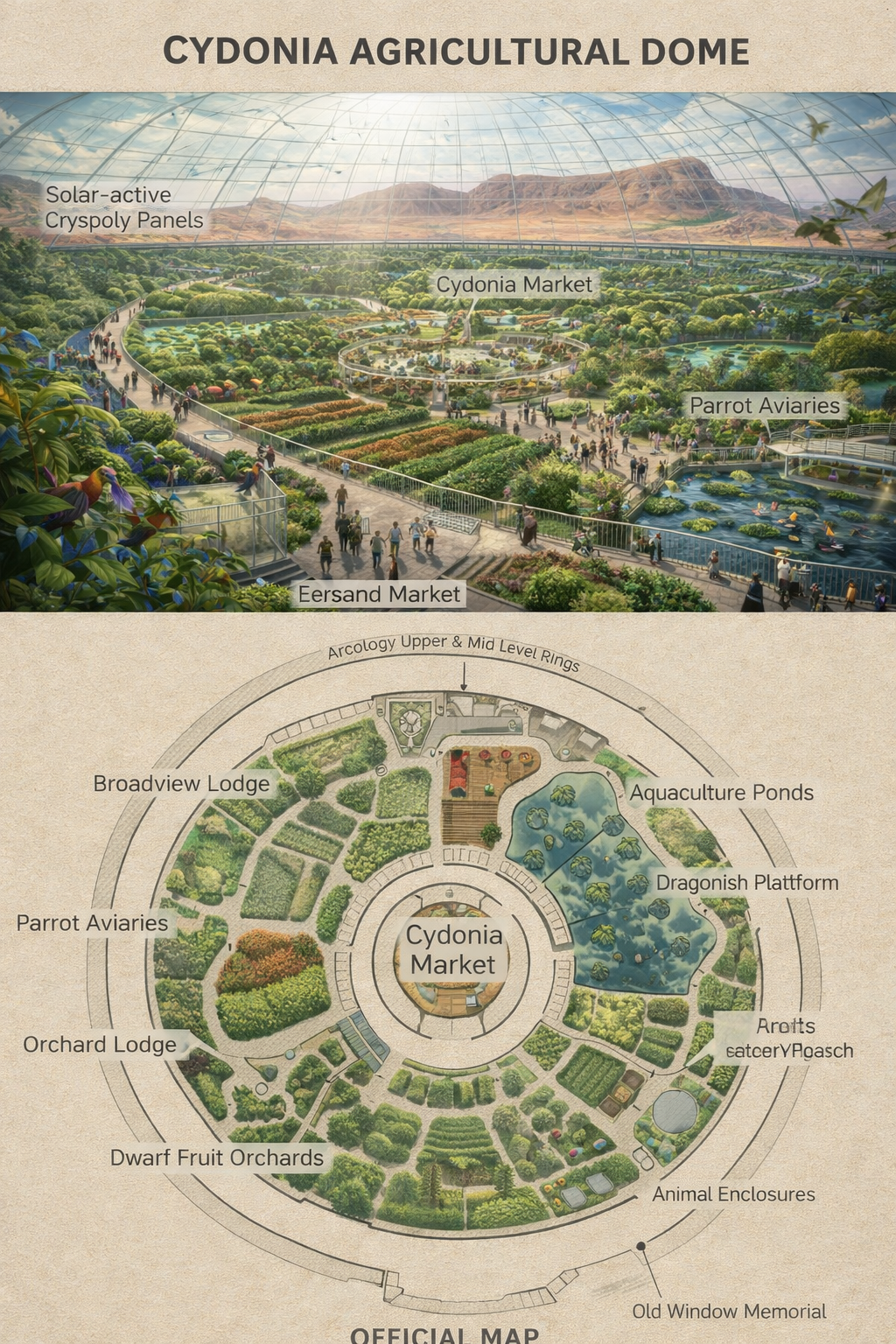
The Cydonia arcology consists of three primary layers:
Upper Civic Ring
Government offices, residences, cultural institutions, and diplomatic spaces. This is where Mars President Geraint Izaäk was born and raised.
Mid-Level Residential and Commercial Ring
Dense but carefully planned neighborhoods, schools, workshops, markets, and transit hubs.
Lower Agricultural Dome
A vast enclosed biome containing farms, orchards, animal enclosures, aquaculture ponds, and the Cydonia Market itself.
New-generation cryspoly windows embedded with solar-active quantum dots cap the arcology. These panels generate power while providing full-spectrum light tuned for plant growth and human circadian rhythms.
The Agricultural Dome
Primary agricultural features include:
• terraced soil farms growing grains, vegetables, and legumes
• orchards of dwarf fruit trees adapted to Martian gravity
• free-range enclosures for cloned rabbits, capybaras, water deer, and muntjacs
• aviaries containing parrots and waterfowl
• poultry zones for chickens, ducks, and geese
• extensive aquaculture ponds
Aquaculture species include:
• jade perch
• tilapia
• gene-modified non-poisonous enlarged dragonfish
The enlarged freshwater lionfish is a particular point of pride. They are slow-moving, brilliantly colored, and highly valued as ceremonial food animals rather than daily protein.
The Cydonia Market
The Cydonia Market, a sprawling, open-plan bazaar where vendors sell food just meters from where they grow or raise it, lies at the heart of the agricultural dome.
The market operates continuously, with peak activity during artificial “daylight” cycles.
Key characteristics:
• open stalls rather than enclosed shops
• strong scents of soil, water, animals, and cooking food
• minimal automation in visible areas to emphasize authenticity
• human vendors dominate, with AI used quietly in logistics
The market is a pilgrimage site for chefs, traders, and cultural tourists from across Mars.
Governance and Society
Who Rules Cydonia
Public authority
A civilian Arcology Council elected by residents, who advise President Izaäk when he is not in the Mars Federation capital, officially governed Cydonia. In reality, the council is little more than a Silt echo chamber.
Public Ruler
President Geraint Izaäk. A Cydonia native, he projects the image of a philosopher-king. His motto, "Sic transit gloria mundi" (Thus passes the glory of the world), reflects the dome’s history of survival through ruin.
President Geraint Izaäk maintains strong informal influence here, though he does not rule directly. His family name still opens doors that would otherwise remain closed.
Reality of Power
While Izaäk handles the politics, the Sodality of the Silt actually runs Cydonia. This guild of master hydrologists and agronomists controls the water reclamation systems and oxygen scrubbers. If the Silt goes on strike, the President breathes vacuum.
The Arcology Infrastructure Directorate, which controls life support and energy, has a representative on the Arcology Council. Other members of the Council are from agricultural guilds that manage food production quotas and political families with deep roots in Cydonia, including the Izaäk lineage.
The People
Because Cydonia predates grav plate technology, descendants of the original Cydonians are known as "Low-G Agrarians." They are tall, lanky, and often have tan-lines from the cryspoly-filtered UV. They are intensely proud of their heritage, viewing themselves as the "seed-bank of Mars."
People recognize Cydonia residents for:
• strong local identity
• skepticism toward off-world corporations
• pride in biological rather than synthetic production
• a cultural emphasis on continuity and memory
Many families trace their lineage back to pre-war Mars. Others arrived during reconstruction and stayed. Compared to other Mars arcologies, Cydonia is less stratified. Wealth exists, but people avoid ostentation.
Attractions
The Cydonia Central Market Hall
The heart of the dome. No visit to Mars is considered complete without walking its aisles.
The Silk and Sunder Bazaar
The premier spot for buying "Pre-War" artifacts recovered from the radioactive ruins of neighboring arcologies. Cleaning the relics minimizes radiation, but collecting too many could be hazardous. Fakes are a common problem, but often those who discover they purchased a fake often dispose of it in shame rather than report it to the authorities.
The Great Lionfish Skeleton
The artificially fossilized remains of the first gene-modified five-meter lionfish ever grown, hanging from the market ceiling.
Five-meter Cydonian Lionfish specimens—augmented with alligator gar DNA and armored with dense, ivory-colored ganoid scales—are significantly heavier than a standard fish of that length because of their bone-plating and robust, predatory build. The weight of an average five-meter lionfish is 1,100 to 1,400 kg.
Why so heavy?
Ganoid Armor
Unlike the thin, overlapping scales of most fish, ganoid scales are bone-like and interlocking. This "ivory" plating adds hundreds of kilograms of "dead weight" to the animal's frame, essentially acting as a suit of biological chain mail.
Predatory Girth
To support a three-to-five-meter frame, the fish requires massive muscle density for burst swimming. Using the standard ichthyology formula for heavy-bodied fish, the weight scales cubically with length.
The "Gar" Factor
Modern alligator gars reach about three meters and 160 kg. Scaling that up to five meters while adding the broader, more vertically compressed body of a lionfish (which has a much deeper "girth" than a gar) pushes the weight into the literal "ton" category.
The Lionfish Ponds
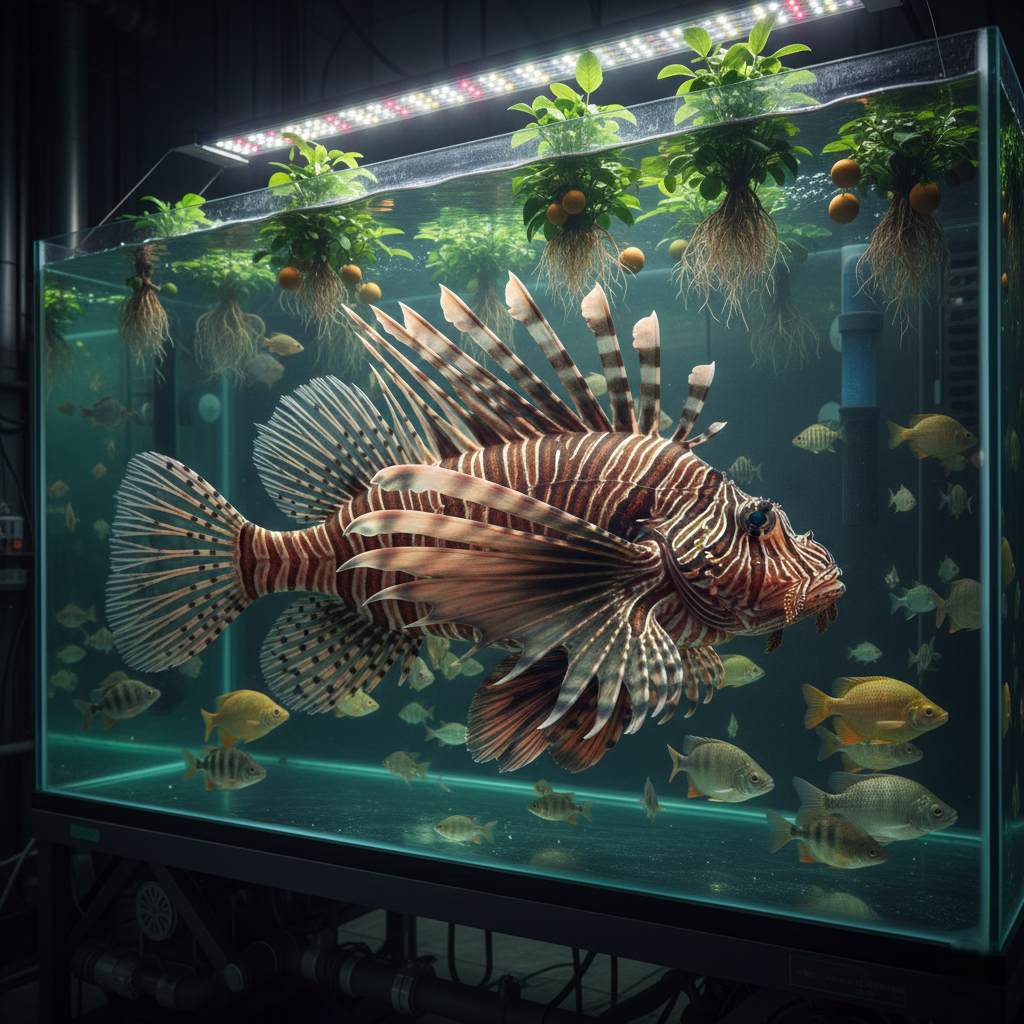
A scenic aquaculture area with elevated walkways and observation decks. In Cydonia usage, lionfish refers to a gene-modified, non-poisonous freshwater lionfish analog, not the extinct Terran reef species.
Lionfish are prestige carnivores, not required for system stability. They are slow-moving, visually striking, and deliberately inefficient from a protein-yield standpoint.
Lionfish are kept in separate but visually adjacent ponds to the ivory gar systems (see below).
Due to their territorial excessive aggression, lionfish ponds are restricted.
Access requires invitation, status, or ceremony. Even long-time residents may never see certain lionfish except through official viewings. Vid channels featuring lionfish are popular LED digital wall decorations.
The Dragon’s Maw Fish Market
Visitors watch the "Aquaponic Cowboys" harvest gene-modified, enlarged freshwater lionfish.
Using the specialized "harpoon-drones" the Cydonian fishers harvest the three-to-five-meter giants without damaging the ganoid scales. These dangerous predatory beasts are non poisonous and delicious.
Because of the alligator gar DNA used in enlarging the lionfish, their scales are now hard, bony interlocking scales, known as ganoid scales.
After drying, cleaning and disinfecting, the fish scales and spines become amazing works of art. Jewelers use the larger bio-luminous glowing scales and spines.
Fish teeth and scale jewelry is a common and distinct feature of the wealthiest of Cydonia residents.
An exquisite jewelry piece the Collar of Still Water came from this market.
Lionfish Market Value
In the post-war Martian economy of Cydonia, a five-meter Ivory Lionfish is more than just meat—it is a liquid asset. Based on the scarcity of "Earth-legacy" biomass and the high cost of maintaining the deep-aquaculture ponds, here is the breakdown of its value in Martian Credits (₵).
Total Market Value: ₵85,000—₵120,000
To put this in perspective, ₵100 is enough to feed a family of four for a week in the Cydonia lower-levels, and a standard mid-range ground-rover costs roughly ₵15,000.
Lionfish value lies in:
• ceremonial consumption
• political gifting
• cultural display
• elite dining experiences
• tourism and diplomacy
They are named, tracked individually, and rarely harvested. Their meat is considered refined and delicate, and their presence signals abundance rather than necessity.
Why the High Price Tag? The "President’s Tax"
Because President Izaäk is a fan of the species, any fish over three meters is technically subject to a "Right of First Refusal" by the state. To sell it on the open market, the fisherman must pay a luxury permit fee, which drives up the price.
Ganoid Scarcity
The "ivory" scales are the only source of organic, bone-like carving material on Mars that doesn't involve recycling human remains or rare cloned bone-growth. People highly covet them for the handles of ceremonial daggers and luxury furniture inlays.
Note: scales from the ivory tarpon, another common aquaponic fish, are sometimes illegally substituted for ivory lionfish scales. The ivory tarpon is a sterile, gene modified, enlarged freshwater fish, but from a cross between a tarpon, a short nose gar, a common carp and genetic material from the Loricariidae catfish family.
Counterfeit ivory lionfish scales are easy to pass off visually, especially to the greedy and ignorant, but any decent microscope or scanner will reveal the deception.
The "Martian Dragon" Mystique
Eating a fish that has alligator gar DNA—a creature that survived Earth's prehistoric era—is a status symbol. It represents the "immortality" of life, a key theme in Cydonian culture.
The "Table Value"
If you were to order a five-meter lionfish as a whole-roasted centerpiece for a corporate banquet at The Gilded Gill, the final bill (including preparation and oxygen-service) would easily exceed ₵250,000.
Note: A "Blemish-Free" fish (one caught with specialized magnetic nets rather than harpoons) can command a 30% premium because the ganoid scales remain undamaged for jewelry work.
In the Cydonia markets, a single five-meter "Ivory Dragon" (as the locals call them) provides:
Meat: roughly 600–700 kg of firm, white, non-poisonous fillets.
Luxury Goods: Artisans harvest the ganoid scales for "Martian Ivory" carvings, jewelry and some very flashy high-end protective apparel. The White Dragon Razorgirls wear jackets covered in pearly ivory dragon scales.
Status: A whole fish this size is usually the center of a "State Dinner" hosted by President Izaäk himself.
Lionfish generate irregular, high-margin value.
Their value comes from:
• ceremonial consumption
• cultural tourism
• prestige gifting
• art commissions
• political symbolism
A single mature lionfish can be worth more than several years of ivory gar output, but only under the right circumstances.
Lionfish materials are rarely worn.
When used at all, they appear as:
- preserved scale mosaics
- ceremonial carvings
- embedded art pieces
- state gifts
- exquisite very expensive jewelry
Lionfish materials signal status through rarity and restraint rather than utility.
Lionfish are admired, even mythologized.
They are named. They are watched. They appear in murals, songs, and dome folklore. Children are brought to see them deliberately.
People remember individual lionfish.
Political Symbolism
Lionfish represent:
• survival after the City State War
• mastery over harsh systems
• willingness to do hard things cleanly
They are often cited in policy discussions about food security and independence.
Lionfish symbolize Martian legitimacy.
They represent:
• continuity beyond survival
• cultural maturity
• the right to beauty
• Mars as a civilization, not a project
President Geraint Izaäk’s presence near lionfish ponds is intentional. It says Mars has moved past desperation.
The Ivory Gar Aquaponic Ponds
Cydonia Agricultural Dome, Lower Ring
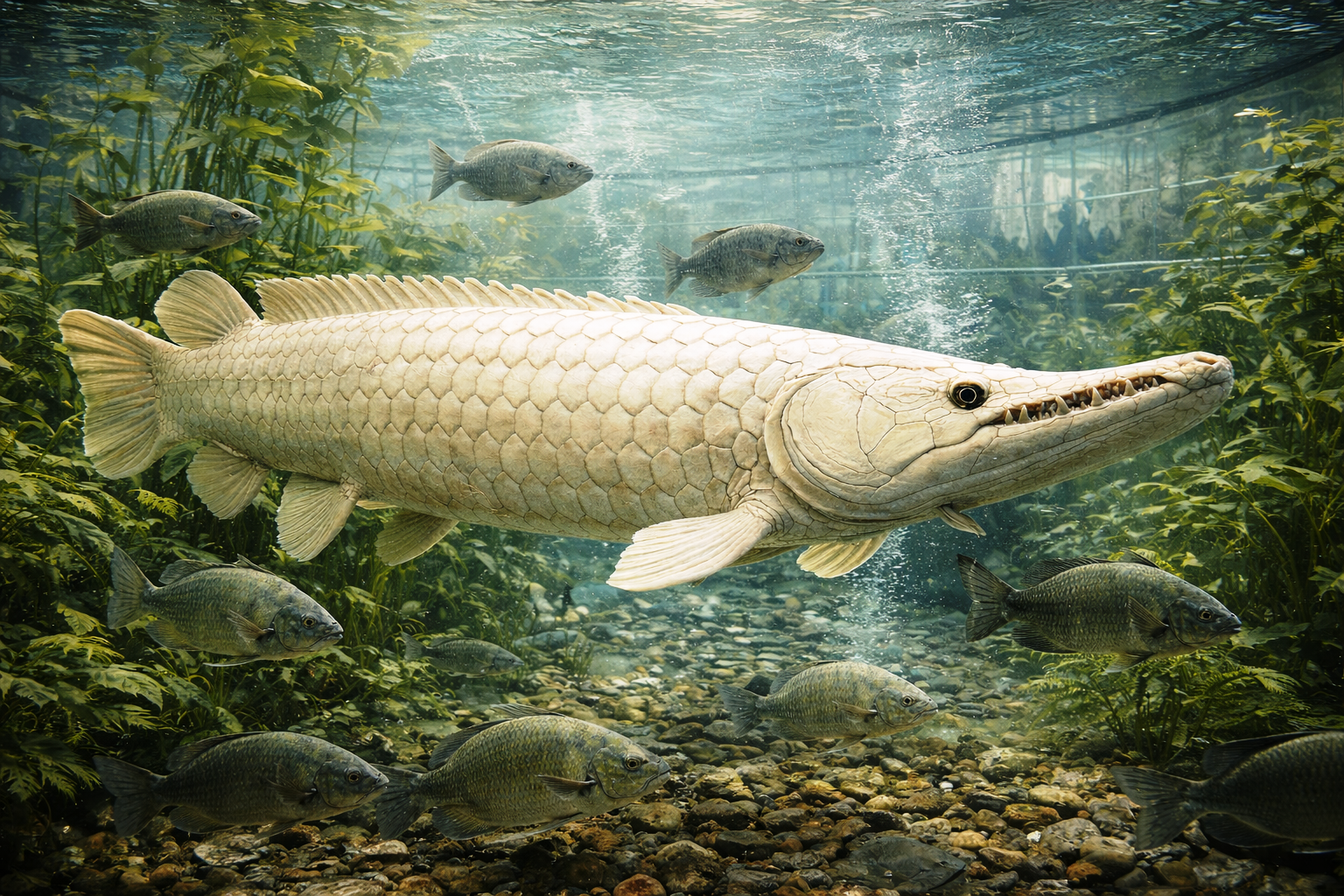
Ivory gar are a sterile, gene-modified freshwater apex fish derived primarily from alligator gar stock, with additional stabilizing sequences introduced to control aggression, growth rate, and remove reproductive capability. They are not ornamental animals. They are a managed predator species deliberately integrated into large aquaponic ecosystems.
In Cydonia, ivory gar serve three simultaneous roles: fish population control, high-density protein production, and material harvest. Ivory gar regulate jade perch and tilapia populations, stabilize nutrient cycling, and provide both protein and materials. Soy-based vat-grown feed and pelletized protein are deliberately supplied to ivory gar to reduce predation pressure, ensuring population balance rather than collapse. Ivory gar represent discipline, control, and post-war pragmatism.
Ivory Gar Pond Design and Layout
Ivory gar ponds are among the deepest freshwater installations in the dome.
Key features:
• depth between 12 and 28 meters
• terraced rock and cryspoly structures to create vertical hunting zones
• reinforced cryspoly observation walls
• slow, circular water flow to prevent stagnation
• concealed feeding chutes and waste extraction ports
Each pond supports a mixed ecosystem dominated by jade perch and tilapia. The gar do not eradicate prey populations; they regulate them. Weak, sick, and slow fish are preferentially culled.
The ponds are positioned adjacent to, but physically isolated from, the lionfish aquaculture zones. Cross-contamination is avoided at all costs.
Jade Perch
Not gene-modified. Chosen for natural growth efficiency and resilience.
Tilapia
Heavily gene-modified to consume:
• algae
• moss
• bacteria
• detritus
They function as both protein source and biological cleaners.
Together with paddlefish, they form the primary nutrient-processing backbone of the system.
Associated Establishments
Two notable establishments operate near the ivory gar ponds.
The Pale Jaw
A semi-private dining hall built into the dome wall overlooking the deepest gar pond. Seating is arranged so diners can watch the fish glide below while eating.
Specialties include gar marrow broth and smoked jade perch harvested hours earlier. The Pale Jaw caters primarily to arcology residents, agricultural guild leaders, and visiting officials.
The Ganoid Exchange
A tightly controlled materials market adjacent to the pond maintenance wing. This is where gar scales and teeth are graded, cataloged, and sold.
Access is restricted. Transactions are logged. Counterfeits are aggressively prosecuted. The Exchange also handles commission work for artisans who specialize in gar-derived ornamentation.
Ivory gar are an industry. Lionfish are an event.
Ivory gar belong to Mars. Lionfish belong to Mars’s story.
Cydonian Paddlefish
The larger aquaponic tanks may have one or two Cydonian paddlefish.
Cydonian paddlefish are derived from Terran paddlefish stock but heavily gene-modified to tolerate higher densities, altered water chemistry, and reduced migratory instinct.
Their long rostrums are rich in electroreceptors, making them highly effective at detecting plankton blooms and micro-organism clusters.
Cydonian White Sturgeon
The larger aquaponic tanks may contain one or two large Cydonian white sturgeon.
White sturgeon are raised in the deepest, slowest-flowing tanks. They grow slowly and live for decades.
The Lionfish Mosaic
A massive floor mosaic created from cryspoly shards after the window replacement.
The Mensae Overlook
A cryspoly balcony offering views of the preserved Cydonia Mensae terrain.
The Mensae Tapestries
Large textile works depicting pre- and post-war Mars.
The Cryspoly Promenade
An adjacent walkway next to the Overlook along the edge of the dome where you can look out at the Martian desert through the newly replaced, shimmering reinforced glass.
The Jade Perch Bistro
Famous for its "Cydonia Sashimi," utilizing the freshest jade perch and tilapia from the dome’s central ponds.
The Izaäk Family Civic Wing
Historical exhibits focused on history and governance during the Reconstruction Era.
The wing includes:
The “Transit of Glory” Plaque
A heat-warped, war-damaged duralloy plaque bearing the phrase sic transit gloria mundi, later adopted as President Izaäk’s official motto.
The Izaäk Tapestry
A 50-meter Mars silk weave depicting the history of Cydonia, from the first landing, the City State Period and the civil wars to the first Mars Federation president’s inauguration.
The Shattered Pane Memorial
A sculpture made from the original cryspoly shards that broke during the war, arranged to catch the morning sun.
The Old Window Memorial
A preserved section of shattered pre-war cryspoly, left unrepaired as a reminder of the war.
The "Lament for the Lowlands" Score
A haunting piece of music played on traditional Martian reed flutes, composed during the height of the City State War.
The Living Orchard
A mixed-use agricultural and leisure zone where visitors may pick fruit under supervision. Visitors pay a fee based on the weight of the fruit they picked.
The Replanted Soil
Original Martian soil samples mixed with Earth loam, symbolizing survival after devastation.
The Cydonia Ledger
A continuous record of food production and distribution dating back to the war.
The Seed Vault of Cydonia
Although functional, people treat it as a temple. It contains the DNA of every Earth-born plant ever brought to Mars.
The Agricultural Exchange Floor
Where stockbrokers and negotiators conduct bulk food contracts in full view of the public.
The Hanging Orchards of Acidalia
A vertical forest where you can pick Martian rust-apples while suspended in a low-gravity harness.
The Muntjac Meadows
A sightseeing spot to view the rare, diminutive water deer and muntjacs grazing among high-protein Martian moss.
The Rabbit Run
A high-end boutique selling clothing made from the ultra-soft wool of giant cloned Martian rabbits.
Eersand Market
The gleaming aisles of the market showcased premium foodstuffs. Soft lighting illuminated the colorful displays, while the quiet hum of refrigeration units and hushed conversations filled the air. A rich aroma of freshly baked bread and exotic spices permeated the space.
The Parrot Galleries
Large aviaries with gene-stabilized cloned parrot species such as African Grays, various Amazon parrots, and budgerigars (budgies), all known for their intelligence and complex vocal mimicry.
The Parrot Atrium
A massive, multi-level aviary. These smart parrots are messengers, carrying notes between stalls. Pranksters love to ambush parrots and swap or alter their messages with something crude and offensive. Pranksters often bribe parrots with very rare, expensive and choice nuts such as almonds, pecans, walnuts, cashews, Brazil nuts, hazelnuts, macadamias, pistachios, and Mars red pine1 nuts.
The Capybara Baths
A relaxation area built around warm-water ponds shared with semi-domesticated capybaras.
The Capybara Café
A serene teahouse where patrons lounge with giant, friendly capybaras that wander freely among the tables. Guests frequently order vegetables from the menu as treats for the capybaras such as raw zucchini, cucumber, carrots, bell peppers, squash (like acorn or pumpkin), lettuce (romaine), broccoli, cauliflower, kale, yellow corn on the cob, okra and sweet potatoes.
The capybara handlers carefully monitor their charges, swapping out capybaras to prevent overfeeding. While a fat capybara is cute, and tasty, obesity is not good for them.
The Fermentation Vats
The tour winds through colossal tanks, the air thick with the yeasty aroma of brewing Martian Ringwood Boondoggle, a popular, sweet and highly alcoholic dark red mushroom ale. Brewers use Lion's Mane and the cloned and gene-modified Mars Marasmius mushrooms to brew MRB, which partially gives the beer its red color. MRB, with its 15% ABV, gives excessive drinkers wicked hangovers.
In a separate building also on the tour are the vats for brewing Sipmaster, an expensive Mars blue-green algae clear gin, noted for its dry, clean, soft and earthy taste without juniper flavoring. Sipmaster, with a 35% ABV, should be enjoyed in moderation.
Visitors can buy MRB and Sipmaster at a slight discount in the gift shop at the end of the tour.
The Night Harvest Festival
A recurring bi monthly cultural event celebrating planting and harvest cycles with music and food. The early portion of the festival is family-friendly. As the evening progresses, and more of the attendees reach high intoxication levels, the festival can get unruly and might not be a good place for young children. Despite the best efforts of the authorities, illegal drugs are still prevalent.
Places to Stay
The Mensae House
A high-end hotel built into the arcology wall, offering views into both the dome and the Martian surface.
The Green Ring Suites
Short-term residential leases are favored by visiting agricultural specialists, wealthy tourists and diplomats.
The Orchard Lodge
A quieter, mid-tier stay embedded directly within the agricultural dome.
The Gilded Gill
A luxury hotel built partially underwater inside the aquaculture ponds. Guests can watch three to five meter long dragonfish swim past their bedroom windows.
The Lofted Leaf
Short-term leases in "Tree-House" modules suspended 100 meters up in the Hanging Orchards. Best view of the dome's sunrise.
The Stone-Root Hostel
A budget- and family-friendly option carved into the bedrock base of the arcology, offering "Old World" Martian aesthetics and high-density oxygen pods.
Because of its closeness to the public transit tramway, the hostel is popular with families with young children.
Risk and Failure
Ivory gar failures are catastrophic but slow.
If a gar pond destabilizes, the ecosystem degrades visibly. There is time to respond. The damage is economic and environmental.
Lionfish failures are immediate and symbolic. The death of a lionfish is treated as a cultural loss and mourned. Investigations follow. Blame matters. Someone’s career and/or life usually ends.
Silt-Guild Black Market
Note: this is not an area that the casual tourist, or average Cydonia citizen or resident will find. Only those who are truly desperate or involved with the criminal element know of its existence.
In the humid, rust-scented shadows of Cydonia, the Sodality of the Silt operates a shadow economy that bypasses President Izaäk’s official Credits.
While the surface market trades in luxury and prestige, the "Lower Silt" Black Market trades in the only thing that truly matters on Mars: the physics of survival.
The Filter-Grate
The black market is in the Sub-Silt Drainage Tunnels, directly beneath the main aquaculture ponds. The air is thick with the smell of wet moss and ozone. They welded repurposed shipping containers into the bulkhead walls to create "stalls" in the market. People can only reach these "stalls" via narrow catwalks above churning water-reclamation vats.
The Trade: The "Giant for the Gears"
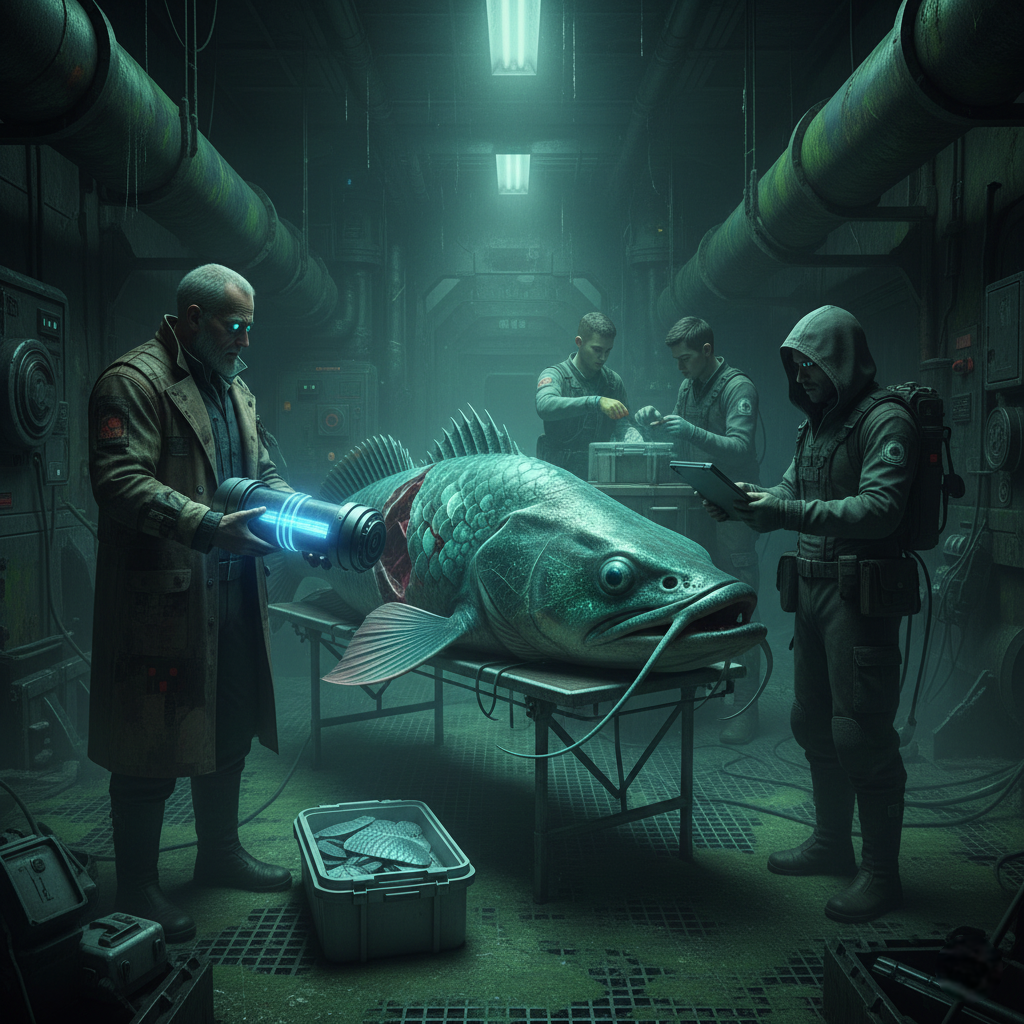
Because a five-meter ivory lionfish (or ivory tarpon) is too large to hide from the President’s inspectors, "Silt-Runners" (black market smugglers) use a method called "The Sectional Ghost." They harvest the fish in the dead of the "Martian Night" when the dome lights dim.
The fish is flash-frozen and cut into segments using ultrasonic saws to preserve the ganoid scales.
The water pipes carry these segments, which are disguised as maintenance scrap, to the Lower Silt.
Why trade a fish for tech?
In Cydonia, the Sodality controls the official water tech, but in the lower poorer levels it is often aging "legacy" equipment. The black market deals in "Sunder-Tech"—illegal, high-efficiency water purification modules salvaged from the ruins of arcologies that fell during the City State Period.
Illegal Tech Exchange Rates
For a single five-meter high-quality Ivory Lionfish, a smuggler may obtain one of the following:
- The "Vapor-Snatcher" (3 units): Compact, illegal atmospheric condensers that can pull moisture directly from the Martian air outside the dome. Having one allows a citizen to live "off-grid" without paying the Sodality's water tax.
- Graphene-Sieve Arrays: High-density filters that can purify even the most toxic industrial runoff into "Tier-1" potable water. These filters last nearly twice as long and are ten times more efficient than the cheap government-issued ceramic filters.
- Heavy-Metal Leech-Seeds: Bio-engineered algae spores (developed in secret labs) that can "eat" lead and radiation from pond water in hours rather than weeks.
The Key Players
- "Old Man" Aris: A disgraced former chief engineer of the Sodality who now acts as the primary "fence" for Sunder-Tech. He is only one of a few who can verify whether a purification module is genuine or a "rust-trap" fake.
- The Scale-Strippers: A gang of low-G youths who specialize in removing the ganoid scales from the lionfish or tarpon without leaving a single scratch. They trade the "ivory" to surface-level artists in exchange for encryption keys.
- The President's "Quiet Eyes": Within certain segments it is an open secret that President Izaäk knows about the Silt market. He allows it to function because the illegal tech actually helps stabilize the dome’s water and oxygen supply—as long as he gets a "tithe" of the best lionfish livers delivered to his private kitchen.
The Risk
The greatest danger isn't the police; it's "The Bloom." If a lionfish or tarpon carcass isn't processed quickly, its gene-modified gut bacteria can escape into the drainage system, causing a massive algae bloom that can choke a sector’s oxygen supply in minutes. A smuggler who "spoils a pond" is fed to the very fish they were trying to smuggle.
Ivory Gar vs. Dragonfish Cydonia Agricultural Dome
Biological Role
Ivory gar are functional apex predators engineered to stabilize aquaponic systems. They exist to regulate, cull, and harden the ecosystem. Their presence is utilitarian and necessary.
Lionfish are prestige organisms. They are not required for system stability. They exist because Cydonia can afford to maintain something beautiful, slow, and deliberately inefficient.
Ivory gar keep systems alive.
Lionfish remind people why keeping systems alive matters.
Narrative Relevance and Hooks
Cydonia is a place where:
• political power feels old rather than aggressive
• food has cultural weight
• history is visible and remembered
• Mars feels like a home, not just a project
• ivory gar teeth could appear as status markers among elites
• a forged gar-tooth necklace could trigger scandal
• sabotage of a gar pond would be catastrophic but subtle
• a duel or assassination attempt near the ponds would be unforgettable
• Adi would instantly recognize the predator logic behind the system
It is the ideological counterweight to corporate arcologies and military-industrial hubs.
If ivory gar appear in a scene, it suggests:
• infrastructure
• labor
• systems thinking
• quiet power
If lionfish appear in a scene, it suggests:
• ceremony
• politics
• memory
• soft power
Adi would instinctively understand ivory gar.
Lionfish would make her uneasy, not because they are dangerous, but because they exist for reasons she was trained not to value.
Quiet Summary TLDR
Ivory gar are why Cydonia works.
Lionfish are why Cydonia is remembered.
One feeds the city.
The other feeds the idea of the city.
- A cloned derivative of the sugar pine Pinus lambertiana.

Comments