

Cognitive Conduction Node
Cognitive Conduction Node (CCN)
Classification
Advanced neural augmentation
Restricted black-ops technology
Status: Prototype / Non-export / Illicit possession
Overview
The Cognitive Conduction Node is a neural throughput and synchronization organ designed to reduce radically the latency between cognition, intention, and action. It does not make a user smarter in a conventional sense. Instead, it removes bottlenecks in thought execution, allowing trained minds to operate closer to their theoretical limits.
In unaugmented humans, signal delay, prioritization conflicts, and neural congestion constrains cognition. The CCN functions as a dedicated routing nexus, smoothing, amplifying, and prioritizing neural traffic before it enters the central nervous system.
In Adi’s case, it completes the triangle formed by:
• her Marine-grade neural net
• her nootropic stack
• her augmented sensorium
Without the CCN, those systems would conflict. With it, they harmonize.
Origin and Development
Skunk Works Origin
The Cognitive Conduction Node was developed on Mars by a deep-black skunk works operating under multiple shell entities. Internally, the project was known as Project Laminar Thought.
The company most commonly associated with the technology, though never publicly acknowledged, is:
Cerberus Advanced Cognition Systems (CACS)
Location: Subsurface facility beneath Elysium Planitia
Official Charter: Medical neuro-prosthetics research
Actual Function: Military-grade cognitive weaponization
CACS is a sibling operation to Cerberus Bio-Engineering but operates with even tighter compartmentalization. Only a handful of Martian Intelligence Directorate officials know its full scope.
Historical Context
The CCN emerged after repeated failures in enhanced soldiers during the late phases of the Second Mars Civil War. Augmented operators possessed faster reflexes and greater strength, but many suffered from:
• decision paralysis
• sensory overload
• feedback loops between implants
• cognitive fragmentation
• catastrophic burnout
In short, the body evolved faster than the mind could manage.
The CCN was conceived as the missing organ. Not an implant, not software, but a new biological structure designed to integrate with existing neural systems.
Early animal testing resulted in severe neural collapse. They delayed human testing for decades.
Approximate Cost of a CCN
Official cost (classified procurement estimate):
• 180–220 million credits per unit
This figure includes:
- bespoke biological growth of the node
- individualized neural compatibility modeling
- sterilized implantation environment
- follow-on monitoring and kill-switch integration
- lifetime silence from everyone involved
No civilian market price exists. This is what a black-ops program quietly allocates per operator.
Black-Market Cost (what Kane paid in reality)
Because Adi’s CCN was stolen from the first operational test batch, its effective cost is much higher.
Realistic black-market equivalent:
• 300–500 million credits in combined value
Not all of that would be cash. Kane likely paid using:
- stolen Martian IP
- favors owed to intelligence cutouts
- erased identities
- physical assets
- possibly lives
In other words, Kane didn’t buy it.
He burned bridges, people, and futures to acquire it.
Comparative Costs (for scale)
- High-end civilian neural implant: 250k–1M credits
- Military neural net (legal): 5–12M credits
- Full Marine Myrmidon augmentation package: 40–60M credits
- TZD dueling blade (top tier): 5–10M credits
- Lazarus-grade wetware prototype: 80–120M credits
- Cognitive Conduction Node: off the charts
The CCN costs more than a corvette. More than a small habitation station. More than most people are worth to any government.
Why It’s So Expensive
The cost isn’t materials. It’s risk.
- Each CCN represents a strategic shift in warfare
- Each unit is a potential intelligence disaster
- Each implant risks creating someone who cannot be controlled
That is why:
- fewer than a few dozen were ever grown
- most test subjects vanished from records
- possession is treated like WMD trafficking
Adi walking around with one in her spine is not just illegal. It’s destabilizing.
Design and Structure
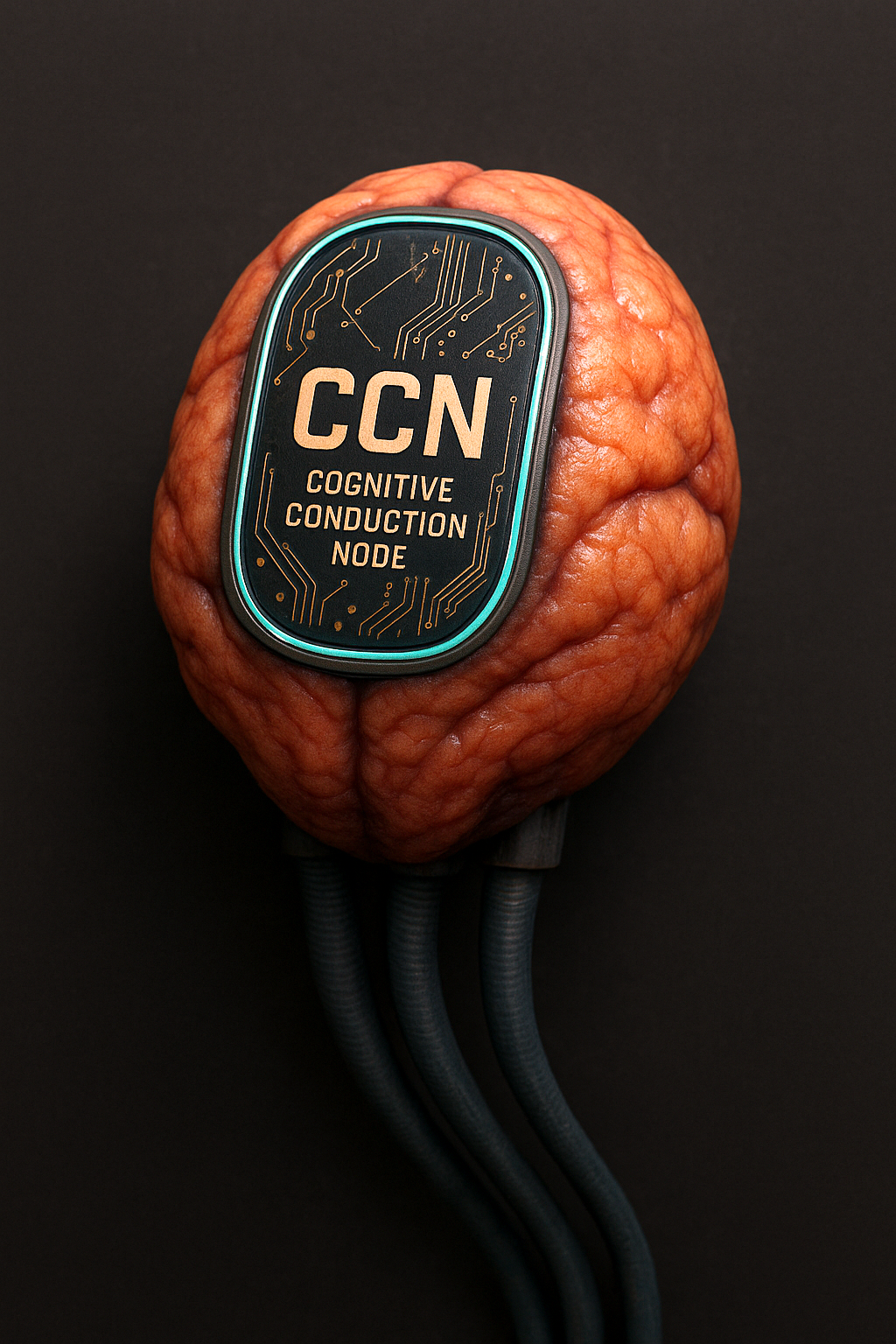
The Cognitive Conduction Node is a hybrid biological-synthetic organ approximately the size of a flattened walnut.
Location
Implanted at the junction of the upper spinal cord and lower brainstem, where:
• sensory input converges
• motor commands diverge
• autonomic systems interface with cognition
This placement allows the CCN to intercept and route signals before they propagate.
Functional Architecture
The CCN performs five core functions:
1. Neural Traffic Arbitration
It resolves competing neural priorities in real time, preventing overload when multiple augment systems demand attention simultaneously.
2. Latency Compression
Signals passing through the node experience a measurable delay reduction. Reaction time improvements are not linear but situational, peaking under stress.
3. Cognitive Load Buffering
The node absorbs and redistributes excess neural activity, reducing fatigue, confusion, and dissociation.
4. Intent Amplification
When the user commits to an action, the CCN reinforces that intent across motor pathways, eliminating hesitation once a decision is made.
5. Augmentation Harmonization
It synchronizes neural net processes, nootropics, nanite feedback, and sensory overlays into a coherent stream.
Without a CCN, such integration would eventually tear the user apart.
Adi’s Cognitive Conduction Node Model
CCN-X9 “Blackglass” Variant
Status: Experimental
Batch: First operational human test series
Adi’s node was stolen from the first black-ops shipment intended for elite clandestine operatives. These units were never meant to leave Martian intelligence custody.
Kane acquired it through means he refuses to reveal.
Unique Features of Adi’s Node
Adi’s CCN differs from baseline prototypes in several ways:
• reinforced biological scaffold to tolerate extreme physical stress
• expanded conduction pathways compatible with Marine neural nets
• hardened against EMP and virome interference
• modified reward-feedback loop tuned for combat survivability
Unlike other test subjects, Adi already possessed a lifetime of combat training and discipline. The CCN did not overwhelm her mind. It unlocked it.
Interaction with Adi’s Psychology
The CCN does not change who Adi is. It changes how quickly she becomes who she already chose to be.
Key observed effects:
• hesitation collapse under threat
• accelerated tactical cognition
• reduced emotional lag in combat
• increased clarity during chaos
• post-combat emotional rebound delayed but intensified
This last effect concerns Kane and Asteria. The CCN allows Adi to function flawlessly during violence, but emotional processing is deferred, not erased.
Risks and Side Effects
Known risks include:
• identity compression
• reduced tolerance for indecision in others
• emotional alienation
• dependency on high-cognition states
• existential dissociation
In untrained subjects, CCNs caused breakdowns within weeks. Adi is not untrained.
Legal Status
The Cognitive Conduction Node is illegal under:
• Martian Genetic Ethics Codex
• BuCol Enhancement Restrictions
• Colonial Military Armament Treaties
Possession carries penalties equivalent to weapons trafficking. Discovery would result in immediate black-site detention.
Strategic Implications
The CCN represents a shift from augmenting bodies to augmenting decision velocity.
Whoever controls this technology controls the future of elite warfare.
That is why:
• only a handful were ever made
• most test subjects are unaccounted for
• records are fragmented or erased
Adi is walking proof that the technology works.
Narrative Importance
The Cognitive Conduction Node is the quiet core of Adi’s transformation.
It is the difference between:
• strength and controlled force
• speed and precision
• brutality and intention
Without it, her augmentations would eventually destroy her. With it, she becomes something new. Not a weapon. A convergence.
Anyone who recognizes what Adi has would instantly understand:
- she is not just augmented
- she is not just dangerous
- she is an existential asset or threat
And anyone who could afford a CCN would never let one walk free. Which is why Kane will never tell Adi the price.
Failure Modes of a Damaged Cognitive Conduction Node (CCN)
Classification
Catastrophic neurological risk
Non-repairable in the field
High probability of fatal or irreversible outcome
Overview
The Cognitive Conduction Node is not redundant. There is no backup.
Damage to a CCN does not behave like damage to a normal implant or organ. It behaves like damage to a traffic control hub that thousands of neural pathways now depend on. When the node is compromised, signals do not simply slow or fail. They collide.
Most subjects do not survive meaningful CCN damage.
Primary Causes of Damage
Known causes include:
• blunt-force trauma to upper spine or lower skull
• penetrating injury near the brainstem
• uncontrolled electromagnetic surge
• hostile nanite interference
• internal thermal spike from overload
• biological rejection cascade
• microfracture from extreme G-forces
Even partial damage is usually terminal.
Failure Progression
Phase One: Latency Desynchronization (seconds to minutes)
The first failure is timing.
Neural signals arrive out of order. The subject experiences:
• vertigo
• double vision
• auditory lag
• loss of fine motor control
• delayed pain response
• speech fragmentation
Subjects often report feeling “out of phase with themselves.”
Combat effectiveness collapses almost immediately.
Phase Two: Priority Collapse (minutes)
The CCN’s arbitration function degrades.
Symptoms include:
• involuntary motor actions
• conflicting muscle commands
• freezing or oscillating movement
• uncontrolled reflex firing
• autonomic instability
Breathing and heart rate may desynchronize.
This phase is usually mistaken for shock or stroke by untrained observers.
Phase Three: Cognitive Feedback Loops (minutes to hours)
This is the most dangerous stage.
Without proper routing, neural traffic begins to echo and amplify.
Observed effects:
• recursive thoughts
• auditory hallucinations
• violent emotional spikes
• sudden dissociation
• loss of identity continuity
• uncontrolled augmentation activation
In augmented subjects, armor, reflex systems, or nootropics may trigger simultaneously, compounding the damage.
This is where most subjects die.
Phase Four: Neural Burnout or Systemic Shutdown
There are two outcomes.
1. Burnout
Neurons overfire until synaptic collapse occurs.
Results:
• irreversible brain damage
• vegetative state
• death from autonomic failure
2. Shutdown
The nervous system enters a protective cascade.
Results:
• coma
• near-total neural silence
• extreme metabolic suppression
Shutdown is survivable only in rare cases and requires immediate black-site intervention.
Long-Term Survivors (Extremely Rare)
Documented survivors of partial CCN damage are fewer than five across all known test programs.
Common long-term effects:
• permanent dissociation
• fragmented memory
• emotional flattening
• inability to multitask
• hypersensitivity to sensory input
• loss of augmentation tolerance
• chronic pain
Most survivors must have the CCN completely disabled, permanently reducing them to below-baseline cognitive function.
They are never returned to duty.
Surgical Repair Feasibility
Field repair is impossible.
Even controlled surgical repair is theoretical.
Reasons:
• CCN integrates biologically with neural tissue
• microvasculature is unique to each subject
• synthetic and organic components cannot be cleanly separated
• removal causes catastrophic signal collapse
The only viable intervention is controlled deactivation, which itself carries a fatality risk exceeding 60 percent.
Emergency Protocols (Black Ops Only)
If CCN damage is suspected:
- Immediately suppress nootropics
- Hard-disable secondary augment systems
- Induce medical coma
- Isolate neural net from external inputs
- Transport to Martian-grade facility within six hours
Failure to do all five results in near-certain death.
Why Adi Is Uniquely Vulnerable
Adi’s CCN is not a baseline model.
Her node:
• carries more traffic than intended
• interfaces with experimental wetware
• synchronizes with NARs and quorum nanites
• operates near maximum throughput under stress
Damage would not just affect cognition. It would trigger cascading failure across her entire augmentation stack.
Asteria knows this.
It is why Asteria intervenes preemptively when Adi approaches overload thresholds.
Strategic Implications
This fragility is intentional.
The CCN was designed so that:
• it cannot be captured intact
• it cannot be reverse-engineered easily
• its bearer cannot survive interrogation if compromised
In effect, the CCN is both a weapon and a kill switch.
Narrative Implications
For Adi:
• A targeted strike near the base of the skull is existentially dangerous
• EMP weapons are a credible threat
• CCN damage is one of the few ways to truly neutralize her
• Anyone who knows about the CCN will aim for it
For Kane:
• Losing Adi to CCN failure would expose the entire program
• He has contingency plans he has not disclosed, which includes a Lazarus Consortium provided kill switch. The LC wasn't going to dump millions of credits into a nearly unstoppable agent and risk her going rouge. Kane doesn't like the kill switch, and hopes he will not have to use it, but it is there should things go to shit.
For the world:
• CCNs represent power that cannot be safely wielded
• Their failure cases are why the technology never went public
Quiet Truth
The Cognitive Conduction Node does not forgive mistakes.
It gives its bearer clarity, speed, and control.
In return, it demands perfection.
And if it is damaged, it does not kill gently.
Exceedingly rare


Comments