

Chendiurian Great Sand Sea Glass
Chendiurian Great Sand Sea Glass
BuCol Xenogeological Reference File
Classification: Non-Volatile Silicaceous Impact Product (NV-SIP)
Hazard Rating: Minimal (0.2)
Cultural Sensitivity Flag: High
1. OVERVIEW
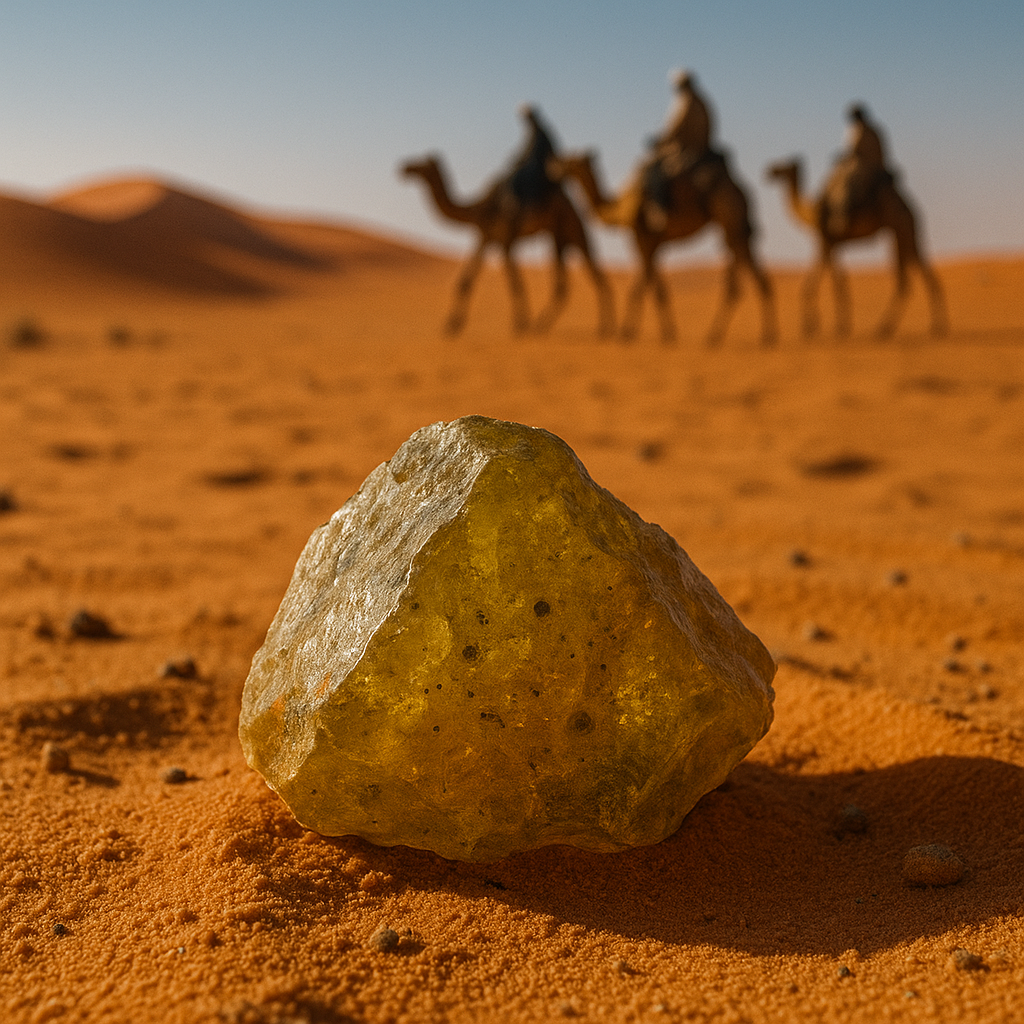
Great Sand Sea glass known locally as Asfar al-Sahra (“Yellow of the Desert”) or Kel Tagelmust Ahenjar (“Veil-Stones”) is a naturally occurring silica glass found only in the Great Sand Sea, the immense central dune ocean of Chendiuria’s Great Desert.
While analogous to the Libyan desert glass found on ancient Earth, Chendiuria’s variant displays a wider chromatic range, higher Mohs hardness, and unique isotopic signatures inconsistent with meteoritic or volcanic formation.
The glass appears in colors ranging from:
- Faint lemon yellow
- Gold
- Dark honey amber
- Occasional greenish-yellow specimens (extremely rare)
All are highly translucent and exhibit faint internal striations caused by rapid cooling under extreme pressure.
2. PHYSICAL PROPERTIES
Composition
~98.7% fused silica with trace iron, zirconium, tungsten, and an unidentified mineral associated with ancient meteor cores
Hardness
7.4 on the Mohs scale (slightly harder than Terran desert glass)
Density
2.25 g/cm³
Fracture
Conchoidal, producing razor-sharp edges
Luminescence
None naturally, though some pieces emit faint sparks under intense friction due to embedded crystalline impurities
BuCol analysis notes that the internal structure contains “shock lamellae inconsistent with known impact pressures,” suggesting a formation mechanism unique to Chendiuria.
3. BUREAU OF COLONIES SPECULATION THE ORIGIN PARADOX
Official BuCol Xenogeology notes (filed ~85 Standard Years before First Landing) state:
The planet shows no recent or ancient meteorite craters of the size, frequency, or distribution required to produce this volume of fused desert glass. However, excavated basalt columns contain heavily eroded ferrous-nickel cores consistent with primordial meteoroids that penetrated before planetary crust stabilization. Chendiuria’s early molten surface may have allowed meteroid impacts to sink beneath the crust without forming surface craters.
Billions of years ago, Chendiuria took many meteorite impacts, but they sank into the still-plastic crust before leaving recognizable craters. Chendiuria's surface was a magma ocean around 7.5 to 8 billion years ago, mirroring Earth's Hadean Eon.
After Asterion's seafloor uplift and basaltic eruptions changed the continent, basalt pillars trapped ancient meteor cores, encasing them in cooled volcanic cores.
Those catastrophic geological events likely ejected Great Sand Sea glass onto the surface when super-heated silica blasted across the Great Desert in molten sheets that cooled mid-air.
This supports the local Bedouin oral traditional legend that the glass “fell from the sky as yellow rain.”
4. HISTORY OF DISCOVERY
Earliest Record Bedouin Oral Accounts
The first known discoverers were unquestionably the local Bedouin tribes, a few years after the colony ship Vernal Horizon arrived.
The Kel-Rihani and Tamashek-descended tribes carried stories of "Desert Jewels."
First Scientific Documentation
Several Research and Exploratory Corps1 surveyors stumbled across the glass during early mapping expeditions, but their samples were misclassified and filed under “silicate vitrification lumps (naturally melted sand).”
The early samples were either stolen, misplaced, or taken as personal souvenirs.
First Bureau of Colonies Documentation (official, 85 SY pre-landing)
Xenogeologist Dr. Sana Odufemi, one of only two Bureau of Colonies xenogeologists to visit Chendiuria on an early pre-colonial BuCol survey mission, cataloged small fragments near the Great Sand Sea’s southern ridges.
However:
- She did not recognize its developing cultural value to the Bedouin tribes who would later immigrate to Chendiuria with the First Wave of colonists
- She incorrectly assumed they were remnants of micro-meteor vaporization (a theory later disproven)
- BuCol senior management rarely referenced her report, which was filed into a lower-priority xenogeological compendium and later forgotten
Only one of Dr. Odufemi's glass samples survives, now housed in the Mars Federation Colonial Museum in the rarely visited xenogeological section.
5. CULTURAL SIGNIFICANCE TO THE BEDOUIN
Jewelry and Status Symbol
Because the glass is difficult to find and even harder to work without shattering, it is considered a status material.
Bedouin artisans work the glass into:
- Veils studded with tiny polished fragments
- Pectorals and chest plates
- Face chains and ear-framed drapes
- Armlets, hair beads, and bridal halters
- Small talismans suspended from tagelmusts (face wraps)
Glass adornment marks:
- Wealth
- Family prestige
- Successful migration seasons
- The coming of age of daughters
Tribal leaders often present visiting Bedouin dignitaries with token glass beads, symbolizing trust and safe passage.
6. Craftsmanship
The most renowned artisan lineages include:
- The House of Kel-Barka — for fractal-cut geometric pendants
- Aisha n’Ténéré — the first to set amber great sand sea glass in titanium silver filigree
- Rashid al-Miraji — known for crafting entire half-veils of interlinked polished micro-stones
Craftsmen safeguard secret production that occurs in concealed, fusion-powered, artificial caverns. Rumors say that some artificial caverns are older than the colony itself.
7. Economical Use
Though rare, Bedouin traders exchange sand sea glass for:
- High-grade protein feed for herds
- Replacement parts for fusion-powered desalinators
- Medical nanite cartridges
- Quick Heal packages
- Simple veterinary supplies
- Antibiotic medicines
- Diagnostic strips
- Advanced rechargeable nuclear batteries
- Fab safe seals for mass fabricators
- Mass fabricator repair parts and upgrades
Despite its rumored value off-world, the Bedouin treat it primarily as a cultural treasure, rarely selling pieces to outsiders.
8. NOTABLE PIECES
The Veil of Téhani al-Rihani
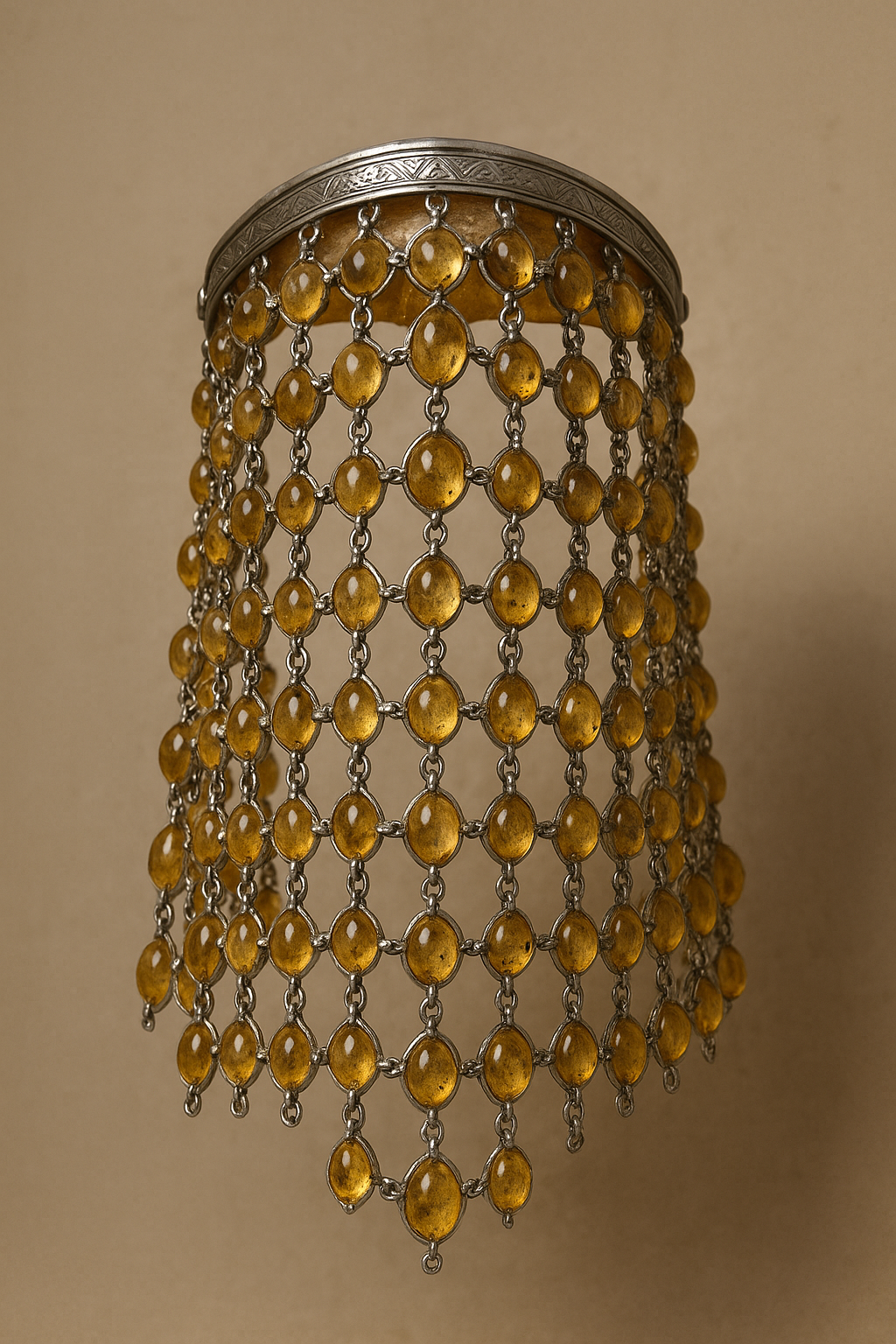
A legendary bridal veil incorporating over 1,200 micro-polished glass beads in a titanium lattice. Worn only during high ceremonial gatherings.
The Twin Comets of Aïr
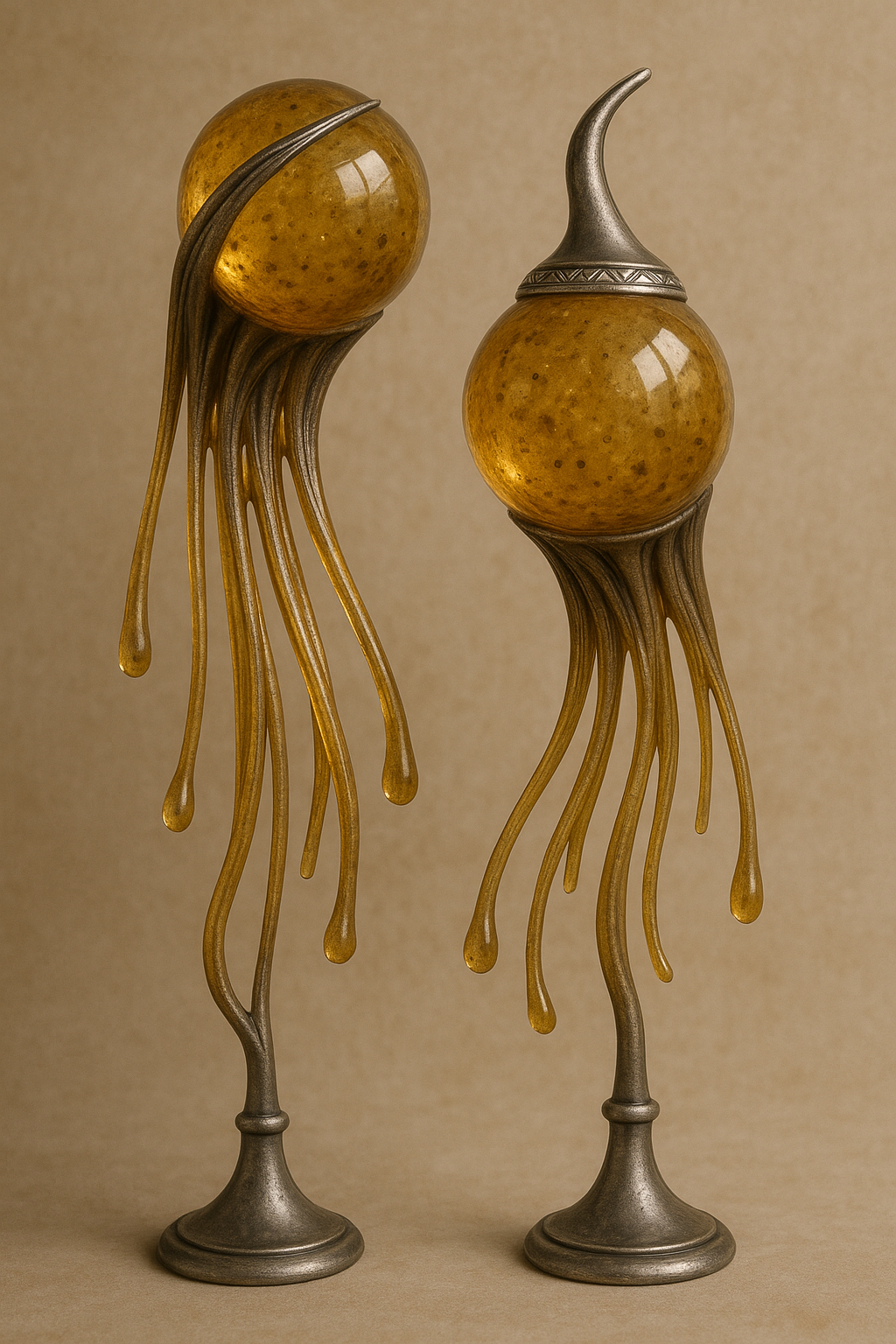
Two matching amber-colored pendants believed to be carved from a single massive fragment, set in mass-fab made sterling silver. Said to bring luck during dangerous migrations.
The Barka Circlet
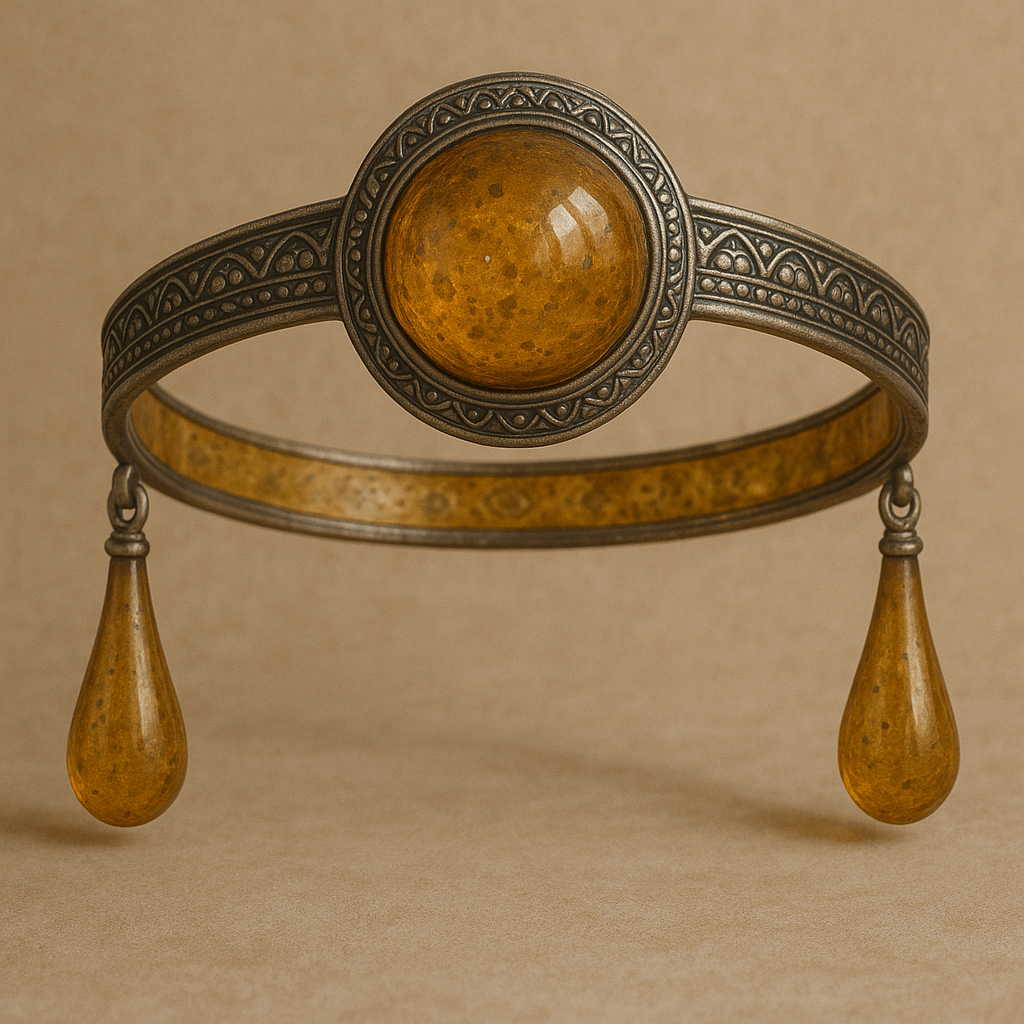
A silver-washed titanium ornate forehead band set with a central dark-amber glass cabochon, its luster comparable to high-grade opal. A large teardrop shaped light-honey colored glass drop on either side. When worn, the teardrops lie against the temples. Worn by senior tribe matrons during negotiations with non-Bedouin outsiders.
The Wandering REC’s Token
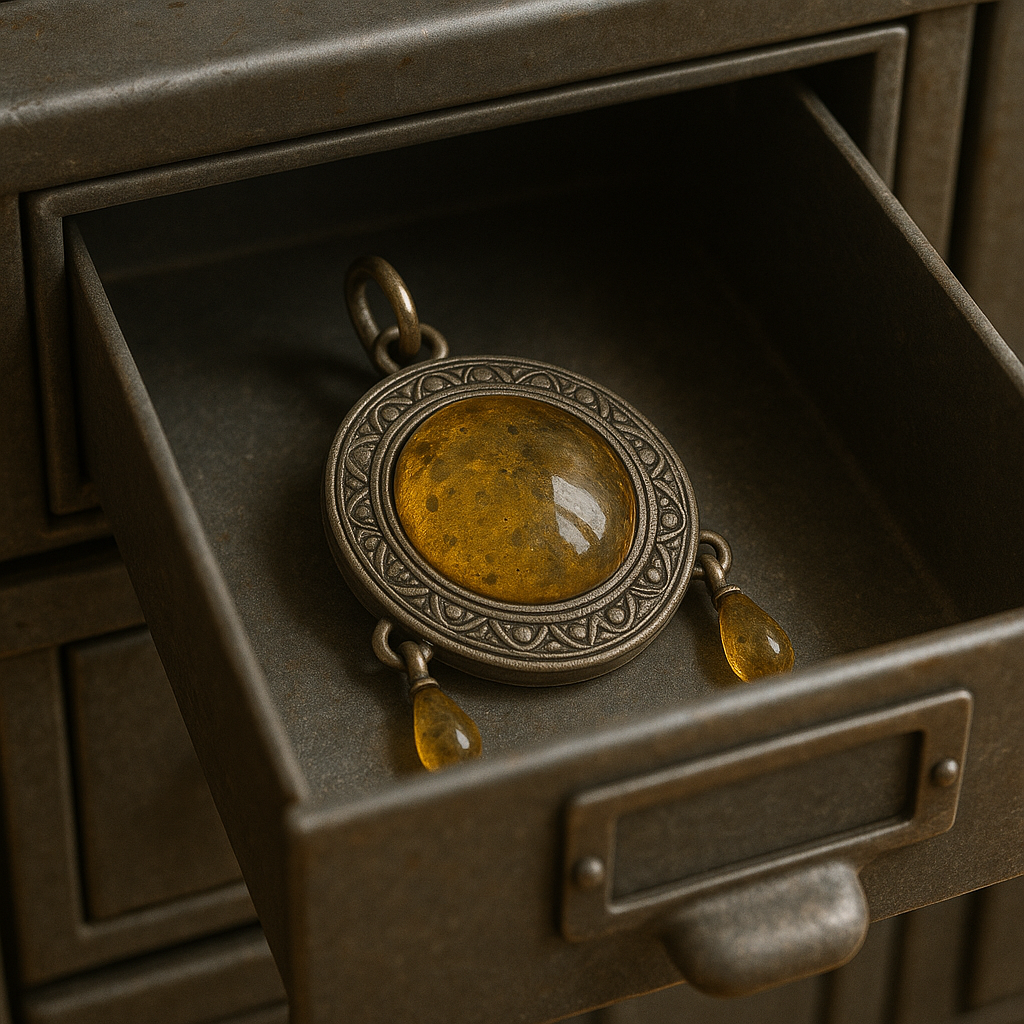
A bead in an ornamental silver-washed stainless steel setting brought off-world by a Research and Exploratory Corps pilot. The bead sits today in an obscure, dusty, forgotten BuCol administrative steel drawer marked “Misc. Silicates in Settings—Unidentified.” Its existence proves a few pieces have escaped Chendiuria, but no one knows who the pilot was that brought the piece back to Mars.
9. MODERN USE OUTSIDE THE DESERT
While exceedingly rare, Great Sand Sea Glass occasionally appears:
- As exotic jewelry among exceptionally wealthy First City residents
- In black-market collections on Mars (rumored)
- As diplomatic gifts smuggled out by traders ignoring Chendiuria export restrictions2
- In BuCol comparative studies of non-meteoritic impact glasses
Rumors persist that a single large specimen, the size of a child’s fist, resides in the private vault of a high-ranking Lazarus Consortium executive, though no one has verified this.
- Research and Exploratory Corps (REC) pronounced as "wreck."
- Recognizing the cultural significance to the Bedouin tribes, Chendiuria prohibits export of Great Sand Sea glass.


Comments