

Chendiuria Cliff Stalker
Chendiuria Cliff Stalker
1. GENERAL OVERVIEW
Common Name: Cliff Stalker (Lurvath ceron)
BuCol Tier: Class III Megafauna – Protected, Hazardous
REC Field Code: “Sky-Knife”
The cliff stalker (Lurvath ceron) is a mid-sized, semi-gliding predatory reptile found only in the Palo Duro Canyon of Chendiuria. It is one of the planet’s few obligate cliff-dwelling predators and is considered a relic species adapted to the canyon’s extreme verticality, thermals, and harsh silicate winds.
Cliff stalkers visually resemble a pterodactyl, but with Chendiurian evolutionary twists:
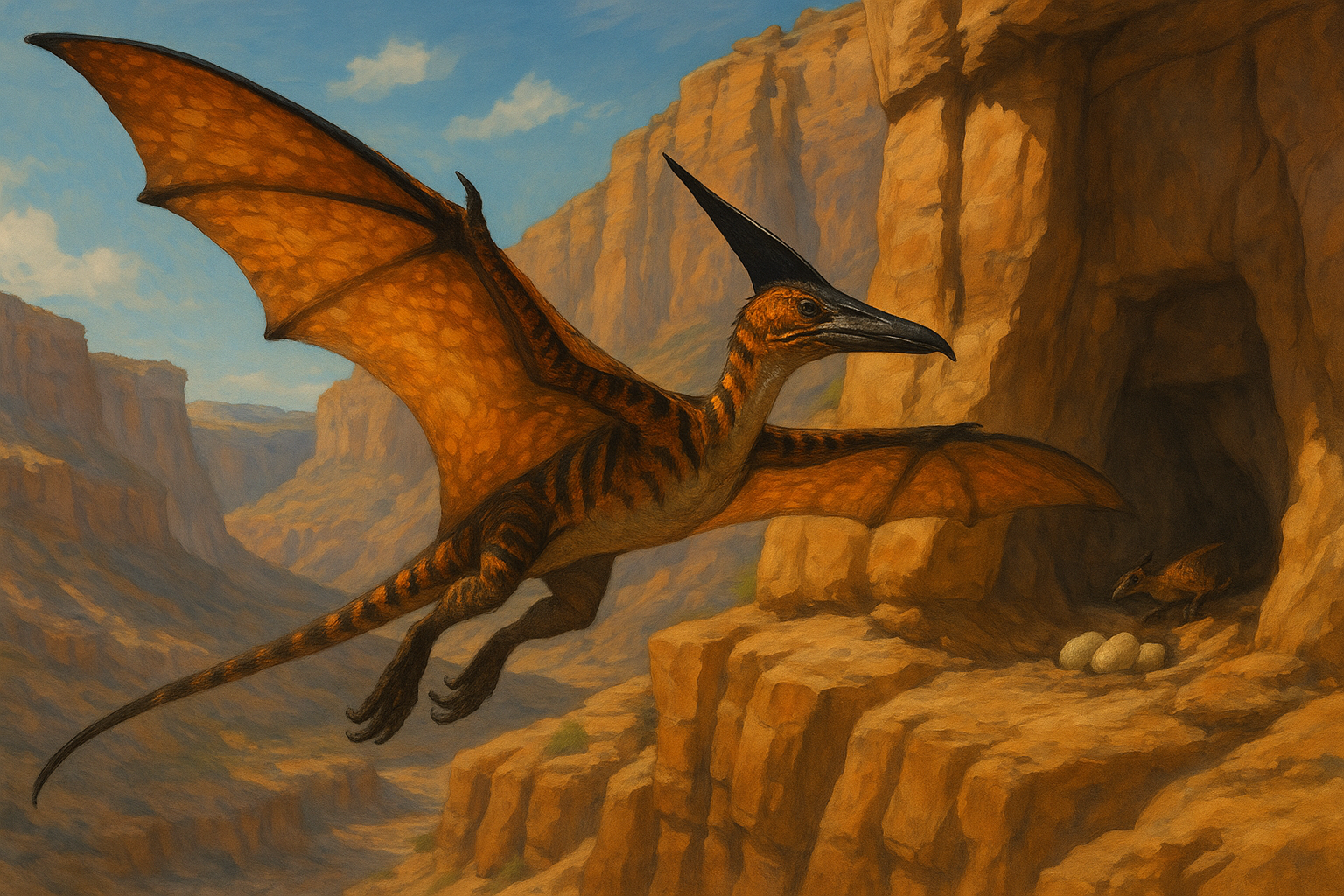
- A compact, muscular body
- A whip-thin tail used for counterbalance
- A cranial crest shaped like an inverted sail
- Four climbing limbs with recurved claws
- A set of gliding membranes that unfurl between forelimbs and body
- A raptorial beak lined with small backward-facing teeth
They do not truly fly. They glide with murderous precision. Their hunting style is both feared and iconic in canyon folklore.
2. APPEARANCE and COLORATION
Because the terrain of Palo Duro Canyon consists of:
- layered yellow-brown sandstone
- dark brown basalt intrusions
- shadowed hollows and sun-blasted ledges
…the cliff stalker evolved extreme camouflage.
Adult Coloration:
- Dorsal side: mottled ochre, rust-red, basalt-black striping
- Wing membranes: translucent amber-brown with darker trailing edges
- Ventral side: lighter tan to pale sandstone gold
- Cranial crest: black spearhead pattern used in sexual display
- Tail whip: ringed with alternating charcoal and dune-yellow bands
Under full sun, the membrane flashes look like brittle stained glass, helping them blend in with glare reflecting off canyon walls.
Juvenile Coloration:
- muted sandy beige
- fewer stripes
- softer membrane colors
Juveniles rely on concealment over aggression.
3. SIZE and SEXUAL DIMORPHISM
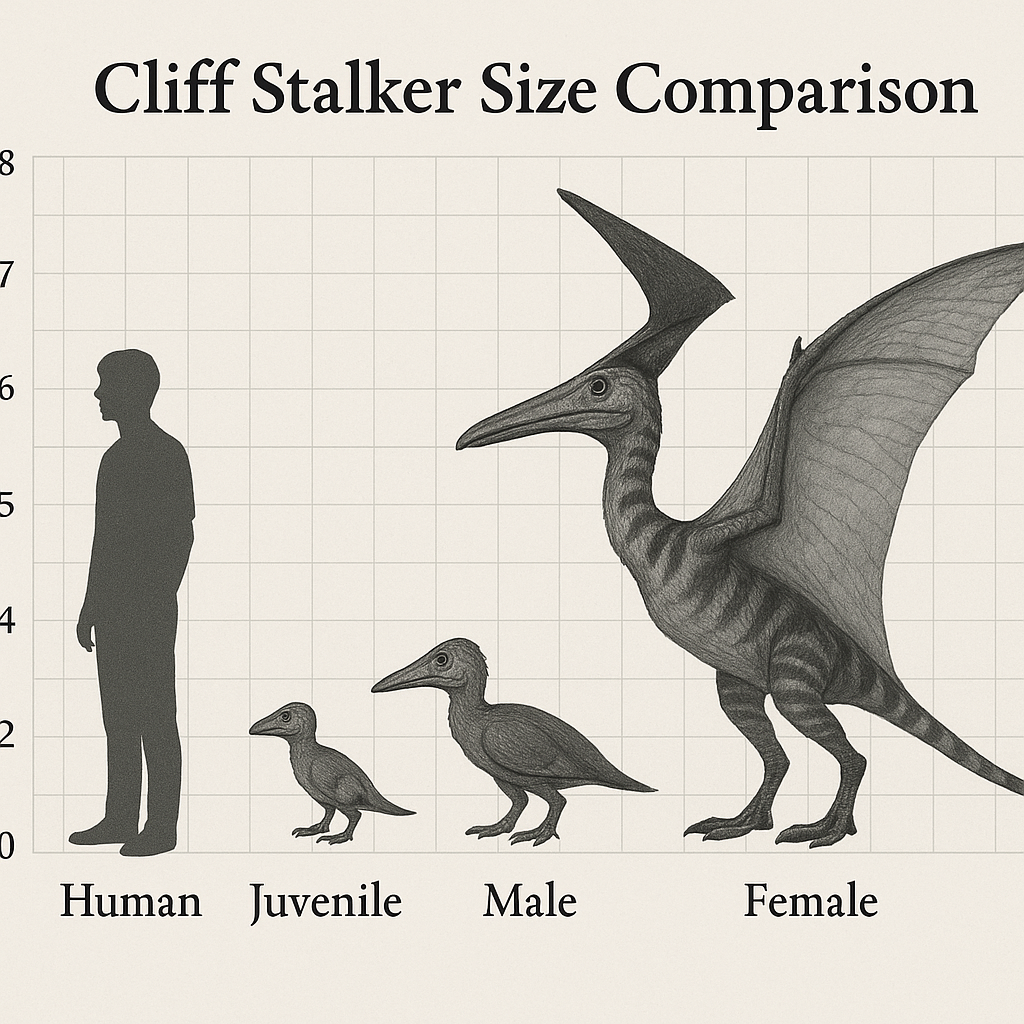
Cliff stalkers show female-biased dimorphism, opposite of many Terran reptiles.
Females:
- Larger (2.3–2.7 m wingspan; 30–35 kg)
- This measurement breaks down as:
- Body (snout to hip): ~4.9 to 5.1 m
- Tail (counterbalance whip): ~2.9 to 3.2 m
- Total extended length: 5.9–6.3 m
- This size allows females to:
- glide efficiently across canyon thermals
- generate enough momentum to strike prey from a fall
- climb vertically on basalt columns using powerful hind limbs
- dominate males physically and territorially
Males:
- Smaller (1.8–2.2 m wingspan; 20–24 kg)
- Quicker climbers
- Primary nest defenders
- Duller colors
Females do most of the gliding attacks; males specialize in stealth, nest guarding, and younger males seeking mates for territorial scouting.
4. BEHAVIOR
Hunting
Cliff stalkers rely on ambush gliding:
- Female scouts the rim or mid-ledge.
- She waits for prey to appear on the canyon floor or mid-slope.
- She launches into a controlled fall using thermals rising from heated stone.
- Membranes extend silently.
- She hits prey with a downward thrust of body weight and hooked beak.
- When she makes a kill, she drags the carcass to a shadowed alcove or vertical wedge.
Preferred prey:
- Canyon runners (small antelope-like herbivores)
- Desert jackalopes
- Chendiuria rock iguanas
- Small bird analogs that roost on walls
- Occasionally, juvenile basalt eels that venture too close to cliffside cracks
Climbing
They climb using their four-limbed sprawl stance, claws biting into stone like pitons. Their tails provide stability while scaling near-vertical or inverted surfaces.
5. REPRODUCTION
Egg-Laying
Cliff stalkers are oviparous, laying 2–4 eggs per clutch.
Eggs are:
- calcified
- sandstone-textured
- cryptically colored
- slightly warm because of internal bacterial symbiosis
Nesting Sites
Males locate nest sites in deep vertical hollows or “pipe caves” within basalt columns.
These sites are chosen because:
- they shield from simoom dust flensing
- they maintain constant temperature
- predators access them only through narrow openings
Females lay eggs, then depart to hunt. Males remain behind as primary guardians, aggressively engaging intruders up to ten times their size. The female feeds nest-guarding males. Males that fail to guard nests are killed by the female or are kicked out and starve to death.
Hatchlings
Hatchlings are:
- palm-sized
- fully mobile
- excellent climbers
- incapable of gliding for the first 3–4 weeks
Survival rates: ~35%.
6. PREDATORS
Apex Predator The Ironmouth Lasher
The lasher is the primary danger to adult cliff stalkers. If stalkers stray too close to basalt hollows or ground-level crevices, lashers ambush and crush them.
Juvenile Predators
- Canyon fox analogs (“Ridgeghosts”)
- Adult gliding serpents analogs (“Shearwings”)
- Other cliff stalkers (cannibalism during prey shortages)
Egg Predators
- Shearwing snakes that descend narrow fissures
- Winged scavengers that cling to basalt ceilings
- Rarely, desperate Bedouin forage parties (eggs are nutrient dense)
- Bedouin foragers admit that cliff stalker eggs taste like shit, but if you get hungry enough, you will eat them
REC notes show that egg predation is a major limiting factor in cliff stalker population recovery.
7. LIFE CYCLE SUMMARY
Stage 1: Egg (0–45 days)
- Incubated by male
- Vulnerable to snakes and small scavengers
Stage 2: Hatchling (0–1 month)
- No gliding ability
- Eats insects, small lizards and chunks of raw meat fed to them by the male and female
- High mortality rate
Stage 3: Juvenile (1–12 months)
- Begins micro-glides
- Hunts small prey
- Recruited by adult female for cooperative hunting lessons
- Coloration begins to shift
Stage 4: Subadult (1–3 years)
- Gains full gliding capability
- Males begin territorial scouting
- Females practice solo hunts
Stage 5: Mature Adult (3+ years)
- Females begin seeking mates through elaborate crest displays
- Males establish multi-nest circuits
- Lifespan: 14–18 Chendiurian years1
8. BUREAU OF COLONY NOTES
Xenobiology Observation Files Include:
- RESTRICTED: Cliff stalkers exhibit a non-random spatial navigation ability similar to micro-magnetic mapping. Their skulls contain ferric microstructures possibly used to detect canyon magnetic fields.
- WARNING: Do not approach nesting hollows. Males attack without hesitation.
- RECOMMENDATION: Consider the species ecologically vital as it regulates canyon prey populations.
BuCol warns against relocation attempts. Cliff stalkers require:
- canyon thermals
- precise geology
- unique microclimates
They cannot survive outside Palo Duro Canyon.
9. RESEARCH & EXPLORATORY CORPS FIELD NOTES
The RECs2 (Research and Exploratory Corps) refer to them as:
“Sky-knives—silent until they hit you.”
Field incidents include:
- shredded tents
- stolen rations
- three documented stalker attacks on REC climbers (all defensive male nest-guard behavior)
- observed cooperative hunting behavior (rare; not previously documented on Chendiuria)
REC training manuals advise:
- never camp under overhangs during dusk
- use IR markers and strobes cliff stalkers avoid them
- carry a climbing whip or strong electric prod to deter close approaches
10. CULTURAL SIGNIFICANCE
Some canyon-dwelling Bedouin claim cliff stalkers:
- “see the world the way the canyon sees itself”
- “carry the souls of those who die in falls”
- are messengers of change when populations increase or decrease
Some Bedouin artists use the tanned female shed membranes (after molting) as decorative tassels or weave them into ritual garments.
- Chendiuria has an approximate 21-month year.
- Pronounced as "wrecks."
1.1 m
30–35 kg
Adult female: 1.9 to 2.3 m, measured from snout to tail-tip.
2.3–2.7 m wingspan
Mottled ochre, rust-red, basalt-black striping.


Comments