

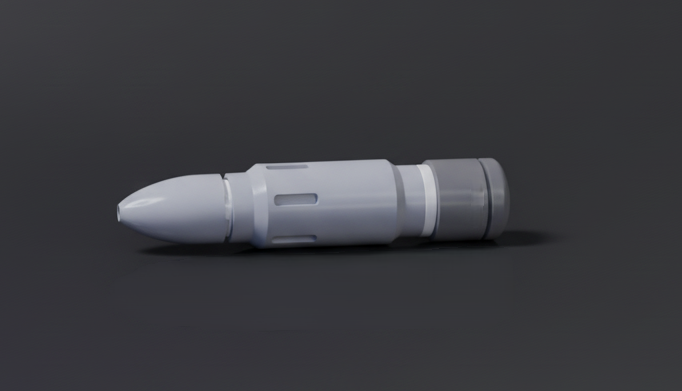
Aegis Mk-II Hypergolic Hyper Velocity 20mm Ammo
20 mm HV–HG Sniper Round — Aegis Mk-II
Common name (casual): Aegis round, “twenty”
Manufacturer: Deimos Ordnance & Dynamics (DODyn) — Deimos Shipyards ordnance division, Valles Marineris City, Mars (longstanding military supplier; civilian shells sold only on strict permit)
Service: Restricted specialist use by precision teams and clandestine contractors; officially withdrawn from routine military issue because of safety and political concerns, though black-market stocks and specialized government black-program units still deploy them.
Overview / Lore
The Aegis Mk-II family are 20 mm diameter, single-shot hypergolic hypervelocity rounds developed in the late 27th century for long-range anti-material and precision interdiction. Each projectile carries a compact superconducting guidance lattice — a very simple in-flight steering microcontroller — intended to correct tiny trajectory errors and counter transverse winds or platform jitter. The rounds are legal only under tightly controlled export and possession rules on most systems because of their lethality, on-flight steering capability, and the hazards inherent to their hypergolic primers.
Catalog Variants
Aegis Mk-II — Common Loadouts
- AP-T (Armor-Piercing, Tungsten Tip): Dense tip for maximum penetration of subdermal plating and light composite armor. (Used when a clean penetration is desired.)
- CS-Sabot (Collapsed Sabot — Tungsten or Carbide core): Lightweight sabot configuration for maximizing retained momentum at range. (Often used by deep-pocket shooters.)
- HE-F (High-Explosive Fragmentation): Small internal fragmentation charge designed to disperse shrapnel after penetration — devastating in enclosed spaces.
- HEI-AP (HE + Incendiary + AP): Dual-purpose for penetrating and then delivering incendiary/thermal effects to composites or fuel lines (restricted / heavily regulated).
- N-Steer (Non-Lethal-tethered steering test rounds): Low-yield inert rounds used for diagnostic and telemetry work (rare, tightly controlled).
Physical Descriptors
- Caliber (nominal): 20 mm (diameter class)
- Length (overall projectile): ~95–120 mm depending on variant
- Weight per round: ~120–180 grams, variant dependent (heavier for full AP tips / lighter for sabot types)
- Form factor: Bottlenecked cartridge profile with a rounded ogive projectile; the rear contains a self-contained firing primer and compact capacitive safety element.
- Visual cues: Matte dark casing with subtle manufacturer hallmarks (DODyn spiral glyph), a small colored band near the base indicating variant (e.g., tungsten band, red = HE variant, black = AP, silver = diagnostic).
Onboard Electronics / Guidance
Each Aegis projectile contains a sealed superconducting micro-lattice that supports a limited on-flight correction routine (very low-bandwidth course adjustments only). The guidance is not a full autopilot — it corrects minute deviations and cannot be remotely commanded once fired. In narrative terms this means an operator can expect higher precision than unguided rounds, and forensic analysts can sometimes recover micro-telemetry traces if the casing survives.
Primer / Hypergolic Note (safety & story)
The term “hypergolic” in this fiction indicates a primer chemistry that is hyper-reactive on activation — it gives the round very consistent ignition characteristics but imposes storage hazards. This is part of why the rounds were phased out for general issue: a damaged casing or a prolonged storage failure can lead to dangerous breaches or cook-offs.
Storage, Packaging & Logistics
- Authorized packaging: Military-grade sealed polymatrix canisters (variants of 10, 50, or 250 rounds), each canister fitted with inert-gas purge ports and tamper seals. Shipments are logged to a national ledger and require biometric release.
- Black-market packaging: When diverted, rounds are commonly repackaged in desiccant-lined polymer tubes or hidden in innocuous freight panels. Smugglers may remove serial traces to prevent trace backs.
- Storage requirements: Official doctrine requires sealed inert atmosphere lockers, routine integrity checks, and controlled-temperature environs; unauthorized storage increases risk of degradation, primer instability, or accidental ignition.
- Transport: Strictly by DODyn certified couriers or government escorts; illicit channels exist, which is how a field-grade merc crew might obtain a small cache for a high-pay contract.
Cost & Market
- Retail / Government contract price (legal, regulated): ~3,500 – 6,000 cr per round (variant dependent; AP and HE variants cost more)
- Gray / black market price: ~8,000 – 25,000 cr per round (high premiums for trace-cleaned or specialty variants like HEI-AP; smuggling/forgery raises price)
- Bulk canister (official 50-round crate): legal procurement ~150,000–220,000 cr; black market crate often doubles/triples that.
Prices signal rarity and huge barriers to casual possession — a hint that whoever used one could afford top-tier tools or had institutional backers.
Forensics & Signature
- Distinctive forensic trace: The superconducting micro-lattice leaves a microscopic electromagnetic signature in casings or recovered fragments—specialist labs can sometimes identify a DODyn production batch from residue patterns. This makes the round a narrative breadcrumb: a forensic team that recognizes the signature can trace procurement to a contractor, shipyard, or military black program.
- Political implications: Use of these rounds is escalatory; if BuCol learns Aegis rounds are circulating in a colony, expect investigations, embargoes, and tactical deployments. In your plot, Rat’s death being from an Aegis round can imply either state involvement or a contractor with deep pockets.
Hazards, Restrictions & Historical Notes
- Why armed forces pulled them: The combination of hyper-reactive primers, onboard electronics, and political blowback made routine issue untenable. A few catastrophic storage incidents and the risk of the rounds being used in crowded habitats pushed policymakers to restrict distribution.
- Current status: Officially restricted; some classified programs retain controlled stocks. A well-placed antagonist (Lazarus, a rogue BuCol cell, or a deep-pocket contractor) could still field them for targeted assassinations — which raises stakes around Rat’s death.
- Narrative opportunities: The rounds create tension—who supplied them? Who cleans procurement trails? A recovered fragment can spin off into a whole subplot of ledger traces, shell companies, or a DODyn shipment manifest.

Comments