
Telchine
Telchines are a class of multi-purpose industrial pod-ships defined by their unique overall structure and well-known for their extreme versatility. Telchines are ubiquitous throughout UNH space and are frequently utilized in spaceborne activities ranging from construction and mining, to salvage and search-and-rescue, to the occasional simple tug work.
Class Specifications
Structure
The body of a telchine is a long, bulky cylinder usually between 8 and 16 meters long, with the various elements of superstructure arranged radially (usually in quadrilateral symmetry). Telchines have small, tube-shaped interior habitats, with a one-seat cockpit at the fore in a domed viewport to allow for maximum pilot visibility. The universal airlock is at the aft, surrounded by a pair of ring-shaped propellant tanks. Due to the wide range of possible acceleration angles, the thrust frame itself is heavily reinforced. When combined with durable hull plating the reinforced frame of a telchine has the added benefit of allowing the vessel to survive collision events that would cripple or destroy other spacecraft, making them perfectly suited for industrial work.Engines
The main defining feature of the telchine class is the engine orientation. Unlike the majority of spacecraft designs which tend to have the main engines mounted at the aft of the spaceframe, telchines have their main engines mounted on high-mobility gimballing struts around the vessel's approximate center of mass. This design allows a telchine ship to apply large accelerating forces in nearly any direction relative to the spaceframe's orientation. The exact type and number of engines vary by model line, but the most common setup is four pairs of solid-core nuclear-thermal engines evenly spaced around the fuselage. The class holotype, the HSW Telchine I, incorporated four pairs of thorium pebble-bed engines which could utilize a variety of propellant fluids but typically used liquid ammonia or hydrazine. This standard is mostly kept today, with some improvement on the original technologies.Arms
The other key feature of the telchine class is the array of high-strength robotic arms that surround the forward viewport. In lieu of a direct grappling clamp or baseplate, the holotype line opted for four reinforced electric-motor arms which can safely lock in certain positions to bear heavy loads with minimal servo damage. This trend has continued in later models and, while it is a slight disadvantage over the more robust clamp system of the Orion-C, it also allows telchine operators to engage in more dexterous tasks using the arms' fine-grasp fittings. This versatility is the driving reason for the telchine class' position as the dominant workhorse craft of the human diaspora.History
The telchine class of space vehicle was pioneered by Hephaestus Spaceworks in the late 21st century CE, who designed the original Telchine I model for use by the company in their orbital drydock facilities. The design mission was to find a highly-functional middle ground between small, single-person hardsuits and the much larger, less maneuverable Orion-C tugs that had been the standard for orbital industry up until then. The result was the Telchine I: a small, highly maneuverable craft with four dexterous robotic arms positioned around the bubble cockpit.It was an immediate game-changer for orbital industry, and HSW soon began producing Telchine I ships for sale in addition to company use. The ease with which the Telchine design could be adapted for different roles made it particularly appealing, leading HSW to produce a more modular base in the Telchine II with several specialized variants such as the Telchine IIb —built for cutting into derelicts with precision— and the Telchine IIc —optimized for drilling on ultra-low-gravity asteroids. Modular interiors added to this flexibility: for example, a Telchine IIb could be equipped for a crew of salvagers or emergency responders, both trained on the same hardware. As human presence in space expanded rapidly, so did the popularity of the telchine.
In this modern age when fusion torches are quite commonplace even among smaller vessels, the nuclear thermal engines of an everyday telchine are a reliable staple of any orbital sphere. Any major station in human space will have an army of telchines at the ready to guide a torchship into port (because it's generally frowned upon to bathe your port of call in a kilometer-long plume of radioactive fusion-temperature plasma). Though regarded as dated by some, there are few ships better equipped for the job of pushing and pulling than a telchine.
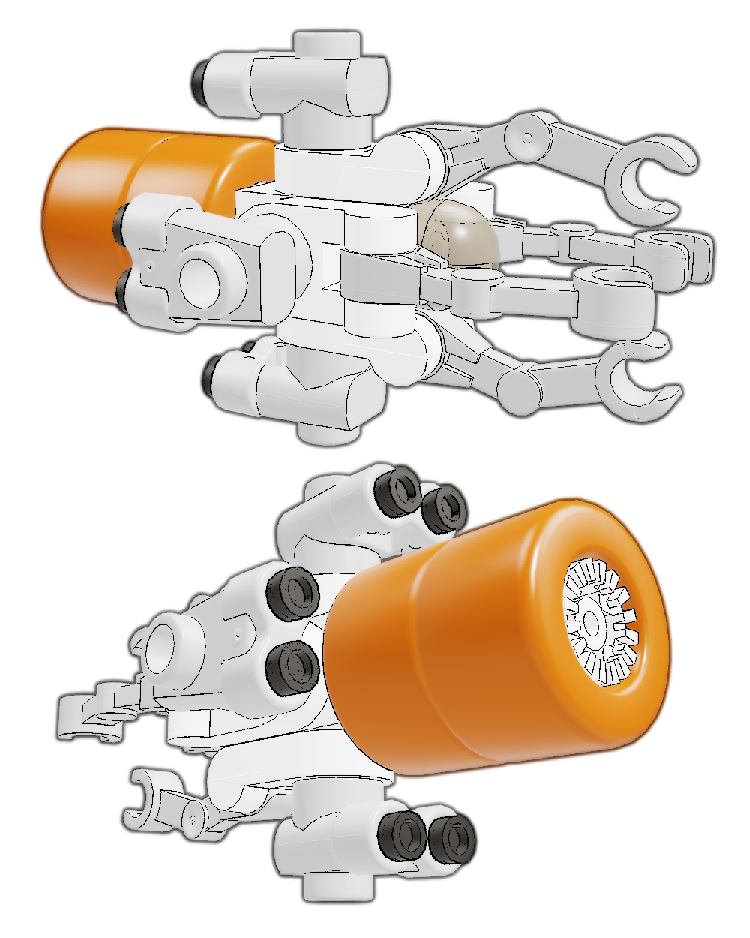
A highly simplified model of the holotype line, the HSW Telchine I.


Aw, I love their little grabby hands! :)
Explore Etrea | WorldEmber 2025
When taking a telchine out of dock for an operation, it's customary for the pilot to clasp and unclasp the manipulator arms a few times as one might a pair of tongs. The ritual is both practical (making sure the machine works properly) and superstitious (if you don't click your tongs together for luck before using them, I don't trust you lol)
Haha I love it. <3
Explore Etrea | WorldEmber 2025