
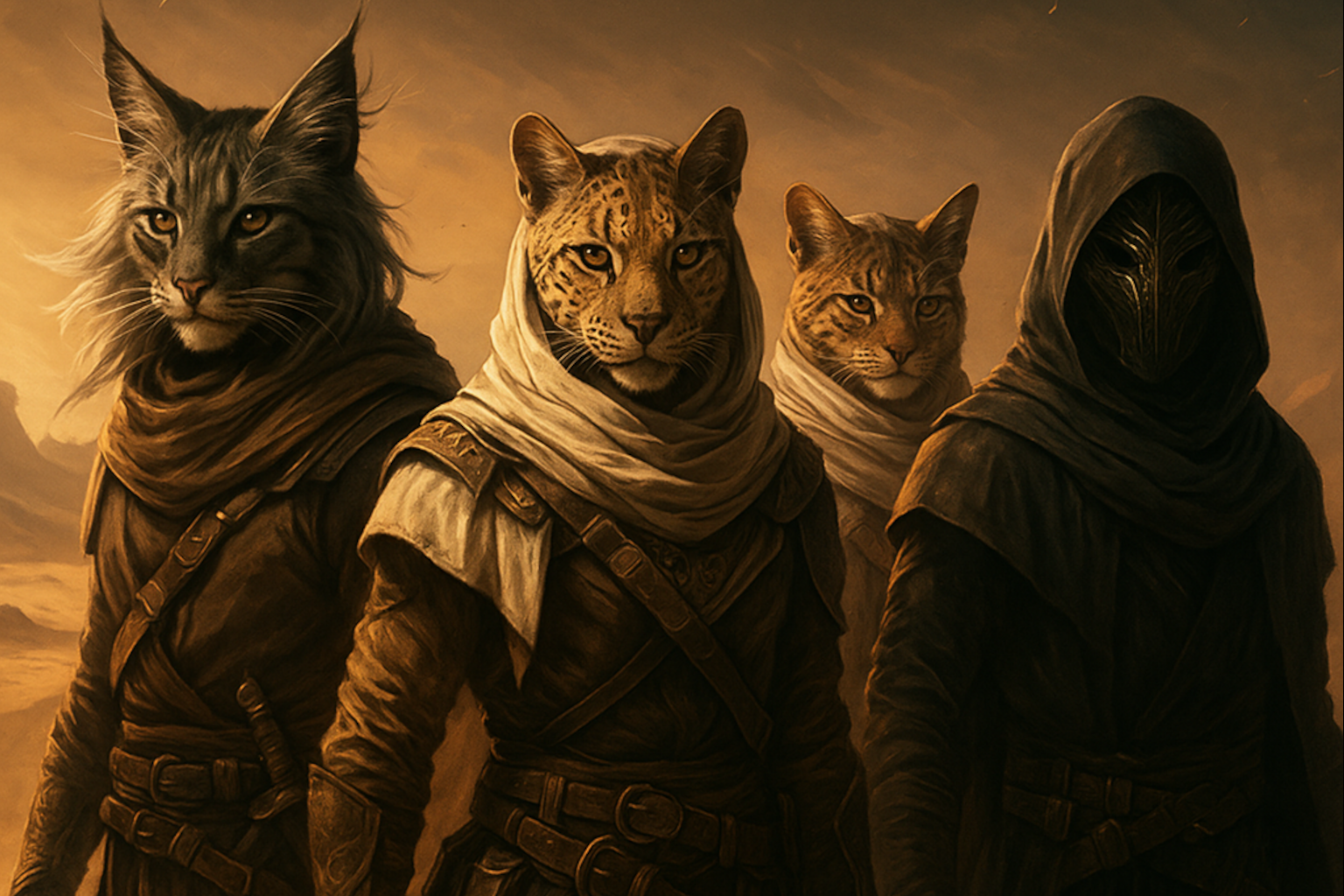
Safahi - Kathuri Ethnicity
"To walk the dunes is to be weighed. By heat, by hunger, by silence. Each breath a choice, each step a judgment. Those who race ahead lose the road; those who cling too long become sand. But those who learn the rhythm , who leave no mark too deep, who speak not over the wind, who give what they carry and carry what they must , these are the ones the desert remembers."
Introduction
The Safahi Kathuri are the ancestral heart of the Kathuri people, desert-born, silence-shaped, and endlessly tested by the fire-breathing soul of their homeland. They are the keepers of the Cycle, the founders of the Pilgrimage, and the living embodiment of a balance so delicate, it cannot be spoken aloud. Their lives, shaped by the harsh grace of Safah, are woven from restraint, endurance, and a deep-seated refusal to betray the equilibrium they have sworn to uphold.
To outsiders, the Safahi seem at once austere and elegant, alien in their silence and terrifying in their certainty. Their villages hide in caves or cling to the shadow of dry canyons; their faces are unreadable, their words few but heavy with intent. They will offer you water when you would perish, and exile you if you waste it. For the desert, like the Cycle, grants no second warnings.
Within their own world, however, the Safahi are not grim or joyless. They sing, they dance, they laugh, but always within the boundaries of necessity and ritual. Beauty is not vanity, but precision; strength is not dominance, but discipline. Their children are raised communally and taught not to desire victory, but to understand cost. Their artisans shape water-catchers from bone, weave silk from cave-worms, and embroider truths into cloth so fine that to misread a hem is to cause offence.
Among the Safahi, adulthood is not granted by age, but earned through the Pilgrimage, a journey beyond Safah’s bounds into the chaotic world beyond. Those who return bring wisdom, hardship, or tools their tribe lacked; those who do not return are never spoken of, unless they achieve greatness and are reborn as Servants of the Cycle. All Safahi know that life is not owned, but loaned, and only through balance, sacrifice, and discipline can it be repaid.
To study the Safahi Kathuri is not to study a people, but a pattern: etched into stone, erased by sand, drawn again with the same fierce precision. They are neither ancient nor modern. They are enduring. In their stillness, a warning. In their walk, a way.
"A blade may glint in sunlight, but a furred back that leaves no print in the dune is deadlier still."
Appearance and Lifestyle
Safahi Kathuri are the very reflection of their homeland: lean, subtle, and fiercely refined by necessity. They are beings of sand and silence, of motion without waste. The desert shapes not only their habits but their bodies and sensibilities, every gesture a calculation, every pose a posture of balance.
Safahi Kathuri stand between 1.2 and 1.6 metres tall, though their narrow torsos and lithe musculature make them appear taller when poised at full stretch. Their movement is fluid and minimised: not simply graceful, but economical, an instinct born from generations raised in an environment where waste means death. Their limbs are long and digitigrade, tipped with retractive claws honed for both ascent and defence.
Their most iconic feature is their stillness. A Safahi Kathuri at rest can seem carved from dune-silt or caught mid-thought by time. When they move, it is with a silence that suggests choice over compulsion, as though each step must be earned from the land beneath.
Fur coats range across tawny gold, desert bronze, dull ochre, or soft ash-grey, often dappled or rosetted in patterns that break the body’s silhouette against dune, cliff, or cave. Facial markings, while subtle, are a source of clan pride: a line of darker fur beneath one eye, or a crescent of light around the muzzle, can signify maternal ancestry or historical honour.
Hair, where visible (most often along the nape, tail, or crest of the head), tends toward paler hues, from sun-bleached cream to desert flax. Markings are rarely dyed, in contrast to more flamboyant Kathuri expatriates, but some tribes use naturally derived mineral paints during festivals or rites.
Whisker rings and tail-bands of copper, bone, or knotted leather are common among clan elders or Pilgrimage-returned adults, often indicating personal trial, spiritual insight, or union with another clan.
Clothing in Safah is designed to conserve water, reflect heat, and insulate against chilling night winds. Most wear tight-wrapped desert suits: multi-layered robes of woven cactus-fibre and treated silkmoss, capable of protecting both the skin and conserving evaporated moisture. These are augmented with long hooded cloaks, veils, and soft-padded sandals adapted for the burning sand.
Within cave-settlements or ritual settings, ceremonial robes take precedence: flowing white or charcoal-grey garments embroidered with symbolic threadwork in patterns unique to clan or pilgrimage path. Scarcity elevates adornment to sacrament, a single silver clasp may carry the weight of decades, and a single thread of blue may mark a life saved by divine balance.
Piercing is uncommon, but scarification is practised in some desert tribes, not as decoration, but as record. A healed stripe above the brow, for example, may mark survival of starvation; a branded circle at the wrist, a vow made and kept during one’s Pilgrimage.
Though largely uniform in appearance to outsiders, regional variation among the Safahi is rich and subtle. In the stony eastern highlands, tribes tend toward darker fur and thicker bone structures, an adaptation to higher elevation and nocturnal hunting. In the central dune-lands, lighter pelts and longer tails dominate, aiding both camouflage and heat dissipation. Among the salt basins of the southern flats, even rarer features can be found: translucent claws, or eyes that reflect in moonlight like mirrored coin.
These variations are rarely codified into hierarchy. A darker pelt may be prized among one tribe, ignored by another, and seen as an omen of imbalance by a third. Nevertheless, all traits are viewed through the lens of function: adaptation that supports harmony is honoured; affectation is not.
Occasionally, a Kathuri is born with white fur, black sclerae, or claws that never dull. These rare children are considered sign-marked, neither blessed nor cursed, but marked for challenge. The Cult of the Cycle typically offers guidance for such individuals, often pressing for early pilgrimage or close spiritual tutelage to ensure their paths do not spiral into imbalance.
The Kathuri do not believe in genetic superiority, but they do observe patterns. Traits that repeat through lineages without explanation are woven into oral genealogies and serve as both cautionary markers and ancestral pride.
Daily life among the Safahi is a dance between necessity and ritual. Labour is often communal and quiet: a band of six will clear irrigation paths with the grace of a single organism, each knowing their role without need for words. Morning prayers follow water distribution; evening meals follow sunset meditations. There is no rush in a society where pace is dictated by survival and ruin by haste.
Crafts are tools of honour. Pottery, metalwork, and sand-glass are all practised by specialist clans, each discipline bound to an oath-cycle that dictates when, why, and how a thing may be made. Even a water jar, if shaped without cause, invites reprimand. Harmony is function married to timing.
The diet of the Safahi Kathuri is minimal and reverent. Cooked meat is a festival food, rare game shared among an entire community with ritual silence. Daily nourishment comes from hardy legumes, flatbreads, preserved cactus pulp, sun-dried seeds, and insects prepared in savoury ground sauces. Meals are often taken communally, in silence or over subdued poetry.
Water is life and religion alike. It is distributed according to clan station, need, and merit, with watchers from the Cult of the Cycle overseeing the ritual of sharing. Infused teas from desert herbs are common, believed to aid clarity of thought and aid balance between body and breath.
Waste of any kind is treated with horror. Leftovers are immediately preserved, re-used, or burned ritually with thanks to the land. Gluttony, while rare, is considered a form of spiritual decay, and a danger to the tribe’s equilibrium.
"Water asks no questions of the vessel; it fills or breaks it. So must the soul bend to balance, or perish in its refusal."
Beliefs and Values
Among the Safahi Kathuri, belief is not a matter of proclamation, but of practice. Their values are not etched in commandments but inscribed in daily gestures, the tilt of a head before speaking, the reverent silence when crossing a threshold, the refusal to act without weighing its consequence. Every moment is an echo of the Cycle, the infinite interplay between Tao and Khaos: the stillness of preservation, and the tremor of change. To live rightly, for a Kathuri, is not merely to survive the desert, it is to honour it, to become part of its slow forgetting, its sharp precision.
Kathuri beauty is measured not in symmetry nor ornament, but in intention. A graceful movement, a poised bearing, a voice tempered to the moment, these are the marks of true allure. Fur that lies smooth despite the wind, eyes that study before they shine, a body that bears its scars in silence: these are beautiful.
Courtship is both art and trial. Dance, slow, precise, imbued with mimicry of predator and prey, forms the core of courtship ritual. Unlike in more expressive cultures, flirtation is measured. A shared breath, a mirrored footfall, a stillness held together, such signs say more than a dozen sonnets. Courtship often unfolds over seasons, tested by mutual endurance, observation, and the weaving of ritual challenge.
Physical intimacy is not taboo, but its display is rare. What matters is alignment, of body, of spirit, of intent. A partnership that endures the lean seasons is regarded more favourably than one born of momentary passion. Such restraint is not repressive, but sacred: a dance walked rightly, not rushed.
Gender in Safahi culture is viewed through the lens of function, not identity. Biological differences are noted, but they do not define destiny. The roles one inhabits, hunter, scribe, vessel-binder, speaker of rain, are dictated by aptitude, not anatomy. Some clans maintain ceremonial roles for those identifying as neither male nor female, often involving spiritual mediation or kin arbitration, but these are not marginal; they are revered.
Personal presentation follows social context. A Pilgrim may adopt the dress and bearing of a distant culture as camouflage or study. Within the homeland, more traditional signals, jewellery worn at the wrist or ankle to denote current relational roles, are employed, though never mandated.
Ultimately, one’s balance matters more than one’s form. A soul who honours the Cycle may wear whatever body they were given, or have shaped.
Marriage is not a singular, permanent bond among the Safahi, it is a cycle in itself. Unions are made and unmade in accordance with need, growth, and spiritual alignment. What matters is that the bond serve the clan’s balance, the individual’s integrity, and the Cycle’s demands.
Some unions last a lifetime, others for a pilgrimage, or the span of a project. All are solemnised by shared fasting, a gifting of water, and a night’s vigil beneath starlight. Separation, when it occurs, is not shameful if done rightly, with ceremony, honour, and the return of tokens given in joy.
Children born of union are considered clan-children, raised by tribe and tutored communally. Parental claim is recognised but not exalted. The act of rearing a balanced soul is a civic act, not a private one.
The journey from childhood to adulthood is marked by the Pilgrimage, a sacred and solitary quest beyond Safah’s bounds. The initiate departs in silence, bearing no name but their lineage, and may not return until they have found something of value to offer their people, knowledge, art, wisdom, or pain.
Upon return, the successful Pilgrim undergoes the Naming Vigil, a night of fasting, reflection, and ancestral invocation. Their chosen name, earned through ordeal and offering, is then spoken aloud by a Servant of the Cycle. Only then are they considered whole in the eyes of the community.
Other rites mark entry into specialist roles: water-priests are named during the Rainfast; warriors during the Vigil of Dust. All rites are private, precise, and rarely discussed beyond those who share them.
When a Kathuri dies, their name is unspoken for a cycle and a day. Their body is returned to the sand: buried beneath the roots of desert vines, offered to wind by cliff-ridge, or cremated into bone-dust and scattered in silence.
The Rite of Diminishing is held by clan and kin: a quiet meal, a story of the dead spoken backwards, and a single act repeated in their name. Grief is not denied, but disciplined. Wailing is forbidden, but the shedding of tears, in silence, in moonlight, is sacred.
Great elders may be remembered in sand-etchings that vanish by next dawn, a reminder that the memory of balance must live in practice, not in stone.
The foundation of Safahi ethics is restraint. The self is not to be indulged at the expense of the community. Anger may be acknowledged, but not acted upon without deliberation. Speech may be sharp, but never wasted. Water may be used, but never spilled.
Chief taboos include waste of resources (especially water), false witness before the Cycle, disruption of ritual balance, and betrayal of kin-oath. More subtle is the taboo against boasting: to speak of one’s deeds without being asked is to disrupt the silence needed for balance.
Humility, endurance, patience, and correct action, these are the unspoken pillars of right living. A life lived in alignment needs no defence. It simply endures.
"A bowl may hold water, or memory, or silence, it is not the shape, but the stillness, that gives meaning."
Culture and Expression
To the Safahi Kathuri, culture is not entertainment, nor is it ornamentation. It is function perfected through discipline, memory rendered into motion, and purpose cloaked in restraint. Their expressions are quiet, refined, and never detached from the rhythms of survival and balance. A story told around a fire, a line carved in a bowl, a note sung before sleep, these are the breaths that preserve a people not through conquest, but continuity.
The Kathuri speak in two principal tongues: Old Safahian, a formal, ritualistic language steeped in metaphor and philosophical precision, and Low Kathuri, a web of practical dialects adapted for trade, survival, and communal life. Every clan has its own inflections, with desert wind, stone resonance, and solar position lending shape to idiom and cadence.
Old Safahian is taught to initiates of the Cycle and used in ritual, judgement, and diplomacy. It is elliptical and reverent, with entire conversations hinging on the placement of a pause or the omission of a pronoun. Mastery of this tongue grants social capital; misuse brings shame.
Most daily speech is conducted in Low Kathuri, with hand-gestures and tail positions acting as silent modifiers. Tone is rarely raised; volume and silence are communicative tools. Among the Safahi, stillness is a statement, and eloquence lies in knowing when not to speak.
Safahi arts are impermanent by design. A sand mandala swept clean after a prayer, a dance performed once beneath a setting moon, a painted robe that fades with sunlight, these acts of expression are not preserved, but performed, always in alignment with purpose.
Music, especially the sahrayin (a hand-plucked resonant disc), accompanies both meditation and storytelling. Songs are sparse and rhythmic, often layered with vocal overtones. Poetry is recited slowly, with pauses dictated by breath patterns or sacred number sequences. It is said that the best verse can be heard even in silence, if spoken in right cadence.
Visual art thrives in utility: water vessels are etched with instructional parables, tent stakes inscribed with prayers of balance. Most artisans are specialists in a tetharn, a spiritual motif handed down their maternal line, to be refined but never contradicted. Even a spoon carries a memory if carved from the right wood, in the right season, by the right oath.
The myths of the Safahi Kathuri are never recited the same way twice. Their stories shift with speaker and season, shaped not for consistency but for resonance. Each telling is an offering to the Cycle, and each listener must discern which version aligns with their present need.
The First Cycle, a tale of a time when all beings lived in balance, is the foundational myth. From its collapse came the first suffering, and from suffering, wisdom. Other tales include The Sand-Mother’s Trial, where the desert itself challenges a child with thirst, and The Broken Dancer, who learned to move again by walking the patterns of wind-dunes. These are not didactic fables, but spiritual riddles: the lesson must be lived, not merely known.
Legendary ancestors are honoured not for triumph, but for insight. Teshan-of-the-Quiet-Well is revered not for surviving drought, but for allowing her death to teach others the path to water. Most heroes end in ambiguity, their stories unresolved, for so too is the Cycle.
Unlike cultures that elevate bloodlines or military victors, the Kathuri honour those who preserved balance, often through silence, sacrifice, or restraint. Foremost among these are the Servants of the Cycle, nameless sages who gave up identity to serve as arbiters, wanderers, and memory-bearers.
Other revered figures include Sahir Duvan, the philosopher of stone-rhythm whose teachings became the basis for Cycle meditation, and Miraka Sand-Eater, a pilgrim who crossed the Black Dune by fasting and chanting alone, carrying back a single sprig of dryroot to cure the sickness of her clan. Their images are not preserved in sculpture, but echoed in stance and proverb.
Honouring the dead is not a matter of monuments. It is a matter of walking their path again, rightly, or correcting it, if need be. Even saints may be questioned, if the Cycle demands it.
The Safahi do not think of history in terms of dynasties or years. Time is measured by the flow of scarcity, the turn of stars, and the stories carried from one oasis to another. Their history is cyclical, marked by collapse, realignment, and renewal.
Safahi origin myths reject conquest. They speak instead of emergence: from stone, from wind, from need. Scholars suspect ancient ruins deep in the Inner Dune Belt may speak of a pre-Cycle civilisation, but the Kathuri neither confirm nor deny. They simply say: “That was before balance.”
Periods of expansion, such as the rise of the hidden well-fortress of Lujan’s Refuge, alternate with eras of dispersal, when tribes vanish into the dunes to weather imbalance or reclaim forgotten wisdom. The Cult of the Cycle, the sole surviving structure through all eras, remains the constant thread, unbroken even when entire cities turn to sand.
"A name is not the self. It is the vessel shaped by the journey, worn smooth by wind, cracked by sorrow, glazed by purpose, and finally, left behind."
Naming and Lineage
To name a Kathuri is not to define them, but to witness them. Names among the Safahi are not bestowed lightly, nor are they permanent. A name is the mark of a stage in one's journey, a note in the rhythm of balance, and may change with role, insight, or error. While all are born with a provisional name, true names are earned, often reshaped during or after the Pilgrimage, and infused with spiritual resonance.
Lineage is not merely blood, but bond, a web of matrilineal clans, spiritual oaths, and kinships formed through shared ordeal. A child belongs to the clan that names and raises them, not necessarily the one that birthed them. Honour and identity are built communally, preserved in stories, tokens, and ritual gesture rather than in records or titles. The self is small; the whole is enduring.
Kathuri receive a Birth Name, usually two syllables, chosen for sound or omened dream, shortly after birth. This name is used only within the family or clan. At the Naming Vigil following their Pilgrimage, they select or are given a True Name, often tied to their trial, insight, or offered gift. This name may include a spiritual descriptor or a mark of their chosen role: e.g. Ralun of the Burning Moon, Nasir Stone-Walker.
Those who enter service to the Cult of the Cycle relinquish all personal names, becoming simply Servant of the Cycle. This is considered one of the most sacred acts a Kathuri can undertake, symbolising the dissolution of self into harmony.
Safahi society is structured around matrilineal Clans, each of which holds ancestral teachings, ritual motifs, and seasonal duties. Clans are often named not after animals or symbols, but after poetic concepts: The Hollow Breath, Ash That Sings, Those Who Drink Starlight. Individuals may bear tokens (beads, bone fragments, pigment markings) that denote their clan and standing within it.
Tribes are looser affiliations of multiple clans, bound by oath or shared pilgrimage paths. Leadership is consultative, not hierarchical. Authority arises from proven balance, not bloodline. Fosterage between clans is common, and loyalty to shared values outweighs biological kinship. Children may be adopted into a new clan after pilgrimage, should their journey reshape their spirit's alignment.
Safahi names tend to be sparse in syllable but dense in meaning. Most begin with hard consonants or open vowels and are drawn from the Old Safahian lexicon of natural forces, virtues, or ancient sites. Epithets are common, especially following the Pilgrimage. These may describe notable deeds (Sand-Eater, Storm-Hidden), spiritual qualities (Burning Moon, Stone-Walker), or place of transformation (of the Bitter Path, from the Broken Shrine).
Common Names (Female): Silha, Miraka, Elun, Sahira, Ranin Common Names (Male): Nasir, Tavaresh, Ralun, Qahir, Veshan Common Names (Neutral): Duvan, Serael, Ashin, Kaht, Yarin
"The desert remembers no names, only the steps that do not break its rhythm."
Geography and Demographics
The heart of the Safahi Kathuri beats beneath the sands of the subcontinent Safah, a place of parched grandeur and carved silence. This desert is not merely a homeland, but a crucible. Every Kathuri clan is shaped by its winds, its bone-dry cliffs, and its narrow, hidden wells. Safah’s geography defines not just where the Kathuri live, but how they live, and who they are allowed to become.
Though diaspora Kathuri may be found across Arora, often as pilgrims, emissaries, or exiles, Safah remains the cultural and spiritual lodestone of their identity. To be Kathuri and not know the taste of Sahmir’s wind or the hush of the Wadirain valleys is to be unrooted, not dishonoured, but unfulfilled. The following entries summarise the major Kathuri homelands and their outward dispersal.
Safah is a land of extremes: sun-scorched dunes, wind-carved cliffs, labyrinthine wadis, and salt-blasted flats. The climate shifts from brutal dry seasons to sudden, rare monsoons that feed the hidden aquifers and gorge-locked gardens of ancient clan settlements. Permanent Kathuri structures are few, typically built into canyon walls or buried beneath stony ridges to preserve coolness and secrecy.
The most populous regions lie around Sahmir and the Crescent Wells, a stretch of linked oases whose aqueducts and water disciplines are guarded with quasi-religious devotion. Tribes move between these anchor points according to seasonal need, pilgrimage patterns, or spiritual rite. Each dune-strand or caravan path is named and remembered in verse, not maps.
Though inter-clan violence is rare, territory disputes are resolved through endurance trials or ritual arbitration rather than open war. External threats, usually from resource-hungry human empires or rogue Seishi traders, are met with quiet sabotage, guided misdirection, or, when necessary, desert-born ambushes that vanish like the wind that birthed them.
While few Safahi Kathuri choose to remain beyond their homeland after the Pilgrimage, some become scholars, diplomats, or mercenaries stationed in distant lands. These are often respected, if cautiously, as spiritual consultants or stewards of rare desert goods. In the port cities of western Erothi and the academies of Valenfar, Kathuri enclaves remain sparse but quietly influential, known for their stoic etiquette and unwillingness to divulge more than surface courtesy allows.
A smaller, more secretive population dwells in ruins or forgotten shrines far from Safah, guardians of ancient artefacts or forbidden lore. These Kathuri are seldom recognised as pilgrims; some may be exiles, others bound by unending spiritual tasks. They are rarely named aloud in clan gatherings.
Importantly, the Safahi diaspora must not be conflated with the Exun Kathuri, those who never returned from their pilgrimages and whose cultural practices have shifted away from Safahi norms. The Safahi maintain spiritual and ritual contact only with those who remain ritually bound to the homeland and its sacred geography.
Remove these ads. Join the Worldbuilders Guild







Comments