

The Two Moons of Arcasia: Selunvar and Thalune
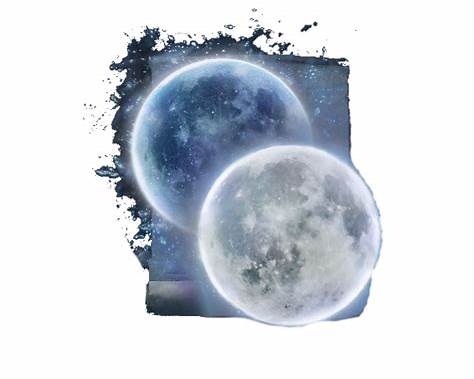
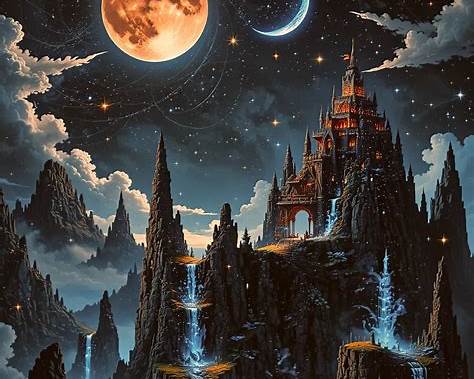
Arcasia’s night sky is ruled by two moons whose movements shape magic, timekeeping, religion, and the tides of history itself. Their cycles are woven into the world’s calendar, festivals, myths, and sorceries. Across every culture, Selunvar and Thalune are seen not merely as celestial bodies, but as living forces whose relationship influences the fate of the world below.
Mortals often describe the moons as siblings: one calm and ancient, the other quick and unpredictable. Scholars, mystics, and navigators build their entire disciplines around tracking their phases. Even the gods are said to be bound by the moons’ rhythms.
Together, they form one of the most defining features of Arcasian cosmology.
Selunvar — The Elder Moon
Selunvar is the larger and older of the two moons, a pale silver sphere streaked with long “riverlike” patterns visible even from the surface. Its orbit is slow and stately, completing a full cycle every thirty-six days. By its phases the Arcasian calendar is structured, with each month beginning on a Selunvar new moon.
To most cultures, Selunvar represents stability, foresight, and the natural order. Its influence is steady rather than volatile, and its light is believed to clarify the mind and reveal hidden truths. Navigators rely on it; oracles attune to it; ritualists time their ceremonies to its crescents.
In mythic tradition, Selunvar stands as a guardian of fate—watchful, impartial, and ancient beyond the reckoning of any god. During times of turmoil, its full presence is seen as a blessing, a moment when the world aligns with a predictable rhythm.
Thalune — The Trickster Moon
In contrast, Thalune is smaller, brighter, and far more erratic. Luminescent blue or violet depending on atmospheric conditions, it completes its orbit in roughly eighteen days—twice in the span of one Selunvar cycle.
Thalune’s irregular pull on magic is well known. Sorcerers feel their spells quicken or twist under its influence. Illusions grow sharper, dreams become stranger, and raw arcana runs hotter. It is the moon of inspiration and chaos, of sudden transformations and unexpected insight.
While Selunvar steadies the sea, Thalune stirs it. Sailor superstitions often treat Thalune’s full phase as both a blessing and a warning. Scholars debate whether Thalune is a younger celestial spirit or a rebellious remnant of an early cosmic age, forever in motion.
In folklore, Thalune plays the role of the wandering flame—mischievous, creative, and capricious, a force that brings both awakening and upheaval.
Combined Phenomena
Though each moon has its own cycle, their interactions create rare celestial events that have profound effects on the world’s peoples and its magic.
Apsira
Apsira occurs when both moons reach fullness on the same night, roughly every 108 days. On this night, magic swells in intensity, divinations become sharper, and veils between realms grow thin. Some cultures mark Apsira as sacred, a time of prophecy and transition. Others treat it with caution, for strange events often follow in its wake.
Shadowfall
Shadowfall takes place when Thalune passes across the face of Selunvar, tinting the world in a muted blue glow. The event lasts only minutes, but its significance is great. Many cultures regard Shadowfall as an omen—sometimes auspicious, sometimes dire. Certain prophecies claim that when Apsira and Shadowfall ever coincide, the seals upon ancient evils may weaken.
Role in Religion and Mythology
Throughout Arcasia, the moons are often personified as divine or semi-divine entities. Selunvar is associated with gods of fate, knowledge, and guardianship; Thalune with deities of magic, inspiration, and change.
Priests of the Lunar Synod teach that the moons once intervened in a cosmic war among the gods, helping to cast down the three evil deities during the Sundering. Their scars, faintly visible on Selunvar’s surface during certain nights, are said to be remnants of that celestial conflict.
In Kurai legends, Selunvar watches over honor and duty, while Thalune tests one’s resolve through illusions and trials. Among Tilçanhu mystics, the two moons are believed to reflect twin aspects of the soul: the fixed and the fluid.
Meanwhile, seers in the Sapphire Ledger keep private charts linking economic cycles to lunar patterns, though they deny this publicly.
Influence on Magic and the Natural World
Magic in Arcasia flows through ley lines that brighten or distort depending on lunar alignment. Selunvar brings calm stability to arcane workings; Thalune injects volatility. Spellcasters often time rituals, experiments, or dangerous workings to specific lunar configurations.
Tides correspond primarily to Selunvar, though Thalune introduces unpredictable surges known as “blue tides,” which sometimes reveal sunken ruins or expose hidden coastal passages.
Certain magical creatures—spirit owls, moonjags, and glimmering reef-born beasts—are said to manifest or transform under the influence of particular lunar phases.
Cultural Significance
Every nation and culture in Arcasia interprets the moons differently:
- In Chelonia, Thalune’s phases are tied to Pearlescent magic, and Selunvar is believed to steady the deep currents.
- In Tilçanhu, moon calendars guide agricultural, mystical, and political cycles.
- Among the Free Peoples, Apsira marks key civic celebrations and contract renewals.
- The Kurai of Sukoku map ancestral paths by Selunvar’s “rivers” and test warriors under Thalune’s erratic light.
- Zareem tribes chart their desert song-lines by watching how moonlight reflects off dunes and stone.
Across Arcasia, moonrise is more than a change in the sky. It is a shift in story, mood, and possibility.
Conclusion
Selunvar and Thalune are not merely celestial bodies orbiting Arcasia. They are forces that shape culture, magic, stability, chaos, prophecy, and myth. Their carefully intertwined cycles govern the calendar, influence the gods, and echo through every major tradition of the world.
To understand the moons is to understand Arcasia’s very soul—its rhythms, its secrets, and its unfolding destiny.

Comments