
Bohra
Introduction
Taxonomy
Kingdom: AnimaliaPhylum: Chordata
Superclass: Hexapoda
Class: Gryphaviformes
Order: Planipterygiformes
Family: Saltipedidae
Genus: Bohrops
Species: Bohra
Next, dear reader, we turn our attention to a people at once akin to the Avara and yet markedly distinct. In the following pages we shall examine the Bohra, those silent giants who tread the Arborean nights and who safeguard their communities with tireless vigilance. The Bohra are neither friendly nor trusting by nature, yet they are unwavering in their loyalties, and in the press of close quarters they are the most formidable of all the People.
Nomenclature
In its earliest divisions, the taxonomy of the Bohra is identical to that of the Avara. They share the same kingdom (Animalia), phylum (Chordata), superclass (Hexapoda), and class (Gryphaviformes). Beyond these categories they diverge, and I was once more obliged to devise new classifications for this stout and singular branch of Arborea's abundant fauna.
I have placed the Bohra within the order Planipterygiformes, chiefly on account of the form of their wings, which allow for controlled gliding but cannot support true flight as in the Avara. I have encountered many creatures that conform to this pattern, and it may be that Arborea harbors a greater multitude of gliders than flyers. Following this, I established the family Saltipedidae for the Bohra and their kin, inspired by the prodigious power of their hindmost limbs, for the Bohra are capable of astounding leaps, hurling themselves forward with a force unlike any I have seen in other worlds. For their genus I have selected Bohrops, a group which, so far as I have observed, contains only this solitary species, though I have little doubt that cousins wait to be discovered in the remoter reaches of Arborea's vast forests. It is distinguished by the Bohra's nocturnal habits and their unusual hand structure, which I shall detail below. Thus, dear reader, I present the formal name of this remarkable creature: Bohrops Bohra.
First Impressions
As I arrived in Highmarket in the morning, I did not meet one of the Bohra on that first day, for they are rarely active before the sky darkens and are even less inclined to socialize during the daylight hours. It was only a few hours after nightfall, as I stood marveling at the million living stars of Arborea's night air, that I first beheld one of these great warriors. I would never have known he was present had not Odysseus pointed him out. The Bohra was perched upon a branch to my left, and had arrived so quietly and remained so motionless that I was entirely unaware of his scrutiny. When Odysseus directed my gaze, I did not at first comprehend what I saw. The light was dim, and the Bohra - whom I would later christen Diomedes - had folded his limbs close to his body, presenting nothing but a featureless mound upon the wood. Only the enormous eyes peering from that feathered visage confirmed that I beheld a creature, and not an outgrowth of the tree itself.
When I stepped forward for a closer look, Diomedes allowed it, but Odysseus restrained me before I could come within reach of the Bohra's deadly kick. Through my psychic enhancer I sensed that the two Arboreans were in communication. Thoughts not directed to oneself create a faint buzz felt in the teeth; one can tell they are present, though their meaning remains elusive. After a short exchange, Diomedes launched himself into the air, and I was astonished at how his long legs and gliding wings unfolded from the cloak of feathers like a conjurer's illusion. His departure was silent save for the soft creak of the branch he had left, for the Bohra make no sound while gliding or leaping, a fact which caused me to start more than once at their stealthy arrivals and departures.
When I discussed the encounter with Odysseus, he informed me that Diomedes was the chief of Highmarket's defenders, and had come to judge what threat I might pose to the community. I was somewhat disconcerted to learn that he had been on the verge of striking me down with his talons before Odysseus intervened on my behalf. My very strangeness had unsettled him enough that he was prepared to remove me for the safety of all. In later encounters I came to understand Diomedes better, but I believe he never wholly trusted me, nor welcomed my presence in Highmarket.
Anatomical Description
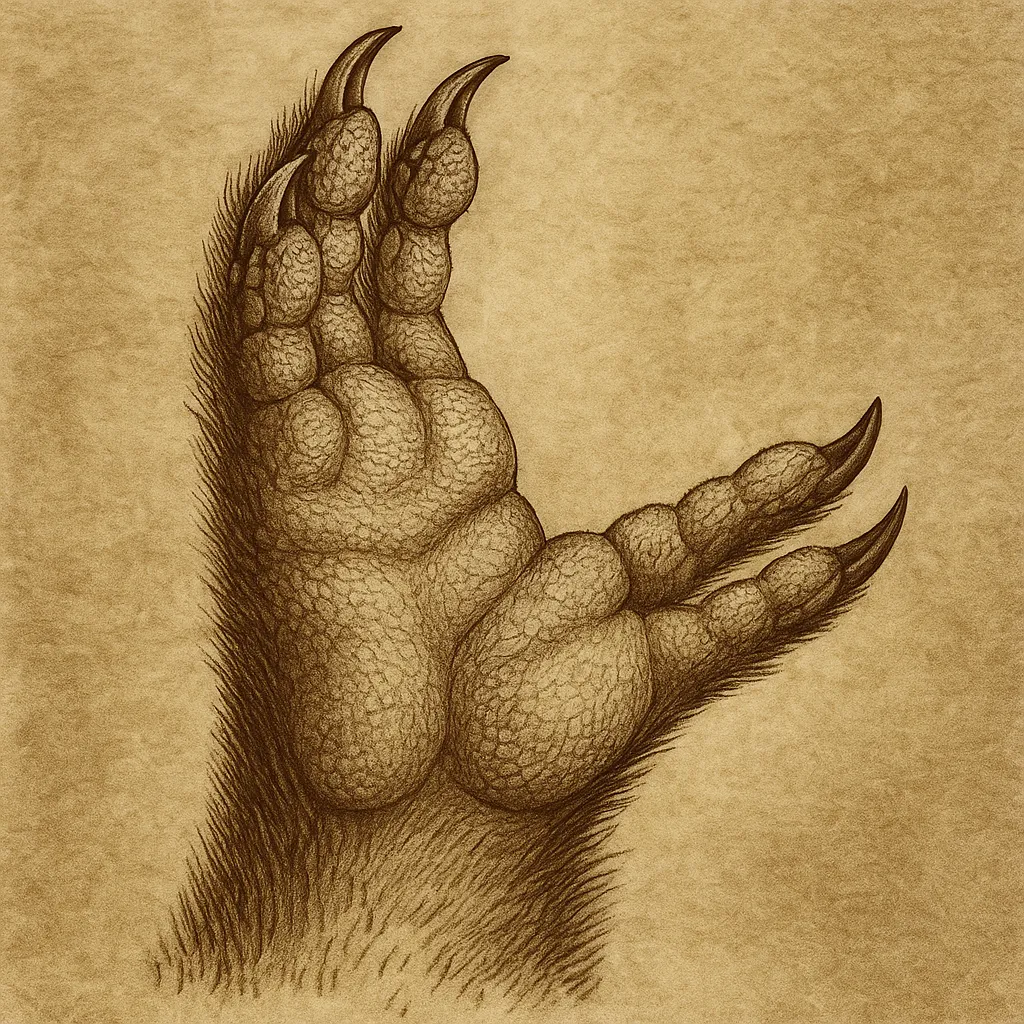
The Bohra, like most vertebrates in Arborea, possess six limbs. Two of these are wings, which grant them the power to glide across great distances. They are also equipped with formidable hind legs that end in large taloned feet, shaped to support their prodigious leaps. These feet bear thick fleshy pads covered in small rough bumps that allow for a steady grip upon the branches. Their arms are shorter than their legs, and their hands are of a curious design, with two thumbs set against three digits. This arrangement provides excellent purchase, and they are among the finest climbers I encountered. A long tail extends behind them as they race along the limbs of the trees, lending balance and control. Their bodies are clad in dense soft feathers that hush their movements and lend them a voluminous outline. When a Bohra chooses, they can hide the true reach of their limbs within this plumage and appear far smaller and less animate than they are. A typical Bohra, when fully extended, stands well over two spans, and some surpass three. Their mass ranges from eighty to four hundred tugs. The species is sexually dimorphic, with the females notably larger than the males. Their feathers vary in shade, though browns, greys, and rust tones are most common, often with a lighter patch at the throat of cream or white.
The face of the Bohra is flat and dominated by two vast eyes set above a curved black beak. These eyes, usually amber or gold, cannot move within their sockets. Instead, the Bohra can turn their head to an extraordinary degree, nearly completing a revolution. Long tufted ears lie along the sides of the head and can shift to catch the faintest sound. Diomedes once claimed that his face in some fashion channels sound toward his ears, though I confess I do not understand the mechanism. Their hearing is superb, and their night vision exceeds that of any of the People, yet they lack all sense of color. They perceive the world only in black, white, and the finest gradations between, and rely upon the telepathic reports of others for any knowledge of hue.
The typical Bohra is powerful and swift, capable of exerting more raw force than any of the People save the Karapax. They are the most carnivorous of the People, with animal flesh making up nearly eighty percent of their diet. This suits their role as the great hunters of Arborea, and though they partake of the livestock tended by other species, they claim a preference for the flavor of wild game.
Lifespan and Reproduction
The Bohra are a long-lived people, and unless claimed by violence or disease may endure for six or seven score years. Like all members of the class Gryphaviformes, they are oviparous, laying but one or two eggs in a clutch. During the incubation period one parent remains with the eggs at all times while the other secures food and guards the nest, the pair exchanging their roles every few days. On rare occasions, and only in circumstances of genuine necessity, they will entrust their eggs to the care of an Avara flock, yet they will never surrender them to another adult Bohra, for reasons they declined to explain and which seem to carry a profound cultural weight.
The eggs hatch after one hundred sixty to one hundred eighty days, at which point the parents typically part ways, the hatchlings remaining with the mother while the father resumes his ordinary pursuits. The young Bohra linger in the nest for several dozen days before they may be observed following their mother through the community. Their growth thereafter is swift, and they become independent within a decade, though they do not reach sexual maturity until their third.
Mental Qualities
The Bohra are a watchful and taciturn folk. They extend trust sparingly and rarely form more than a handful of close bonds in the course of a lifetime. Yet within those few ties they show a loyalty that borders on fierce devotion, and their commitment to the safety of whatever community shelters them is widely admired. At gatherings they tend to hold to the edges, not from disinterest but from duty, for their attention habitually turns toward the dark beyond the firelight. They stand guard without being asked.
Their speech follows the same principle. They do not converse for its own sake. When they choose to speak, they do so in brief, weighty bursts, and every message is carried by conviction. Early in my stay I mistook this reserve for a lack of emotional breadth, but I was wrong. Their passions run deep. They simply reveal them only when purpose demands it. My first true understanding came when I heard them sing.
The song of the Bohra is unlike any other expression I encountered above Arborea. Their voices form a deep, thrumming drone that rises and falls in hypnotic pulses. Alongside the sound they project a wordless surge of feeling through the mind itself. These performances do not recount tales. Instead they convey a sweeping field of emotion: love, loyalty, sorrow, pride, and the quiet certainty of shared purpose. One listens to a Bohra choir not as a narrative but as an immersive landscape of sentiment.
Like all the People, the Bohra show varied psychic aptitudes, though certain gifts occur among them with marked frequency. Telekinesis is by far the most common, a trait I have noted in many gliding species rather than in those capable of true flight. Aerokinesis appears regularly as well, while Pyrokinesis is almost unknown. They seldom develop Thaumokinesis, and those who do face strong discouragement from pursuing it, for the codes of Arborean society forbid Bohra from the study of magical arts.
Clairvoyance and precognition are not especially prevalent among them, yet they display a modest tendency toward the rarer endowments of retrocognition and psychometry. Most distinctive of all is a gift I encountered only in their kind. On occasion a Bohra awakens the faculty to manipulate sound itself, a skill I termed phonokinesis. Practitioners can muffle or amplify sound, generate it at a chosen point, or draw distant sounds directly to their ears. It is a subtle power, but in Bohra hands it becomes remarkable.
Social Organization
Of all the People of Arborea, the Bohra are the least inclined toward company. They do not gather in great numbers, and many seem to find greater ease among other species, particularly the Avara, than among their own kind. Yet despite this reserve they maintain a quiet but intricate social structure.
Within any settlement the Bohra track one another with unerring awareness. Each individual is understood to possess a personal territory in which that Bohra's primacy is acknowledged. When one of them moves through a community, they know at once whose sphere they have entered and will defer to that individual in any dispute. Overlaying these small domains is a wider hierarchy that guides those rare moments when the Bohra must act in concert. They recognize a single figure as leader for such occasions.
How that leader is chosen remains a mystery to me. The Bohra would not speak of it, and my acquaintances among the other Peoples warned against pressing the matter. They regard the process as an internal affair, and rightly so. The Bohra are self-possessed to a degree few can match, and their privacy is a boundary they guard with the same vigilance they bring to all else.
Societal Role
The Bohra stand foremost among the People as hunters and defenders. In all matters of warfare their authority is rarely questioned, and when the grim business of inter-community raiding occurs, it is the Bohra who lead the charge. They keep constant watch for predators, whether beast or sapient foe, and either drive them off or bring them down with remarkable efficiency. Some among the councils claim that the Bohra dwell too intently upon potential dangers and move too swiftly to eliminate them, yet in my experience this view is exaggerated, my own near-death at Diomedes' claws notwithstanding.
Their place among the other races is shaped by affinity and habit. They are especially close to the Avara, in whose settlements many Bohra choose to live, and they share the long hours of night with the Roark, whose temperament suits them well. With the Kouatl they maintain a steady harmony, for both peoples place great weight upon territory and the boundaries of private space, and the Kouatl provide streams of valuable intelligence. The Bohra are also well paired with the Karapax in the construction and upkeep of communal fortifications. Their dealings with the Ceph vary from cordial to fraught depending entirely on the personalities involved. As for the Mycora, most Bohra regard their mischief with weary forbearance at best and thinly veiled irritation at worst.
Notable Individuals
The Bohra whom I came to observe most closely was Diomedes - and yet, truthfully, I never knew him well. Throughout our acquaintance he remained reserved, maintaining a standoffish distance and never entirely at ease with my presence in the community. I seized what opportunities I could to study him, and he did accompany me on several expeditions into the surrounding territory - presumably to ascertain the true purpose of my wanderings. When I departed Arborea, Diomedes still held the esteemed post of Defender of Highmarket, and I am convinced he was regarded as one of the most formidable warriors among all the People of Arborea. He frequently engaged in training against knots of Avara stick-fighters, and I witnessed him hold his own against groups of six or seven, even when they employed magical gifts to augment their prowess. In one particularly remarkable instance, he dispatched an attacking Feliscyllidae with a single, swift kick, leaving the nocturnal predator reduced to a mere carcass upon the bark.
Conclusion
While many mysteries yet shroud the Bohra, I have set forth all that I have been able to discern, and I trust, dear reader, that you will now hold a greater appreciation for their magnificence. In the following section, we shall turn our attention from the nocturnal defenders of the People to their sorcerous artists and balloon-pilots - the supple and remarkable Ceph. Turn the page, and accompany me as we explore one of Arborea's most unearthly inhabitants.

Comments