"The arcane arts, for all their shimmering grandeur, cast long shadows upon our societies. To harness it without catastrophe requires libraries most cannot enter, tutors most cannot afford, and years most cannot spare. Thus do they become the privilege of the few — the varnished, the powerful, the ensconced. With a single misapplied word, a mage may warp the material world; with a misaligned sigil, they may trespass into the sanctum of another’s thoughts. Is it any wonder that common folk tremble, even as they force their lips into polite neutrality, unwilling to utter aloud their suspicion that spellworkers are perilous by nature?
It is for this reason that the investigators bear so crucial a role. Their very presence proclaims a challenge to hubris: You, who bend the cosmos, are not excused from mortal law. Your spells are not shields. Your sigils are not crowns. And in that idea, that very idea, lies the faint, flickering hope of justice still remaining in our world."— From: "The Compendium of Netherdyn: Volume III - A Study of Netherdyn’s Peoples" by Arvandus Quillborne
In realms where magic is ubiquitous, such as the
Golden Marquisate of Dorcroix or
the Witchrealm of Morvathia, it has inevitably found its way into the world of crime. These illicit acts range from spontaneous acts of revenge between competing witches to the calculated machinations of organized crime, all executed or aided by spellcasting. When extortion, burglaries, and even murder can be committed without leaving a conventional trace, the average city guard is simply unequipped to respond. This is where the profession of the investigator comes in: specialized detectives focused on solving magical or supernatural crimes and mysteries.
The exact way investigators are organized and integrated into a judicial system varies between realms. Typically, they are hired on a case-by-case basis as freelancers by local authorities, traveling to where their unique skills are needed. Much like monster hunters or
thresholders, these freelance investigators often find work through adventuring guilds or mercenary agencies. In other realms, however, their role is far more official. In Morvathia, where
witchcraft and thus magical crime are more common,
the Court of the Chalice works closely with this profession. It is not unusual for larger Morvathian cities to have an investigator on hand at all times, working within the ranks of the city guard as an official Inspector.
Yet, no matter how they are organized, be they a wandering freelancer or a state-sanctioned official, their core methodology and toolset remain remarkably consistent. These are shared principles and practices, developed across realms with a single, unifying purpose: to equalize justice between the magically gifted and those without such power.
Becoming an Investigator
The path to becoming an investigator is arduous and exclusionary, which explains why their numbers are so few. The profession demands an intimate knowledge of spellcraft, requiring many years of dedicated study that most academics would prefer to pursue from the safety of a library or laboratory. Furthermore, the freelance lifestyle is often lonely, itinerant, and perilous, making it deeply unattractive to all but the most driven individuals.
Because of these immense demands, few choose this path willingly. It is often a calling born of personal tragedy or profound conviction: disillusioned former city guards who have seen justice fail, victims of magical crimes seeking to prevent others from suffering their fate, or alchemists and scholars who have witnessed the dangers of unchecked spellwork and can no longer stand idly by.
For those who do walk this path, their education is built upon three foundational pillars.
The first and most fundamental pillar is
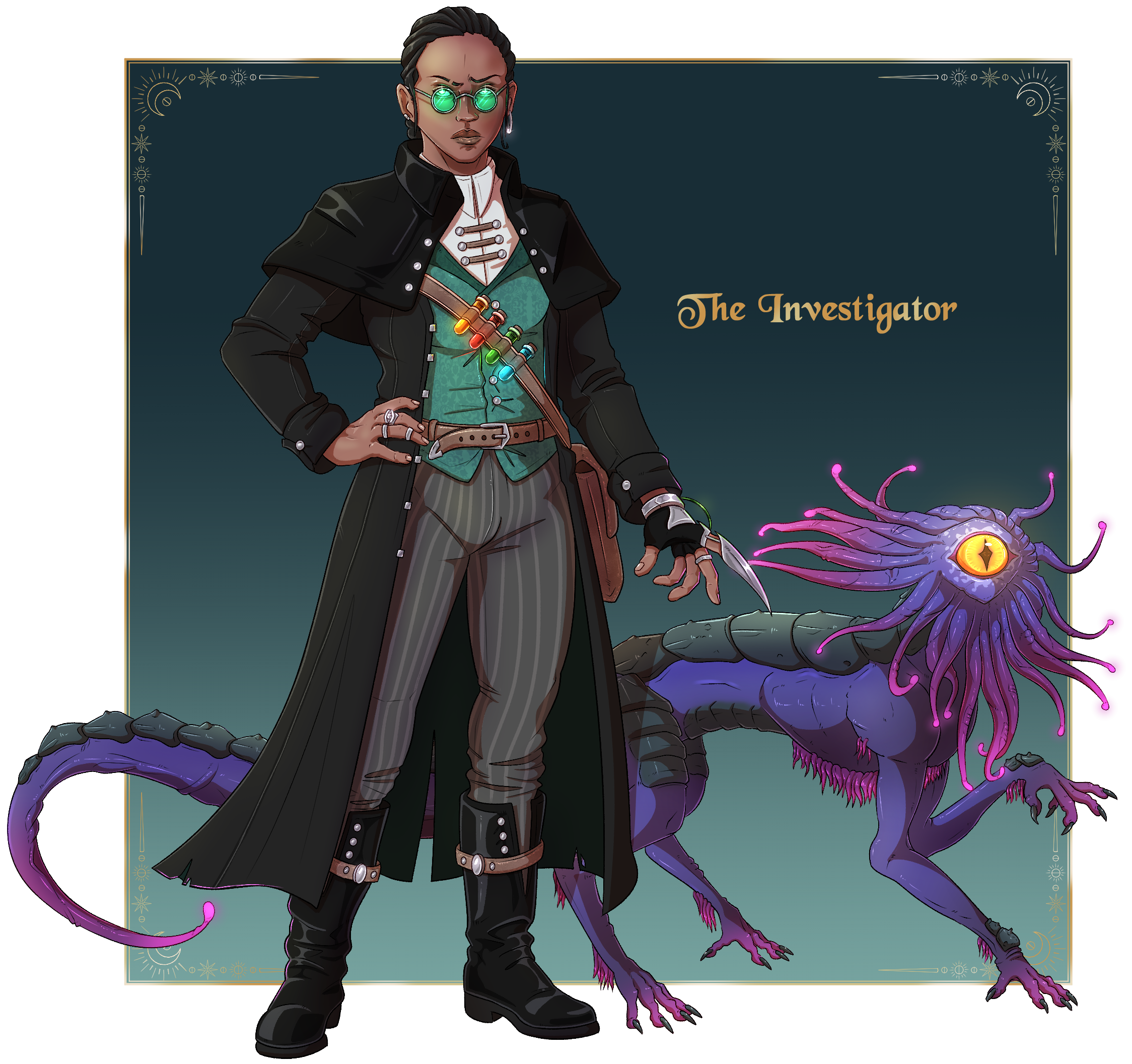
alchemy. There are no exceptions; every investigator is a trained alchemist. Much of their work relies on the use of specialized substances and reagents for identifying arcane residues, solutions for analyzing potions left at a crime scene, or elixirs to provide protection against the harmful magical energies that linger at a site of disturbance.
The second pillar is an extensive knowledge of spellwork, encompassing both
General Arcane Theory and
Applied Spell Theory. While they rarely possess the raw power of a dedicated spellcaster, an investigator learns to cast a practical array of spells tailored for their work: wards, tracking glamours, minor divinations, counter charms, and even subtle magics for interrogation and stealth. This practical training is often supplemented by specialized academic courses such as
Magical Forensics and
Comparative Demonology.
The third and perhaps most unique pillar involves the creation and use of the investigator's greatest tool: the
geist. A geist is an alchemically created chimera, a bespoke living construct that acts as an investigator's equivalent to a track hound. This is not a creature one finds or buys; it is one an investigator builds. The creation, maintenance, and modification of a geist is done by the investigator themself, requiring not only a mastery of alchemy but also a deep understanding of
Chimerology — the esoteric field dedicated to the creation of artificial life.
The Investigator's Arsenal
While individual investigators may specialize in certain types of crime, a handful of tools are considered commonplace in their arsenal, forming a standard methodology shared across the profession.
The Alchemical Forensics Kit
The cornerstone of any investigator's field kit is alchemical forensics. This collection of reagents and concoctions for on-site analysis typically includes residue powders that cling to latent arcane energies, causing them to fluoresce; vials of stabilized gas that can disrupt and dispel minor illusions or glamours; and pouches of purified salt used to safely dismantle active ritual circles.
With a portable test kit, an investigator can often analyze and identify the key ingredients of a potion from a single drop left at a crime scene. A key tool for this is the "Alchemist's Needle," a fine, hollow blade fitted around the index finger, used to precisely collect samples or administer testing reagents to a surface.
Tools of Planar Detection
Not all disturbances are the work of mortal spellcasters. Since it is not always immediately apparent if an incident is the result of a rogue mage or an otherworldly being, investigators are usually equipped with a limited arsenal to detect such influences.
Chief among these is a pair of Planar Spectacles, finely-wrought lenses that allow the wearer to perceive subtle tears in the fabric of reality, revealing nascent rifts or planar intrusions as oily, shimmering distortions in the air. Depending on their typical region of work, many investigators also invest in specialized protective gear against the specific threats of spirits, fae, or demons.
The Geist
The most famous and indispensable part of an investigator's arsenal, however, is the geist. These chimeric beings, comparable in size to a large dog, are alchemically created to serve as the perfect investigative partner. A geist possesses a sinuous, elongated body supported by slender, almost humanoid limbs, but its most striking feature is the oversized, singular eye that dominates its triangular head, which is otherwise devoid of features like a mouth or nose. This ocular organ is purpose-built to pierce magical subterfuge, cutting through illusions, glamours, and unnatural darkness as if they were mist.
Surrounding the head is a fringe of sensitive, prehensile tentacles. These appendages "taste" the ambient magic in an area, their glowing tips pulsing with light and color in a complex, non-verbal language that communicates the nature, school, and potency of any spells to their handler. A geist can memorize the signature of a spell and, if the magical residue is recent enough, track it back towards the caster, leading the investigator directly to the perpetrator or at least helping them reconstruct the course of events.
A deep, symbiotic bond links the geist to its creator. By attuning their own senses to this connection, an investigator can perceive the world through the geist's eye, allowing them to share its supernatural sight for scouting or exploration. Furthermore, geists are remarkably versatile. Since they are created and maintained by the investigator, they are frequently modified with alchemical grafts to suit a case or overcome common obstacles. A geist might be augmented to become incorporeal and phase through walls, reinforced with sturdy chitinous armor for dangerous assignments, or even be given the ability to project protective wards for its owner. While a geist's chimeric matrix can only handle so many augmentations before becoming unstable, this inherent limitation ensures that no two geists are ever truly identical, as each is a reflection of its creator's specific needs and expertise.
The History of Solving Supernatural Crimes
The modern investigator profession was born in the Witchrealm of Morvathia, forged in the aftermath of civil war and a profound crisis of justice. During the brutal regime of Violante Valtessa, witchcraft was used to terrorize and dominate the public on an unprecedented scale. After the war that ended with
Witchking Alaric Valtessa taking the throne, numerous initiatives were started to rebuild public trust in witches and witchcraft as a whole. One of the most significant was spearheaded by
Euridir's Heirs, an organization dedicated to establishing equality between magic-users and the non-magical populace.
Their proposition was simple: equip the realm's guard force with the means to investigate and prosecute transgressions committed by spellcasters, thereby bringing justice to everyone, regardless of their magical aptitude. Prior to this, guards had occasionally made use of private detectives specializing in magical crimes, but without widespread funding for their unique tools, spells, and training, these efforts were largely inefficient.
The proposal was initially met with heavy criticism from the Witchrealm's ruling class and
the Morvathian Coven. They argued that it placed all witches under general suspicion and insisted the current justice system was already equal. The harsher punishments for crimes committed with magic, codified under "§2 Crimes of the Arcane," were often presented as proof that the government took public safety seriously. This, of course, conveniently ignored the criticism that such punishments were difficult to administer if the guard was unequipped to actually identify and apprehend the perpetrators.
Undeterred by the pushback and with only limited funds, Euridir's Heirs founded the
Widowbird Agency. This initiative brought together witches, alchemists, and field researchers to hone existing methods of spell detection and develop a new arsenal of analytical tools. Their methodology quickly became popular with city guards, who were often frustrated by baffling, seemingly impossible crimes they lacked the time and resources to solve. As more of these "investigators" became involved and their results spoke for themselves, their methods became so common that the Morvathian Coven could no longer ignore them. They changed their tune and put their considerable weight behind the Widowbird Agency.
With access to the Coven's vast resources, the investigators' methods became increasingly sophisticated, cementing the profession as a niche but highly recognized part of Morvathia's justice system. However, this transition was not without criticism. It is often suspected that the Coven co-opted the agency's original purpose, sharpening its methods not to protect the public, but to create a force of loyal agents to be used against rogue witches and other political opponents.
Luckily for those fearing such conflicts of interest, the profession soon stopped being exclusive to the Widowbird Agency. Shortly after their methods proved effective in practice, private detectives and agencies in other realms began to copy their skills and tools, creating a new, independent line of work for mercenaries and freelance adventurers all over Vespero.




Geists are so cute! I would read a book series about an investigator, for sure. This is such a good article.
Explore Etrea | WorldEmber 2025
You are giving me ideas! It would be quite a fun book to write. Thank you! ^w^
At the end of everything, hold onto anything.