
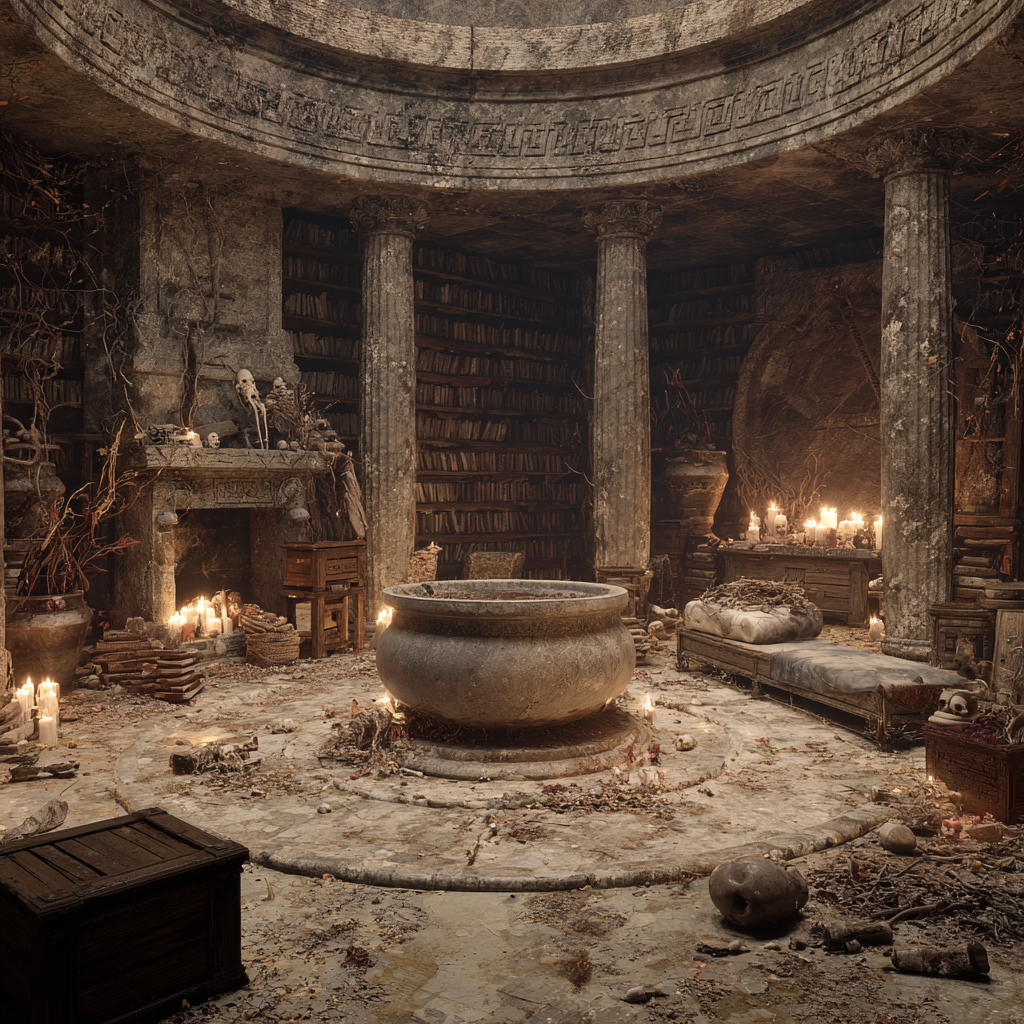
Necromantium
Necromantiums are hidden ritual chambers, rooms, and buildings found squirrelled away in places that cover their use. Found in ancient Greece, the necromantiums are places that are used for the practise of necromancy.
Purpose / Function
Necromantiums were originally constructed or altered to allow for the raising & querying of the dead.
Alterations
Most were built for the intention of necromancy to begin with but a number were made from old ruins or caves. These repurposed necromantiums created with dealing with the dead.
Architecture
In pretty much all cases, the necromantiums were of Classical Greek origin shown in the construction & adaption of the building. Many have libraries and book cases, stone furniture, ritual spell spaces, and Old Greek writings on the fixtures to act like a beacon for the dead and to trap them.
Defenses
The defences of a necromantium is initially quite straightforward, with it hidden from view and it's location known only to a few who use it. Other than that there is a couple of other defences usually employed to stop prying eyes from outside finding it.
The first is a number of animals are regularly placed there especially animals related to death or the afterlife. Mostly, bats are used, but sometimes within the vicinity itself, owls are used. Any disturbance will cause a reaction to those trying to gain entrance and even frighten them off. This is especially true with the views of bats & owls being linked in Greek legends concerning the souls being took by owls to the afterlife, and bats seen as creatures of the night in many cultures.
The second is much more insidious. Usually trapped souls of the dead are used. Apparitions & hauntings are deliberately left behind to frighten would-be intruders, and sometimes animated dead such as skeletons & zombies are used to act as guardians & servants that can attack and scare off the trespassers.
History
Necromantiums have existed since the Classical Greek times with the ancient Greek city states. Usually banned due to the sinister acts that are carried out involving animated dead, they are still thought off as places where the desperate can go if needing an extreme form of divination.
Many have fallen into disrepair and old evils & undead sometimes spill out from these, while others are seen as accursed places where in the surrounding lands the dead don't stay at rest. Some are completely abandoned and don't have any real effect, while others are still in use, sometimes by spellcasters or other unnatural beings.
Most though are long forgotten except in local tales spoken off in old wives tales, and the mutterings of by village drunks or madmen. All regularly contain old crumbling parchments and other tidbits carved into the walls left behind by the original users.
Most are dedicated to specific deities pf the ancient Greeks, and Hades is a common deity, along with the following:
- Atropos who cuts the thread of life
- Charon, the ferryman who takes the dead to Hades
- Erebus a primordial god of darkness and the underworld
- Hecate, the goddess of magic, with magic being best used at night
- Persephone, the goddess wife of Hades
- The seven gods of the underworld rivers (each giving their name to their respective river): Acheron, Alpheus, Cocytus, Endanos, Phlegethon, and Styx
These were found to be used in conjunction with one another and could be invoked to bring the dead forth, or to return the souls of the dead back to the underworld.
In a rare few cases, other death gods were used and combined to carry out necromantic rituals, and sometimes the demonic were invoked to do the same but usually at a higher cost and harder to get rid off. They seem to be referred to as Daimons in many leftover records and likely more to do with the personal spirits assigned to individuals to act as their guides in life.
Since the Greek States are primarily ruled over now by Slavs, Avars and more importantly, the Byzantine Empire, the use of necromantiums have fallen out of favour. Anyone found doing so faces heavy penalties including up to the use of execution for such practises. Also, when one is discovered by the authorities, it is usually blessed by clerics of the respective society who lives in the region then destroyed.

Comments