
Dragons
Dragons are ancient creatures feared by many who know of them. Some are hunted down, some are seen as avatars of the gods.
Basic Information
Anatomy
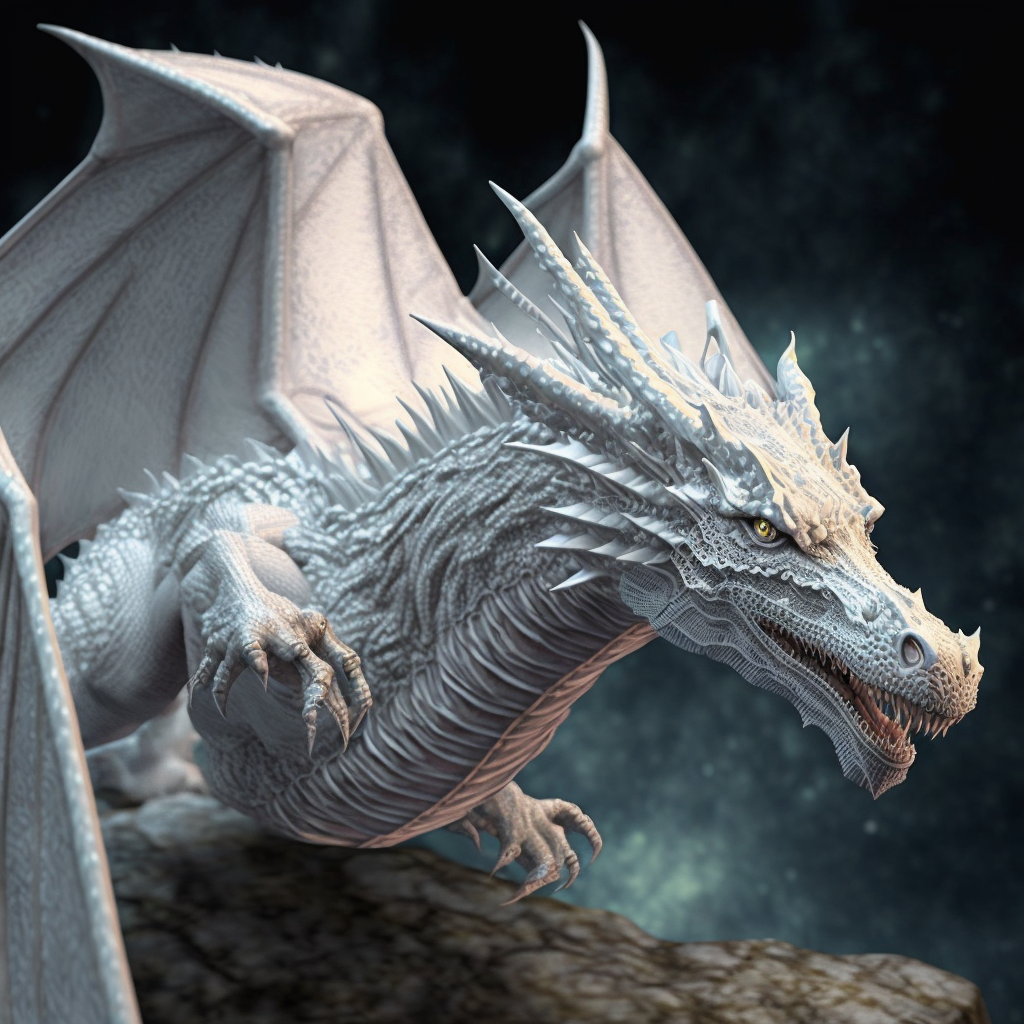
Dragons are gargantuan creatures almost reptilian in looks. Serpentine in shape, with two frontal legs and two hind legs, the former dexterous enough to generally wield some objects that are big enough to fit in their grasp.
A huge pair of wings sprout from where their backs meet the sides these leathery appendages have the necessary muscular attachments to bear the dragon aloft. When a wyrmling, they spend a great deal of time practising to fly to build up the strength to support themselves in the sky.
Each dragon type has a breath weapon generated by a pair of glands just behind their lower jaws in the thoracic passageway. Compounds corresponding to each dragon's type builds up in these glands allowing them to produce anything from fire to cold to acid or even disease. These pick up the necessary compounds from their diet.
Each dragon has a strong digestive tract and uses specific treasures to act break up other foodstuffs. These are swallowed whole and with dragons being naturally saturated in the magic of the Material Plane, a part of that said magic saturates any non-magical item and upgrading the level of any that already is. These items are generally passed out with other solid waste.
The Dragons of Asia generally don't have wings and are generally more lithe that many others .They usually have hair-like growths on parts of their faces and/or bodies.
Biological Traits
Dragons come in many types with some of the common types are spread over Chromatic, Metallic, and Gem Dragons. Other creatures are related and usually referred to as Dragon-kin. The true dragons all have specific breath attacks related to their colour. The usual types are as follows
Chromatic:
- Red Dragons, whose scales get darker red when the older it gets. They generally breathe cones of fire.
- Black Dragons, whose scales get darker with age and duller. They generally breathe corrosive acid in a cloud.
- Blue Dragons, whose scales start light blue getting a deep royal blue when old enough. They breathe out lightning blasts.
- Green Dragons, whose scales start as a light green colour getting a deep dark green the older they get. They generally breathe out poisonous green gas.
- White Dragon, whose pale ice blue scales get whiter with hints of pale grey as they age. They breathe out cones of ice or frost.
Metallic:
- Gold Dragons, whose scales are yellow gold getting shinier with age. They breathe out a cone of fire.
- Silver Dragons, whose scales go from a dull iron-like colour getting much more lustrous with age. They breathe a cone of freezing cold.
- Bronze Dragons, whose scales start slightly metallic brown sheen getting more yellow as it gets older. Their breath is electrical in nature.
- Copper Dragons, whose scales turn from a brownish yellow to a yellowy colour with slight green hints. They breathe acid.
- Brass Dragons, whose scales turn from a coppery colour to a darkened metallic brown colour. They breathe out Sleeping gas.
Gem:
- Amethyst Dragons, whose scales turn from a pale opaque purple to a deep purple the older it gets. Their breath is a concussive force.
- Emerald Dragons, whose scales turn from a pale opaque green to a deep purple the older it gets. Their breath is a powerful blast of wind.
- Sapphire Dragons, whose scales turn from a pale opaque blue to a deep blue the older it gets. They use a breath weapon that is a blast of sound causing enemies to panic.
- Crystal Dragons, whose scales range in translucent crystal types, though usually clear, get deeper in colour the older it gets. It attacks with a breath weapon of blinding pure light.
Asian Dragons look more like serpentine forms with hair-like growths in place of scales. These can range over the whole body or to specific patches including down the back, around the face or looking like facial hair on a human. They can fly like any Dragon but nobody can explain how as many don't have wings or appear as small weak organs that wouldn't look out of place on a human sized creature.
Each dragon is highly magical even if it doesn't use spells, and this gets stronger with age. The older the dragon the more powerful it becomes growing to huge if not gargantuan size. They sleep longer the older they get too. More treasure is gathered and this becomes impregnated with the Dragon's magic, especially if used to help to break up foodstuffs while in the stomach.
They seem to attract Dragon-kin too where possible, especially the following:
- Draconians. These humanoid creatures appear when magic is used to interrupt Dragon eggs developing to final stage. They take their traits from the specific egg type and may be split into specific roles depending on the magic & egg used. The magic itself seems to be specifically cast on the eggs and not random. It is speculated this emerged in a far off world and brought to Earth by some traveller in a far distant past. They have a tendency of being hated by outsiders and act as armies, guards, servants and dignitaries for Dragons.
- Dragonborn. Dragonborns appear to be humanoid creatures originally derived from dragon eggs. Exactly when and how they came about is unknown but seem to be related, albeit loosely, to Draconians. Natural selection seems to have took over breeding practises, and while the Draconians are sterile, the Dragonborn aren't with whole clans forming around a few central families. Hated in Europe most are either killed or flee. In Asia they are respected, even revered, as a link to the gods.
- Kobolds. Kobolds seem to be diminutive dragonlike humanoids that came from somewhere else. It seems they developed in the Feywild and came to many worlds through the use of portals from the Feywild. Hated wherever they go they keep a low profile and worship Dragons as their masters. Many Dragons have Kobolds as their only servants as they are easily replaceable due to the Kobolds breeding in large numbers, and are easily dominated by by stronger creatures. They help protect Dragon lairs by force of numbers and laying traps (they're known for being adept at building these) throughout. They have an ongoing hatred for Gnomes after the latter trapped the Kobold's god in a supernatural maze.
- Dragonnels. These creatures have been bred by scholars & wizards who appear to stunt the growth of the creature by getting it hatch early, and with a dose of magic. Some have escaped and breed now throughout he world creating small enclaves where the Dragonnels of a brood will take up their own hunting grounds close to siblings. If took as an egg or trained early they offer a flying mount to those with the patience to train them.
- Wyverns. Speculations abound as to where Wyverns come from. Thought to come from experiments carried out by Dragons and Giants in the early days of the wars between both, they now are a separate species that breeds true. Found in high rocky areas, the Wyverns have no breath weapon, and a stinger at the end of their tails instead. They are another that can be trained from hatchling age up to near adult age to take a rider. Though saying this, they are very temperament a number of cases mentions the rider being duked or dropped off the Wyvern's back, and some stung to death as well.
- Sea Serpents. Sea Serpents are huge or gargantuan Dragon kin that live in the largest deepest lakes or in the seas of the world. Believed to be descendants of Dragons that didn't escape from the flooding caused by Pangea breaking up, they are adept at living in the sea. Some who have seen these creatures say they resemble horrifically long eels or sea snakes. They still collect treasures but generally don't appear as intelligent as many of the other Dragons. They have no wings, but have a limited ability to breathe in air while preferring to breathe in water. They have a tendency of spitting high pressure water from the mouth, and attacking large sea vessels both to eat the crew and get wealthy from the treasures on board.
- Dragon Turtles. Nobody can be sure how Dragon Turtles came about. Living in the seas, especially in waters that are warm and equatorial, the Dragon Turtles are huge to say the least. The largest can appear as islands as dirt, debris and plants can take root on their shells. If anything this allows them to carry out attacks on ships and against almost all attackers thinking it is an island or floating mass of land. Like other Dragons they have a breath weapon, and when used it is a scalding blast of hot water causing burns to living flesh. They are thought off as an experiment in ages past gone wrong mixing Dragon & Turtle anatomy. It should be noted that they can't fly at all, but one of the hardiest Dragon kind, and can go without breathing air or eating anything hours to months.
Genetics and Reproduction
Dragons of any type can breed with any other irrespective of any other type. The eggs that are produced are laid in specific hidden rooms in the female Dragon's lair and the temperature affects whether it becomes male or female, the hotter it is will lead to more males, the colder more females.
The general environment will also determine which type of the Dragon that fathered it. If the male dragon is a Red Dragon, and the eggs are laid in a hot volcanic lair then it will become a Red Dragon, and a Gold Dragon if a male Gold Dragon was the father and laid in the same conditions.
Growth Rate & Stages
Dragons are slow growing, really slow growing. They can spend centuries in certain stages of life.
When it is an egg it can take months to a full year to grow.
As a Wyrmling it starts as a newly hatched Dragon and can spend 0 to 5 years in this form.
When becoming young it can be at this stage between 5 to 100 years at this age.
Reaching adulthood, the Dragon can love anywhere from 100 to 800 years of age
Where the Dragon lives to become Ancient, it lives for over 800 years, and can love up to 2000 years on average.
The rarest form of the Mythic Dragon types starts at 2000 years and no known age of the eldest.
By the time the Adult Dragon stage is reached it will have left the nest or driven out by any other Adults or older more established Dragons. It searches out a lair of it's own or a place to build one. From there it will dominate the region around it if possible, and look to build up a treasury and personal rooms within. It will look to gain followers too even creating some from any of their own eggs or eggs took from others.
Ecology and Habitats
Swamps, deserts, coastal regions, mountain tops, deep forests, volcanic areas, and freezing ice banks are common. A few, especially the crystalline dragons, look to take up residence in Underdark caverns huge enough to accommodate them.
In every case they look to become the dominant apex predator, even those who are generally Good in alignment. Each Dragon will drive off those they can't dominate and keep those around that can be used as servants, slaves and protectors of their region & lair. A few of these creatures will scour all around the region to bring precious items to the Dragon along with foodstuffs, and act as diplomats or soldiers as needed.
The Asian Dragons generally live in religious domains or religious sites dedicated to an singular or even multiple gods. They rarely eat and many believers in the gods will leave animals nearby for them to eat.
Dietary Needs and Habits
Dragons are generally predatory and usually carnivorous in nature. They don't need to eat in decades if need be. If sleeping for decades or longer then they can go for longer.
They usually have servants or slaves to get the basic foodstuffs that the Dragon would need, and hunt down those animals that provide a challenge to these servants and makes for a good hunt that the Dragon can use to claim their own prowess in battle & hunting.
Behaviour
Dragons have a strong self belief in themselves and themselves alone. Each views the other Dragons as minor players on the great game of life.
Metallic Dragons generally view other species with pity or sympathy , and generally either avoid intelligent species or uses disguises to interact with them. Many will use subterfuge and misdirection to avoid contact or to help where both sides come out with little negative consequences.
Chromatic Dragons are generally ill-tempered entities with some like the Red Dragons being hyper aggressive to nearly all other creatures, while White Dragons are cold hearted hunters, while the Blue Dragons like to "toy" with prey species. Others generally have similar unpleasant personality types.
Crystalline Dragons are generally neutral in outlook, usually patient and preferring the darkness of the Underdark with little life nearby to bother them, unless hungry or looking for something in particular of course.
Asian Dragons are unique in the sense they are the avatars of the gods and take on personality aspects of the god they serve. Most appear distant, and when one is seen to be a blessing or a curse depending on the Dragon & it's deity's patronage.
Additional Information
Social Structure
Dragons have a tendency of being loners, and only Draconians, Dragonborn & Kobolds seem to enjoy each other's company. Only the wyrmling stage seems to keep Dragons of a brood together, more for defence than anything. When old enough, usually when they are young ,they look to go and find a lair for themselves and start building up their treasure, as well as dominating anything in the surrounding area.
The largest kind, the Mythic Dragons, are found deep in lairs so ancient that most have been forgotten about. This appeals to many Dragons who will try to steal into such lairs awaiting the death of the original occupant, or even look to kill of the Mythic Dragon. Fortunately this is rare indeed, and partly why many Adult or older dragons will try to drive off r kill young dragons that make their appearance in the vicinity of their own lairs. The young will be driven out of their own nesting chambers too as they get older for the same purpose.
Domestication
Certainly with the Dragons themselves they never can be domesticated, at least for long. They are usually too powerful and dangerous when they eventually grow to be able to be domesticated.
Some of the Dragon kin can be domesticated and used for flying mounts, but only under certain conditions, and as for Draconians, Dragonborn, and the Kobolds, they can and do live with others of their kind, each other, and even other species. With them being part of a society already they quickly learn how to fit in if the conditions are right.
Uses, Products & Exploitation
Dragon kin are usually exploited for labour, and as military units (including as mercenaries) in many regions. In regions such as Asia, they are usually clerics and monks, and a few are rulers or community leaders where their links to the gods are prized.
A regular by-product of Dragons are their scales, bones, skins, parasites and treasure. The scales, bones and skins can be turned into armour and weapons that are exceptionally strong & hardy. It has been noted that armours made from these can protect against certain conditions depending on the Dragon it came from, such as a Red Dragon scale mail providing protection against fire. Similarly, weapons made using these components can cause further damage specific to the Dragon it came from, such as fire damage from a longsword from a Red Dragon bone.
A unique parasite found in Dragon hoards is incredibly useful for treasuries of individuals & nations. The Hoard Mimic is an incredibly rare creature related to the classic mimic found in other treasure hoards. Grown to huge sizes due to the inherent magic found such hoards, it can grow almost as large as a Dragon itself. Woe to anyone who encounters such a creature.,, due to it being able to swallow a fully grown knight in one go.
The treasure hoard of a Dragon can be vast, and filled with many rare, priceless and magical items. Anyone who can claim one will instantly be able to live a life of luxury along with so many generations of them afterwards. There is the boasting rights too, especially if they are involved with the destruction of the original owner, and survives anyone or anything trying to get their own hands on it.
Geographic Origin and Distribution
Worldwide, usually in hidden lairs.
Average Intelligence
Average to highly intelligent.
Perception and Sensory Capabilities
Having the standard senses, some of these are slightly more powerful, mainly better eyesight, hearing and smell.
On top of this, Dragons have Truesight. This ability comes from their genetic history with boosted by the magical energy naturally found within the Dragon's body. They can see that which is hidden even by powerful magic, and can easily hunt such creatures in the dark, partly due to the ability of Darksight.
Civilization and Culture
History
Dragons are ancient, as ancient as Earth itself, maybe older. The story of Dragons start in the very ancient past. Having been seeded in many worlds throughout the universe in it's early days by their parents Bahamut and Tiamat, they eventually appeared on Earth in it's very early days.
At the same instance, Star Spawn fell to Earth too, Both assumed that the world was theirs leading to a series of wars in the early years. This caused massive damage that was quickly covered over by the Earth settling covering the scars of such wars. Nothing much is remembered except in the minds of the Star Gods and the eldest of Mythic Dragons. Both sides took hold of specific places that they preferred and since they both had differing outlooks, they quickly left each other alone from then on.
How the Dragons arrived before this time is a matter of conjecture. One thing is clear, they appeared shortly after Tiamat left her mark. The evil goddess & mother of Dragon-kind found the world scrying enough into the future to see her children spread across the world. Always looking for an opportunity to increase numbers and the thought of another world for her children to conquer, Tiamat landed in what would eventually become the Persian region of the Middle East. Laying the first eggs there, she marked it for greatness and homeland of all dragons. Leaving here she had also marked the same region with an element of herself. This would eventually lead to her worship by early modern human groups such as the Akkadians, Sumerians and Babylon. Others are assumed to have worshipped her too.
The Dragons spread from there throughout the world adapting and filling niches within the ecosystems. Variations were common and it is thought that many more variants were present at this time but no proof exists, at least at present.
Many helped early life flourish, and made contact with other deities beside Bahamut & Tiamat. Those Dragons who eventually settled in the Far East met deities that they turned to, and became their avatars. Those that had settled in the Middle East, Europe, & Africa stayed true to Tiamat... except for one. They generally became the enemy of many creatures that rose millions of years later when the latter's deities realised the danger such ancient creatures would pose if disturbed. Thus, the idea of Dragons and their kin is viewed as evil in most of these regions.
One Dragon stands out here. All that is known is that it is a mythic Black Dragon, known only by the name of Leviathan. It seems that it had been round for at least a few million years old or longer, and fell under the machinations of an evil deity. This deity seems to have subsumed the very soul of Leviathan taking it's name for itself, and turning it into it's avatar on Earth. It still exists deep under the Mediterranean Sea just off the city of Alexandria.
The Dragon / Giant Wars
The Dragons may have fought the Star Gods but either were barely affected in the long run. Another set of wars that affected them in a highly negative way.
This became known as the Dragon & Giant Wars. Giants had arrived the time before the Hyperborean Age. Being more numerous than the Adult & older Dragons, the Giants swept down from the north killing many before the Dragons started fighting back. Both used experimentation and magic to create creatures such as the Draconians and the Trolls to act as foot soldiers. Both fought long enough less & less Dragons survived to Adult age, and so the Dragons withdrew from many regions, leaving the Giants take over.
When the Hyperborean Age was at it's zenith, and then the break up of Pangea, caused even more Dragons to be lost. The First Men devastated the Dragons during the former, and the latter caused who regions to be lost along with many lairs. During this time, the Giants backed off after many of their own strongholds were overrun driving them off too.
Eventually, the wars petered out and both of these species became myths, legends and folk tales / religious iconography.
The main source of these wars comes from a carved wall in a cavern deep in the Scandes Mountains.
The Modern Dragon
Many of the modern Dragons right up to many of the Mythic Dragons , are rare, some might say legendary. Even the Dragons of the Far East are exceptionally rare, believed to only interacting with the world when on missions from the Gods themselves.
Most are hidden away in desolate regions, or regions that are difficult for most to reach. This helps protect the Dragons and their offspring while helping create further aura to the myths of Dragonkind. When adventurers and dragonslayers make their way into these regions, they usually find that many of these regions are indeed inhabited by the monster that terrified generations of locals.
Most Dragons now sleep, waiting for the world to change and hoping that potential threats eventually pass or forget about the Dragon threat. A few do still interact seeing the chance to carve a name for themselves and actively create empires like those of the past.
Lithe and powerful, regularly appearing and gigantic lizards, with wings and if unlucky extremely hardy in build.

Comments