

The Malachai - Twisted Children of the Elves
Excerpt from “Echoes of the Architect’s Error”, by High Curator Thalen Vorris, Church of the Lifestar (restricted archive)
“The beings known as the Malachai are not simply a corrupted people — they are a window through which the Astral Shoals observe us.
In their blood, one finds not mana, nor ley resonance, but a pulse that does not belong to this world. It is my belief that Malachor did not create them so much as convert them — tuning their very essence to the frequency of the Astral.
They are the song of a world reflected: a hymn sung backward through the veil. When they whisper, they do not speak to each other alone — they are answering something that still whispers back.”
Classification: Corrupted Humanoid (Elderkin)
Origin: The War of Rebellion, Age of Origin
Affiliation: None — though many serve the lingering will of Malachor
Current Habitat: Dark woods, cavern systems, and the twilight zones beneath Aesos
Historical Account
Millennia ago, during the War of Rebellion in the Age of Origin, the Elves and Dwarves — the Elder Races and first creations of the Architect — waged a brutal conflict against their former servitors, Humanity. The Elder Races, mighty though they were, had grown complacent through the long ages. Humanity’s numbers, ambition, and adaptability pressed them to the brink of ruin, and what began as a war of control descended into a desperate struggle for survival.
When the Elder Races stood at a stalemate and the outcome grew uncertain, the First Demon came to them with an offer. It promised power beyond their comprehension — enough to shatter Humanity’s rebellion and restore their dominion — in exchange for a single price: a foothold in the material world.
The precise wording of this bargain has been lost to time, but whatever the Elves and Dwarves believed they would receive, and whatever they believed they would owe, was far from what was truly agreed.
The Corruption of the Elves
To enact the pact, the First Demon chose one of its lieutenants — Malachor, the Lord of Pleasure and Desolation — to corrupt the Elves. Malachor wove fragments of his own essence into their bodies and souls, reshaping their spirits in his image. The Elves’ luminous grace became shadowed and warped; their beauty curdled into predatory allure.
Thus were born the Malachai.
The transformation granted them strange power — a reflection of Malachor’s own — but the cost was terrible. Their spiritual link to the natural light of Aesos was severed; they became beings of shadow and dimness, shunned by sun and starlight alike. In agony and shame, they withdrew into the dark woods and shallow underworlds, building their hidden enclaves in the twilight beneath the world’s surface.
Forever more, Malachor’s influence extended through them. Through their dreams and rituals, he whispers, ensuring the First Demon’s foothold endures.
Appearance
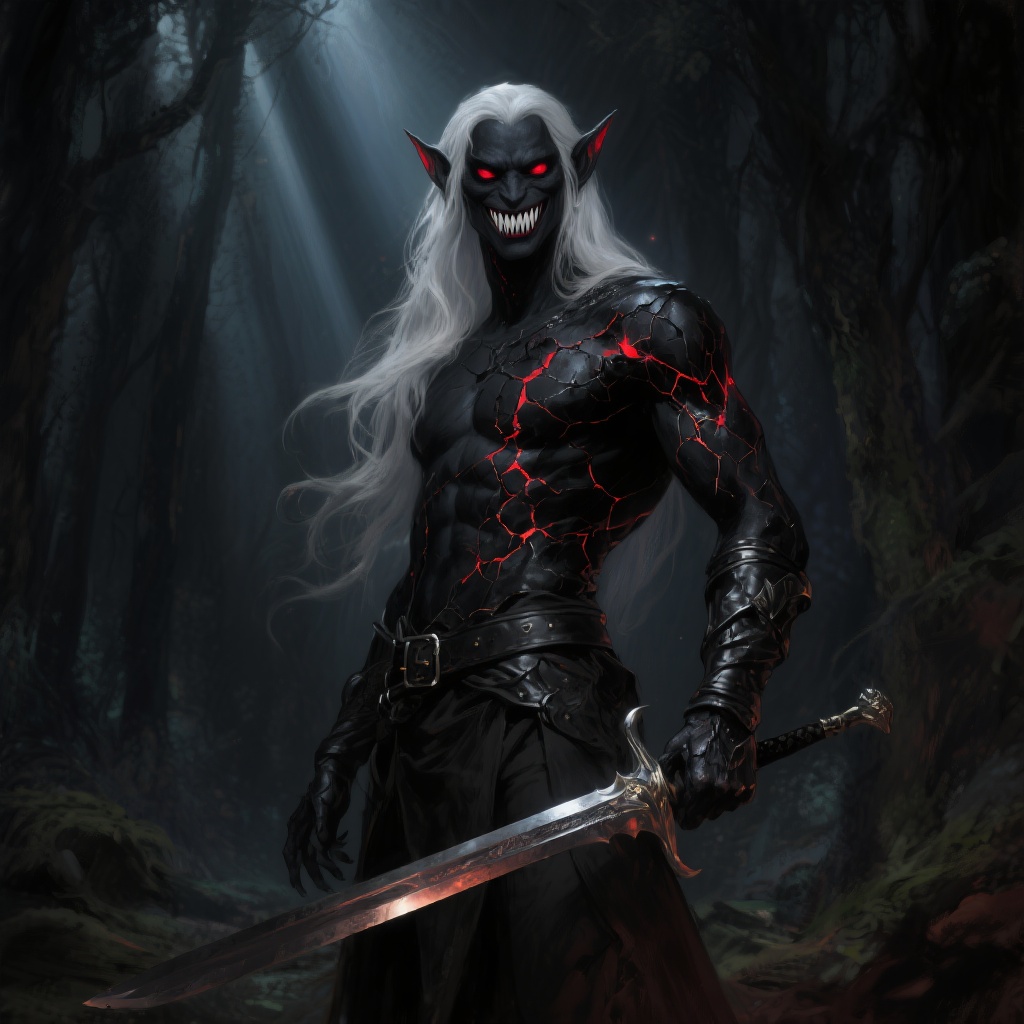
The Malachai retain echoes of their Elven ancestry — tall, lean, and sharp-featured — but their forms are visibly corrupted. Their obsidian-blue skin is fractured by faintly glowing red fissures, pulsing softly like embers beneath stone. Crimson eyes gleam from shadowed sockets, and elongated ears taper to vicious points. Their teeth are serrated, their nails hardened into claws.
They move with a hunter’s grace, shoulders slightly hunched, their presence unsettling even in stillness. Most wear fragments of ancient armor — spiked bracers, rune-etched belts, and scavenged plating — relics of the war they lost and the civilization they betrayed.
Behavior and Society
Malachai society is fragmented and tribal, often ruled by the most cunning or cruel among them. They dwell in underground shanty towns, fungus-lit caverns, and the roots of cursed forests, where the air hums with whispered prayers to Malachor.
They venture above ground rarely — usually under twilight or clouded moonlight — to raid, hunt, or reclaim lost relics of their Elven kin. Humanity, whom they blame for their fall, remains their most hated enemy. Captured humans are often sacrificed in rites meant to rekindle their lost connection to the Architect’s light, though none have ever succeeded.
Legacy
To most of Aesos, the Malachai are a tale from a darker age — monsters of the deep wood and the forgotten places beneath the world. Yet scholars of the Church of the Lifestar maintain that their existence is proof of the First Demon’s enduring reach, and that the corruption of the Elves remains one of the greatest tragedies of creation.
Abilities and the Mark of Malachor
The Malachai’s power is the legacy of their corruption — fragments of Malachor’s essence embedded within their being. These fragments act as conduits between the mortal realm and the Astral Shoals, allowing Malachor’s will to seep through the boundaries of the world. Their power is neither divine nor arcane in the traditional sense, but a reflection of the Astral itself: elusive, emotive, and corruptive.
The Shard Within
Every Malachai carries what scholars call a Shard of Malachor: a splinter of the demon’s consciousness fused to the soul. It hums faintly within them, an ember of Astral resonance. Those of strong will can wield its strength without losing themselves, while others are slowly unmade by the whispers that flow through the connection.
When called upon, the shard’s power manifests subtly — never bright or overt. A faint red glow stirs beneath their cracked skin, and the air grows heavy, as though the world itself hesitates to breathe.
Common Manifestations
1. Shadow Veil
By drawing upon the Astral reflection through their shard, they can bend light and perception, cloaking themselves in a haze of shadow. To observers they appear half-seen, movement caught at the corner of the eye, accompanied by a primal unease.
2. Glamour of the Lost
A remnant of their former grace, now warped by Astral influence. They can project an unnatural allure that entrances mortals, but beneath the surface lies a quiet terror — an impression of vast, watching awareness.
3. Whispercraft
Through low, rhythmic murmurs that resonate with the Astral Shoals, a Malachai can stir fear, confusion, or despair within the minds of others. The effect grows stronger in dim or enclosed places where the boundary between realms thins.
4. Blood Echo
A forbidden art practiced by seers and warlords. By mingling their blood with another’s, they forge a sympathetic link across the Astral reflection, sensing the heartbeat, location, or pain of the bonded soul. The Church of the Lifestar classifies this as a form of Astral Contagion, a practice outlawed across Cezorus.
Spiritual Corruption and Weakness
The shard grants strength but exacts obedience. Each use deepens the tether to Malachor, drawing the bearer’s thoughts toward his will. Those who rely upon their shards too freely eventually lose the boundary between self and shard — their individuality dissolved into a single, unified hunger.
Sunlight and sanctified radiance cause the Astral link to recoil, dimming the red glow beneath their skin and leaving them weak or disoriented. Ancient Malachai bear light-burned scars, where the glow has hardened into dull black stone.
Philosophical Notes
To Cezorian historians, the Malachai represent the peril of reaching beyond the world’s veil. They are living conduits — proof that the Astral Shoals can touch and reshape flesh through will alone.
To the Church of the Lifestar, they are a warning written in blood: that creation itself can be corrupted when it gazes too long into the reflection beyond.
To the Malachai, it is a curse of memory. Their hatred of Humanity burns from envy — for humans may walk freely beneath the sun, while they forever dwell in the shadow of their own unmaking.
Culture & Society
Malachai civilization endures in the twilight places of Aesos — scattered enclaves hidden beneath forest roots, or in sprawling shanty towns carved from shallow cave networks. They are a people bound by loss, sustained by fragments of memory and the lingering whispers of Malachor.
Their communities are often loosely organized, fluctuating in number and allegiance. Where the Elves once built crystalline towers to the light, the Malachai construct latticed settlements of stone and bone, their walls veined with glowing red mineral — the residue of Astral resonance that leaks from their very presence.
Hierarchy and Clan Structure
Each enclave is ruled by a Voice, a Malachai who has learned to channel the shard within without succumbing to it. Voices act as both ruler and conduit, interpreting the will of Malachor through trance, dream, or blood ritual. Beneath them are the Shard-Bound, those who wield their Astral connection with precision — warriors, whispercrafters, and hunters who defend the clan and maintain the delicate boundary between survival and madness.
The lowest caste are the Faded — those whose shards have grown dormant or silent. Once their glow dims completely, the Faded are treated as ill omens, their presence said to invite the hunger of the Astral reflection. Some enclaves exile them into the deep woods; others entomb them in the stone to “return their essence to the reflection.”
Power among the Malachai is measured not by wealth or conquest but by clarity — the ability to maintain one’s sense of self while channeling the shard’s strength.
Faith and the Astral Reflection
The Malachai do not worship Malachor as a god but revere him as the First Mirror — the being who revealed the true nature of the world: that every soul has its reflection in the Astral Shoals, and that light and shadow are merely two sides of the same consciousness.
Their rites often involve mirrors of polished obsidian or black water, used as focal points to commune with the reflection. The most sacred of these places are called Hollow Shrines, where the veil between Aesos and the Astral grows thin enough for whispers to pass through. The air within these shrines hums faintly, as if resonating with unseen tides.
Despite their corruption, the Malachai cling to fragments of their old Elven spirituality. They still sing in the ancient tongue, though their voices carry strange dissonance — harmonies warped by the Astral influence that permeates their being. Their songs are dirges for what they once were, half-prayer, half-confession.
Relations and Worldview
The Malachai regard other races with a mixture of disdain and fascination. Humanity is the object of their deepest hatred, for they believe it was the rebellion of humankind that drove them to accept the First Demon’s bargain. Yet even amid their hatred, some scholars among them study human art, language, and invention — seeking echoes of the light they lost.
The Dwarves are remembered with cold indifference; their corruption in the same war is seen as proof that none of the Elder Races were spared the price of pride.
Among themselves, the Malachai maintain a stoic fatalism. They see their existence as a cycle — to burn brightly with the shard’s glow until the self dissolves into reflection, and then to be reborn again in the Shoals when Malachor calls them home.
Art, War, and Daily Life
Malachai craftsmanship blends remnants of Elven elegance with grim necessity. Their weapons are sleek but jagged, forged from dark metals that hum faintly with Astral resonance. Their art often takes the form of carved reliefs in obsidian, depicting the fall of the Elves and the merging of soul and shadow.
Warriors adorn their bodies with markings of crimson pigment — not mere decoration, but symbolic maps of the cracks beneath their skin. Each pattern marks the path of their shard’s glow, serving both as identity and proof of strength.
In daily life, they are a quiet people — communal but wary, moving with deliberate purpose. Light is shunned; their settlements are lit only by fungal bioluminescence or the faint shimmer of red crystal. To dwell among them is to live in perpetual dusk, beneath whispers that never cease.
Legacy
Though the world has largely forgotten them, the Malachai remain one of the most enduring scars upon Aesos. Their presence beneath the surface is a reminder that the echoes of the Age of Origin still linger — and that every shadow may yet conceal something that once called itself divine.
To encounter a Malachai is to glimpse what the Elves might have become had the light turned away from them completely.
Accounts and Fragments
Collected from the records of the Royal Cartographer’s Office, the Church of the Lifestar, and various unverified testimonies.
“They moved like mist between the trees — silent, but I could feel them watching. One smiled at me. Gods, it smiled. The glow beneath its skin pulsed like a heartbeat, red through black stone. I fired the shot, but it was already behind me.”
— Field notes of Sergeant Merrow Caltren, 7th Expeditionary Patrol, Western Thuirfeld
“Their voices are wrong. It’s like hearing a choir through water — the words make sense, but the meaning slides away. You don’t understand what they’re saying until later, when you dream about it.”
— Anonymous miner, recovered journal fragment from the Hollow Downs dig
“They are not beasts, nor demons, nor ghosts. They looked at me as though I were the reflection — not the other way around. I think, perhaps, we are the shadows to them.”
— Account of an itinerant priest, presumed lost beyond Craiys Cros
“Their eyes do not see as ours do. I caught my own reflection in one’s gaze — and for a heartbeat, I was certain it pitied me.”
— From the private correspondence of Scholar Elyra Wint, Ley-Theoretical Society of Rillmarch
Malachor, the Velvet Rot
